Boston College Athletics
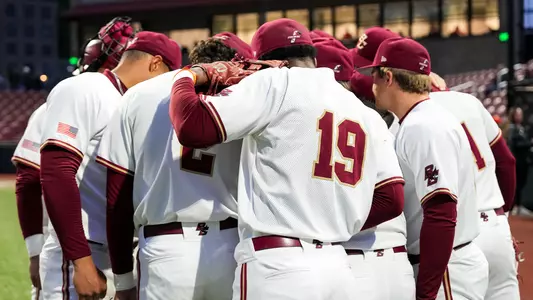
Photo by: Meg Kelly
Take Me Out To The Ballgame, Charlotte
May 19, 2026 | Baseball, #ForBoston Files
The ACC Tournament's second year of a revamped format provides no shortage of drama.
The 2016 college baseball season remains a seminal moment from the entirety of Boston College's Birdball history. The Eagles hadn't qualified for the national postseason in seven years and failed to advance to the Atlantic Coast Conference's 10-team championship for six consecutive years before a 35-win season brought BC to the brink of achieving Omaha-based dreams. A dramatic undefeated run through Mississippi's Oxford-based regional supplanted the home crowd's favored team after host Ole Miss bombed out of two straight games, and two wins over the American's regular season champion Tulane team bookended a one-run victory over Pac-12 champion Utah for the first bracket-based victory in nearly 50 years.
A bitterly-fought three-game series against Miami ended the year in the best-of-three Super Regionals one week later, but clearing the benches to battle the Hurricanes ended the year with a restoration of BC pride and a record-setting year that stood alone as arguably the greatest season in program history. Three years later, another near-trip to the NCAA Tournament fell short of replicating that success, but BC spent the next decade dancing around the regionals as a newly-discovered Northeast baseball powerhouse.
It's therefore easy to forget how the Eagles entered their final weekend of the 2016 regular season with an uphill struggle for the postseason conversation. A loss in their final three-game series at Georgia Tech left them with an 11-17 record in the ACC and essentially dictated a must-sweep situation during a Saturday doubleheader against the Yellow Jackets to even advance to the ACC Championship week. The product of a much-different era, the bottom four teams would miss the tournament altogether, and even the four lower-seeded teams required a one-game, winner-take-all play-in game to determine the final two spots of the upcoming pool play.
History underscored those two final games in Atlanta because a 30-win season didn't automatically clinch a spot in the national tournament. Duke's consecutive 35-win teams missed the NCAA Tournament in 2008 and 2009 because they didn't advance to the conference championship, and both Maryland and Virginia Tech produced 30-win seasons that ultimately failed to get them into the tournament before the next round of realignment. North Carolina's 2010 season was an exception, but those final two games were critical to BC's chances of ever advancing to the field of 64 teams.
Ten years later, the circumstances surrounding this week's ACC Championship are very different, but the architecture of BC's Cinderella run remains well intact after another record-setting season. For the second time in four years, Birdball is a lock for the national tournament, and the second year of a revamped format clinched an all-important double-bye after the No. 4 seed automatically sent the Eagles to the quarterfinal round. But the glass slipper - the all-important belief that a conference championship is within an ever-elusive grasp - kicks off this week with a new outlook for a team that's part of a guaranteed wild week in Charlotte.
"I'm just looking forward to going to bed before 5 a.m.," joked head coach Todd Interdonato ahead of this week's tournament. "Instead of playing a game from midnight until 2 a.m and doing a team meeting at 2:30, when you're back in the hotel and trying to figure out how to play the next day. But this is the tournament that I think is exactly the way that it should be. It was a collective decision among the head coaches and people on the [conference's] committee, and this is exactly the bracket that I would choose. It's exactly how I would set it up."
College baseball reputationally crams 50-plus games into a four-month regular season before shortening its postseason to double-elimination formats. A majority of conferences that once forced teams to play upwards of a half-dozen games now factor quick results into their postseason resumes while maintaining some sort of "champion's advantage" for better-seeded teams, but lower-seeded teams are still allotted opportunities to boost their reputation along grueling paths.
In the ACC, varying formats attempted to maximize opportunity while minimizing potential damage for national seeds and regional hosting. The nine-team league prior to expansion forced its bottom two teams to play one another before implementing a double-elimination format for the remaining eight sides, but adding Miami, which was a national powerhouse as an independent, and the non-power conference teams from BC and Virginia Tech forced the league to break its qualification into a round robin format. Head-to-head tiebreakers became more prevalent, and further expansion with Notre Dame and Pittsburgh guaranteed qualifying teams two games in pool play with pod champions advancing. To maintain the "champion's advantage," the top seeds retained tiebreakers based on their better finish.
Adding Cal and Stanford, though, forced the league to rethink that approach, and last year's tournament included all 16 baseball-sponsored schools for the first time since the original nine teams all qualified. Similar to the basketball tournament, the bottom eight teams played First Round games against one another while teams seeded fifth through eighth gained byes to the Second Round. The top four seeds doubled their bye to the Quarterfinals, to which a single elimination format began protecting top seeds by allowing them to avoid wasting innings in games that wouldn't impact their national or regional standing.
"If you're leaving out four teams, you could get to that last weekend of the regular season and have teams trying to jockey for position with someone who has been eliminated," explained Interdonato, "and that ruins the integrity of the rest of the regular season at that point. This format still weighs heavily into the regular season because you wind up with three tiers, but it sets our institutions up for the best possible way to move into the regional week. If you're a team that's on the bubble and needs to make a run, you can do that while a team that's already in a regional doesn't have to play five games in five days and wear out. It's perfect, and I'm really excited that we're getting a double bye, but we're still already in the same place that we earned our way into from last year."
Perhaps most pressing is what will happen at Truist Field in the days leading up to BC's debut on Thursday afternoon. Three games featuring ninth-seeded NC State, No. 14 Pittsburgh and No. 15 Clemson are all leaving the league with storylines for teams facing bubble conditions. For the Pack Nine, that's especially true after winning a huge regular season finale over North Carolina because finishing with one more loss and one less win would have sent them spiraling into a tie with Stanford, Cal, Notre Dame and Louisville - none of which are on the national bubble to start the week.
Pittsburgh and Clemson, meanwhile, face significant challenges because they finished in two of the league's bottom three spots, but a run through their respective brackets would include games against Virginia Tech and North Carolina for the Tigers and games against Wake Forest and Florida State for the Panthers - all of which could swing the national picture.
BC, meanwhile, is in a bracket with Stanford, Cal and Miami, which means the Eagles draw one of three teams capable of upending Birdball's late-May dreams. In the First Round case, both the Cardinal and Golden Bears are less than four years removed from involvement in the NCAA Tournament conversation, and Stanford's three consecutive trips to the College World Series included three straight Top-10 seeds, two top-8 seeds, and a No. 2 seeding in 2022.
As for Miami, history from 10 years ago is always present whenever the two teams cross paths.
"We're leaving [on Tuesday]," said Interdonato, "and we're going to get into Charlotte with a chance to watch some of the games on [Tuesday night]. We'll have a full day on Wednesday [before suiting up on Thursday]."
The 2026 ACC Championship kicks off on Tuesday, May 19, with four games spread across a full day of baseball. No. 9 NC State and No. 16 Duke begin the action at 9 a.m. with No. 12 Stanford and No. 13 California beginning at approximately 1 p.m. In the evening, No. 10 Notre Dame plays No. 15 Clemson at 5 p.m., and the night finishes with No. 11 Louisville and No. 14 Pittsburgh in a 9 p.m. start. Victorious teams advance to similar times on Wednesday in Sessions 3 and 4 before the Quarterfinals kick off on Thursday with top-seeded Georgia Tech and fourth-seeded Boston College.
BC's game is at 7 p.m. on Thursday with all games slotted for Truist Field in Charlotte, North Carolina, and all games can be seen on national television via the ACC Network and its online streaming companion, available through the ESPN family of Internet and mobile device apps.
A bitterly-fought three-game series against Miami ended the year in the best-of-three Super Regionals one week later, but clearing the benches to battle the Hurricanes ended the year with a restoration of BC pride and a record-setting year that stood alone as arguably the greatest season in program history. Three years later, another near-trip to the NCAA Tournament fell short of replicating that success, but BC spent the next decade dancing around the regionals as a newly-discovered Northeast baseball powerhouse.
It's therefore easy to forget how the Eagles entered their final weekend of the 2016 regular season with an uphill struggle for the postseason conversation. A loss in their final three-game series at Georgia Tech left them with an 11-17 record in the ACC and essentially dictated a must-sweep situation during a Saturday doubleheader against the Yellow Jackets to even advance to the ACC Championship week. The product of a much-different era, the bottom four teams would miss the tournament altogether, and even the four lower-seeded teams required a one-game, winner-take-all play-in game to determine the final two spots of the upcoming pool play.
History underscored those two final games in Atlanta because a 30-win season didn't automatically clinch a spot in the national tournament. Duke's consecutive 35-win teams missed the NCAA Tournament in 2008 and 2009 because they didn't advance to the conference championship, and both Maryland and Virginia Tech produced 30-win seasons that ultimately failed to get them into the tournament before the next round of realignment. North Carolina's 2010 season was an exception, but those final two games were critical to BC's chances of ever advancing to the field of 64 teams.
Ten years later, the circumstances surrounding this week's ACC Championship are very different, but the architecture of BC's Cinderella run remains well intact after another record-setting season. For the second time in four years, Birdball is a lock for the national tournament, and the second year of a revamped format clinched an all-important double-bye after the No. 4 seed automatically sent the Eagles to the quarterfinal round. But the glass slipper - the all-important belief that a conference championship is within an ever-elusive grasp - kicks off this week with a new outlook for a team that's part of a guaranteed wild week in Charlotte.
"I'm just looking forward to going to bed before 5 a.m.," joked head coach Todd Interdonato ahead of this week's tournament. "Instead of playing a game from midnight until 2 a.m and doing a team meeting at 2:30, when you're back in the hotel and trying to figure out how to play the next day. But this is the tournament that I think is exactly the way that it should be. It was a collective decision among the head coaches and people on the [conference's] committee, and this is exactly the bracket that I would choose. It's exactly how I would set it up."
College baseball reputationally crams 50-plus games into a four-month regular season before shortening its postseason to double-elimination formats. A majority of conferences that once forced teams to play upwards of a half-dozen games now factor quick results into their postseason resumes while maintaining some sort of "champion's advantage" for better-seeded teams, but lower-seeded teams are still allotted opportunities to boost their reputation along grueling paths.
In the ACC, varying formats attempted to maximize opportunity while minimizing potential damage for national seeds and regional hosting. The nine-team league prior to expansion forced its bottom two teams to play one another before implementing a double-elimination format for the remaining eight sides, but adding Miami, which was a national powerhouse as an independent, and the non-power conference teams from BC and Virginia Tech forced the league to break its qualification into a round robin format. Head-to-head tiebreakers became more prevalent, and further expansion with Notre Dame and Pittsburgh guaranteed qualifying teams two games in pool play with pod champions advancing. To maintain the "champion's advantage," the top seeds retained tiebreakers based on their better finish.
Adding Cal and Stanford, though, forced the league to rethink that approach, and last year's tournament included all 16 baseball-sponsored schools for the first time since the original nine teams all qualified. Similar to the basketball tournament, the bottom eight teams played First Round games against one another while teams seeded fifth through eighth gained byes to the Second Round. The top four seeds doubled their bye to the Quarterfinals, to which a single elimination format began protecting top seeds by allowing them to avoid wasting innings in games that wouldn't impact their national or regional standing.
"If you're leaving out four teams, you could get to that last weekend of the regular season and have teams trying to jockey for position with someone who has been eliminated," explained Interdonato, "and that ruins the integrity of the rest of the regular season at that point. This format still weighs heavily into the regular season because you wind up with three tiers, but it sets our institutions up for the best possible way to move into the regional week. If you're a team that's on the bubble and needs to make a run, you can do that while a team that's already in a regional doesn't have to play five games in five days and wear out. It's perfect, and I'm really excited that we're getting a double bye, but we're still already in the same place that we earned our way into from last year."
Perhaps most pressing is what will happen at Truist Field in the days leading up to BC's debut on Thursday afternoon. Three games featuring ninth-seeded NC State, No. 14 Pittsburgh and No. 15 Clemson are all leaving the league with storylines for teams facing bubble conditions. For the Pack Nine, that's especially true after winning a huge regular season finale over North Carolina because finishing with one more loss and one less win would have sent them spiraling into a tie with Stanford, Cal, Notre Dame and Louisville - none of which are on the national bubble to start the week.
Pittsburgh and Clemson, meanwhile, face significant challenges because they finished in two of the league's bottom three spots, but a run through their respective brackets would include games against Virginia Tech and North Carolina for the Tigers and games against Wake Forest and Florida State for the Panthers - all of which could swing the national picture.
BC, meanwhile, is in a bracket with Stanford, Cal and Miami, which means the Eagles draw one of three teams capable of upending Birdball's late-May dreams. In the First Round case, both the Cardinal and Golden Bears are less than four years removed from involvement in the NCAA Tournament conversation, and Stanford's three consecutive trips to the College World Series included three straight Top-10 seeds, two top-8 seeds, and a No. 2 seeding in 2022.
As for Miami, history from 10 years ago is always present whenever the two teams cross paths.
"We're leaving [on Tuesday]," said Interdonato, "and we're going to get into Charlotte with a chance to watch some of the games on [Tuesday night]. We'll have a full day on Wednesday [before suiting up on Thursday]."
The 2026 ACC Championship kicks off on Tuesday, May 19, with four games spread across a full day of baseball. No. 9 NC State and No. 16 Duke begin the action at 9 a.m. with No. 12 Stanford and No. 13 California beginning at approximately 1 p.m. In the evening, No. 10 Notre Dame plays No. 15 Clemson at 5 p.m., and the night finishes with No. 11 Louisville and No. 14 Pittsburgh in a 9 p.m. start. Victorious teams advance to similar times on Wednesday in Sessions 3 and 4 before the Quarterfinals kick off on Thursday with top-seeded Georgia Tech and fourth-seeded Boston College.
BC's game is at 7 p.m. on Thursday with all games slotted for Truist Field in Charlotte, North Carolina, and all games can be seen on national television via the ACC Network and its online streaming companion, available through the ESPN family of Internet and mobile device apps.


Thursday, October 01
Thursday, October 01
Thursday, October 01
Tuesday, September 29