Boston College Athletics
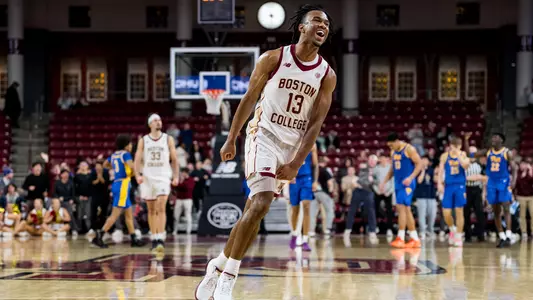
Photo by: Meg Kelly
The Opening Tip: Notre Dame
January 23, 2026 | Men's Basketball, #ForBoston Files
BC looks to blast past Notre Dame with an icy chill fit for the ACC.
The breakup of the old Big East is a hotly-debated topic based predominantly on the Atlantic Coast Conference's decision to expand at the start of the 21st century. The ACC sought to split its football league into two divisions as a prerequisite for a lucrative championship game, so adding three teams to the nine-team league required them to raid a separate league. The decision to add Miami, Virginia Tech and Boston College subsequently spiraled into expansion and realignment across the board in college sports, and the slow decline, breakup and reformation of a league initially steeped in basketball tradition points the first stone directly at the departure of three recognizable, relevant brands.
It's often forgotten, then, how the Big East nearly ruptured during the mid-1990s after its newly-minuted football league attempted to integrate into a single entity. The league had formed two years earlier with the addition of affiliate members at Rutgers, West Virginia, Virginia Tech and Temple, but none of them aside from Miami were admitted to the league as all-sports members. Attempting to merge the two leagues would therefore have required the basketball schools at Connecticut, Providence, Villanova, Georgetown, Seton Hall and St. John's to admit all four teams into a growing 14-team league, but wary perceptions about allowing more football schools into a "basketball league" split the conference membership along divisive fault lines.
Almost everyone believed that the football schools were prepared to form their own basketball-football league if the basketball schools didn't acquiesce to some of their demands, so a compromise admitted Rutgers and West Virginia while leaving Virginia Tech and Temple in the Atlantic 10 Conference. Four months later, a separate compromise admitted Notre Dame, which wanted a conference for all sports outside of its lucrative independent football program.
"When we went to 12 teams, I thought the Notre Dame issue was dead," admitted commissioner Mike Tranghese in 1994. "I was surprised when they said they were still interested in talking because they had always expressed a concern about being in a large conference. And I didn't think our schools would have the appetite for getting larger."
Any realignment conversation regarding Notre Dame rightly centers on its football program, but adding the Fighting Irish as a basketball school added a giant amount of star power to a league brimming with hardwood history. Head coach Digger Phelps routinely led them to NCAA Tournament berths during the mid-1970s, and the 1973-1974 team dethroned UCLA's 88-game winning streak before going to the NCAA Tournament with a 26-3 record. A Final Four team before the end of the decade, Phelps had redefined a program with 10 overall trips to the 25-team bracket by advancing to 14 separate tournaments.
John MacLeod admittedly hadn't matched that output as a Division I Independent, but BC's built-in rivalry with the Notre Dame football and hockey programs allowed the Eagles to continue fomenting a Holy War matchup with another Catholic institution. Playing annually between the 1995-1996 season and BC's departure in 2005, the teams traded wins to the tune of seven Notre Dame wins in 12 matchups. They never met at the Madison Square Garden postseason, but BC's undefeated 20-0 start to the 2004-2005 season ended when the Irish earned a three-point win in South Bend.
"It's disappointing losing," said head coach Al Skinner in the aftermath of the loss. "Being unbeaten [was] nice, but I'm more concerned about why we lost this basketball game. I was never overly concerned with the fact that we were undefeated. It's just that we didn't play as well as we could have."
A full generation later, Boston College and Notre Dame are members of an Atlantic Coast Conference stretching from the Northeast to the Deep South to Florida to Texas and California. Midwest representation includes Louisville in addition to the Notre Dame program that's maintained its football independence. The geographic rivalries from the Big East are long dead, and in their place are a series of former football conference rivals or teams more recognizable from their battles on the gridiron.
That history, though, still matters, and Saturday's game between Boston College and Notre Dame triggers all of those emotions. It's endured through the apocalyptic expansion eras, and it's the relic from a conference once steeped in the Catholic institutions of the Northeast.
It's still the Holy War, and it's still the Holy War on Hardwood.
On with the preview:
****
Notre Dame Storylines (Dr. Jack Ramsay Edition)
Teams that never concede defeat can accomplish incredible victories.
Notre Dame's red-hot 9-3 start had fans and analysts dreaming about a shamrocked return to the NCAA Tournament after the Fighting Irish knocked off Missouri and TCU. Losses to Ohio State, Kansas and Houston were close enough to register quality points opposite the five-point win over Rutgers, and the blowout victories over lower-tiered teams from LIU, Detroit Mercy, Eastern Illinois, Evansville and other mid-major programs included a 15-point win over Idaho.
Then came the Purdue Fort Wayne game and a disastrous loss now standing as the induction point of a month-long tailspin.
"I [have to] get us gritty and grimy to be able to come in here and sustain and do what we need to do," said head coach Micah Shrewsberry after Notre Dame's 91-69 loss to North Carolina. "I apologized to those guys because I've been too nice to them. I've been too soft on them to be ready to fight and compete in an environment like this."
Notre Dame hasn't yet won in January, but even the returns from the seven-point win over Stanford post ugly numbers since a pre-Christmas three-point loss to the Horizon League's Mastodons. Scoring that once averaged over 77 points per game is down 11 points since the December 21 game against Fort Wayne, and even removing the outlier performance from the 47-40 win over the Cardinal doesn't elevate the number beyond 70 points. A shooting percentage that averaged 52 percent on the season on effective field goal range failed to exceed 41 percent in the loss to the Tar Heels and hasn't burst through 50 percent since the Miami game, which was a 12-point loss.
From a more national perspective, a team that averaged a season-long number good enough to rank within the top-130 of college basketball is instead pushing numbers that are at the supreme bottom of college basketball. As of Friday afternoon, that loss to the Hurricanes is anchoring a number that otherwise would push the ten teams at 40 percent or lower.
Winning is more related to good defense than good offense.
Having said that, the issues plaguing Notre Dame aren't limited to the offensive side of the ball. Defensively, North Carolina shot the lights to the tune of two-thirds of its two-point attempts and nearly 40 percent of its three-point shots. Caleb Wilson was especially effective at driving inside of the arc while Henri Veesaar and Derek Dixon served as secondary options for an offense that dominated the middle quarters of the game clock.
In contrast, losing the first 10 minutes of the second half had virtually no impact on Boston College's game against Pittsburgh because of the defensive output of the first 20 minutes of the ballgame. Even with 28 points by the Panthers, the Eagles backside help prevented anything more than 22 points in the first half and 12 points down the stretch of a game that narrowly avoided overtime.
Prevention of rim-based and interior opportunities clearly helped BC in that objective, and it's unlikely that Notre Dame is capable of matching Pitt's inside ferocity. Point again to season-long numbers, the Fighting Irish have never controlled inside two-point percentages against opponents, and their reliance on the three-pointer compounds issues with a slower tempo team. In short, this is an offense that works the outside for a good look at a three but is prone to falling into isolation ball with an offense ranked No. 314 on assists-to-field goals made.
The best players I have seen and known have confidence in their teammates. They know that basketball's not a one-man game.
There is, of course, a caveat to Notre Dame's trouble at the window. A team with one of the lowest two-point shot attempt distances in college basketball possesses a high block percentage and one of the lowest offensive rebounding rates in the nation at 24.7 percent, so there are elements of defensive prevention that help spur an offensive wheel that's considerably different from Syracuse or Pittsburgh. Even understanding how teams switch between man and zone defenses against BC isn't likely to change that commitment, especially when Notre Dame is fine to stop a team before slowing things even further on the offensive end.
*****
Question Box
Can Notre Dame finally utilize ball movement?
Jalen Haralson's arrival in South Bend made it easy for Micah Shrewsberry to build this year's offense around the three-pointer. The five-star freshman was one of the most sought-after recruits before he chose to remain in Indiana with the Irish, and his spot on the roster ensured that the highest-rated prospect in ND program history could build on his 16 points and seven rebounds at La Lumiere School in La Porte, Indiana.
He's been a rock for a program that suffered through its January issues, and his double figures in all but two games this year lead the team to the degree that it doesn't feel like Markus Burton is the sole superstar in uniform anymore. At six feet, seven inches tall, Haralson is also unique among guards - see also: BC's backcourt combinations that run smaller against the front-court power forwards that are six feet, nine inches tall.
Haralson is shooting just under 50 percent on two-point baskets but ranks second on the team in assists with 2.3 helpers per game. Burton is the team leader with 3.7 assists per game, but he's been out since injuring his ankle against TCU. Unsurprisingly, the cratering that occurred shortly thereafter is because nobody has been able to feed the ball around the team's offense.
BC is hardly the defense that option offenses excel against, but Notre Dame needs to start moving the ball with a crispness that's been lacking. A home game against a team that doesn't necessarily pop offensively therefore seems like a great opportunity.
How does BC continue its full-blown development?
Boden Kapke's production against Pitt echoed breakout big man performances from years past, but crowning him alongside Nik Popovic's 22-point, 14-rebound game against Columbia or Quinten Post's 13-point, six-board game against Notre Dame during the 2021-2022 season wallpapered the gaps that emerged from a back court that struggled in the first half. Looking back over those first 20 minutes, Fred Payne, Luka Toews, Chase Forte and Donald Hand, Jr. combined for 10 points on 4-of-14 shooting with five combined fouls committed before straightening out for 28 points in the second half, 16 from Payne.
That leaves two different perspectives on BC's overall performance - one that's significantly harsher than the other. On the bad side, uneven guard play can't happen against teams that run and key off missed jumpers, and they certainly can't happen against Notre Dame and its ability to prevent second chance looks. On the plus side, confidence in the big men against a slower tempo team is exactly how BC attacked and defeated Pitt.
Does everyone have a working snowblower?
I'm not an alarmist by any stretch of the imagination. I hate it when snow projections continuously increase and get larger on a daily basis, and I'm never one for believing in the massive numbers until they're actually on the ground. I'm a born skeptic with an inherent distrust, so that checks out.
There's something about Sunday's snowstorm into Monday that's freaking me out, though. Maybe it's the thought of being stuck in the house for another day with two daughters unquestionably sick of each other by the end of every weekend, and maybe it's the thought of losing power during the AFC Championship Game. Maybe it's the constant run on bread and milk that occurs at the drop of a hat. I'm just wired to see this one differently.
As an amateur meteorologist with no expertise or know-how in any sense of the word, I'm figuring that the frigid cold of the weekend, combined with the size of a storm blanketing the entire United States, is a recipe for a blizzard that we haven't seen since that year that a snowfall followed a Patriots Super Bowl win. I think it was 2015, but I was probably up all night for that one.
If you don't have a snowblower, you've volunteered as tribute, and you're a better person than me. I used to get excited to shovel 20 inches of snow, but I'm old enough that I don't even like carrying golf clubs for longer than a hole or two.
*****
BC-Notre Dame X Factor
You see us as you want to see us - in the simplest terms, in the most convenient definitions. You see us as a brain, an athlete, a basket case, a princess and a criminal. Correct? That's the way we saw each other at 7:00 this morning. We were brainwashed. -The Breakfast Club
Notre Dame lost a giant part of its identity when Markus Burton suffered an ankle injury in the win over TCU. The team leader in scoring, assists, steals, minutes and free throw percentage had six points and five assists when he crumpled to the court against the Horned Frogs, and he was barely one game removed from moving the ball through 10 assists in the win over the Missouri Tigers.
Not being able to replace him as an individual is understanding, but Notre Dame's aggregate seemingly can't adjust to Burton's absence. At a global level and without the proper context of the non-conference games without Burton (one of which included the Fort Wayne loss), removing five percent off of the team's field goal percentage from overall numbers to ACC play effectively drops Notre Dame to anywhere from six-to-eight points lower on a per-game basis. On a team where the three-point percentage likewise dropped five full percentage points, that number extends closer to 10-to-12 points because it translates to an additional one or two three-pointers.
At some point, Notre Dame has to therefore change its approach. Running an offense through a substituted player isn't working, so a big question ahead of Saturday's game against a red-hot Boston College team centers on the team's ability to produce a point guard in the aggregate. Haralson is obviously the primary option in that instance because of his burgeoning assist numbers and ability to facilitate through scoring, but reducing the number of three-pointers to instead get the ball through Braeden Shrewsberry or Cole Certa can therefore help create mismatches in the defensive alignment.
It's kind of a strange notion because neither player is a natural distributor. Shrewsberry is a 43 percent three-point shooter because he's more of a catch-and-release, rhythm shooter, and Certa is more of a secondary outside threat who can shoot exceptionally well at the free throw line. Carson Towt is a traditional big that doesn't shoot threes, and other bigs like Brady Koehler and Garrett Sundra are reservists who aren't used in that regard.
Shrewsberry talked about change through the lens of a team that needs more toughness, but I'm wary of any radical shift in the team's alignment. That doesn't mean bigs are going to bring the ball up-court in a natural ball handler position, but some more inside-out could work some wonders to get catch-and-release shooters into more open positions.
*****
Scoreboard Watching
Saturday historically offers college basketball plenty of big time opportunities to showcase big games once college football and the National Football League start to die down on their schedule, so expect some huge matchups to begin dotting the weekend television schedule. This week in the ACC, for example, a primetime game between BC and Notre Dame precedes a Cal-Stanford rivalry that harkens back to the old Pac-12 while Miami plays at Syracuse in the mid-afternoon. Combine that with Virginia Tech's game at Louisville, and there's plenty of basketball worth watching after the four-game midday slate includes Wake Forest-Duke, North Carolina-Virginia, and Clemson-Georgia Tech.
Outside of the ACC, the day begins with some noon tips carrying massive implications. In the Big Ten, No. 7 Nebraska goes to Minnesota while Maryland heads to No. 10 Michigan State, and No. 15 Vanderbilt heads to Mississippi State for an SEC entry into the 12 p.m. slate. Less than an hour later, the Big East jumps into things with Villanova's trip to No. 2 UConn and Georgetown's trip to Providence, while the SEC continues its day at 1 p.m. with No. 21 Georgia's trip to Texas.
Mid-afternoon begins with No. 6 Houston visiting No. 12 Texas Tech and No. 1 Arizona hosting West Virginia before No. 4 Purdue hosts No. 11 Illinois. By dinnertime, a game between No. 9 Iowa State and Oklahoma State tips off, as does No. 16 Florida's game against Auburn. Within that primetime window, No. 13 BYU hosts Utah in a Big 12 rivalry game.
The 8 p.m. window carries No. 8 Gonzaga's game against San Francisco and the interstate rivalry between No. 19 Kansas and Kansas State before the night ends with No. 17 Alabama's game against Tennessee.
*****
This Random Day In History
I grew up at a time when professional wrestling broke through to a pop culture iconic status. I was born in the year after Hulk Hogan defeated the Iron Sheik to win his first World Heavyweight Championship, so I was the kid who would run around the house with the yellow headband while we played Derringer's Real American on the old record player in our living room. For what it's worth, I cried nonstop when Hulk Hogan lost to the Ultimate Warrior at Wrestlemania VI, and I somehow remember tearing my shirt more often than I should probably admit.
Yesterday marked the 22nd anniversary of Hulk Hogan's win over the Iron Sheik. It's often noted as the birthdate for the Hulkamania phenomenon that ripped through the 1980s and into the early 1990s, and it's the date that got pro wrestling on a path for my childhood to intertwine with it. My brothers and I beat the snot out of each other in our bedrooms by reenacting moves that we saw on television - probably not the best idea to try a powerbomb and high cross body splash off of a bunk bed - so those highlights are kind of the baseline for my childhood - almost as much as watching Mark McGwire pummel home runs for the Oakland A's.
Getting older complicated the conversation because Hulk Hogan was very flawed in his personal life. Pro wrestling generally pulled wool over the eyes of its viewers and made us believe in a reality that didn't exist, but the stories eventually emerging about my childhood superhero painted him in anything but a positive light. By the time he died last year, even his most fervent supporters had to admit that the pro wrestling crowd was done with his appearances - his final appearance had him booed beyond vociferously.
That said, you'd be hard-pressed to find a kid who didn't execute his hulk-up leg drop move in the living room of his house in 1990. Five-year old Dan Rubin certainly did, and my brothers absolutely powerbombed me and played the bad guy until I hulked up and hit them with everything in my arsenal. We ripped shirts, we cupped our ears for fake cheers, and Hulk always won the title. Maybe that's a little too childlike and innocent, but getting older does that to you.
*****
Pregame Quote and Final Thoughts
We won a game yesterday. We win today, that's two in a row. If we win tomorrow, that's called a winning streak. It has happened before. -Lou Brown, Major League II
Major League II is nowhere near as good as the first edition, but I've used this line to sarcastically describe far too many two-game winning streaks in sports. Considering that plenty of people left Boston College on the road to nowhere ahead of the Syracuse game, I find it amazing to think that momentum is shifting in a way that puts the Eagles on a clear path towards the ACC Tournament.
Earl Grant said it best after the Pitt win when he talked about ignoring the past for the present. Concerning this BC team with anything from the first half of the season is a disservice to the strides taken over the past week, and focusing too heavily on this two-game winning streak as proof of a renaissance is a disservice to the future road that's increasingly difficult. The goal is always to remain in the present, to focus on Notre Dame, and to face down a team with a controlled urgency.
Boston College and Notre Dame tip off on Saturday at 6:00 p.m. from the Joyce Center in South Bend, Indiana. National television coverage is available on ACC Network with radio coverage available through the Boston College Sports Network, locally in Boston on WEEI 850 AM.
It's often forgotten, then, how the Big East nearly ruptured during the mid-1990s after its newly-minuted football league attempted to integrate into a single entity. The league had formed two years earlier with the addition of affiliate members at Rutgers, West Virginia, Virginia Tech and Temple, but none of them aside from Miami were admitted to the league as all-sports members. Attempting to merge the two leagues would therefore have required the basketball schools at Connecticut, Providence, Villanova, Georgetown, Seton Hall and St. John's to admit all four teams into a growing 14-team league, but wary perceptions about allowing more football schools into a "basketball league" split the conference membership along divisive fault lines.
Almost everyone believed that the football schools were prepared to form their own basketball-football league if the basketball schools didn't acquiesce to some of their demands, so a compromise admitted Rutgers and West Virginia while leaving Virginia Tech and Temple in the Atlantic 10 Conference. Four months later, a separate compromise admitted Notre Dame, which wanted a conference for all sports outside of its lucrative independent football program.
"When we went to 12 teams, I thought the Notre Dame issue was dead," admitted commissioner Mike Tranghese in 1994. "I was surprised when they said they were still interested in talking because they had always expressed a concern about being in a large conference. And I didn't think our schools would have the appetite for getting larger."
Any realignment conversation regarding Notre Dame rightly centers on its football program, but adding the Fighting Irish as a basketball school added a giant amount of star power to a league brimming with hardwood history. Head coach Digger Phelps routinely led them to NCAA Tournament berths during the mid-1970s, and the 1973-1974 team dethroned UCLA's 88-game winning streak before going to the NCAA Tournament with a 26-3 record. A Final Four team before the end of the decade, Phelps had redefined a program with 10 overall trips to the 25-team bracket by advancing to 14 separate tournaments.
John MacLeod admittedly hadn't matched that output as a Division I Independent, but BC's built-in rivalry with the Notre Dame football and hockey programs allowed the Eagles to continue fomenting a Holy War matchup with another Catholic institution. Playing annually between the 1995-1996 season and BC's departure in 2005, the teams traded wins to the tune of seven Notre Dame wins in 12 matchups. They never met at the Madison Square Garden postseason, but BC's undefeated 20-0 start to the 2004-2005 season ended when the Irish earned a three-point win in South Bend.
"It's disappointing losing," said head coach Al Skinner in the aftermath of the loss. "Being unbeaten [was] nice, but I'm more concerned about why we lost this basketball game. I was never overly concerned with the fact that we were undefeated. It's just that we didn't play as well as we could have."
A full generation later, Boston College and Notre Dame are members of an Atlantic Coast Conference stretching from the Northeast to the Deep South to Florida to Texas and California. Midwest representation includes Louisville in addition to the Notre Dame program that's maintained its football independence. The geographic rivalries from the Big East are long dead, and in their place are a series of former football conference rivals or teams more recognizable from their battles on the gridiron.
That history, though, still matters, and Saturday's game between Boston College and Notre Dame triggers all of those emotions. It's endured through the apocalyptic expansion eras, and it's the relic from a conference once steeped in the Catholic institutions of the Northeast.
It's still the Holy War, and it's still the Holy War on Hardwood.
On with the preview:
****
Notre Dame Storylines (Dr. Jack Ramsay Edition)
Teams that never concede defeat can accomplish incredible victories.
Notre Dame's red-hot 9-3 start had fans and analysts dreaming about a shamrocked return to the NCAA Tournament after the Fighting Irish knocked off Missouri and TCU. Losses to Ohio State, Kansas and Houston were close enough to register quality points opposite the five-point win over Rutgers, and the blowout victories over lower-tiered teams from LIU, Detroit Mercy, Eastern Illinois, Evansville and other mid-major programs included a 15-point win over Idaho.
Then came the Purdue Fort Wayne game and a disastrous loss now standing as the induction point of a month-long tailspin.
"I [have to] get us gritty and grimy to be able to come in here and sustain and do what we need to do," said head coach Micah Shrewsberry after Notre Dame's 91-69 loss to North Carolina. "I apologized to those guys because I've been too nice to them. I've been too soft on them to be ready to fight and compete in an environment like this."
Notre Dame hasn't yet won in January, but even the returns from the seven-point win over Stanford post ugly numbers since a pre-Christmas three-point loss to the Horizon League's Mastodons. Scoring that once averaged over 77 points per game is down 11 points since the December 21 game against Fort Wayne, and even removing the outlier performance from the 47-40 win over the Cardinal doesn't elevate the number beyond 70 points. A shooting percentage that averaged 52 percent on the season on effective field goal range failed to exceed 41 percent in the loss to the Tar Heels and hasn't burst through 50 percent since the Miami game, which was a 12-point loss.
From a more national perspective, a team that averaged a season-long number good enough to rank within the top-130 of college basketball is instead pushing numbers that are at the supreme bottom of college basketball. As of Friday afternoon, that loss to the Hurricanes is anchoring a number that otherwise would push the ten teams at 40 percent or lower.
Winning is more related to good defense than good offense.
Having said that, the issues plaguing Notre Dame aren't limited to the offensive side of the ball. Defensively, North Carolina shot the lights to the tune of two-thirds of its two-point attempts and nearly 40 percent of its three-point shots. Caleb Wilson was especially effective at driving inside of the arc while Henri Veesaar and Derek Dixon served as secondary options for an offense that dominated the middle quarters of the game clock.
In contrast, losing the first 10 minutes of the second half had virtually no impact on Boston College's game against Pittsburgh because of the defensive output of the first 20 minutes of the ballgame. Even with 28 points by the Panthers, the Eagles backside help prevented anything more than 22 points in the first half and 12 points down the stretch of a game that narrowly avoided overtime.
Prevention of rim-based and interior opportunities clearly helped BC in that objective, and it's unlikely that Notre Dame is capable of matching Pitt's inside ferocity. Point again to season-long numbers, the Fighting Irish have never controlled inside two-point percentages against opponents, and their reliance on the three-pointer compounds issues with a slower tempo team. In short, this is an offense that works the outside for a good look at a three but is prone to falling into isolation ball with an offense ranked No. 314 on assists-to-field goals made.
The best players I have seen and known have confidence in their teammates. They know that basketball's not a one-man game.
There is, of course, a caveat to Notre Dame's trouble at the window. A team with one of the lowest two-point shot attempt distances in college basketball possesses a high block percentage and one of the lowest offensive rebounding rates in the nation at 24.7 percent, so there are elements of defensive prevention that help spur an offensive wheel that's considerably different from Syracuse or Pittsburgh. Even understanding how teams switch between man and zone defenses against BC isn't likely to change that commitment, especially when Notre Dame is fine to stop a team before slowing things even further on the offensive end.
*****
Question Box
Can Notre Dame finally utilize ball movement?
Jalen Haralson's arrival in South Bend made it easy for Micah Shrewsberry to build this year's offense around the three-pointer. The five-star freshman was one of the most sought-after recruits before he chose to remain in Indiana with the Irish, and his spot on the roster ensured that the highest-rated prospect in ND program history could build on his 16 points and seven rebounds at La Lumiere School in La Porte, Indiana.
He's been a rock for a program that suffered through its January issues, and his double figures in all but two games this year lead the team to the degree that it doesn't feel like Markus Burton is the sole superstar in uniform anymore. At six feet, seven inches tall, Haralson is also unique among guards - see also: BC's backcourt combinations that run smaller against the front-court power forwards that are six feet, nine inches tall.
Haralson is shooting just under 50 percent on two-point baskets but ranks second on the team in assists with 2.3 helpers per game. Burton is the team leader with 3.7 assists per game, but he's been out since injuring his ankle against TCU. Unsurprisingly, the cratering that occurred shortly thereafter is because nobody has been able to feed the ball around the team's offense.
BC is hardly the defense that option offenses excel against, but Notre Dame needs to start moving the ball with a crispness that's been lacking. A home game against a team that doesn't necessarily pop offensively therefore seems like a great opportunity.
How does BC continue its full-blown development?
Boden Kapke's production against Pitt echoed breakout big man performances from years past, but crowning him alongside Nik Popovic's 22-point, 14-rebound game against Columbia or Quinten Post's 13-point, six-board game against Notre Dame during the 2021-2022 season wallpapered the gaps that emerged from a back court that struggled in the first half. Looking back over those first 20 minutes, Fred Payne, Luka Toews, Chase Forte and Donald Hand, Jr. combined for 10 points on 4-of-14 shooting with five combined fouls committed before straightening out for 28 points in the second half, 16 from Payne.
That leaves two different perspectives on BC's overall performance - one that's significantly harsher than the other. On the bad side, uneven guard play can't happen against teams that run and key off missed jumpers, and they certainly can't happen against Notre Dame and its ability to prevent second chance looks. On the plus side, confidence in the big men against a slower tempo team is exactly how BC attacked and defeated Pitt.
Does everyone have a working snowblower?
I'm not an alarmist by any stretch of the imagination. I hate it when snow projections continuously increase and get larger on a daily basis, and I'm never one for believing in the massive numbers until they're actually on the ground. I'm a born skeptic with an inherent distrust, so that checks out.
There's something about Sunday's snowstorm into Monday that's freaking me out, though. Maybe it's the thought of being stuck in the house for another day with two daughters unquestionably sick of each other by the end of every weekend, and maybe it's the thought of losing power during the AFC Championship Game. Maybe it's the constant run on bread and milk that occurs at the drop of a hat. I'm just wired to see this one differently.
As an amateur meteorologist with no expertise or know-how in any sense of the word, I'm figuring that the frigid cold of the weekend, combined with the size of a storm blanketing the entire United States, is a recipe for a blizzard that we haven't seen since that year that a snowfall followed a Patriots Super Bowl win. I think it was 2015, but I was probably up all night for that one.
If you don't have a snowblower, you've volunteered as tribute, and you're a better person than me. I used to get excited to shovel 20 inches of snow, but I'm old enough that I don't even like carrying golf clubs for longer than a hole or two.
*****
BC-Notre Dame X Factor
You see us as you want to see us - in the simplest terms, in the most convenient definitions. You see us as a brain, an athlete, a basket case, a princess and a criminal. Correct? That's the way we saw each other at 7:00 this morning. We were brainwashed. -The Breakfast Club
Notre Dame lost a giant part of its identity when Markus Burton suffered an ankle injury in the win over TCU. The team leader in scoring, assists, steals, minutes and free throw percentage had six points and five assists when he crumpled to the court against the Horned Frogs, and he was barely one game removed from moving the ball through 10 assists in the win over the Missouri Tigers.
Not being able to replace him as an individual is understanding, but Notre Dame's aggregate seemingly can't adjust to Burton's absence. At a global level and without the proper context of the non-conference games without Burton (one of which included the Fort Wayne loss), removing five percent off of the team's field goal percentage from overall numbers to ACC play effectively drops Notre Dame to anywhere from six-to-eight points lower on a per-game basis. On a team where the three-point percentage likewise dropped five full percentage points, that number extends closer to 10-to-12 points because it translates to an additional one or two three-pointers.
At some point, Notre Dame has to therefore change its approach. Running an offense through a substituted player isn't working, so a big question ahead of Saturday's game against a red-hot Boston College team centers on the team's ability to produce a point guard in the aggregate. Haralson is obviously the primary option in that instance because of his burgeoning assist numbers and ability to facilitate through scoring, but reducing the number of three-pointers to instead get the ball through Braeden Shrewsberry or Cole Certa can therefore help create mismatches in the defensive alignment.
It's kind of a strange notion because neither player is a natural distributor. Shrewsberry is a 43 percent three-point shooter because he's more of a catch-and-release, rhythm shooter, and Certa is more of a secondary outside threat who can shoot exceptionally well at the free throw line. Carson Towt is a traditional big that doesn't shoot threes, and other bigs like Brady Koehler and Garrett Sundra are reservists who aren't used in that regard.
Shrewsberry talked about change through the lens of a team that needs more toughness, but I'm wary of any radical shift in the team's alignment. That doesn't mean bigs are going to bring the ball up-court in a natural ball handler position, but some more inside-out could work some wonders to get catch-and-release shooters into more open positions.
*****
Scoreboard Watching
Saturday historically offers college basketball plenty of big time opportunities to showcase big games once college football and the National Football League start to die down on their schedule, so expect some huge matchups to begin dotting the weekend television schedule. This week in the ACC, for example, a primetime game between BC and Notre Dame precedes a Cal-Stanford rivalry that harkens back to the old Pac-12 while Miami plays at Syracuse in the mid-afternoon. Combine that with Virginia Tech's game at Louisville, and there's plenty of basketball worth watching after the four-game midday slate includes Wake Forest-Duke, North Carolina-Virginia, and Clemson-Georgia Tech.
Outside of the ACC, the day begins with some noon tips carrying massive implications. In the Big Ten, No. 7 Nebraska goes to Minnesota while Maryland heads to No. 10 Michigan State, and No. 15 Vanderbilt heads to Mississippi State for an SEC entry into the 12 p.m. slate. Less than an hour later, the Big East jumps into things with Villanova's trip to No. 2 UConn and Georgetown's trip to Providence, while the SEC continues its day at 1 p.m. with No. 21 Georgia's trip to Texas.
Mid-afternoon begins with No. 6 Houston visiting No. 12 Texas Tech and No. 1 Arizona hosting West Virginia before No. 4 Purdue hosts No. 11 Illinois. By dinnertime, a game between No. 9 Iowa State and Oklahoma State tips off, as does No. 16 Florida's game against Auburn. Within that primetime window, No. 13 BYU hosts Utah in a Big 12 rivalry game.
The 8 p.m. window carries No. 8 Gonzaga's game against San Francisco and the interstate rivalry between No. 19 Kansas and Kansas State before the night ends with No. 17 Alabama's game against Tennessee.
*****
This Random Day In History
I grew up at a time when professional wrestling broke through to a pop culture iconic status. I was born in the year after Hulk Hogan defeated the Iron Sheik to win his first World Heavyweight Championship, so I was the kid who would run around the house with the yellow headband while we played Derringer's Real American on the old record player in our living room. For what it's worth, I cried nonstop when Hulk Hogan lost to the Ultimate Warrior at Wrestlemania VI, and I somehow remember tearing my shirt more often than I should probably admit.
Yesterday marked the 22nd anniversary of Hulk Hogan's win over the Iron Sheik. It's often noted as the birthdate for the Hulkamania phenomenon that ripped through the 1980s and into the early 1990s, and it's the date that got pro wrestling on a path for my childhood to intertwine with it. My brothers and I beat the snot out of each other in our bedrooms by reenacting moves that we saw on television - probably not the best idea to try a powerbomb and high cross body splash off of a bunk bed - so those highlights are kind of the baseline for my childhood - almost as much as watching Mark McGwire pummel home runs for the Oakland A's.
Getting older complicated the conversation because Hulk Hogan was very flawed in his personal life. Pro wrestling generally pulled wool over the eyes of its viewers and made us believe in a reality that didn't exist, but the stories eventually emerging about my childhood superhero painted him in anything but a positive light. By the time he died last year, even his most fervent supporters had to admit that the pro wrestling crowd was done with his appearances - his final appearance had him booed beyond vociferously.
That said, you'd be hard-pressed to find a kid who didn't execute his hulk-up leg drop move in the living room of his house in 1990. Five-year old Dan Rubin certainly did, and my brothers absolutely powerbombed me and played the bad guy until I hulked up and hit them with everything in my arsenal. We ripped shirts, we cupped our ears for fake cheers, and Hulk always won the title. Maybe that's a little too childlike and innocent, but getting older does that to you.
*****
Pregame Quote and Final Thoughts
We won a game yesterday. We win today, that's two in a row. If we win tomorrow, that's called a winning streak. It has happened before. -Lou Brown, Major League II
Major League II is nowhere near as good as the first edition, but I've used this line to sarcastically describe far too many two-game winning streaks in sports. Considering that plenty of people left Boston College on the road to nowhere ahead of the Syracuse game, I find it amazing to think that momentum is shifting in a way that puts the Eagles on a clear path towards the ACC Tournament.
Earl Grant said it best after the Pitt win when he talked about ignoring the past for the present. Concerning this BC team with anything from the first half of the season is a disservice to the strides taken over the past week, and focusing too heavily on this two-game winning streak as proof of a renaissance is a disservice to the future road that's increasingly difficult. The goal is always to remain in the present, to focus on Notre Dame, and to face down a team with a controlled urgency.
Boston College and Notre Dame tip off on Saturday at 6:00 p.m. from the Joyce Center in South Bend, Indiana. National television coverage is available on ACC Network with radio coverage available through the Boston College Sports Network, locally in Boston on WEEI 850 AM.


Players Mentioned

G
/ Men's Basketball
F/C
/ Men's Basketball
G
/ Men's Basketball
G
/ Men's BasketballTuesday, August 25
Wednesday, August 19
Monday, August 17
Wednesday, July 29