Boston College Athletics
Trading the Maroon and Gold for Blue and White
July 21, 2017 | Softball, #ForBoston Files
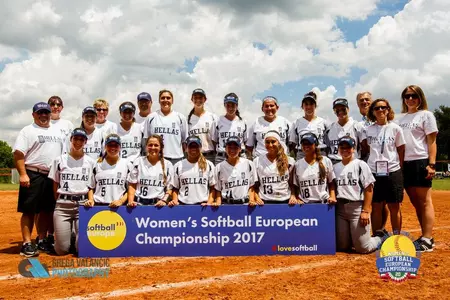
Olivia Markopoulos played for the Greek National Softball Team
For any athlete, earning the right to represent his or her country is an unsurpassed honor. Putting on a jersey adorned with national flags and colors is something greater than any paycheck or affiliation. It gives an athlete a unique opportunity to honor one's personal past or heritage, from parents to grandparents and beyond, while discovering new pieces of identity.
That's something Olivia Markopoulos is finding out. Though American born, she is a member of the Greek national softball team. The granddaughter of immigrants, it's a chance to learn more about herself, while playing for a cause well beyond anything she could ever imagine.
"It is an incredible feeling to represent an entire country," she said. "Hearing and singing a national anthem of the uniform you're wearing is just an amazing experience. Every country we've played against is so prideful, and it creates a melting pot of pride. That's such an awesome feeling because you're living your ancestry."
It is opportunity that began when head coach Ashley Obrest conveyed a message from the Greek softball federation. Representatives from the Hellenic Republic recognized Olivia's last name as they searched for Division I softball student-athletes with Greek surnames. Coach Obrest asked Markopoulos if she was interested, enabling the Eagle to contact the Greek representatives.
"I was named to a pool of athletes," Markopoulos explained. "The Greek federation then selected and announced names five at a time. When I was selected, I had to have Coach Obrest sign a form for the NCAA allowing me to play. I had kept it a little quiet throughout the process, but a couple of my teammates were there when I told her. I didn't want to brag, and even though I was excited. My teammates couldn't have been more excited for me and they wanted to know why I didn't tell them sooner. All of my teammates congratulated me and they all wished me luck. They all want to know how this experience is; they couldn't be more supportive."
The excitement then gave way to a process that proved Markopoulos' devotion to her newly-adopted nation. A Virginia native, her father is also a native-born American despite having full Greek blood. So she had to explore and become a Greek citizen before she could join the national team.
"It was really a lengthy process because I had to get Greek citizenship," she said. "I went to Washington, D.C., to meet with the Greek Embassy and I had to receive both citizenship and a Greek passport in order to be eligible to play for the team. In order to qualify for citizenship, you had to have a certain amount of Greek heritage. But I was super excited and right when I got home, after our season ended, and I had to do some extra training in order to go play with the team in Italy."
Markopoulos joined a Greek team featuring 15 teammates, of which three were native-born to the nation. Of those three, only one spoke fluent English, allowing for a unique blend and learning opportunity of her heritage at the ground level.
"It was really cool since I got to learn about things that were native to them," she said. "We ended up making some great friends on that team and we're able to keep in contact through social media. I had some teammates who also played at schools like Rutgers and Notre Dame, so we had a little bit of familiarity from being Division I athletes."
Though the roster construction finished, there was still the matter of actually playing softball games. Greece was in a pool of 25 nations playing in the ESF Women's Championship in Bollate, Italy. With only a week to get ready, learning to play together required a short timetable for the athletes.
"I flew to Rimini, got off the plane and had practice the next day," Markopoulos said. "It's a little south of Milan, which is where the tournament was being held, so we had a training camp for a week near the beach. That was helpful because it was a little bit cooler than the rest of Italy, which gets pretty hot around this time of year."
Just one week later, the Greek team was in a group opposite some of Europe's top softball athletes. Group B also consisted of the Netherlands, in search of its 10th European championship, and Germany, a team consistently in the top 10 of the continent's competition.
But after losing to the Dutch in its opening game, 7-0, Greece rallied in a big way. The Greek team dominated Germany, 9-3, then held the rest of its group completely scoreless, beating Ireland, Lithuania and Slovakia by a combined score of 33-0 to finish second in Group B. With the top two finishers in each group advancing to championship group play, Greece found itself within shouting distance of the knockout Medal Round. And though the team ultimately failed to advance that far, its sixth-place finish was the best result ever in the country's history.
"We have a lot of versatility," Markopoulos said. "A lot of the girls can play other positions so we can all move around. We have a lot of speed and since most of the girls play at the Division I level in college, we have an idea going into games about the speed and flow of the game. At the international level, everyone is quick. You have to get rid of the ball fast. It's a whole other level of softball, but D1 competition is the closest anyone can get, so we have experience in that aspect."
Though Greece didn't finish strong enough to qualify for the 2018 Women's Softball World Championships in Japan, the strong European finish gives the team hope for the next stage.
"Our finish was the best ever for a Greek national softball team," Markopoulos said. "We finished sixth, which gives us hope that we could qualify for the World Championships next in Japan. The end goal is the Olympics, since we want to get there in 2020. The top three teams from Europe qualified, so we would need another qualifier. But there's nothing more than my coaches, my teammates and I want than to qualify. That's the next step before the Olympics."
For someone born in the United States, it's a new layer to a personal identity woven from her heritage. It's a story, in a way, amazingly American: someone who is able to celebrate what sets her apart while at the same time working hard for a common goal with teammates. It's there for everyone to cheer.
"All of the fans in Europe were into their national anthems and so excited to see us play," Markopoulos said. "Whether they rooted for Greece or not, they cheered anyways. They were just so supportive of the game and they just wanted to watch good softball. The USA has the best softball players in the world. It's the best team in the world. Everyone looks up to that team, whether you're from the USA or not. I've thought about how good they are when I see them on television. Not many people are good enough to play for that team. It would be so cool to play against them, and we would love that opportunity to compete against players of that caliber."
That's something Olivia Markopoulos is finding out. Though American born, she is a member of the Greek national softball team. The granddaughter of immigrants, it's a chance to learn more about herself, while playing for a cause well beyond anything she could ever imagine.
"It is an incredible feeling to represent an entire country," she said. "Hearing and singing a national anthem of the uniform you're wearing is just an amazing experience. Every country we've played against is so prideful, and it creates a melting pot of pride. That's such an awesome feeling because you're living your ancestry."
It is opportunity that began when head coach Ashley Obrest conveyed a message from the Greek softball federation. Representatives from the Hellenic Republic recognized Olivia's last name as they searched for Division I softball student-athletes with Greek surnames. Coach Obrest asked Markopoulos if she was interested, enabling the Eagle to contact the Greek representatives.
"I was named to a pool of athletes," Markopoulos explained. "The Greek federation then selected and announced names five at a time. When I was selected, I had to have Coach Obrest sign a form for the NCAA allowing me to play. I had kept it a little quiet throughout the process, but a couple of my teammates were there when I told her. I didn't want to brag, and even though I was excited. My teammates couldn't have been more excited for me and they wanted to know why I didn't tell them sooner. All of my teammates congratulated me and they all wished me luck. They all want to know how this experience is; they couldn't be more supportive."
The excitement then gave way to a process that proved Markopoulos' devotion to her newly-adopted nation. A Virginia native, her father is also a native-born American despite having full Greek blood. So she had to explore and become a Greek citizen before she could join the national team.
"It was really a lengthy process because I had to get Greek citizenship," she said. "I went to Washington, D.C., to meet with the Greek Embassy and I had to receive both citizenship and a Greek passport in order to be eligible to play for the team. In order to qualify for citizenship, you had to have a certain amount of Greek heritage. But I was super excited and right when I got home, after our season ended, and I had to do some extra training in order to go play with the team in Italy."
Markopoulos joined a Greek team featuring 15 teammates, of which three were native-born to the nation. Of those three, only one spoke fluent English, allowing for a unique blend and learning opportunity of her heritage at the ground level.
"It was really cool since I got to learn about things that were native to them," she said. "We ended up making some great friends on that team and we're able to keep in contact through social media. I had some teammates who also played at schools like Rutgers and Notre Dame, so we had a little bit of familiarity from being Division I athletes."
Though the roster construction finished, there was still the matter of actually playing softball games. Greece was in a pool of 25 nations playing in the ESF Women's Championship in Bollate, Italy. With only a week to get ready, learning to play together required a short timetable for the athletes.
"I flew to Rimini, got off the plane and had practice the next day," Markopoulos said. "It's a little south of Milan, which is where the tournament was being held, so we had a training camp for a week near the beach. That was helpful because it was a little bit cooler than the rest of Italy, which gets pretty hot around this time of year."
Just one week later, the Greek team was in a group opposite some of Europe's top softball athletes. Group B also consisted of the Netherlands, in search of its 10th European championship, and Germany, a team consistently in the top 10 of the continent's competition.
But after losing to the Dutch in its opening game, 7-0, Greece rallied in a big way. The Greek team dominated Germany, 9-3, then held the rest of its group completely scoreless, beating Ireland, Lithuania and Slovakia by a combined score of 33-0 to finish second in Group B. With the top two finishers in each group advancing to championship group play, Greece found itself within shouting distance of the knockout Medal Round. And though the team ultimately failed to advance that far, its sixth-place finish was the best result ever in the country's history.
"We have a lot of versatility," Markopoulos said. "A lot of the girls can play other positions so we can all move around. We have a lot of speed and since most of the girls play at the Division I level in college, we have an idea going into games about the speed and flow of the game. At the international level, everyone is quick. You have to get rid of the ball fast. It's a whole other level of softball, but D1 competition is the closest anyone can get, so we have experience in that aspect."
Though Greece didn't finish strong enough to qualify for the 2018 Women's Softball World Championships in Japan, the strong European finish gives the team hope for the next stage.
"Our finish was the best ever for a Greek national softball team," Markopoulos said. "We finished sixth, which gives us hope that we could qualify for the World Championships next in Japan. The end goal is the Olympics, since we want to get there in 2020. The top three teams from Europe qualified, so we would need another qualifier. But there's nothing more than my coaches, my teammates and I want than to qualify. That's the next step before the Olympics."
For someone born in the United States, it's a new layer to a personal identity woven from her heritage. It's a story, in a way, amazingly American: someone who is able to celebrate what sets her apart while at the same time working hard for a common goal with teammates. It's there for everyone to cheer.
"All of the fans in Europe were into their national anthems and so excited to see us play," Markopoulos said. "Whether they rooted for Greece or not, they cheered anyways. They were just so supportive of the game and they just wanted to watch good softball. The USA has the best softball players in the world. It's the best team in the world. Everyone looks up to that team, whether you're from the USA or not. I've thought about how good they are when I see them on television. Not many people are good enough to play for that team. It would be so cool to play against them, and we would love that opportunity to compete against players of that caliber."
Players Mentioned

2B/OF
/ SoftballNo. 20 Baseball defeats UMass Lowell (April 28, 2026)
Wednesday, April 29
From the Desk of Blake James | Episode 8
Friday, April 24
Baseball: 2026 ALS Game vs Virginia Tech Recap
Tuesday, April 21
No. 24 Baseball Defeats Duke (April 18, 2026) - Game 2
Sunday, April 19