Boston College Athletics
Throwback Thursday: Maine
September 17, 2026 | Football, #ForBoston Files
A lack of on-field history won't prevent BC and Maine from fostering on-field ties.
The University of Maine's flagship campus in Orono is approximately 250 miles from the main Boston College footprint in the Boston enclave of Chestnut Hill. Driving between the two points requires approximately four hours of travel time without traffic, during which cars weave through a highway system that stretches around quiet areas north of Portland's metropolitan destination. The rolling stretch of road is lined with wooded areas and lush greenery from which the occasional moose or wild animal strikingly emerges.
That distance and time is equal to most road trips out of the Boston area. A trip to New York City, for example, tumbles through Connecticut and Westchester County before cars arrive in the concrete jungle of the five boroughs, and a trip north-by-northwest to the Canadian border opens the gateway to French-speaking Quebec in the same amount of time as the navigation to the Penobscot River.
Each region carries its own unique ties to Massachusetts, but few boast the close relationship that exists below the surface of the BC-Maine brotherhood. From an overall sports standpoint, their parallel histories as founding members of college hockey's Hockey East conference provides instant headlines whenever the Eagles travel north to Alfond Arena's legendary confines, and the Black Bears have emerged from Boston with national recognition and league championships. Each program is a top-ranked icon of its sport, teams that recognize one another as a first place or second place team on a near-annual basis.
Their divergent paths between the Yankee Conference and an older world of high level independence assured impossible overlaps in their overall profile. No logical path existed for a natural hatred, and decades-long gaps between their matchups existed until the NCAA adopted rules allowing bigger, more powerful programs to schedule teams from the former Atlantic-10 and current Coastal Athletic Conference.
Gridiron roads between BC and Maine couldn't exist after the Division I-A and I-AA schism split from the late-1980s, but Saturday's matchup still represents the small and ancient world tying the New England-based college football world to its member institutions. A rich and vivid history exists and ties the teams together without the regular results of a more natural rivalry, and it points to a world where the Eagles and Black Bears fully understand how to prepare themselves within the growing and ever-expanding modern college football landscape.
"This is Boston College, so we need to understand what every opportunity [represents]," said head coach Bill O'Brien. "It was a great job last Friday against Rutgers, but we only get 12 games, so every game is vitally important to us. No game is more important than any other game. Every single game at BC is very, very important."
Emphasizing the importance of the individual game underscores the connections or degrees of separation between BC and its northernmost New England neighbor. Looking back from the current day, Maine head coach Jordan Stevens once played for Jack Cosgrove near the end of Cosgrove's legendary three-decade career, and they were part of an era when the Black Bears advanced to the NCAA Division I championship tournament on a semi-regular basis. More specifically, he was on Cosgrove's roster when the Atlantic 10 merged into the Colonial Athletic Association, and he was in Orono when the Black Bears advanced to the Division I national tournament in 2008.
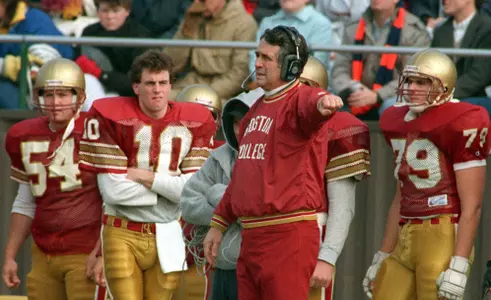
Cosgrove would eventually end his run at Maine with three conference championships between the Atlantic 10 and the CAA, which rebranded as the Coastal Athletic Association in 2023, but his career began when he worked at Boston College under Jack Bicknell, his former Maine head coach from the late-1970s. He was in Chestnut Hill in the aftermath of the Doug Flutie era, and he moved back to Maine after two seasons to coach quarterbacks and wide receivers under Tim Murphy, who had been elevated to the head coaching position after Buddy Teevens left to begin his first stint at Dartmouth.
Murphy's departure for Harvard eventually opened the door for a one-year Yankee Championship run under Tom Lichtenberg, who in turn left for Ohio. His replacement was current Iowa head coach Kirk Ferentz before Ferentz joined the NFL's Cleveland Browns in 1993 - at which point Cosgrove became the head coach after serving as offensive coordinator for four years.
Murphy eventually won 10 Ivy League championships as Harvard's head coach after spending two years at Cincinnati, but he began his career as a Brown University assistant coach under John W. Anderson, who was both Joe Yukica's defensive line coach during Yukica's first year at Boston College and the head coach who won Brown's first Ivy League championship in 1976 with Paul Michalko at quarterback.
Michalko's successor was Mark Whipple, a two-year starter in 1977 and 1978 and the future head coach of Brown at a time when the staff included Bill O'Brien, who began his career under his former college coach, Mickey Kwiatkowski.
Like Anderson, Kwiatkowski started his career at BC, coaching under Yukica in 1972.
"Jack [Cosgrove] was the head coach for a lot of years," said O'Brien, "but my connection is when I think I was a freshman at Brown. Back in the day, Maine played in the Yankee Conference, and Maine was very good. They had a quarterback named Mike Buck. He was six-five, probably 230, and I think we played in the NFL for a little while. Their line had massive dudes."
"They played us at Brown," he smirked, "and it was not pretty. I can remember just looking over at them in warmups at Brown Stadium and thinking that it was going to be a long day for the Brunonians."
Those links might not mean much to the greater college football landscape, but they offer undeniable connection between two teams lacking a remarkable head-to-head history. Maine's three wins over BC, for instance, occurred when Bill Carrigan managed the Boston Red Sox to a World Series championship with Babe Ruth and Tris Speaker, and the next two meetings didn't occur until 1929 and 1967. Both were BC shutout victories, and the Black Bears wouldn't score another touchdown against the Eagles until their 2014 matchup. Their latest game in 2022 offered the most competitive outcome because BC surrendered 17 points, but not even the world of increased FCS upsets over FBS programs was able to build much to the annals or history books.
But that's why BC and Maine still matter to one another. The rivalry ordinarily reserved for the hockey rink featured people like Bicknell, current UMass head coach Joe Harasymiak once coached for Maine before leaving to coach at Minnesota and Rutgers, where he worked on a staff with current Harvard head coach Andrew Aurich, former Boston College offensive lineman Augie Hoffman and current UConn offensive coordinator Nunzio Campanile - a coach who is linked to a number of former BC coaches, including his brother, Anthony, who was on staff with the Eagles before moving to the NFL.
"You're only guaranteed 12 opportunities," said O'Brien, "so you have to make the most of all 12. That's each and every day. That's one of the most incredible things about football. You can put in thousands of hours in winter conditioning, spring practice, summer conditioning, training camp, practice during the week. You practice a whole lot more than you actually play the game, but the reason why you're doing it is for the games. So let's be ready to play each and every game. We put thousands of hours into this, so let's be ready to play each and every game."
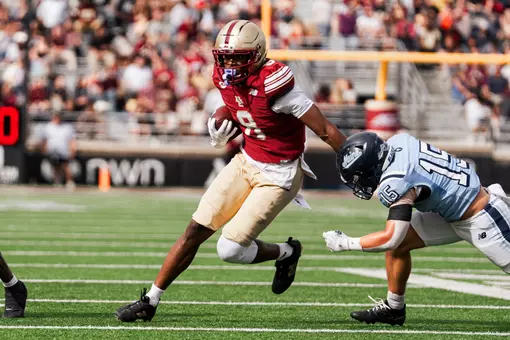
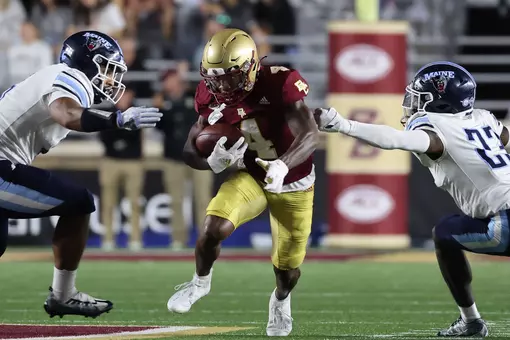
Boston College continues its 2026 season on Saturday when it hosts Maine at Alumni Stadium in Chestnut HIll, Massachusetts. Game time is scheduled for 2 p.m. with coverage available through the ACC Network Extra's streaming platform available within the ESPN family of Internet and mobile device apps.
That distance and time is equal to most road trips out of the Boston area. A trip to New York City, for example, tumbles through Connecticut and Westchester County before cars arrive in the concrete jungle of the five boroughs, and a trip north-by-northwest to the Canadian border opens the gateway to French-speaking Quebec in the same amount of time as the navigation to the Penobscot River.
Each region carries its own unique ties to Massachusetts, but few boast the close relationship that exists below the surface of the BC-Maine brotherhood. From an overall sports standpoint, their parallel histories as founding members of college hockey's Hockey East conference provides instant headlines whenever the Eagles travel north to Alfond Arena's legendary confines, and the Black Bears have emerged from Boston with national recognition and league championships. Each program is a top-ranked icon of its sport, teams that recognize one another as a first place or second place team on a near-annual basis.
Their divergent paths between the Yankee Conference and an older world of high level independence assured impossible overlaps in their overall profile. No logical path existed for a natural hatred, and decades-long gaps between their matchups existed until the NCAA adopted rules allowing bigger, more powerful programs to schedule teams from the former Atlantic-10 and current Coastal Athletic Conference.
Gridiron roads between BC and Maine couldn't exist after the Division I-A and I-AA schism split from the late-1980s, but Saturday's matchup still represents the small and ancient world tying the New England-based college football world to its member institutions. A rich and vivid history exists and ties the teams together without the regular results of a more natural rivalry, and it points to a world where the Eagles and Black Bears fully understand how to prepare themselves within the growing and ever-expanding modern college football landscape.
"This is Boston College, so we need to understand what every opportunity [represents]," said head coach Bill O'Brien. "It was a great job last Friday against Rutgers, but we only get 12 games, so every game is vitally important to us. No game is more important than any other game. Every single game at BC is very, very important."
Emphasizing the importance of the individual game underscores the connections or degrees of separation between BC and its northernmost New England neighbor. Looking back from the current day, Maine head coach Jordan Stevens once played for Jack Cosgrove near the end of Cosgrove's legendary three-decade career, and they were part of an era when the Black Bears advanced to the NCAA Division I championship tournament on a semi-regular basis. More specifically, he was on Cosgrove's roster when the Atlantic 10 merged into the Colonial Athletic Association, and he was in Orono when the Black Bears advanced to the Division I national tournament in 2008.
Cosgrove would eventually end his run at Maine with three conference championships between the Atlantic 10 and the CAA, which rebranded as the Coastal Athletic Association in 2023, but his career began when he worked at Boston College under Jack Bicknell, his former Maine head coach from the late-1970s. He was in Chestnut Hill in the aftermath of the Doug Flutie era, and he moved back to Maine after two seasons to coach quarterbacks and wide receivers under Tim Murphy, who had been elevated to the head coaching position after Buddy Teevens left to begin his first stint at Dartmouth.
Murphy's departure for Harvard eventually opened the door for a one-year Yankee Championship run under Tom Lichtenberg, who in turn left for Ohio. His replacement was current Iowa head coach Kirk Ferentz before Ferentz joined the NFL's Cleveland Browns in 1993 - at which point Cosgrove became the head coach after serving as offensive coordinator for four years.
Murphy eventually won 10 Ivy League championships as Harvard's head coach after spending two years at Cincinnati, but he began his career as a Brown University assistant coach under John W. Anderson, who was both Joe Yukica's defensive line coach during Yukica's first year at Boston College and the head coach who won Brown's first Ivy League championship in 1976 with Paul Michalko at quarterback.
Michalko's successor was Mark Whipple, a two-year starter in 1977 and 1978 and the future head coach of Brown at a time when the staff included Bill O'Brien, who began his career under his former college coach, Mickey Kwiatkowski.
Like Anderson, Kwiatkowski started his career at BC, coaching under Yukica in 1972.
"Jack [Cosgrove] was the head coach for a lot of years," said O'Brien, "but my connection is when I think I was a freshman at Brown. Back in the day, Maine played in the Yankee Conference, and Maine was very good. They had a quarterback named Mike Buck. He was six-five, probably 230, and I think we played in the NFL for a little while. Their line had massive dudes."
"They played us at Brown," he smirked, "and it was not pretty. I can remember just looking over at them in warmups at Brown Stadium and thinking that it was going to be a long day for the Brunonians."
Those links might not mean much to the greater college football landscape, but they offer undeniable connection between two teams lacking a remarkable head-to-head history. Maine's three wins over BC, for instance, occurred when Bill Carrigan managed the Boston Red Sox to a World Series championship with Babe Ruth and Tris Speaker, and the next two meetings didn't occur until 1929 and 1967. Both were BC shutout victories, and the Black Bears wouldn't score another touchdown against the Eagles until their 2014 matchup. Their latest game in 2022 offered the most competitive outcome because BC surrendered 17 points, but not even the world of increased FCS upsets over FBS programs was able to build much to the annals or history books.
But that's why BC and Maine still matter to one another. The rivalry ordinarily reserved for the hockey rink featured people like Bicknell, current UMass head coach Joe Harasymiak once coached for Maine before leaving to coach at Minnesota and Rutgers, where he worked on a staff with current Harvard head coach Andrew Aurich, former Boston College offensive lineman Augie Hoffman and current UConn offensive coordinator Nunzio Campanile - a coach who is linked to a number of former BC coaches, including his brother, Anthony, who was on staff with the Eagles before moving to the NFL.
"You're only guaranteed 12 opportunities," said O'Brien, "so you have to make the most of all 12. That's each and every day. That's one of the most incredible things about football. You can put in thousands of hours in winter conditioning, spring practice, summer conditioning, training camp, practice during the week. You practice a whole lot more than you actually play the game, but the reason why you're doing it is for the games. So let's be ready to play each and every game. We put thousands of hours into this, so let's be ready to play each and every game."
Boston College continues its 2026 season on Saturday when it hosts Maine at Alumni Stadium in Chestnut HIll, Massachusetts. Game time is scheduled for 2 p.m. with coverage available through the ACC Network Extra's streaming platform available within the ESPN family of Internet and mobile device apps.
Tuesday, September 22
Tuesday, September 22
Tuesday, September 22
Monday, September 21