Boston College Athletics
October 26, 2026 | Football, #ForBoston Files
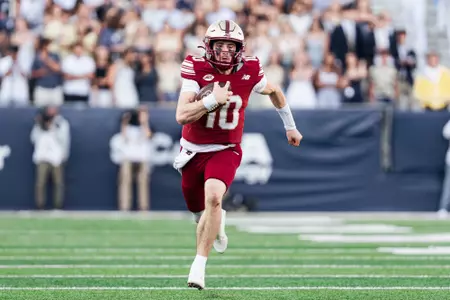
Mason McKenzie's rushing performance puts him on an uncharted path in BC Football history.
The evolution of a quarterback's role in a college football's rushing offense is a continuous and decades-long change that's based on a player's athleticism. What began as a purely option-based mechanic and a unicorn that had no place at the game's professional level is now advanced into a sophisticated and space-oriented strategic weapon that's an expectation for modern play-design.
Boston College never totally utilized a rushing quarterback until the late-2010s. The Eagles based their offense on horsepower running backs that plowed forward behind strong and rugged linemen, so the bulk of their yardage set career numbers behind the 3,000-yard backs of the early 21st century. Players like Mike Cloud, William Green, Derrick Knight, Montel Harris, Andre Williams and AJ Dillon enjoyed storybook careers and passed the torch to one another, all while they left the quarterback to avoid carrying the football outside of basic passes or roll-out throws.
The gold standard didn't emerge until Tyler Murphy transferred from Florida and installed a fully-optional offense without a primary passing attack, and it didn't continue until Thomas Castellanos' 2023 season joined him among the program's only 1,000-yard rushing quarterbacks. The idea of a dual threat - especially during the eras defined by trailblazing offenses at West Virginia, Texas and Florida - never came anywhere near Chestnut Hill.
Saturday's win over Georgia Tech cemented a very different look at the Boston College offense, though, by embracing Mason McKenzie as the centerpiece of an offense that's now welcoming designed runs and integrated looks. For the first time, the Eagles are making waves by building their team around an offense that's both counter-culture and mainstream, all while signaling that they can morph between the two systems to protect their efficiency and outline their success.
"I think the coaches did a great job of planning this [scheme] during the week," said head coach Bill O'Brien, "and the players really executed well in practice. We were able to do some things and adjust some things at halftime, and I give the players and the coaching staff on both sides of the ball a lot of credit."
McKenzie's two-week destruction of two highly-touted defenses included varied and differing schemes built around the Eagles' ability to design and run plays through his complex skills. He rushed for 170 yards on Saturday by setting the table with both designed runs by running backs Bo MacCormack III and Mekhi Dodd, and he twice passed for long gains ahead of explosive running plays in the second half. His third quarter pass to Javarius Green went for 21 yards on the first play of a drive that began on BC's 25-yard line, three plays prior to his 27-yard run to the Georgia Tech red zone. Two plays after that, a 15-yard carry to the end zone came after MacCormack rushed up the middle for four yards.
Earlier in the first half, a similar situation allowed McKenzie to hit Nedrick Boldin, Jr. for a 25-yard touchdown pass after MacCormack rushed three times for a combined 48 yards. A shorter pass to Dodd and an over-the-middle attempt then drew coverage further into the lower section of the defense while Boldin ran through and around defensive back Jaylen Mbakwe within a single one-on-one battle along the right sideline.
"It goes back to those five guys up front," said McKenzie. "They were just moving guys all day, especially in that second half, and we just kept calling the same couple of plays, over and over in different formations. They say that if it's not broken, don't fix it, so those guys did a great job of opening up our entire offensive playbook."
BC infamously repeated a gap run scheme during a 13-play third quarter drive against Rutgers during a 30-16 win in 2019, but those Eagles constructed their offense around AJ Dillon. Quarterback Anthony Brown didn't need to do much outside of going 13-for-25 for 159 yards passing with an additional 40 yards on 11 carries and a score, and he didn't throw more than two passes on either the third quarter drive or the 75-yard touchdown drive that ate seven minutes of the fourth quarter because he had Dillon's bell-cow in the backfield. The running back went for 150 yards on 32 carries while David Bailey gained 82 yards on 12 carries, numbers that totaled the inside of the Rutgers defensive line with BC's offense pushing the load.
Dillon also finished that season with 318 carries - third most in BC history - and was the only running back to rush more than 800 times, doing so 845 times over three years at the end of the decade. Prior to that, Montel Harris, Derrick Knight and Andre Williams remained the only backs with 700 carries, and even Andre Callender amassed 637 carries during the golden era in the mid-2000s. Their success made it impossible for a running back like Jon Hilliman to touch their yardage despite rushing 612 times over a four-year span that included 200-plus carries during his first season.
McKenzie is therefore a unicorn in comparison to even the numbers produced by Murphy and Castellanos. Murphy's 230 passing attempts in 2014, for example, are 120 attempts less than Glenn Foley in 1990, and Foley would eventually end his career with more throws than Doug Flutie. Castellanos, meanwhile, attempted 330 passes in 2023 while rushing for five yards per carry, but the offense was much more free flowing and designed to withstand mistakes that stemmed from his 14 interceptions.
McKenzie hasn't thrown an interception in three of his last four games and shifted from a run-first offense against Virginia Tech to push closer to 300 yards passing against Pittsburgh. Trusted to run the football against the Hokies, SMU and now Georgia Tech, he's run for 614 yards through seven games with two games that were north of 100 yards. His five rushing touchdowns on the season are four less than the career numbers of both Phil Jurkovec and Chris Crane, and his season-long yardage is already fifth-most among BC's career signal callers and approximately 120 yards behind Doug Flutie for fourth overall.
Of the quarterbacks ahead of him in career rushing numbers, only Flutie had a season with 2,500 yards passing while playing for BC. Even with 101 yards on Saturday, McKenzie is still on a pace that would match that would potentially match those numbers.
"It's a special thing when you can run the ball like that," said McKenzie. "It really just opens everything up, but we're running the ball so well that we didn't even have to get into the passing game. We had a good plan in the pass game, but there's no reason to take shots down the field when you can sustain drives like that. It's a very good feeling to see that we can get rolling a little bit and give those guys up front a little bit more confidence."

Players Mentioned

RB
/ Football
WR
/ Football
RB
/ Football
QB
/ FootballWednesday, October 28
Tuesday, October 27
Tuesday, October 27
Tuesday, October 27