Boston College Athletics
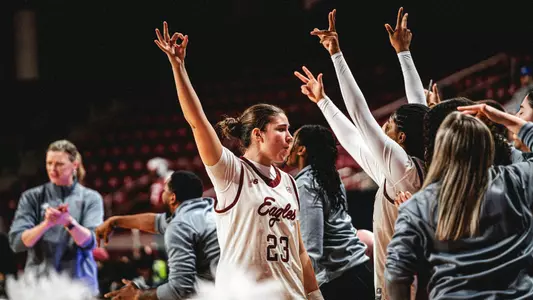
November 24, 2026 | Women's Basketball, #ForBoston Files
BC's roster construction is more United Nations than United States, a sign of the current times in basketball.
There was a time when young women growing up in Europe rarely imagined becoming basketball stars halfway around the world. The sport was their universe, but opportunities were largely confined by their geopolitical boundaries. They learned fundamentals and embraced discipline, developed tactical awareness and understood the importance of team play, yet the possibility of competing at the highest levels beyond their own borders remained largely out of reach at a time when their national team represented the ultimate destination for one region's most talented players.
The fall of the Iron Curtain in the late 1980s began to change that reality, and dismantled barriers over the next three decades opened pathways that had once been restricted or virtually unimaginable. The world grew smaller as technology and NCAA recruiting sought more ways to develop the game, and the European model - particularly the one developed in Western European democracies and the old Soviet republics - gained greater international visibility as players from both sides of the continent made their way across the Atlantic Ocean.
Today, women's basketball, much like its male counterpart, is truly an international enterprise, and in the United States, the opportunity to combine higher education with elite competition fueled a remarkable influx of international talent into the college game. At Boston College, that transformation is helping shape a program increasingly influenced by its international student-athletes, and a roster built primarily from incoming European players is laying the foundation for head coach Kate Popovec-Goss's entry into a style of play that's becoming increasingly standard to the analytics-driven basketball game.
"I think what's happened is that the American game has transitioned more into the European model," said Popovec-Goss. "When we go recruiting - and European recruiting is kind of trendy now - there are certain schools that don't play European basketball at all, and I don't feel that those kids are going to be good fits [at those schools]. Or we'll see schools that don't really recruit European players, but they're trying to transition how they're playing, and that's why they're getting into the European market. We recruit internationally because our system really is more European. The way that we play and the way that we run things is more congruent with the European offense than the old school way."
Nearly 1,500 international players are represented on NCAA women's basketball rosters for the 2025-2026 season with more than 70 percent of those international athletes competing in Division I. Approximately 400 are in their first year of college competition, and only about 15 percent of those Division I programs do not have a player who was born outside of the United States.
At Boston College, seven players were born internationally, including two each from Canada and Spain, along with one representative apiece from Australia, Lithuania and Paraguay. All but were brought to Chestnut Hill by Popovec-Goss and her coaching staff, and the vast majority participated in their respective national team's development programs. In one case, Daniele Paunksnyte already earned experience with her country's senior national team during Lithuania's EuroBasket qualifying experience over this past year.
"What I've noticed with a lot of our European recruits, they want to come to the United States because of the pace of the game, the athleticism, the strength and the defensive stuff that they're going to run into here," said Popovec-Goss. "More holistically, most European players IQs are probably among the best that I've coached because they grew up in team systems and learned to play basketball within a team concept, whereas in America, it's much more focused on the [individual] and focusing on 'you, you, you' before we put 'you' on a team. That's why we like the European players, and I think a lot of them understand that the resources we have, the pace and athleticism that they're going to see, it's going to be the best in the world."
That impact became apparent in the season opener, when Paunksnyte recorded 13 points and 14 rebounds in her collegiate debut. Two games later, she scored 15 points against Providence despite having an off-night from the field, and her performance against Merrimack included 11 points and seven rebounds, with five defensive boards contributing to an effort that came close to producing another double-double.
Most recently, her 18-point night against UMass included three assists and a season-high five steals while an earlier game against Harvard also featured four blocks.
"The way that someone like Daniele plays in Europe is very team-oriented," said Popovec-Goss. "At times, she's had to be the superstar when she's playing with her age group, and then there are times when she's playing with 30-year olds. So she's used to being someone who isn't the first option, and that's okay, but when the moments come, she can take advantage of them, and that's very much her mindset. We're now trying to challenge her by saying that we need her to score to be successful, that we need her to be more aggressive on offense to be successful, and she's starting to get more comfortable with that."
Canadian newcomer Eucinia Salgado, meanwhile, recorded back-to-back double-doubles, following a 23-point, 11-rebound performance against Providence with 14 points and 10 boards against Merrimack. Through six games, her 18 offensive rebounds were more than double the next-highest totals recorded by Paunksnyte, Megan Hollingsworth and Nuria Ausaverri, all of whom are also international players.
"Someone like Euni, her biggest superpower is her competitiveness," explained Popovec-Goss. "She has this really high level of confidence in who she is as a player, even though she's very, very young, and I want her to play off of her instincts and feel more than I want her to analyze and process the game because that's just not who she is. Her instincts are amazing, and the more that she's in the flow of a game, she's a rhythm player, so I really want her to trust those instincts and play with a lot of freedom.
"In a way, I want everyone to play like that, but there are kids that are really highly competent in processing at a high level and others who will play off of that with her instincts. I don't want to mess with that too much."
Bringing different basketball styles and systems together into one cohesive unit is a major reason why international players are finding success in the modern game. At the WNBA level, the championship won by Golden State featured just six players representing the United States, and both the Valkyries and the New York Liberty advanced to the postseason semifinals with rosters composed predominantly of internationally born players.
Among them was rookie Juste Jocyte, a former No. 5 overall pick who elected not to play for Golden State during the 2025 season, choosing instead to focus on EuroBasket competition with Lithuania's national team. This past year, she returned to those duties during the 2027 EuroBasket qualifying competition, and she played alongside Paunksnyte in games that earned Lithuania victories over both Belgium and Sweden.
"We're starting to develop our identity," said Popovec-Goss. "I'm learning about my players, what we need, and I think as a staff, we're now trying to identify things that are okay and what might become consistent problems. They're all things that we're growing with, and we're trying to address the issues. I'm pleased with our trajectory, but we have a long way to go and tons to learn. We're learning how to win, and we're learning who we are, as a team."
BC hosts Northeastern on Tuesday night with top-off scheduled for 6 p.m. from Conte Forum in Chestnut Hill, Mass. Television coverage is slated for the ACC Network Extra with streaming available on ESPN's family of streaming and mobile device apps.

Players Mentioned

F
/ Women's Basketball
G
/ Women's Basketball
G
/ Women's BasketballWomen's Basketball: UMass Highlights (Nov. 20, 2026)
Monday, November 23
Men's Basketball: NJIT Postgame Press Conference (Nov. 22, 2026)
Monday, November 23
Men's Basketball: Colby Duggan 22 Points & 7 Rebounds (Nov. 22, 2026)
Monday, November 23
Men's Basketball: NJIT Highlights (Nov. 22, 2026)
Monday, November 23