Boston College Athletics
October 29, 2026 | Football, #ForBoston Files
A Saturday at Fenway Park offered respite from the previous week's stock market crash.
The autumn of 1929 broke the American spirit when the Stock Market Crash of late October heralded the horrors of the Great Depression. Runaway growth from earlier in the year dissolved into catastrophic contraction after summer's uneasy calm curdled into September's overall anxiety, and Thursday, October 24 sputtered the ticker tape to a halt as frantic sell-offs and panic descended into outright economic bedlam.
Within a week, the collapse crippled telegraph wires and telephone lines across the country, and the Dow Jones Industrial Average relentlessly fell into a crushing 40 percent loss. Winter was coming, so the irony of the impending shadows of a worldwide hardship wasn't lost on their growing creep and stretch.
Yet for one fleeting Saturday in early November, New England found refuge from the storm by turning its attention to the gridiron, where Harvard and Boston College prepared for their own homebound games against Florida and Duke, two institutions that traveled north as the world seemingly stopped around them.
"In each of their games, the Blue Devils managed to score, but nevertheless were outclassed," said The Boston Daily Globe. "Duke may threaten through the air today, but Boston College appears to have enough to turn the tide."
New England - its heartbeat in Massachusetts - represented the epicenter of the college football world at the time. Seven claimed national championships were part of Harvard's short history, and several more voting organizations bestowed five additional titles on the Crimson with the most recent banner occurring in the aftermath of their 7-6 Rose Bowl win over Oregon in 1920. Their slip to a five-win program by the 1928 season allowed Boston College to claim eastern supremacy in the first year under head coach Joe McKenney, and the Eagles twice filled Fenway Park for their wins over Fordham and Holy Cross.
The Eagles were emerging as a premier independent program for the first time since Frank Cavanaugh's final season, and the perfect 1928 team included four shutouts during a 26-point defensive season. Connecticut was the only team to score in double figures during the season, and dueling 19-0 victories over Duke and Holy Cross bookended a run that included a 27-7 win over Boston University and a 60-6 win over Manhattan. Fordham had Cavanaugh, but the Rams lost four straight games after starting the year with a 4-1 overall record.
The voting boards declined to list BC over Penn, Carnegie Tech, Army or NYU, but captain Warren McGuirk was every bit as legendary as Yale's mercurial lightweight sensation Albert Booth or Dartmouth quarterback Alton Marsters - players slated to compete against one another while the Crimson hosted Florida and BC hosted Duke.
"As in 1927, when Yale scored three touchdowns, Dartmouth comes down with signal victory at the stadium close behind," screamed The Boston Sunday Globe. "But with nearly 40 touchdowns scored this Fall, a team together almost from the start and a Marsters performing at his best, Hanover's hopes again run high, and if Dartmouth does hold its pace, Yale's improvement must continue to be marked if the Blue is to hold tight its record of never having yielded a football game to the Wah Hoo Wah and his green war paint from the New Hampshire hills."
Duke, for what it's worth, was still trying to find its way under head coach Jimmy DeHart. The new Duke Stadium was open on campus, and Southern Conference membership conjoined the Blue Devils to fellow schools from Tobacco Road and the future SEC. Their loss to Pittsburgh was excusable because the Panthers held expectations for the national championship and the Rose Bowl, but the losses to Navy and Villanova were compounding the recent historical Fenway Park defeat from the previous season. They'd never been better than an approximate .500 team since before Trinity College became Duke University, and the mighty Eagles were expected to earn an easy victory before heading back into games against their northeastern opponents.
"Since that day when Georgetown ran Boston College ragged, the Eagles have been undefeated," wrote The Boston Evening Globe. "Except for the recent tie game with Villanova, Boston College has won 16 times. Duke doesn't appear to have the stuff to spoil that record, though Fordham, next week, may."
Indeed, BC would emerge victorious in a 20-12 game against Duke before losing to Fordham, and a second loss to Marquette sent the Eagles into a group of eastern schools that trailed both the Rams and Pittsburgh. Wins over Boston University and Holy Cross couldn't stop that, and the unblemished record under McKenney came to a close.
The world, by then, also looked considerably different from early November, and the entire country devolved into a state of lost innocence. Alvan Fuller, the former governor of Massachusetts who had retired in early 1929, had used his place at a smoker ahead of the BC-Holy Cross game to decry a political killing of the ex-chairman of the Boston Finance Commission, and a wild local football game between undefeated Malden and its ancient rival from Medford devolved into a riotous brawl before a record-setting crowd of 18,000 fans in attendance.
The economy continued its decline without a lender of last resort, and the Dow Jones Industrial Average eventually landed on a second slide that lasted for two-plus years. McKenney's Eagles would go 8-1 during the 1933 season but never reach the undefeated heights of their first season, and it would take another six years and three head coaching changes before Frank Leahy led BC to the Cotton Bowl, the Sugar Bowl and the 1940 national championship.
Nearly a century later, BC and Duke are still on the college football grounds, but the world - and college football - is nothing like its ancient predecessor. Fun as it is, Saturday is going to look considerably different, all while reviving the ghosts of DeHart and McKenney, McGuirk and Kistler.
"I think Duke is a really good football team," head coach Bill O'Brien said about Saturday's opponent. "I think they're well-coached. They're tough. They're disciplined. I have a lot of respect for Manny [Diaz] and how he runs his program, so I think it's going to be a big challenge for us. We need to continue to have a good week of practice and go down there and do the best that we can."
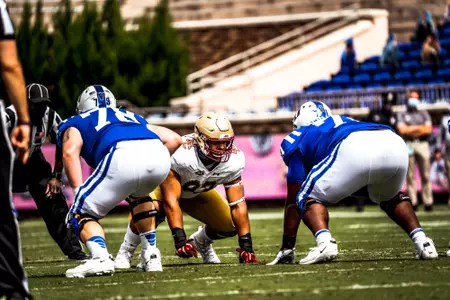
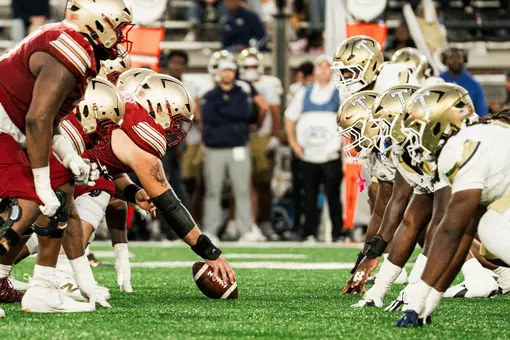
BC and Duke kick off on Saturday, October 31, at 12 p.m. from Brooks Field at Wallace Wade Stadium in Durham, North Carolina. Television coverage is set for the CW Network.

Thursday, October 29
Thursday, October 29
Thursday, October 29
Wednesday, October 28