Boston College Athletics
2026 Boston College Football Preseason: Offensive Reconfiguration Takes First Stage
August 07, 2026 | Football, #ForBoston Files
The first look at BC's offense offered insight into its future development.
CHESTNUT HILL, Mass. - The 2025 offseason represented a pivotal moment for the Boston College Football program and Gregory P. Barber '69 and Family Head Coach Bill O'Brien. The flashes of potential from last season that were often met with inconsistency unraveled into a personnel exodus akin to the situations emergent throughout college football's transfer portal era. Roughly half of the snaps taken during the 2025 regular season disappeared during a newer and more accelerated window at the end of the season, taking starting quarterbacks, running backs and wide receivers with them. The NFL Draft subsequently allowed other key Eagles to matriculate onto professional rosters, which in turn left Boston College with a need to completely reconfigure its look ahead of the 2026 season.
O'Brien's reputation as an offensive innovator therefore stepped to the forefront of the Eagles spring session. The former offensive coordinator at Georgia Tech and Duke once blended shotgun and ace-style formations into pro-style collegiate schemes before taking his ideas onto the New England Patriots' five-wide passing sets of the Tom Brady era, after which his utilization of evolving skills redefined the Houston Texans around a lethal running game and a dual-threat quarterback.
Nearly every scheme carried O'Brien's trademark toughness and discipline, so Boston College's reinvention therefore handed a well-mixed idea to a well-traveled wizard. He primarily tasked roster management with finding personnel capable of fulfilling his belief in high compete levels, and as training camp opened this week, the positive excitement transformed question marks and unknowns away from terms carrying inherent negativity.
"Compared to 20 years ago, these guys are here year-round," said O'Brien in his first media availability of the 2026 preseason. "We had basically 15 practices over the summer. We had winter conditioning, we had spring practice, and summer was five days per week with two of those days being practice days. So I feel like we're on the right track, and these guys have done a really good job of learning the systems and working to be in shape and all of those different things. Football training camp's a lot different than summer conditioning, obviously, but I believe that we really know our X's and O's."
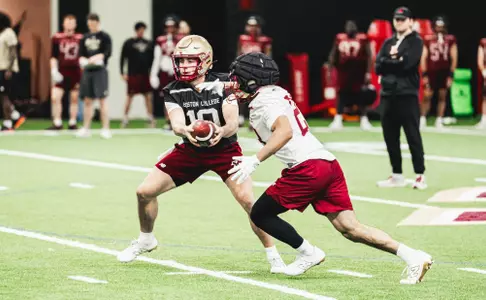
Adding Mason McKenzie as the team's new starting quarterback clearly defined the redesign over the past few months, but it's critical to fully understand how offensive reconfigurations begin with the quarterback. The primary objective - moving the football down the field - begins with streamlined decision-making built around a signal caller's strengths and continues growing throughout the unit's overall development. Continuity is therefore paramount because schematic depth and complications stagger and scaffold the overall build between high-percentage throws and the carefully-timed deep shots that pair with a quarterback's current ability to run the football.
Ensuring that flow subsequently requires the quarterback - in this case, McKenzie - to remain as healthy as possible for the entire season, but protecting his safety in the backfield extends beyond simple blocking schemes or an offensive line. At its very best, an offense requires its linemen to provide time and space for a quarterback or running back to balance the running game against passes, which in turn require receivers to gain separation in an allotted window. By the same token, a defense's ability to prevent an opposing offense from scoring provides shorter rest periods for opposing defenses, which in turn creates more time for an offense to flourish.
"Coach O'Brien has been around the game a long time," said running back Evan Dickens. "He has a lot of football knowledge, and I know that he can put me in the right position on the field to succeed and achieve my dream to go to the next level. I'm still hungry for more. I had a really successful season last season [at Liberty], but that's in the past. I'm looking forward to mimicking or having a better season this year. I'm not satisfied, and I want to keep climbing."
Dickens rushed for 1,339 yards and 16 touchdowns last season, so adding him out of the transfer portal augments O'Brien's intention to deploy a multi-faceted offense. Beyond him, other players are likely to factor into roles that develop over the next few weeks while simultaneously building around the new backfield. Their inclusion and rotation will remain unclear to the naked or untrained eye, but the subtle build-out is all part of a process expected to increase formational diversity and multiple attacks.
"The operation when you're in a team period or a seven-on-seven is very important," said O'Brien. "That's where you have to practice just as much as a coach as you would as a player. So once we go into team periods during training camp, it's basically what it's going to be like during the game. It's what we do every day. It's a common deal and a daily deal.
"Wednesday was about 60 minutes of full speed work," he said. "Thursday was 70 minutes, and then on Friday, we're off. We come back on Saturday with 80 minutes, then 90 minutes, and then we feel, after the ramp-up of four practices, we can go to whatever we want. It'll never really become 120 minutes of full speed action…but we feel good. We came out of practice healthy, and we feel like there's nothing more important than the health of the team. We definitely want to stay on track with our timing, and we're doing a good job of it."
Per O'Brien's remarks, the second training camp practice on Thursday preceded an off-day today with a third session scheduled for Saturday morning. Saturday morning's session is open to media, but practices from the Fish Field House and its outdoor facility are closed to the public.
O'Brien's reputation as an offensive innovator therefore stepped to the forefront of the Eagles spring session. The former offensive coordinator at Georgia Tech and Duke once blended shotgun and ace-style formations into pro-style collegiate schemes before taking his ideas onto the New England Patriots' five-wide passing sets of the Tom Brady era, after which his utilization of evolving skills redefined the Houston Texans around a lethal running game and a dual-threat quarterback.
Nearly every scheme carried O'Brien's trademark toughness and discipline, so Boston College's reinvention therefore handed a well-mixed idea to a well-traveled wizard. He primarily tasked roster management with finding personnel capable of fulfilling his belief in high compete levels, and as training camp opened this week, the positive excitement transformed question marks and unknowns away from terms carrying inherent negativity.
"Compared to 20 years ago, these guys are here year-round," said O'Brien in his first media availability of the 2026 preseason. "We had basically 15 practices over the summer. We had winter conditioning, we had spring practice, and summer was five days per week with two of those days being practice days. So I feel like we're on the right track, and these guys have done a really good job of learning the systems and working to be in shape and all of those different things. Football training camp's a lot different than summer conditioning, obviously, but I believe that we really know our X's and O's."
Adding Mason McKenzie as the team's new starting quarterback clearly defined the redesign over the past few months, but it's critical to fully understand how offensive reconfigurations begin with the quarterback. The primary objective - moving the football down the field - begins with streamlined decision-making built around a signal caller's strengths and continues growing throughout the unit's overall development. Continuity is therefore paramount because schematic depth and complications stagger and scaffold the overall build between high-percentage throws and the carefully-timed deep shots that pair with a quarterback's current ability to run the football.
Ensuring that flow subsequently requires the quarterback - in this case, McKenzie - to remain as healthy as possible for the entire season, but protecting his safety in the backfield extends beyond simple blocking schemes or an offensive line. At its very best, an offense requires its linemen to provide time and space for a quarterback or running back to balance the running game against passes, which in turn require receivers to gain separation in an allotted window. By the same token, a defense's ability to prevent an opposing offense from scoring provides shorter rest periods for opposing defenses, which in turn creates more time for an offense to flourish.
"Coach O'Brien has been around the game a long time," said running back Evan Dickens. "He has a lot of football knowledge, and I know that he can put me in the right position on the field to succeed and achieve my dream to go to the next level. I'm still hungry for more. I had a really successful season last season [at Liberty], but that's in the past. I'm looking forward to mimicking or having a better season this year. I'm not satisfied, and I want to keep climbing."
Dickens rushed for 1,339 yards and 16 touchdowns last season, so adding him out of the transfer portal augments O'Brien's intention to deploy a multi-faceted offense. Beyond him, other players are likely to factor into roles that develop over the next few weeks while simultaneously building around the new backfield. Their inclusion and rotation will remain unclear to the naked or untrained eye, but the subtle build-out is all part of a process expected to increase formational diversity and multiple attacks.
"The operation when you're in a team period or a seven-on-seven is very important," said O'Brien. "That's where you have to practice just as much as a coach as you would as a player. So once we go into team periods during training camp, it's basically what it's going to be like during the game. It's what we do every day. It's a common deal and a daily deal.
"Wednesday was about 60 minutes of full speed work," he said. "Thursday was 70 minutes, and then on Friday, we're off. We come back on Saturday with 80 minutes, then 90 minutes, and then we feel, after the ramp-up of four practices, we can go to whatever we want. It'll never really become 120 minutes of full speed action…but we feel good. We came out of practice healthy, and we feel like there's nothing more important than the health of the team. We definitely want to stay on track with our timing, and we're doing a good job of it."
Per O'Brien's remarks, the second training camp practice on Thursday preceded an off-day today with a third session scheduled for Saturday morning. Saturday morning's session is open to media, but practices from the Fish Field House and its outdoor facility are closed to the public.

Players Mentioned
RB
/ Football
QB
/ FootballWednesday, September 16
Wednesday, September 16
Tuesday, September 15
Tuesday, September 15