Boston College Athletics
October 21, 2026 | Football, #ForBoston Files
An opening game win turned into a bigger game than anyone realized.
College football entered a new world with the 1998 arrival of the Bowl Championship Series. For the first time, a statistical algorithm based on rankings and computerized polls would determine the two teams that would play for the national championship with buy-in from each major conference and postseason game. The Fiesta Bowl, Sugar Bowl, Orange Bowl and Rose Bowl retained their traditional tie-ins with the SEC, the Big Ten, the ACC and the Big 12 with the Big East additionally assured of an at-large position. No more than two teams from any conference could receive berths in BCS games unless two non-champions from an automatic qualifier were the two best teams in the nation, and Notre Dame was included as an at-large team if it finished inside of the top eight spots of the computer rankings.
It built on its predecessors in the Bowl Coalition and the Bowl Alliance by specifically negotiating with the Rose Bowl and the non-Bowl Alliance teams, hurdles that ultimately divided national championships in 1990, 1991 and 1997 while simultaneously becoming the spiritual parent to future expansions, alterations and creations by the mid-2010s. Eventually, the College Football Playoff replaced the BCS as the system to determine the national champion with its own expansion turning into the 12-team bracket that's now part of the sports calendar.
"We knew we had to do something differently, especially when you had bowls cutting deals well before the end of the regular season and split national championships in three of the previous eight seasons," said former SEC executive associate commissioner Mark Womack in a 2023 interview with ESPN. "[SEC commissioner] Roy [Kramer] had the vision of putting together a game and twisting as many arms as he had to."
The BCS fundamentally altered how teams approached games in college football, and the bell curve associated with the computer rankings became one of the more immediate focal points after Georgia Tech - one of the split national champions in 1990 - missed a potential berth in the BCS because of an early season loss to Boston College. Margins were razor thin, and the grand promises of the new era undid George O'Leary's team with a blistering home loss and a 200-yard rushing day that nobody saw coming.
"[Georgia Tech] meant a lot to my career," said current BC head coach Bill O'Brien. "I spent eight or nine years there. I was a [graduate assistant] for three years. I was the running backs coach. I was a coordinator. I was the recruiting coordinator and assistant head coach. I worked with some unbelievable players, including George Godsey and Brent Key, and great coaches: George O'Leary, Ralph Friedgen, Doug Marrone, Randy Edsell, Ted Roof - unbelievable coaches. Pat Watson, God rest his soul, I learned a lot from when I was a GA. It's a great place."
Georgia Tech was O'Brien's first major football program after starting his post-playing career with his alma mater at Brown, and he was in his first year as the running backs coach when the Yellow Jackets took the field for 1998's opening game against BC. Head coach George O'Leary was subsequently in his fourth full season after taking over for Bill Lewis during the 1994 season, and the upswing of the rebuilding project from the 1-10 season gave Tech its first bowl berth since Bobby Ross followed the 1990 national championship with an Aloha Bowl victory in 1991.
BC's return was a couple of years behind that trajectory, and second year head coach Tom O'Brien was coming off of a four-win season in 1997. The Eagles hadn't produced a winning season since playing Kansas State in the 1994 Aloha Bowl and lacked a finish higher than fifth in the Big East in all but one year since Tom Coughlin's departure. From a head-to-head standpoint, the two teams rarely played because of their respective obligations to the northeast-based Big East and southern-based ACC, but their 1997 meeting ended with the Yellow Jackets crushing BC with 303 rushing yards and a 42-14 win at Alumni Stadium.
"They've always been a [physical opponent]," O'Brien told The Boston Globe ahead of their 1998 meeting. "That's the way George coaches. It's another good indicator if we're a smarter football team - no turnovers, no mistakes, no missed assignments or missed tackles. Those kind of things just kill you. Many times opening games are lost, they're not win. We don't want to beat ourselves, like we did last year at Temple."
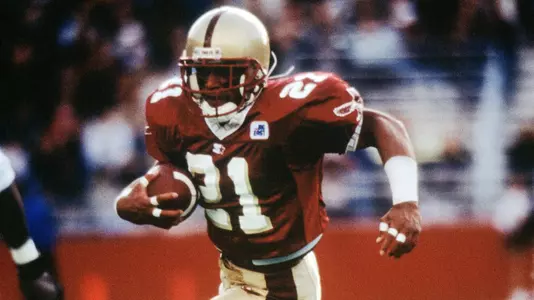
What instead unfolded was a home run akin to Mark McGwire's chase for the single season record. On three separate occasions, Georgia Tech rallied to tie BC after falling behind, but the Eagles never stopped attempting to pull away from the hot and sweltering Atlanta conditions. Mike Cloud ran for 203 yards while quarterback Scott Mutryn went 16-of-26 for 220 yards with three total touchdowns, including two on the ground as part of a performance that included 25 first downs, 491 total yards, and zero turnovers. Brian Maye had an interception in the second quarter that set up Mutryn for a 15-yard pass to tight end Rob Tardio before the end of the first half, and a 66-yard fourth quarter pass to wide receiver Anthony DiCosmo further allowed the fifth year senior to run the first of his touchdowns into the end zone.
"I think he did a great job," said O'Brien. "Obviously, I'm going to argue with him on a couple of decisions here and there, but he made no bad decisions. We had some guys open that he missed, but for the most part, he was 16-for-26 for 220 yards, and that's good."
Cloud's second 200-yard performance of his career eviscerated a defense that posted elite numbers during the 1997 season and handed scintillating thoughts to BC fans after the next two weeks produced dominant wins over Rutgers and Temple, but a late September blowout at Louisville preceded a scheduling stretch against Virginia Tech, Syracuse, Navy, Miami and Notre Dame - four ranked teams and a service academy triple option that always gave BC fits. By the end of the year, another 4-7 season ended O'Brien's year with a bit of disappointment after its start, even as everyone understood that better days were ahead.
But back in Atlanta, that record became a much larger presence than anyone could have predicted. The Yellow Jackets had won five straight games after the BC loss and entered late October as the No. 20 team in the nation. They were the front runners for the conference championship after beating a top-10 Virginia team, and their head-to-head matchup with preseason No. 2 Florida State became a de facto championship game after the Seminoles lost to NC State in early September. Even after losing to FSU in Atlanta, a co-championship opened the door for a potential at-large bid or, if FSU slipped again, the automatic bid to the Orange Bowl.
The loss to BC negated all of that. Instead of playing for an at-large bid, the Yellow Jackets were No. 17 in the initial BCS computer poll, and each loss by the Eagles anchored Georgia Tech with a bigger and more catastrophic mathematical loss. A 10-1 ACC co-champion with top-tier wins over Georgia, Virginia and North Carolina would have presented an airtight case for the algorithm's berth in the Orange or Sugar Bowl, but the double-digit loss to a sub-.500 team pushed the Yellow Jackets further down the polls. They'd never get higher than No. 12 after beating the Bulldogs in their annual rivalry game, and they wouldn't get as close to a BCS game until Paul Johnson led the team to a 2009 ACC Championship Game victory, one year after a head-to-head tiebreaker cost them a shot at BC in the 2008 version.
Now members of the same conference, they'll play Saturday in their 14th all-time game. They'll play for the second consecutive year and the fifth time since 2020. They played their 2016 game in Dublin, Ireland and played twice during BC's championship game era in 2007 and 2008. Their ninth meeting as conference opponents is nearly double their previous all-time meetings, and last year ended with a two-point margin of victory that echoed BC's late season near-misses.
"The Virginia Tech game, they came storming back and had every chance to win that game," said O'Brien of this year's Georgia Tech team. "They beat Duke, which I think is a really good football team. I think it's going to be a big, big challenge on the road and in a place that's very tough to play. I'm trying to get the guys to understand to stay in the moment and go one day at a time. Let's have a good Tuesday, have a good Wednesday and build from there."
Women's Basketball: Merrimack Postgame Press Conference (Nov. 17, 2026)
Wednesday, November 18
Football: Head Coach Bill O'Brien Media Availability (November 17, 2026)
Tuesday, November 17
Football: JuJu Jumeau Media Availability (November 17, 2026)
Tuesday, November 17
Football: Carter Davis Media Availability (November 17, 2026)
Tuesday, November 17