Boston College Athletics
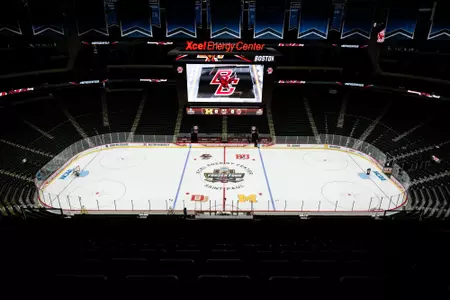
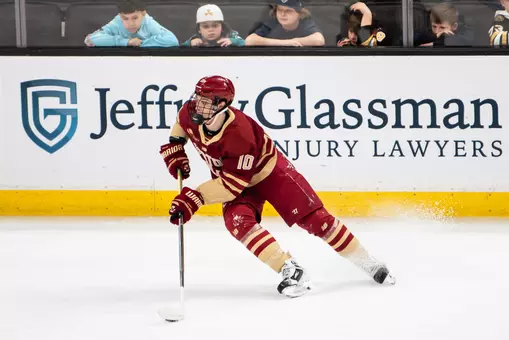
Photo by: Joe Sullivan
Drop The Puck: BC vs. Michigan
April 11, 2024 | Men's Hockey, #ForBoston Files
The road to the national championship game reaches its conclusion in the semifinal tonight.
Headlines of The Boston Daily Globe in the late-1940s spun a grim story about the world's prospects. Superpowers once united by the common goal of defeating Germany in the first half of the decade fractured along their ideological differences, and the latter years of the decade saw President Harry Truman deliver a doctrine based on protecting nations bent on defying the powerful Soviet Union. A civil war in Greece made front page news by 1948, and the Scandinavian nations directly bordering Russia's western flank pledged their support to Western democracy as America bolstered its defense of the German military sector in Berlin. Peacetime, it felt, was anything but peaceful as debates raged over a selective service conscription draft.
The political spectrum rumbled the world's newfound nuclear age, but people in Massachusetts found solace from the underlying chaos by wrapping themselves in successful sports stories. Ted Williams' return from service coincided with the Boston Red Sox' first trip to the World Series since the Babe Ruth era, and the pitching duo of Warren Spahn and Johnny Sain had the crosstown Braves primed for their first run at a National League pennant in 34 years.
The Boston Celtics were an upstart team primed for a playoff run after finishing 27 games behind the Washington Capitols in their first season in the Basketball Association of America, but the mighty Boston Bruins emerged from the wartime absences of Woody Dumart and Milt Schmidt to once again challenge mighty Toronto and Montreal with both the addition of Pete Babando as a 20-goal scorer and the transition of Dit Clapper from player-coach to full-time coach.
Holy Cross' national championship run in basketball in 1947 earned the Crusaders a return to Madison Square Garden in 1948, and a win over Michigan earned front page headlines on The Boston Daily Globe. The story spilled deep into the paper's full pages, but its box score wrestled for space against a story developing out of Colorado Springs, Colorado, where four teams had been invited to play at Colorado College's Broadmoor Ice Palace for the first-ever NCAA hockey championship.
Two teams from the Eastern and Western sectors of college hockey traveled to Colorado via the nation's rail network that week, and Michigan, despite losing to Holy Cross in New York City, found itself with a second chance at a national championship after Vic Heyliger led the Wolverines to a stellar 17-win season. The top-seeded Western team, the road to the first national championship required his alma mater to defeat the second-seeded Eastern team from Boston College before facing either Dartmouth or the host Tigers.
None of the teams felt similar to one another, but Michigan and BC drew stark contrasts from one another. Both had head coaches from Massachusetts, but Heyliger attended Lawrence Academy before earning All-American status with Michigan. He briefly played for the Chicago Blackhawks before remaining in the Midwest as the coach at Illinois, and his return to his alma mater created a postwar haven for intercollegiate hockey with a 17-win season in his second year.
John "Snooks" Kelley, meanwhile, was five years older and possessed very different roots from Heyliger. The two-sport athlete at Boston College High School played both hockey and baseball at Boston College but graduated after his alma mater suspended the hockey team during the Great Depression. He never played professionally, but a quick start to a career in coaching resurrected the Eagles in 1932 and built a near-perfect season before enlisting in the United States Navy to serve in World War II.
His departure resulted in one additional year under John Temple before BC once again suspended the program, but Snooks' return to the team in 1946 came one year after it played three games under Joseph Galvin. There was no Beanpot or conference affiliation to help rebuild, but the local coach built a rugged and tough group from the local hockey culture. The 1947-1948 team had beaten Harvard and Boston University late in the year after losing earlier games to both teams, and a win over Northeastern in the New England Tournament amounted to the third win over a team that otherwise went 10-6.
Playing Michigan was a huge opportunity for BC, and the Eagles jumped on the Wolverines by scoring first ahead of a 3-1 lead by the second period. A third period comeback eventually pushed Michigan into a 4-3 lead, but a goal with 50 seconds remaining forced overtime, where Michigan's Walle Gacek scored to once again post a one-goal lead. Rules at the time did not include sudden victory, so BC continued to pepper goalie Jack McDonald despite the Michigan netminder sustaining an injury earlier in the game. Forced to pull their goalie in the last minute, the Eagles surrendered a clinching goal late and lost, 6-4.
Michigan went on to defeat Dartmouth and win the first-ever national championship, but BC raised the stakes on its program by nearly beating an unbeatable western power. A return to Colorado one year later saw BC grab the No. 1 seed in the East after going 21-1 overall with a 19-1 record against intercollegiate opponents, but a Dartmouth win over Michigan avoided a rematch at the game's highest level before the Eagles hung their first championship banner.
Those meetings started a tradition for the NCAA, and the next eight decades established both the Wolverines and Eagles as two of the greatest programs in the sport's overall history. As they ready themselves for a semifinal rematch 76 years in the making, the ghosts from the 1950 and 1954 NCAA consolation games, the 1998 national championship game in Boston, and the 2004 NCAA Northeast Regional final in New Hampshire are gritting their teeth as Snooks and Heyliger prepare to battle across the benches once more behind Greg Brown and Brandon Naurato.
Here's what to watch for when the Eagles return to the Frozen Four and meet the ever-mighty Wolverines:
****
Game Storylines (Herb Brooks Edition)
You win with people, not with talent. So the quality of the people is very important in building your team. I always looked for people with a solid value system. Then I recruited kids from a cross-section of different personalities, talents and styles of play.
It's easy to look at this matchup and quickly talk about Boston College's overall talent levels, but the Eagles' defining factor more centrally involves how the roster harnessed that skill within a team-style game. The debate surrounding whichever player is considered the "best on the roster" is more dependent on the context or criteria because of how good BC has been at creating situations for everyone to thrive.
Cutter Gauthier, for example, is the BC player on the Hobey Hat Trick finalist list and a frontrunner for the program's fourth-ever Hobey Baker Award win, but he's not even the best player on his own team in certain situations. His 37 goals make him arguably the best goal scorer in the nation, but Ryan Leonard has 31 goals on 50 less shots while Will Smith finished with 69 points and 46 assists over Gauthier's 64 points and 27 assists. That makes Smith a better distributor than Gauthier, but Gauthier's 10 game-winning goals and 13 power play goals make him a better assassin than other skaters who might have better numbers in other areas.
"It's a huge opportunity for us as a group to be where we're at today," Gauthier said. "We're super fortunate for how our season's gone so far, and we couldn't be more excited and thrilled to be here in St. Paul and to get the games underway. Like I said, we're just super thrilled for this opportunity to be here."
Michigan similarly has a high-powered offense, but finding a way to defeat and punch holes in BC's offense is a difficult task for a team without the sterling defensive numbers surrounding a team like Quinnipiac. That said, the Wolverines held Michigan State to two goals and North Dakota to a one-goal loss, so it's not necessarily about how the defense plays so much as how the defense wins certain situations. Of its last seven games, all but one were one-goal games, and the only that was lost was the Big Ten championship against Michigan State, which was quickly avenged on the bigger NCAA stage.
"They have a lot of talented players up front," said Eamon Powell. "I think it goes to show you for all the teams that are here, a lot of really good players up front [and] a lot of offense. As of recent, their defense has been great. I've played with Marshall Warren and know a couple of the other defensemen as well. They're all talented players and could definitely impact a game. It's not to be taken lightly. They have a strong squad, and they're here for a reason. We're just building up and gearing towards playing them tomorrow night."
Legs feed the wolf.
National semifinal games feel very different from regional games, which in turn are different from conference tournament games, which in turn are different from regular season games, but the biggest asset facing either team in Thursday's matchup involves their ability to play both from behind and ahead, which sounds muddy or ironic or even like it's not even an explanation about game flow. Looking deeper, it's more about how both teams had to find ways to bury opponents with well-timed or back-breaking goals at various stages of a game. In some ways, it was all about timing, and looking back at the performances in their respective regions explains that statement a little bit deeper.
Michigan, for example, dropped the first goal in the Regional Final game against Michigan State by surrendering a goal in the first period with a penalty kill that's statistically nowhere near the offense's success rate. Having trailed 1-0 at the end of the first period, Big Blue's early second period strike drove a stake through it with a sense of finality that turned the game into a slugfest for the second period before Marshall Warren put Sparty on its heels with a goal earlier in the third. After Michigan State tied the game with another power play goal, the dueling goals from Dylan Duke and Gavin Brindley essentially ended the game within the two minutes after the Spartan's goal was scored thanks to a hammer-down goal within 30 seconds of the go-ahead goal.
BC, meanwhile, hasn't lost since the Beanpot semifinal game against Boston University because the Eagles are one of the best teams at stopping adversity against opponents, and it's not particularly difficult to find a couple of prime examples. The 6-4 win over Merrimack in the season finale, for example, featured a two-goal rally in the second period after the Warriors grabbed a 2-0 lead, and BC later slammed Merrimack's upset hopes with four straight goals after seeing a second, one-goal deficit. Michigan Tech likewise held BC to a 1-1 game after the first period before the Eagles mashed their gas pedal, and the two-goal rally against Quinnipiac in the regional final seemed to encompass everything that made the roster great.
"There can be nothing going on," Michigan head coach Brandon Naurato said, "and [BC] can have ultra-talented players that can make something happen out of nothing. That's the biggest thing with momentum shifts. You feel like a team is outshooting the other team 9-to-1 in a segment [and] deserve to score. That's the difference when you have game-breakers. You can be getting out-shot or out-played, and they put one in the back of the net and it changes all the momentum."
What is courage? Let me tell you what I think it is. An indefinable quality that makes a man put out that extra something, when it seems there is nothing else to give. I dare you to be better than you are.
BC's greatness ahead of Thursday's game is deeper than just its freshman line, and the depth chart reflects players who bring big game experience to a team that needed to somehow balance its natural ability. Players like Jack Malone and Jacob Bengtsson understand what it's like to lose at this level, and their backbone often tempers the raw horsepower that exists atop the team's top lines.
"Our older guys are so vital [in] keeping the calmness on the bench and just the steady play and reliable play," said head coach Greg Brown last week. "Jack's line with Jamie [Armstrong] and Colby [Ambrosio] was fantastic against Quinnipiac, and I thought they were a huge reason why we kept pushing and why we weren't down when we got behind. They had one shift halfway through the second period when the first half of the period wasn't going well for us, and that shift was somewhere around the 10-minute mark where it really turned momentum. I thought we were much better in the second half of that period, and it was all because of the shift they put out there."
BC is going to run into a problematic area at some point on Thursday night, but moving past the area - whether it's on the ice or in dealing with the off-ice, rigid structure of anything that goes on this week - is a big part of what this older class is capable of providing. There's a structure in place that allows the younger players to thrive because their backbone is always present, and the delicate balance relies on that older experience of playing in these big spots.
*****
BC-Michigan X Factor
Jacob Fowler
The Frozen Four carries a number of different storylines that rightfully take the top billing on the marquee above the Xcel Energy Center. The matchups include the four "bluest of blooded" teams with the richest histories and the best offenses in the country, but putting them on a collision course omitted the conversation that BC is the only team remaining in the NCAA Tournament field with one of the four best defenses in the nation.
Defenses historically beat good offenses, but Eagles netminder Jacob Fowler still feels overlooked as a possible game-breaker against teams that haven't had issues breaking through scoreboards. That he's the backstop of one of the nation's best penalty kill units is also omitted from the conversation, but it's the differentiating factor that no other team can claim ahead of Thursday night's matchups.
"He's been awesome all year," said Powell. "Sometimes he doesn't get the credit he deserves, which is crazy because he gets so many accolades, but he brings so much confidence to our group. Other teams, other good teams are going to push the pace and bring some momentum, and he's always back there giving us confidence."
Fowler's performance extends beyond numbers supporting a Mike Richter Award candidacy. His style isn't easily pinned to a butterfly or freestyle format, and he doesn't have easy holes to break. When he's given up goals, the freshman bounced back by making a big save in a big spot, which is something that pins BC to its championship resume. Even in the games against Michigan Tech and Quinnipiac, the prevailing attitude geared towards how he'd respond, not if he'd respond, and that's a major difference from the other three goalies in the Frozen Four.
*****
Dan's Non-Hockey Observation of the Week
Working in college hockey for the past 15-plus years opened up some really unique doors over the years, but Frozen Four week consistently ranks atop my personal list of favorite times for the college hockey media. It's a big family reunion, but getting together and sharing stories with people who I haven't seen for months or years operates on the backdrop of the best college hockey in the country. It seldom disappoints, and playing it in Minnesota adds a mystique from an arena situated within the State of Hockey's intelligent and passionate fanbase.
I intended to join my college hockey family for this week's festivities until I looked at an actual calendar and saw that the national championship game coincided with my older daughter's third birthday. Call me soft, but the thought of her waking up on Saturday morning without a big birthday hug from Daddy crushed my soul. Like…it really got to me, and I'm pretty sure it kept me up for a couple of nights in January while my internal monologue tap-danced on my mind.
It wasn't really a debate, so don't get me wrong here. I never intended to miss my kiddo's birthday, but of course - OF COURSE - the one national championship weekend with both Boston teams in Minnesota occurred when my kid's birthday was on the championship Saturday. This is something I wished and hoped when four western teams landed in Boston for the 2022 Frozen Four, and now I can't go.
Anyone who is a dad understands what I just said.
*****
Pregame Quote and Prediction
I'd have missed two Olympics. Best thing that ever happened to me was that I turned down pro hockey. -Bill Cleary
I first met Jack Riley before an independent hockey league game on Cape Cod. I knew he'd been the coach of the 1960 Olympic gold medal team for the United States, but I didn't totally understand his impact on the game's overall legacy until I started researching how the team's upset over world powers resonated on a level unseen until 1980's Miracle on Ice. It's often rudely ushered off center stage by the win in Lake Placid, but the group of college kids who went to Squaw Valley, California were nothing more than a bunch of good hockey players who pulled off improbable wins.
The Cleary brothers were on that roster, and I remember reading - and hearing - about how Bill Cleary turned down NHL contracts to play Olympic hockey in both 1956 and 1960. Not going pro in hockey seemed ludicrous to me at the time, but I realized how playing college hockey at Harvard meant more to him than playing for the Stanley Cup with one of the Original Six franchises.
College hockey is unique, and the Frozen Four is one of the most unique tournaments in sports. Its landscape is different, its teams are different, and its players are different. Players who will eventually head to the World Championships or the NHL choose to play college hockey because of the developmental benefits ahead of their professional career, and they often play against grown men who won't skate after graduation. It's unique because of the junior hockey circuit and the older nature of the game, but the widening blend of age and experience in the transfer portal era makes games among blue-blooded programs feel similar to their histories.
Boston College and Michigan are, in that respect, two of college hockey's original powers, and the players on the ice are linked to the oldest days of the sport because they resonate with the local fans. On Thursday night, the team that plays the better game advances to play for a national championship. In a sport based on weekend series and multiple games, the biggest stakes carry single-elimination results and require teams to play their best.
Boston College and Michigan drop the puck in the Frozen Four's semifinal round on Thursday night at 8:30 p.m. from the XCel Energy Center in St. Paul, Minnesota. Television coverage is available on national television via ESPN2 with online streaming available through ESPN's platform of online and mobile apps. Radio broadcast is also available through the Boston College Sports Network from Learfield with local coverage available on WEEI 850 AM. Streaming audio is also available through the Varsity Network.
The political spectrum rumbled the world's newfound nuclear age, but people in Massachusetts found solace from the underlying chaos by wrapping themselves in successful sports stories. Ted Williams' return from service coincided with the Boston Red Sox' first trip to the World Series since the Babe Ruth era, and the pitching duo of Warren Spahn and Johnny Sain had the crosstown Braves primed for their first run at a National League pennant in 34 years.
The Boston Celtics were an upstart team primed for a playoff run after finishing 27 games behind the Washington Capitols in their first season in the Basketball Association of America, but the mighty Boston Bruins emerged from the wartime absences of Woody Dumart and Milt Schmidt to once again challenge mighty Toronto and Montreal with both the addition of Pete Babando as a 20-goal scorer and the transition of Dit Clapper from player-coach to full-time coach.
Holy Cross' national championship run in basketball in 1947 earned the Crusaders a return to Madison Square Garden in 1948, and a win over Michigan earned front page headlines on The Boston Daily Globe. The story spilled deep into the paper's full pages, but its box score wrestled for space against a story developing out of Colorado Springs, Colorado, where four teams had been invited to play at Colorado College's Broadmoor Ice Palace for the first-ever NCAA hockey championship.
Two teams from the Eastern and Western sectors of college hockey traveled to Colorado via the nation's rail network that week, and Michigan, despite losing to Holy Cross in New York City, found itself with a second chance at a national championship after Vic Heyliger led the Wolverines to a stellar 17-win season. The top-seeded Western team, the road to the first national championship required his alma mater to defeat the second-seeded Eastern team from Boston College before facing either Dartmouth or the host Tigers.
None of the teams felt similar to one another, but Michigan and BC drew stark contrasts from one another. Both had head coaches from Massachusetts, but Heyliger attended Lawrence Academy before earning All-American status with Michigan. He briefly played for the Chicago Blackhawks before remaining in the Midwest as the coach at Illinois, and his return to his alma mater created a postwar haven for intercollegiate hockey with a 17-win season in his second year.
John "Snooks" Kelley, meanwhile, was five years older and possessed very different roots from Heyliger. The two-sport athlete at Boston College High School played both hockey and baseball at Boston College but graduated after his alma mater suspended the hockey team during the Great Depression. He never played professionally, but a quick start to a career in coaching resurrected the Eagles in 1932 and built a near-perfect season before enlisting in the United States Navy to serve in World War II.
His departure resulted in one additional year under John Temple before BC once again suspended the program, but Snooks' return to the team in 1946 came one year after it played three games under Joseph Galvin. There was no Beanpot or conference affiliation to help rebuild, but the local coach built a rugged and tough group from the local hockey culture. The 1947-1948 team had beaten Harvard and Boston University late in the year after losing earlier games to both teams, and a win over Northeastern in the New England Tournament amounted to the third win over a team that otherwise went 10-6.
Playing Michigan was a huge opportunity for BC, and the Eagles jumped on the Wolverines by scoring first ahead of a 3-1 lead by the second period. A third period comeback eventually pushed Michigan into a 4-3 lead, but a goal with 50 seconds remaining forced overtime, where Michigan's Walle Gacek scored to once again post a one-goal lead. Rules at the time did not include sudden victory, so BC continued to pepper goalie Jack McDonald despite the Michigan netminder sustaining an injury earlier in the game. Forced to pull their goalie in the last minute, the Eagles surrendered a clinching goal late and lost, 6-4.
Michigan went on to defeat Dartmouth and win the first-ever national championship, but BC raised the stakes on its program by nearly beating an unbeatable western power. A return to Colorado one year later saw BC grab the No. 1 seed in the East after going 21-1 overall with a 19-1 record against intercollegiate opponents, but a Dartmouth win over Michigan avoided a rematch at the game's highest level before the Eagles hung their first championship banner.
Those meetings started a tradition for the NCAA, and the next eight decades established both the Wolverines and Eagles as two of the greatest programs in the sport's overall history. As they ready themselves for a semifinal rematch 76 years in the making, the ghosts from the 1950 and 1954 NCAA consolation games, the 1998 national championship game in Boston, and the 2004 NCAA Northeast Regional final in New Hampshire are gritting their teeth as Snooks and Heyliger prepare to battle across the benches once more behind Greg Brown and Brandon Naurato.
Here's what to watch for when the Eagles return to the Frozen Four and meet the ever-mighty Wolverines:
****
Game Storylines (Herb Brooks Edition)
You win with people, not with talent. So the quality of the people is very important in building your team. I always looked for people with a solid value system. Then I recruited kids from a cross-section of different personalities, talents and styles of play.
It's easy to look at this matchup and quickly talk about Boston College's overall talent levels, but the Eagles' defining factor more centrally involves how the roster harnessed that skill within a team-style game. The debate surrounding whichever player is considered the "best on the roster" is more dependent on the context or criteria because of how good BC has been at creating situations for everyone to thrive.
Cutter Gauthier, for example, is the BC player on the Hobey Hat Trick finalist list and a frontrunner for the program's fourth-ever Hobey Baker Award win, but he's not even the best player on his own team in certain situations. His 37 goals make him arguably the best goal scorer in the nation, but Ryan Leonard has 31 goals on 50 less shots while Will Smith finished with 69 points and 46 assists over Gauthier's 64 points and 27 assists. That makes Smith a better distributor than Gauthier, but Gauthier's 10 game-winning goals and 13 power play goals make him a better assassin than other skaters who might have better numbers in other areas.
"It's a huge opportunity for us as a group to be where we're at today," Gauthier said. "We're super fortunate for how our season's gone so far, and we couldn't be more excited and thrilled to be here in St. Paul and to get the games underway. Like I said, we're just super thrilled for this opportunity to be here."
Michigan similarly has a high-powered offense, but finding a way to defeat and punch holes in BC's offense is a difficult task for a team without the sterling defensive numbers surrounding a team like Quinnipiac. That said, the Wolverines held Michigan State to two goals and North Dakota to a one-goal loss, so it's not necessarily about how the defense plays so much as how the defense wins certain situations. Of its last seven games, all but one were one-goal games, and the only that was lost was the Big Ten championship against Michigan State, which was quickly avenged on the bigger NCAA stage.
"They have a lot of talented players up front," said Eamon Powell. "I think it goes to show you for all the teams that are here, a lot of really good players up front [and] a lot of offense. As of recent, their defense has been great. I've played with Marshall Warren and know a couple of the other defensemen as well. They're all talented players and could definitely impact a game. It's not to be taken lightly. They have a strong squad, and they're here for a reason. We're just building up and gearing towards playing them tomorrow night."
Legs feed the wolf.
National semifinal games feel very different from regional games, which in turn are different from conference tournament games, which in turn are different from regular season games, but the biggest asset facing either team in Thursday's matchup involves their ability to play both from behind and ahead, which sounds muddy or ironic or even like it's not even an explanation about game flow. Looking deeper, it's more about how both teams had to find ways to bury opponents with well-timed or back-breaking goals at various stages of a game. In some ways, it was all about timing, and looking back at the performances in their respective regions explains that statement a little bit deeper.
Michigan, for example, dropped the first goal in the Regional Final game against Michigan State by surrendering a goal in the first period with a penalty kill that's statistically nowhere near the offense's success rate. Having trailed 1-0 at the end of the first period, Big Blue's early second period strike drove a stake through it with a sense of finality that turned the game into a slugfest for the second period before Marshall Warren put Sparty on its heels with a goal earlier in the third. After Michigan State tied the game with another power play goal, the dueling goals from Dylan Duke and Gavin Brindley essentially ended the game within the two minutes after the Spartan's goal was scored thanks to a hammer-down goal within 30 seconds of the go-ahead goal.
BC, meanwhile, hasn't lost since the Beanpot semifinal game against Boston University because the Eagles are one of the best teams at stopping adversity against opponents, and it's not particularly difficult to find a couple of prime examples. The 6-4 win over Merrimack in the season finale, for example, featured a two-goal rally in the second period after the Warriors grabbed a 2-0 lead, and BC later slammed Merrimack's upset hopes with four straight goals after seeing a second, one-goal deficit. Michigan Tech likewise held BC to a 1-1 game after the first period before the Eagles mashed their gas pedal, and the two-goal rally against Quinnipiac in the regional final seemed to encompass everything that made the roster great.
"There can be nothing going on," Michigan head coach Brandon Naurato said, "and [BC] can have ultra-talented players that can make something happen out of nothing. That's the biggest thing with momentum shifts. You feel like a team is outshooting the other team 9-to-1 in a segment [and] deserve to score. That's the difference when you have game-breakers. You can be getting out-shot or out-played, and they put one in the back of the net and it changes all the momentum."
What is courage? Let me tell you what I think it is. An indefinable quality that makes a man put out that extra something, when it seems there is nothing else to give. I dare you to be better than you are.
BC's greatness ahead of Thursday's game is deeper than just its freshman line, and the depth chart reflects players who bring big game experience to a team that needed to somehow balance its natural ability. Players like Jack Malone and Jacob Bengtsson understand what it's like to lose at this level, and their backbone often tempers the raw horsepower that exists atop the team's top lines.
"Our older guys are so vital [in] keeping the calmness on the bench and just the steady play and reliable play," said head coach Greg Brown last week. "Jack's line with Jamie [Armstrong] and Colby [Ambrosio] was fantastic against Quinnipiac, and I thought they were a huge reason why we kept pushing and why we weren't down when we got behind. They had one shift halfway through the second period when the first half of the period wasn't going well for us, and that shift was somewhere around the 10-minute mark where it really turned momentum. I thought we were much better in the second half of that period, and it was all because of the shift they put out there."
BC is going to run into a problematic area at some point on Thursday night, but moving past the area - whether it's on the ice or in dealing with the off-ice, rigid structure of anything that goes on this week - is a big part of what this older class is capable of providing. There's a structure in place that allows the younger players to thrive because their backbone is always present, and the delicate balance relies on that older experience of playing in these big spots.
*****
BC-Michigan X Factor
Jacob Fowler
The Frozen Four carries a number of different storylines that rightfully take the top billing on the marquee above the Xcel Energy Center. The matchups include the four "bluest of blooded" teams with the richest histories and the best offenses in the country, but putting them on a collision course omitted the conversation that BC is the only team remaining in the NCAA Tournament field with one of the four best defenses in the nation.
Defenses historically beat good offenses, but Eagles netminder Jacob Fowler still feels overlooked as a possible game-breaker against teams that haven't had issues breaking through scoreboards. That he's the backstop of one of the nation's best penalty kill units is also omitted from the conversation, but it's the differentiating factor that no other team can claim ahead of Thursday night's matchups.
"He's been awesome all year," said Powell. "Sometimes he doesn't get the credit he deserves, which is crazy because he gets so many accolades, but he brings so much confidence to our group. Other teams, other good teams are going to push the pace and bring some momentum, and he's always back there giving us confidence."
Fowler's performance extends beyond numbers supporting a Mike Richter Award candidacy. His style isn't easily pinned to a butterfly or freestyle format, and he doesn't have easy holes to break. When he's given up goals, the freshman bounced back by making a big save in a big spot, which is something that pins BC to its championship resume. Even in the games against Michigan Tech and Quinnipiac, the prevailing attitude geared towards how he'd respond, not if he'd respond, and that's a major difference from the other three goalies in the Frozen Four.
*****
Dan's Non-Hockey Observation of the Week
Working in college hockey for the past 15-plus years opened up some really unique doors over the years, but Frozen Four week consistently ranks atop my personal list of favorite times for the college hockey media. It's a big family reunion, but getting together and sharing stories with people who I haven't seen for months or years operates on the backdrop of the best college hockey in the country. It seldom disappoints, and playing it in Minnesota adds a mystique from an arena situated within the State of Hockey's intelligent and passionate fanbase.
I intended to join my college hockey family for this week's festivities until I looked at an actual calendar and saw that the national championship game coincided with my older daughter's third birthday. Call me soft, but the thought of her waking up on Saturday morning without a big birthday hug from Daddy crushed my soul. Like…it really got to me, and I'm pretty sure it kept me up for a couple of nights in January while my internal monologue tap-danced on my mind.
It wasn't really a debate, so don't get me wrong here. I never intended to miss my kiddo's birthday, but of course - OF COURSE - the one national championship weekend with both Boston teams in Minnesota occurred when my kid's birthday was on the championship Saturday. This is something I wished and hoped when four western teams landed in Boston for the 2022 Frozen Four, and now I can't go.
Anyone who is a dad understands what I just said.
*****
Pregame Quote and Prediction
I'd have missed two Olympics. Best thing that ever happened to me was that I turned down pro hockey. -Bill Cleary
I first met Jack Riley before an independent hockey league game on Cape Cod. I knew he'd been the coach of the 1960 Olympic gold medal team for the United States, but I didn't totally understand his impact on the game's overall legacy until I started researching how the team's upset over world powers resonated on a level unseen until 1980's Miracle on Ice. It's often rudely ushered off center stage by the win in Lake Placid, but the group of college kids who went to Squaw Valley, California were nothing more than a bunch of good hockey players who pulled off improbable wins.
The Cleary brothers were on that roster, and I remember reading - and hearing - about how Bill Cleary turned down NHL contracts to play Olympic hockey in both 1956 and 1960. Not going pro in hockey seemed ludicrous to me at the time, but I realized how playing college hockey at Harvard meant more to him than playing for the Stanley Cup with one of the Original Six franchises.
College hockey is unique, and the Frozen Four is one of the most unique tournaments in sports. Its landscape is different, its teams are different, and its players are different. Players who will eventually head to the World Championships or the NHL choose to play college hockey because of the developmental benefits ahead of their professional career, and they often play against grown men who won't skate after graduation. It's unique because of the junior hockey circuit and the older nature of the game, but the widening blend of age and experience in the transfer portal era makes games among blue-blooded programs feel similar to their histories.
Boston College and Michigan are, in that respect, two of college hockey's original powers, and the players on the ice are linked to the oldest days of the sport because they resonate with the local fans. On Thursday night, the team that plays the better game advances to play for a national championship. In a sport based on weekend series and multiple games, the biggest stakes carry single-elimination results and require teams to play their best.
Boston College and Michigan drop the puck in the Frozen Four's semifinal round on Thursday night at 8:30 p.m. from the XCel Energy Center in St. Paul, Minnesota. Television coverage is available on national television via ESPN2 with online streaming available through ESPN's platform of online and mobile apps. Radio broadcast is also available through the Boston College Sports Network from Learfield with local coverage available on WEEI 850 AM. Streaming audio is also available through the Varsity Network.
Players Mentioned

D
/ Men's Hockey
G
/ Men's Hockey
F
/ Men's Hockey
F
/ Men's Hockey
F
/ Men's Hockey
D
/ Men's Hockey
F
/ Men's Hockey
D
/ Men's HockeyBaseball Defeats Merrimack (March 25, 2026)
Wednesday, March 25
Softball Home Opener Preview
Wednesday, March 25
The Podcast for Boston Track Edition
Wednesday, March 25
Football: Max Tucker Media Availability (March 24, 2026)
Tuesday, March 24