Boston College Athletics
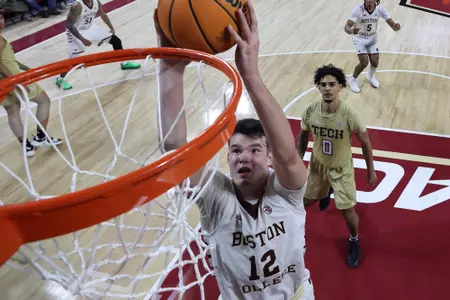
Photo by: John Quackenbos
Thursday Three-Pointer: Week VI
January 13, 2022 | Men's Basketball, #ForBoston Files
Foundational pieces were set despite the two setbacks against Pitt and Georgia Tech
CHESTNUT HILL, Mass. -- Reaching the halfway point of a season forces college basketball teams to reassess their positions relative to the rest of their conference. The top-ranked teams are jockeying for seeding regardless of their league affiliation, but some of those early season bubbles built by strong starts start to pop as late season Cinderella runs force difficult conversations. The mid-major bids take their own shape, and the strong basketball leagues, including those with teams that struggled through their first half of the year, start regaining ground lost in those early-season defeats.
The resumes and visions are geared towards March, and every team, even those who don't audibly appear to harbor postseason dreams, understand what it means to play through big wins and tough losses. Every game impacts every team differently, but over the past week, Boston College continued down the road of Earl Grant's initial framework season and the future of the Eagles came into a little bit of clearer vision after losses to both Pittsburgh and Georgia Tech.
Both of those games represented something altogether different to the Boston College storyboard. With Pitt, the pregame hype machine emphasized the Eagles' opportunity to end a road losing streak dating back a dozen games, a fact that underscored and possibly understated the difficulty of actually beating the Panthers. The back-and-forth affair defined a game of runs, and while BC lost by two, it managed to show what could happen if given an opportunity to excel for swaths of an ACC-level basketball game.
"The biggest thing was our execution," Grant said after the Pitt game. "With the possessions we had, I would imagine it was around a 65-possession game, and we valued the ball and took care of it. We got good shots on around 85 percent of our possessions. But there was always a patch of possessions where guys were staring down a charge and we ran him over, or we'd take a shot with 12 or 15 seconds on the clock where we could work for something better. We did that a handful of times."
It was, in many ways, a bounceback from the North Carolina game even if the result said something different. The message was well received heading into the Georgia Tech game because the Yellow Jackets were an altogether different opponent. The defending ACC Champions have earned a level of swagger, but the losses of both Jose Alvarado and Moses Wright built gaps in the roster for head coach Josh Pastner.
"I thought throughout the [Pitt] game that we did a great job of playing at our pace," Grant said. "There's been some growth but not enough growth to win, so we have to keep trying to get better and keep trying to build on what happened [in the game]. We have to find ways to keep guys encouraged to move in the right direction."
While Georgia Tech wasn't the same program as last year's trophy-hoisting crew, but it also wasn't a roster blown apart by complacency or ego. The pieces were still there, along with the head coach responsible for constructing a conference champion.
In the end, Georgia Tech came back from down four with 3:35 to play for the win.. The Eagles again overcame some odds to get into a tight endgame situation. Like the Pitt game, it didn't break their way, but continually getting into those one or two-possession games will eventually pay off with dividends in the future, even as the present stock losses forced the team further down the ACC standings.
"Obviously there are certain things you have to do to finish the game," Grant said after Georgia Tech, "but we'll go back and watch the film. We did a great job getting back into position to win the game with maybe two minutes to go, so me and my staff have to be able to help them in that situation. We've had these situations in the last two games, but it was deja vu in both games. Guys want to do it, and we're trying to do it, but things just haven't bounced our way yet."
With those two games now in the books, here's the look forward for BC with observations of the weekly lookback:
1) Steely Gaze
BC entered last Saturday's game against Pitt having last won a road game on February 8, 2020. That win, a 77-73 overtime decision over Virginia Tech, is nearly two years old and spans multiple seasons, but it's worth contextualizing what exactly that means in the current climate.
The Eagles only played seven true road games last year during a season under the COVID-19 curtain. Games mashed together on the schedule, and two of those seven games came at opposite ends of a 10-day span. They were against Duke and Notre Dame, which aren't exactly geographical neighbors, and a month-long pause ensued after the game in South Bend. That in and of itself killed any momentum gained from the win over Miami, and by the time the season resumed, BC couldn't get out of first gear. It closed the season with two more road games in Florida and lost to both Florida State and Miami before ending its exhaustive season in the ACC Tournament.
The 2021-22 season, meanwhile, opened with two true road games before Saturday's game at the Petersen Events Center, and of that duo, the game at Rhode Island required a bus, not a flight. The sole plane trip was back in early December, when the Eagles traveled to Saint Louis.
As for Pitt itself, BC hadn't played at the Pete since January 22, 2020 when it lost by two, and the Eagles played five true road games over the course of the rest of that 2019-2020 season. They played back-to-back games on the road once, a stretch that ironically started with the win over Virginia Tech, and finished the year with four of six games in Conte Forum.
The Panthers, meanwhile, established a pretty good home court rapport by winning 18 games over the past two years. Eleven of their 16 victories in 2019-2020 happened at the Pete, and in 2018-2019, the last year of a normal season and postseason, Pitt lost every game on the road but still won 14 games by going 11-7 at home.
All of this sounds like excuse-making, but it's not. BC certainly had its opportunities to win that game and couldn't close the deal. The offense had the ball with time winding down and couldn't, as a unit, tie for overtime or win at the buzzer. Understanding the context, though, explains how this team doesn't quite know how to do that yet, and as Grant talked about, the room for growth means this is a necessary experience that eventually will teach these players and this culture how to correct that - either later this year or into the future.
"At the end of the day, it was a one-possession game and we had a shot to win it," Grant said. "Our guys executed to put us in position. We were down six with four minutes to go, and we executed and took care of the ball, got good shots and put ourselves in position to have the ball with a chance to tie it. So there was growth, but we have to learn how to win and to learn how to win on the road."
2) "I liked the fight."
Both games this week broke in a way that ended with BC losing, but nobody can take away the team's burning desire to break through that glass ceiling. In both instances against Pitt and Georgia Tech, the Eagles fought back to play for a win, and missing the opportunity to celebrate in the locker room overshadowed the effort that brought them into that position in the first place.
"I really liked the fight to get back into it," Grant said after Georgia Tech. "I didn't like the fact that we came out and had turnovers [to start the second half]. We were down 12, and they had eight points off turnovers. So when we clean that up and don't turn the ball over, they have a hard time scoring. But then we played with passion over the next five minutes and took care of the ball and [the score] went right back from 12 to six."
Basketball's a game of runs, but it felt like Georgia Tech dictated the game flow by employing a four-guard style built around creating a run from outside. Tristan Maxwell went 7-for-11 from the perimeter and Deebo Coleman scored 11 points by going 3-for-6 on 3-pointers. Just under half of Georgia Tech's field goal attempts came from beyond the arc, and about a third of those buckets that went in counted for an extra point, building the five-point advantage that counteracted the near double-double by Quinten Post against the unicorn, 1-3-1 defensive zone.
"[The 1-3-1] is pretty unique," Grant said. "We knew it was coming, and 76 points is the most we've scored all year. So obviously we did a pretty good job of attacking it, but we just turned the ball over too many times. It took us a while to find our rhythm in it, but if I go back, that's almost as many points as we've had in the last two months. So we did a good job against that defense.
"Tristan just comes in and makes seven threes," he explained. "We gave up too many long rebounds, offensive rebounds, but 76 points is enough points to win the game. That's the highest number we've had."
3) You're the One (Three-One).
In 2004, the year before Boston College left the Big East for the ACC, Georgia Tech won 28 games and advanced to the Final Four for the second time in program history and the first time in 14 years. It finished the year as a national finalist after losing to Connecticut in the last game of the tournament and posted one of the best seasons possible behind a roster teeming with future NBA talent. It was a capstone for Paul Hewitt, who arrived four years earlier after a three-year stint at Siena, and signaled a potential shift in the ACC at a time when the conference was undergoing a national overhaul.
Unfortunately for the Yellow Jackets, that season served as a reminder of the difficulty in sustaining success. Within five years, they were the 12th place team in the league, and two years later, after finishing 10th, Hewitt was removed from his position. He had qualified for the tournament in 2010, the year in between those finishes, but the unstoppable slide out of national contention meant the program wouldn't return to any postseason tournament until they were selected for the 2016 National Invitational Tournament. Josh Pastner arrived that offseason, but by the time he took Georgia Tech to the NIT finals in his first year, more than a decade had passed since the program's last trip to March Madness.
Georgia Tech made the NCAA Tournament five times during the 2000s and produced NBA talents like Will Bynum and Chris Bosh, but the program wasn't anywhere near that peak in those first years under Pastner. He needed to rebuild from the component studs, and after four years of stripping the program down, the dividends paid off in a big way with last year's run to the ACC championship.
He recruited both Jose Alvarado and Moses Wright while developing Michael Devoe into a pure shooter, and he hit on the transfer market by bringing in complementary contributors who had multiple years of eligibility. Those pieces - James Banks III, Bubba Parham and Kyle Sturdivant - all offered something to those bigger pieces, and they all had roles in both stabilizing and building the Georgia Tech banner winners.
How Pastner built that blueprint is remarkably similar to what Earl Grant is trying to accomplish at Boston College. He brought Brevin Galloway to Boston College to help establish his culture while the other transfers - Quinten Post, TJ Bickerstaff, Jaeden Zackery - all either carried multiple years of eligibility or, in Zackery's case, could enroll as a freshman.
Over time, that foundation will set the new expectations while further developing into the right pieces that Grant will build. Given the personnel that both transferred out and in, he's essentially stripping this program down to its studs while identifying the way he wants to build for the future. None of that is a knock against anyone who played before his time, but it does offer at least a window into the mindset of a coach and a sleeping, rebuilding power.
"We just came together five months ago," Grant said, "and right now, we're making mistakes. So we have to continue to help them mature and understand how to deal with these situations and how to figure out how to be tough enough, smart enough, wise enough and mature enough to win the game. I'm really proud of our effort, but right now, we're just coming up short."
Layup Line: Bracketology Season Begins
The first of the year truly changes the conversation in college basketball. Those marquee matchups from the non-conference or multi-team event tournaments are well in the past, and the bulk of the year, the real meat of the schedule, is firing on all cylinders with conference games.
Each game feels like a live-or-die situation, and I tuned into a couple of games this week that offered some really awesome competition at a league level. The UConn-Seton Hall game last weekend was electric from start to finish, and the raw emotion after the game made it feel like a postseason game. The Wisconsin-Maryland game on Sunday felt similar, especially in the second half when the Terrapins effectively played like they were fighting for their Big Ten lives.
Even the down ballot games showed what happens when teams know way too much about their opponents. Fairfield lost to Siena, 69-62, on Sunday but led Iona by six at halftime before the Gaels mounted a second half comeback. In the A-Sun, North Alabama beat Eastern Kentucky by one after neither team figured out how to pull away from the other.
The highlights, though, came from the power conferences and the drama that's offered when two highly-ranked teams take the fight to one another. In the Big 12, No. 1 Baylor lost for the first time this season when it couldn't hit a buzzer-beating, game-tying shot against No. 19 Texas Tech, and No. 9 Kansas dueled No. 15 Iowa State to a 62-61 final. In the SEC, No. 4 Auburn parried No. 24 Alabama behind Jabari Smith's 25 points and seven rebounds.
These games felt like March-style basketball games, and the sense of urgency on the court reflected the risers and fallers of the most recent bracketology updates. It's still early, and it's important to remember that there's a ton of basketball remaining. Anything's still possible, even for teams that look like they're totally out of the running, and over the next six or seven weeks, we're going to learn a lot more than we already knew.
The resumes and visions are geared towards March, and every team, even those who don't audibly appear to harbor postseason dreams, understand what it means to play through big wins and tough losses. Every game impacts every team differently, but over the past week, Boston College continued down the road of Earl Grant's initial framework season and the future of the Eagles came into a little bit of clearer vision after losses to both Pittsburgh and Georgia Tech.
Both of those games represented something altogether different to the Boston College storyboard. With Pitt, the pregame hype machine emphasized the Eagles' opportunity to end a road losing streak dating back a dozen games, a fact that underscored and possibly understated the difficulty of actually beating the Panthers. The back-and-forth affair defined a game of runs, and while BC lost by two, it managed to show what could happen if given an opportunity to excel for swaths of an ACC-level basketball game.
"The biggest thing was our execution," Grant said after the Pitt game. "With the possessions we had, I would imagine it was around a 65-possession game, and we valued the ball and took care of it. We got good shots on around 85 percent of our possessions. But there was always a patch of possessions where guys were staring down a charge and we ran him over, or we'd take a shot with 12 or 15 seconds on the clock where we could work for something better. We did that a handful of times."
It was, in many ways, a bounceback from the North Carolina game even if the result said something different. The message was well received heading into the Georgia Tech game because the Yellow Jackets were an altogether different opponent. The defending ACC Champions have earned a level of swagger, but the losses of both Jose Alvarado and Moses Wright built gaps in the roster for head coach Josh Pastner.
"I thought throughout the [Pitt] game that we did a great job of playing at our pace," Grant said. "There's been some growth but not enough growth to win, so we have to keep trying to get better and keep trying to build on what happened [in the game]. We have to find ways to keep guys encouraged to move in the right direction."
While Georgia Tech wasn't the same program as last year's trophy-hoisting crew, but it also wasn't a roster blown apart by complacency or ego. The pieces were still there, along with the head coach responsible for constructing a conference champion.
In the end, Georgia Tech came back from down four with 3:35 to play for the win.. The Eagles again overcame some odds to get into a tight endgame situation. Like the Pitt game, it didn't break their way, but continually getting into those one or two-possession games will eventually pay off with dividends in the future, even as the present stock losses forced the team further down the ACC standings.
"Obviously there are certain things you have to do to finish the game," Grant said after Georgia Tech, "but we'll go back and watch the film. We did a great job getting back into position to win the game with maybe two minutes to go, so me and my staff have to be able to help them in that situation. We've had these situations in the last two games, but it was deja vu in both games. Guys want to do it, and we're trying to do it, but things just haven't bounced our way yet."
With those two games now in the books, here's the look forward for BC with observations of the weekly lookback:
1) Steely Gaze
BC entered last Saturday's game against Pitt having last won a road game on February 8, 2020. That win, a 77-73 overtime decision over Virginia Tech, is nearly two years old and spans multiple seasons, but it's worth contextualizing what exactly that means in the current climate.
The Eagles only played seven true road games last year during a season under the COVID-19 curtain. Games mashed together on the schedule, and two of those seven games came at opposite ends of a 10-day span. They were against Duke and Notre Dame, which aren't exactly geographical neighbors, and a month-long pause ensued after the game in South Bend. That in and of itself killed any momentum gained from the win over Miami, and by the time the season resumed, BC couldn't get out of first gear. It closed the season with two more road games in Florida and lost to both Florida State and Miami before ending its exhaustive season in the ACC Tournament.
The 2021-22 season, meanwhile, opened with two true road games before Saturday's game at the Petersen Events Center, and of that duo, the game at Rhode Island required a bus, not a flight. The sole plane trip was back in early December, when the Eagles traveled to Saint Louis.
As for Pitt itself, BC hadn't played at the Pete since January 22, 2020 when it lost by two, and the Eagles played five true road games over the course of the rest of that 2019-2020 season. They played back-to-back games on the road once, a stretch that ironically started with the win over Virginia Tech, and finished the year with four of six games in Conte Forum.
The Panthers, meanwhile, established a pretty good home court rapport by winning 18 games over the past two years. Eleven of their 16 victories in 2019-2020 happened at the Pete, and in 2018-2019, the last year of a normal season and postseason, Pitt lost every game on the road but still won 14 games by going 11-7 at home.
All of this sounds like excuse-making, but it's not. BC certainly had its opportunities to win that game and couldn't close the deal. The offense had the ball with time winding down and couldn't, as a unit, tie for overtime or win at the buzzer. Understanding the context, though, explains how this team doesn't quite know how to do that yet, and as Grant talked about, the room for growth means this is a necessary experience that eventually will teach these players and this culture how to correct that - either later this year or into the future.
"At the end of the day, it was a one-possession game and we had a shot to win it," Grant said. "Our guys executed to put us in position. We were down six with four minutes to go, and we executed and took care of the ball, got good shots and put ourselves in position to have the ball with a chance to tie it. So there was growth, but we have to learn how to win and to learn how to win on the road."
2) "I liked the fight."
Both games this week broke in a way that ended with BC losing, but nobody can take away the team's burning desire to break through that glass ceiling. In both instances against Pitt and Georgia Tech, the Eagles fought back to play for a win, and missing the opportunity to celebrate in the locker room overshadowed the effort that brought them into that position in the first place.
"I really liked the fight to get back into it," Grant said after Georgia Tech. "I didn't like the fact that we came out and had turnovers [to start the second half]. We were down 12, and they had eight points off turnovers. So when we clean that up and don't turn the ball over, they have a hard time scoring. But then we played with passion over the next five minutes and took care of the ball and [the score] went right back from 12 to six."
Basketball's a game of runs, but it felt like Georgia Tech dictated the game flow by employing a four-guard style built around creating a run from outside. Tristan Maxwell went 7-for-11 from the perimeter and Deebo Coleman scored 11 points by going 3-for-6 on 3-pointers. Just under half of Georgia Tech's field goal attempts came from beyond the arc, and about a third of those buckets that went in counted for an extra point, building the five-point advantage that counteracted the near double-double by Quinten Post against the unicorn, 1-3-1 defensive zone.
"[The 1-3-1] is pretty unique," Grant said. "We knew it was coming, and 76 points is the most we've scored all year. So obviously we did a pretty good job of attacking it, but we just turned the ball over too many times. It took us a while to find our rhythm in it, but if I go back, that's almost as many points as we've had in the last two months. So we did a good job against that defense.
"Tristan just comes in and makes seven threes," he explained. "We gave up too many long rebounds, offensive rebounds, but 76 points is enough points to win the game. That's the highest number we've had."
3) You're the One (Three-One).
In 2004, the year before Boston College left the Big East for the ACC, Georgia Tech won 28 games and advanced to the Final Four for the second time in program history and the first time in 14 years. It finished the year as a national finalist after losing to Connecticut in the last game of the tournament and posted one of the best seasons possible behind a roster teeming with future NBA talent. It was a capstone for Paul Hewitt, who arrived four years earlier after a three-year stint at Siena, and signaled a potential shift in the ACC at a time when the conference was undergoing a national overhaul.
Unfortunately for the Yellow Jackets, that season served as a reminder of the difficulty in sustaining success. Within five years, they were the 12th place team in the league, and two years later, after finishing 10th, Hewitt was removed from his position. He had qualified for the tournament in 2010, the year in between those finishes, but the unstoppable slide out of national contention meant the program wouldn't return to any postseason tournament until they were selected for the 2016 National Invitational Tournament. Josh Pastner arrived that offseason, but by the time he took Georgia Tech to the NIT finals in his first year, more than a decade had passed since the program's last trip to March Madness.
Georgia Tech made the NCAA Tournament five times during the 2000s and produced NBA talents like Will Bynum and Chris Bosh, but the program wasn't anywhere near that peak in those first years under Pastner. He needed to rebuild from the component studs, and after four years of stripping the program down, the dividends paid off in a big way with last year's run to the ACC championship.
He recruited both Jose Alvarado and Moses Wright while developing Michael Devoe into a pure shooter, and he hit on the transfer market by bringing in complementary contributors who had multiple years of eligibility. Those pieces - James Banks III, Bubba Parham and Kyle Sturdivant - all offered something to those bigger pieces, and they all had roles in both stabilizing and building the Georgia Tech banner winners.
How Pastner built that blueprint is remarkably similar to what Earl Grant is trying to accomplish at Boston College. He brought Brevin Galloway to Boston College to help establish his culture while the other transfers - Quinten Post, TJ Bickerstaff, Jaeden Zackery - all either carried multiple years of eligibility or, in Zackery's case, could enroll as a freshman.
Over time, that foundation will set the new expectations while further developing into the right pieces that Grant will build. Given the personnel that both transferred out and in, he's essentially stripping this program down to its studs while identifying the way he wants to build for the future. None of that is a knock against anyone who played before his time, but it does offer at least a window into the mindset of a coach and a sleeping, rebuilding power.
"We just came together five months ago," Grant said, "and right now, we're making mistakes. So we have to continue to help them mature and understand how to deal with these situations and how to figure out how to be tough enough, smart enough, wise enough and mature enough to win the game. I'm really proud of our effort, but right now, we're just coming up short."
Layup Line: Bracketology Season Begins
The first of the year truly changes the conversation in college basketball. Those marquee matchups from the non-conference or multi-team event tournaments are well in the past, and the bulk of the year, the real meat of the schedule, is firing on all cylinders with conference games.
Each game feels like a live-or-die situation, and I tuned into a couple of games this week that offered some really awesome competition at a league level. The UConn-Seton Hall game last weekend was electric from start to finish, and the raw emotion after the game made it feel like a postseason game. The Wisconsin-Maryland game on Sunday felt similar, especially in the second half when the Terrapins effectively played like they were fighting for their Big Ten lives.
Even the down ballot games showed what happens when teams know way too much about their opponents. Fairfield lost to Siena, 69-62, on Sunday but led Iona by six at halftime before the Gaels mounted a second half comeback. In the A-Sun, North Alabama beat Eastern Kentucky by one after neither team figured out how to pull away from the other.
The highlights, though, came from the power conferences and the drama that's offered when two highly-ranked teams take the fight to one another. In the Big 12, No. 1 Baylor lost for the first time this season when it couldn't hit a buzzer-beating, game-tying shot against No. 19 Texas Tech, and No. 9 Kansas dueled No. 15 Iowa State to a 62-61 final. In the SEC, No. 4 Auburn parried No. 24 Alabama behind Jabari Smith's 25 points and seven rebounds.
These games felt like March-style basketball games, and the sense of urgency on the court reflected the risers and fallers of the most recent bracketology updates. It's still early, and it's important to remember that there's a ton of basketball remaining. Anything's still possible, even for teams that look like they're totally out of the running, and over the next six or seven weeks, we're going to learn a lot more than we already knew.


Players Mentioned



Saturday, October 03
Saturday, October 03
Thursday, October 01
Thursday, October 01