Boston College Athletics
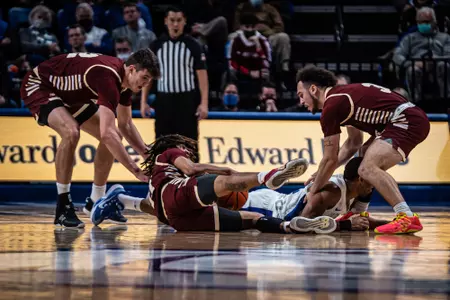
Photo by: Joe Sullivan
Thursday Three-Pointer: Week 5
December 16, 2021 | Men's Basketball, #ForBoston Files
BC lost twice, but the focus remains on building consistency for the positives
CHESTNUT HILL, Mass. -- Last weekend's matchup between Boston College and Saint Louis offered the perfect look into the cross-section of college basketball. The pregame hype was as obvious as its base components. A very good Atlantic 10 team drew an ACC team at home, but the respect owed to a team out of a perceived power conference couldn't overcome the resume of a very good basketball program.
Searching for the truth led directly to the middle ground between the two teams, but it likely didn't mean much after one team played better than the other on that particular day. Saint Louis shot better, especially from the outside, and had more assists, and the Billikens controlled the tempo by limiting Boston College's opportunities. The Eagles played into that for the better part of the first half, and after allowing a season-high 79 points, they made a mad dash comeback in the closing minutes that fell short in an 11-point loss.
"They pressured us into settling for some of our shots. We wanted to go inside, but we took too many threes in the first half with 14 or 15 seconds left on the [shot] clock," head coach Earl Grant said, "We needed to be more disciplined to work for a better shot, and I thought we got better in the second half about turning down a good shot for a great shot or an okay shot for a good shot."
Playing on the road wasn't an excuse, but it did offer a brief window into how the Billikens used the opening minutes to overwhelm the Eagles. BC was 8-for-27 shooting in the first half and never truly got on track, and with only one three-point field goal from outside, a lack of inside drive prevented free throws from ever mounting. Subsequently rushing the shots from around the arc meant shot selection wasn't as good, and the Billikens, firmly in control of the game's pace, finished 15-for-28 with six shots from beyond the arc.
That first half built a 17-point lead, and BC was left to play catchup over the rest of the game. The Eagles settled down to an extent, but the split observation defined the need for consistency, especially in a game away from Conte Forum. It was the kind of adversarial game Grant advised against during the team's early successes, but it felt necessary given its litmus test against a slightly better opponent.
"We had a lot more assists and shared the ball [in the second half]," Grant said. "That first half was just uncharacteristic, and we didn't play well enough in the first half. In those first eight minutes on the road, you have to be really good against a team trying to throw a punch. They were trying to go on a run, and they did."
Then came the Albany game two days later and an unexpected loss in a game that defined the adversity Grant continually stressed. The Great Danes looked and played like a very good basketball team, and BC, playing a team with the inverted style of the Billikens, suffered another slow start and dropped its second straight game.
"I give Albany credit," Grant said after Monday's stinging loss. "They did a great job, made some tough shots and played extremely hard. De'Vondre Perry was really, really good."
The results didn't break BC's way, but they produced the unintended realization of Grant's statements about the Eagles' future climb. They defined the recency bias associated with the highs and lows of the season and served a reminder not to get too high after wins or too low after defeats. They weren't easy to slice or accept, but how the Eagles soldier forward and learn from them is more important than how they happened. That goes for both the wins and the losses and now stands as the critical lesson during the final exam week break.
Here are the observations from a tough week in Chestnut Hill:
1) The games
Digesting multiple losses isn't an easy task for any game, but suffering back-to-back defeats over a three-day span stung particularly hard on the Boston College basketball front. The Albany game, in particular, hurt after the Great Danes built a nine-point lead at the half and consistently shot better numbers over both periods. Whatever shots missed were compensated by 3-pointers, and they largely avoided foul trouble save for Jamel Horton fouling out.
Perry shot 7-for-11, but Matt Cerruti fired from outside early to balance his production with 14 points built from four threes. Paul Newman, meanwhile, hustled the interior and recorded seven points and seven rebounds in 17 minutes off the bench as Albany complemented those two and prevented the Eagles from adding steals.
"A big key to the game was to not let [Cerruti] get going from three," Grant said, "and he made some threes early that gave them some confidence. He got away from us, so we didn't do a good job, and Perry is a good player. He had hurt, really hurt us, with some crucial baskets from 15 feet, but then we didn't get any rhythm and flow early. I thought we were driving to make plays at the rim, but there was a lot of traffic, so we didn't make the right decision to kick out for assists."
Never really finding an answer wounded BC, and even with three starters playing almost the full 40 minutes, the Eagles didn't make their run until the latter stages of the second half. Individually, the numbers were there, but the upped totals from Jaeden Zackery and Quinton Post, along with a lack of fouls committed on both ends of the floor, didn't resolve the game situation.
It was the type of game that could explode an analytics crowd built around comparing head-to-head numbers, and it summarily played into the notion that any team can win on any given night. Those analytics remove that emotion to offer explanations for performances, but they also exist on pure hypotheticals that exist only when a team pulls another team up through the poll.
Those polls ultimately offer the right regressions to the mean over the course of a whole season, but one game against one team, a good night versus a bad night, is weighted on the same plane as every other game. Without the future results, it's possible one team reeled by two losses, drops 10-20 spots and produces an uneven prediction for the next game.
Don't get me wrong; analytics are incredibly important, and I reference those polls as much as anyone else. I do think they need context, though, and I think it's more important for BC to identify the positives moving forward. The negatives have their impact, but developing consistency is more than just a one-game weighted average. It's a process, and it's important to let things progress while focusing and building on the positives.
2) Well okay, Dan, tell me what you're thinking.
Let's start by going back to the Saint Louis game. The Billikens led by 21 with four minutes remaining in the second half after Francis Okoro hit for an old-fashioned three-point play, and it was the third time over a ten-minute span that the lead cracked the 20-point barrier. By most accounts and based on the analytics of the previous 36 minutes, BC would never have come back.
By the end of the game, though, the Eagles whittled the lead down to seven points. They didn't do anything earth-shatteringly different, but they reinforced their style of play against a team that was giving them opportunities. BC didn't go bombs away from outside, and the offense bore down to create fastbreak opportunities. Jaeden Zackery started dishing out assists as SLU fell back in transition, and the stiff, complementary basketball built by strong defense simply wore down the Billikens as opportunities pounded the inside areas.
The defense needed to stop the outside shot earlier, but Grant explained how that could be done in the games moving forward. "You just have to keep contesting hard, making sure to do what you can do to control or help [your opponent] miss," he said. "[Gibson Jemison] may have had five threes, but he took 13. We took a lot, but they had some other guys who knocked down a few shots. We contested a lot of them, but we just had to contest harder."
BC's direction and definition stands within that approach. Albany got hot early, and the Eagles admittedly lost track of Cerruti on the outside shot. As a result, they wound up chasing the Great Danes, and they didn't regain momentum until they clamped down on both ends of the court. Once that happened, the entire perception of the game - in those exact spurts - swung into what BC already knew about the need to enforce its style of play more consistently.
3) Tomorrow, tomorrow, I love ya, tomorrow. You're only a … week … away.
The schedule surrounding BC's final exam break was a little weird, but those two games occurred within three days of one another both before and after long waits to get back on the court. The Notre Dame, for example, was eight days before the trip to Saint Louis, while the Albany game preceded the current, nine-day break leading up to the Wake Forest game next week.
By the time BC reaches the Wake game, the headlines will talk about old news, but that just means the effects won't linger. The glow and spotlight will exist, but fading it into the background with time is exactly what happened after the Notre Dame game. That's more than enough time to work on corrections without rushing preparations with equal opportunity to develop the consistency needed over the full 40 minutes.
"Anything can happen in this game," Grant said after the Albany loss, "so you have to be prepared. For us, we don't have a huge margin for error. We have to be really mentally locked-in and ready to go. I thought it took us a while to get going, and that's why we were down nine [in the first half]. The second half, we made a good push, but we let them hang around."
The recency of results offer a good amount of inflection, so it'll be interesting to see what happens when the Eagles travel to Winston-Salem next Wednesday. The Demon Deacons will be coming off their own five day break after their game against Charlotte on Friday, and they struggled to distance themselves from VMI on Tuesday. The wins over Northwestern and Virginia Tech help, but the full scope of their season is hard to analyze because they are the lowest-rated, 10-win team in the KenPom rankings and are slotted only seven spots higher than a Syracuse team that's been forced to battle VCU, Arizona State, Auburn, Indiana, Villanova and Georgetown in its non-conference schedule.
Layup Line: Saturday Showdowns
The end of college football season always transitions nicely into college basketball season, and this week marks the first time a full day on the hardwoods runs unimpeded by its gridiron counterpart. It's going to be pretty nice, then, that the schedule carries as much electricity as it does for a full day of watching games.
It starts right off the bat with Butler's intracity game against No. 3 Purdue at noon in the Crossroads Classic in Indianapolis. That game precedes the Indiana-Notre Dame game but also tips off an hour before No. 5 Gonzaga plays No. 25 Texas Tech in the Jerry Colangelo Classic in Phoenix. A few hours north and two hours after tip-off, No. 4 UCLA plays North Carolina in the CBS Sports Classic at T-Mobile Arena in Las Vegas. The second game of the Colangelo Classic also features an ACC team when Georgia Tech plays No. 10 USC, while the second game in Las Vegas features No. 15 Ohio State and No. 21 Kentucky.
In the Big East, two conference games tip off in the early evening hours when Marquette visits Xavier and Providence heads to UConn. Later on, Stephen F. Austin - a team I really like - is at No. 7 Kansas while No. 13 Auburn heads to Saint Louis. Newly-minted No. 1 and defending national champion Baylor is in the 10 p.m. spot against Oregon.
Searching for the truth led directly to the middle ground between the two teams, but it likely didn't mean much after one team played better than the other on that particular day. Saint Louis shot better, especially from the outside, and had more assists, and the Billikens controlled the tempo by limiting Boston College's opportunities. The Eagles played into that for the better part of the first half, and after allowing a season-high 79 points, they made a mad dash comeback in the closing minutes that fell short in an 11-point loss.
"They pressured us into settling for some of our shots. We wanted to go inside, but we took too many threes in the first half with 14 or 15 seconds left on the [shot] clock," head coach Earl Grant said, "We needed to be more disciplined to work for a better shot, and I thought we got better in the second half about turning down a good shot for a great shot or an okay shot for a good shot."
Playing on the road wasn't an excuse, but it did offer a brief window into how the Billikens used the opening minutes to overwhelm the Eagles. BC was 8-for-27 shooting in the first half and never truly got on track, and with only one three-point field goal from outside, a lack of inside drive prevented free throws from ever mounting. Subsequently rushing the shots from around the arc meant shot selection wasn't as good, and the Billikens, firmly in control of the game's pace, finished 15-for-28 with six shots from beyond the arc.
That first half built a 17-point lead, and BC was left to play catchup over the rest of the game. The Eagles settled down to an extent, but the split observation defined the need for consistency, especially in a game away from Conte Forum. It was the kind of adversarial game Grant advised against during the team's early successes, but it felt necessary given its litmus test against a slightly better opponent.
"We had a lot more assists and shared the ball [in the second half]," Grant said. "That first half was just uncharacteristic, and we didn't play well enough in the first half. In those first eight minutes on the road, you have to be really good against a team trying to throw a punch. They were trying to go on a run, and they did."
Then came the Albany game two days later and an unexpected loss in a game that defined the adversity Grant continually stressed. The Great Danes looked and played like a very good basketball team, and BC, playing a team with the inverted style of the Billikens, suffered another slow start and dropped its second straight game.
"I give Albany credit," Grant said after Monday's stinging loss. "They did a great job, made some tough shots and played extremely hard. De'Vondre Perry was really, really good."
The results didn't break BC's way, but they produced the unintended realization of Grant's statements about the Eagles' future climb. They defined the recency bias associated with the highs and lows of the season and served a reminder not to get too high after wins or too low after defeats. They weren't easy to slice or accept, but how the Eagles soldier forward and learn from them is more important than how they happened. That goes for both the wins and the losses and now stands as the critical lesson during the final exam week break.
Here are the observations from a tough week in Chestnut Hill:
1) The games
Digesting multiple losses isn't an easy task for any game, but suffering back-to-back defeats over a three-day span stung particularly hard on the Boston College basketball front. The Albany game, in particular, hurt after the Great Danes built a nine-point lead at the half and consistently shot better numbers over both periods. Whatever shots missed were compensated by 3-pointers, and they largely avoided foul trouble save for Jamel Horton fouling out.
Perry shot 7-for-11, but Matt Cerruti fired from outside early to balance his production with 14 points built from four threes. Paul Newman, meanwhile, hustled the interior and recorded seven points and seven rebounds in 17 minutes off the bench as Albany complemented those two and prevented the Eagles from adding steals.
"A big key to the game was to not let [Cerruti] get going from three," Grant said, "and he made some threes early that gave them some confidence. He got away from us, so we didn't do a good job, and Perry is a good player. He had hurt, really hurt us, with some crucial baskets from 15 feet, but then we didn't get any rhythm and flow early. I thought we were driving to make plays at the rim, but there was a lot of traffic, so we didn't make the right decision to kick out for assists."
Never really finding an answer wounded BC, and even with three starters playing almost the full 40 minutes, the Eagles didn't make their run until the latter stages of the second half. Individually, the numbers were there, but the upped totals from Jaeden Zackery and Quinton Post, along with a lack of fouls committed on both ends of the floor, didn't resolve the game situation.
It was the type of game that could explode an analytics crowd built around comparing head-to-head numbers, and it summarily played into the notion that any team can win on any given night. Those analytics remove that emotion to offer explanations for performances, but they also exist on pure hypotheticals that exist only when a team pulls another team up through the poll.
Those polls ultimately offer the right regressions to the mean over the course of a whole season, but one game against one team, a good night versus a bad night, is weighted on the same plane as every other game. Without the future results, it's possible one team reeled by two losses, drops 10-20 spots and produces an uneven prediction for the next game.
Don't get me wrong; analytics are incredibly important, and I reference those polls as much as anyone else. I do think they need context, though, and I think it's more important for BC to identify the positives moving forward. The negatives have their impact, but developing consistency is more than just a one-game weighted average. It's a process, and it's important to let things progress while focusing and building on the positives.
2) Well okay, Dan, tell me what you're thinking.
Let's start by going back to the Saint Louis game. The Billikens led by 21 with four minutes remaining in the second half after Francis Okoro hit for an old-fashioned three-point play, and it was the third time over a ten-minute span that the lead cracked the 20-point barrier. By most accounts and based on the analytics of the previous 36 minutes, BC would never have come back.
By the end of the game, though, the Eagles whittled the lead down to seven points. They didn't do anything earth-shatteringly different, but they reinforced their style of play against a team that was giving them opportunities. BC didn't go bombs away from outside, and the offense bore down to create fastbreak opportunities. Jaeden Zackery started dishing out assists as SLU fell back in transition, and the stiff, complementary basketball built by strong defense simply wore down the Billikens as opportunities pounded the inside areas.
The defense needed to stop the outside shot earlier, but Grant explained how that could be done in the games moving forward. "You just have to keep contesting hard, making sure to do what you can do to control or help [your opponent] miss," he said. "[Gibson Jemison] may have had five threes, but he took 13. We took a lot, but they had some other guys who knocked down a few shots. We contested a lot of them, but we just had to contest harder."
BC's direction and definition stands within that approach. Albany got hot early, and the Eagles admittedly lost track of Cerruti on the outside shot. As a result, they wound up chasing the Great Danes, and they didn't regain momentum until they clamped down on both ends of the court. Once that happened, the entire perception of the game - in those exact spurts - swung into what BC already knew about the need to enforce its style of play more consistently.
3) Tomorrow, tomorrow, I love ya, tomorrow. You're only a … week … away.
The schedule surrounding BC's final exam break was a little weird, but those two games occurred within three days of one another both before and after long waits to get back on the court. The Notre Dame, for example, was eight days before the trip to Saint Louis, while the Albany game preceded the current, nine-day break leading up to the Wake Forest game next week.
By the time BC reaches the Wake game, the headlines will talk about old news, but that just means the effects won't linger. The glow and spotlight will exist, but fading it into the background with time is exactly what happened after the Notre Dame game. That's more than enough time to work on corrections without rushing preparations with equal opportunity to develop the consistency needed over the full 40 minutes.
"Anything can happen in this game," Grant said after the Albany loss, "so you have to be prepared. For us, we don't have a huge margin for error. We have to be really mentally locked-in and ready to go. I thought it took us a while to get going, and that's why we were down nine [in the first half]. The second half, we made a good push, but we let them hang around."
The recency of results offer a good amount of inflection, so it'll be interesting to see what happens when the Eagles travel to Winston-Salem next Wednesday. The Demon Deacons will be coming off their own five day break after their game against Charlotte on Friday, and they struggled to distance themselves from VMI on Tuesday. The wins over Northwestern and Virginia Tech help, but the full scope of their season is hard to analyze because they are the lowest-rated, 10-win team in the KenPom rankings and are slotted only seven spots higher than a Syracuse team that's been forced to battle VCU, Arizona State, Auburn, Indiana, Villanova and Georgetown in its non-conference schedule.
Layup Line: Saturday Showdowns
The end of college football season always transitions nicely into college basketball season, and this week marks the first time a full day on the hardwoods runs unimpeded by its gridiron counterpart. It's going to be pretty nice, then, that the schedule carries as much electricity as it does for a full day of watching games.
It starts right off the bat with Butler's intracity game against No. 3 Purdue at noon in the Crossroads Classic in Indianapolis. That game precedes the Indiana-Notre Dame game but also tips off an hour before No. 5 Gonzaga plays No. 25 Texas Tech in the Jerry Colangelo Classic in Phoenix. A few hours north and two hours after tip-off, No. 4 UCLA plays North Carolina in the CBS Sports Classic at T-Mobile Arena in Las Vegas. The second game of the Colangelo Classic also features an ACC team when Georgia Tech plays No. 10 USC, while the second game in Las Vegas features No. 15 Ohio State and No. 21 Kentucky.
In the Big East, two conference games tip off in the early evening hours when Marquette visits Xavier and Providence heads to UConn. Later on, Stephen F. Austin - a team I really like - is at No. 7 Kansas while No. 13 Auburn heads to Saint Louis. Newly-minted No. 1 and defending national champion Baylor is in the 10 p.m. spot against Oregon.
Players Mentioned

G
/ Men's BasketballSunday, October 18
Saturday, October 17
Saturday, October 17
Saturday, October 17