Boston College Athletics
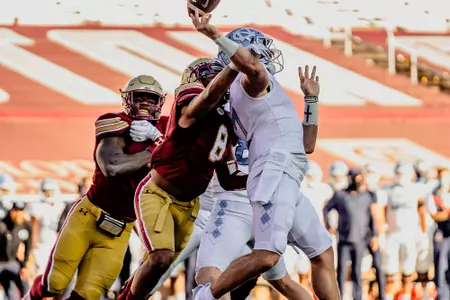
Photo by: Anthony Garro
Beware of Eye Violators!
October 15, 2020 | Football, #ForBoston Files
Nobody wants to see their name on that list on Sunday morning.
The Sunday morning walk into the safeties room filled Jahmin Muse with a few seconds of anxiety. He was less than 24 hours removed from a 31-30 victory, and he once again had a solid game in deep coverage against a pass-first offense. He knew his two tackles helped his cause, but that didn't stop him from replaying mistakes in the back of his mind.
The one thing he really didn't want was to see his name on one of two lists in the room. The first list carried the names of players with missed assignment, a bad enough transgression for any defensive player, but he especially didn't want to grace the second list, labeled "Eye Violators."
"You do not. Take your Eyes. Off. That. Man," Muse emphasized with a smile. "You do not want to come in on Sunday and be known as an eye violator. It's not a good look."
A standard football play only lasts for a few seconds, but its outcome is determined by hundreds of chess matches operating under the surface. Pieces move against one another physically, but knowing and seeing where to go is an intricately-planned, well-thought process. It's built on one part by weight room and strength training and on the other by intelligence and the ability to digest information in nanoseconds.
Winning an individual chess match requires players to outsmart their opponents as much as they overpower each other physically. Eye violators are therefore the definition of a lost focus or drifted vision. It an egregious transgression for any personnel member and one that highlights the underlying discussion and planning by both players and coaches on both sides of the ball on every play.
"Eye discipline is one of the most important things in defensive football," head coach Jeff Hafley said. "Some guys see too much and don't see anything. If they focus, they see so much more. Some guys say, 'See a little, see a lot.' That's so true, even in the NFL. Defensive backs are supposed to cover people, (but) their eyes wander. As soon as (they) sneak a peek inside at the quarterback, that's when (they) get beat."
It's a criticality baked into every play and starts during the design phase of a given week when coaches analyze upcoming matchups. They crunch their own information and construct a defense around variable objectives that shift and remain fluid over each quarter. The circumstances dictate the number of complexities and further vary based upon personnel combinations in a series of proactive measures.
The coaches assign players space or matchups based upon the breakdown but do so through different mentalities. Man coverage, for example, locks players into the individual, but zone coverage shifts areas as plays develop. Combinations and the ability to move from one type to another further builds complexities into the scheme and sows confusion on an opposing offense.
"If we're in man, then I should be looking at you the entire down no matter what," Hafley said. "In zone, if I'm reading the man on the line of scrimmage and I get a pass read, theN I might have to go to the quarterback to transfer my eyes. That gets into my initial key, my second key, and (where I) would have to be disciplined."
It directly leads players to lock sense during games in such a way where their mental acumen drives their individual and collective physicalities. It's crunched in seconds both before and during the play and draws a distinct line between what's considered a vision transfer versus an incorrect body movement.
"We always talk about eyes before feet," Hafley said. "My eyes have to transfer to the target before my feet because if I don't, I'm going to drift and not make a play. Having discipline in breaks means your body is going to follow your eyes."
"You have to keep your eyes clear," Muse said. "That's a thing we harped on this week. We come into practice, and you can't have eye violators. If you have the tight end, keep your eyes on the tight end. If you have the slot, keep your eyes on the slot. Play action shouldn't be too bad, if we keep our eyes clean and run to the ball."
An offense, then, tries to warp the perceptive field on a defender by running its own plays and adjustments. Play design is a role, but the same information is processed in real time on both sides of the ball. A defense is trying to force the offense to see the field in a certain way, but the offense is doing the exact same thing in an invisible tug-of-war between the eyes and minds on both sides of the ball.
"Defenders' eyes tell (you) a lot," quarterback Phil Jurkovec said. "You can see where they're looking and just their predisposition to the receivers. They have to give up something on defense, and they're going to cheat somewhere. They're going to overplay something, and it's going to create gaps and holes. Recognizing eyes and body posture can tell (you) where they're going."
An offense applies nearly the same concepts as a defense's side of the ball and adjusts in the same real time in an attempt to stay one or two steps ahead. Last week, BC won the upper hand over Pitt by introducing minor detail changes to its pass pattern and blocking scheme in order to break explosive plays to Zay Flowers, but there are smaller, less noticeable changes in order to threaten different areas on the opposite side of the ball.
"There are routes where you work leverage because a (defensive back's) eyes aren't right," tight end Hunter Long said. "It'll throw them off. It's a minor thing that you work into your game, but it's something we pay attention to."
"Routes aren't any different from Zay to me," wide receiver CJ Lewis said. "The biggest thing is that Zay might create separation at the line of scrimmage where I create separation at the top. If Zay is creating separation at the top, I'm going to bully someone. It's just a different type of playing style, as opposed to a difference in routes."
From film study to execution, every play is a living, breathing example of the mental and visual chess match. For a winning team or unit, controlling the way the field looks can be a valuable tool. Players will always be bigger or stronger than one another physically, but how that's viewed is created by vision and the growing list of eye violators who hold their breath in the film room on Sunday.
Boston College and No. 23 Virginia Tech will kick off at 8 p.m. on Saturday night from Lane Stadium in Blacksburg, Virginia. The game can be seen on ACC Network with online streaming at WatchESPN.com for cable subscribers with access to the channel. It can be heard on radio via the BC Learfield IMG Sports Network, locally in Boston on WEEI 93.7 FM.
The one thing he really didn't want was to see his name on one of two lists in the room. The first list carried the names of players with missed assignment, a bad enough transgression for any defensive player, but he especially didn't want to grace the second list, labeled "Eye Violators."
"You do not. Take your Eyes. Off. That. Man," Muse emphasized with a smile. "You do not want to come in on Sunday and be known as an eye violator. It's not a good look."
A standard football play only lasts for a few seconds, but its outcome is determined by hundreds of chess matches operating under the surface. Pieces move against one another physically, but knowing and seeing where to go is an intricately-planned, well-thought process. It's built on one part by weight room and strength training and on the other by intelligence and the ability to digest information in nanoseconds.
Winning an individual chess match requires players to outsmart their opponents as much as they overpower each other physically. Eye violators are therefore the definition of a lost focus or drifted vision. It an egregious transgression for any personnel member and one that highlights the underlying discussion and planning by both players and coaches on both sides of the ball on every play.
"Eye discipline is one of the most important things in defensive football," head coach Jeff Hafley said. "Some guys see too much and don't see anything. If they focus, they see so much more. Some guys say, 'See a little, see a lot.' That's so true, even in the NFL. Defensive backs are supposed to cover people, (but) their eyes wander. As soon as (they) sneak a peek inside at the quarterback, that's when (they) get beat."
It's a criticality baked into every play and starts during the design phase of a given week when coaches analyze upcoming matchups. They crunch their own information and construct a defense around variable objectives that shift and remain fluid over each quarter. The circumstances dictate the number of complexities and further vary based upon personnel combinations in a series of proactive measures.
The coaches assign players space or matchups based upon the breakdown but do so through different mentalities. Man coverage, for example, locks players into the individual, but zone coverage shifts areas as plays develop. Combinations and the ability to move from one type to another further builds complexities into the scheme and sows confusion on an opposing offense.
"If we're in man, then I should be looking at you the entire down no matter what," Hafley said. "In zone, if I'm reading the man on the line of scrimmage and I get a pass read, theN I might have to go to the quarterback to transfer my eyes. That gets into my initial key, my second key, and (where I) would have to be disciplined."
It directly leads players to lock sense during games in such a way where their mental acumen drives their individual and collective physicalities. It's crunched in seconds both before and during the play and draws a distinct line between what's considered a vision transfer versus an incorrect body movement.
"We always talk about eyes before feet," Hafley said. "My eyes have to transfer to the target before my feet because if I don't, I'm going to drift and not make a play. Having discipline in breaks means your body is going to follow your eyes."
"You have to keep your eyes clear," Muse said. "That's a thing we harped on this week. We come into practice, and you can't have eye violators. If you have the tight end, keep your eyes on the tight end. If you have the slot, keep your eyes on the slot. Play action shouldn't be too bad, if we keep our eyes clean and run to the ball."
An offense, then, tries to warp the perceptive field on a defender by running its own plays and adjustments. Play design is a role, but the same information is processed in real time on both sides of the ball. A defense is trying to force the offense to see the field in a certain way, but the offense is doing the exact same thing in an invisible tug-of-war between the eyes and minds on both sides of the ball.
"Defenders' eyes tell (you) a lot," quarterback Phil Jurkovec said. "You can see where they're looking and just their predisposition to the receivers. They have to give up something on defense, and they're going to cheat somewhere. They're going to overplay something, and it's going to create gaps and holes. Recognizing eyes and body posture can tell (you) where they're going."
An offense applies nearly the same concepts as a defense's side of the ball and adjusts in the same real time in an attempt to stay one or two steps ahead. Last week, BC won the upper hand over Pitt by introducing minor detail changes to its pass pattern and blocking scheme in order to break explosive plays to Zay Flowers, but there are smaller, less noticeable changes in order to threaten different areas on the opposite side of the ball.
"There are routes where you work leverage because a (defensive back's) eyes aren't right," tight end Hunter Long said. "It'll throw them off. It's a minor thing that you work into your game, but it's something we pay attention to."
"Routes aren't any different from Zay to me," wide receiver CJ Lewis said. "The biggest thing is that Zay might create separation at the line of scrimmage where I create separation at the top. If Zay is creating separation at the top, I'm going to bully someone. It's just a different type of playing style, as opposed to a difference in routes."
From film study to execution, every play is a living, breathing example of the mental and visual chess match. For a winning team or unit, controlling the way the field looks can be a valuable tool. Players will always be bigger or stronger than one another physically, but how that's viewed is created by vision and the growing list of eye violators who hold their breath in the film room on Sunday.
Boston College and No. 23 Virginia Tech will kick off at 8 p.m. on Saturday night from Lane Stadium in Blacksburg, Virginia. The game can be seen on ACC Network with online streaming at WatchESPN.com for cable subscribers with access to the channel. It can be heard on radio via the BC Learfield IMG Sports Network, locally in Boston on WEEI 93.7 FM.
Players Mentioned

WR
/ Football
QB
/ Football

TE
/ Football
DB
/ FootballFrom the Desk of Blake James | Episode 8
Friday, April 24
Baseball: 2026 ALS Game vs Virginia Tech Recap
Tuesday, April 21
No. 24 Baseball Defeats Duke (April 18, 2026) - Game 2
Sunday, April 19
No. 24 Baseball Defeats Duke - April 18, 2026 Game 1
Saturday, April 18