Boston College Athletics
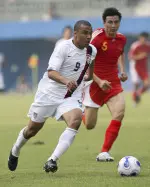
Charlie Davies Shares Soccer Thoughts
July 06, 2009 | Men's Soccer
July 6, 2009
Former Boston College striker Charlie Davies has emerged as a soccer star on the international stage following success with his Swedish Club Hammarby IF and as a member of the U.S. national team that finished as the runner-up (to Brazil) in the 2009 FIFA Confederations Cup in South Africa in late June. The 5-foot-10-inch forward scored Team USA's first goal in a 3-0 victory over Egypt, played a key role in a 2-0 semifinal-round win over world No. 1 Spain and assisted on Landon Donovan's first-half goal in a 3-2 loss to Brazil in the Confederations Cup final. Most recently, Davies scored in Team USA's 4-0 win over Grenada in CONCACAF Gold Cup opener on Saturday, July 4 in Seattle, Wash. The Manchester, N.H., native recently spoke with bceagles.com about his many experiences.
Can you update us on where you've been playing since finishing your career at BC?
I went from Boston College to Hammarby, which is in the Swedish top division. I've been living in Stockholm. I've also played for the (U.S.) national team. I went to the Olympics and I was a part of the Confederations Cup team and now the Gold Cup team.
Tell us a little about Sweden.
I can speak pretty good Swedish. I understand it. I can communicate and get around. Stockholm is a beautiful city and probably the best place that I could've possibly started. I really enjoy it.
Talk about the challenges of playing professionally in Europe.
The biggest challenge, I think, is the everyday aspect of being a professional day in and day out - eating right, which is a big change from college where you're used to late night and cheeseburgers for lunch.
Also, you really have to know how to spend your free time. You can't really be going down and doing the college partying and socializing so much. I go out after training with the guys and have a coffee. Everyone really keeps it professional. Everyone's in training and needs to stay fit and focused.
You really have to come to training every day with the focus to get better and things might not go your way. In college, you can kind of get away with taking trainings off because you're a star player or you think you're a star player. In this atmosphere, no matter if you're the best player or the worst player, you still have to give 110 percent and really bring it every day and try to prove yourself not only to your teammates and the coach, but also to yourself.
Can you describe the excitement and the intensity of the game over there?
In my first season in Hammarby we played small-sided games (4 v 4) and one of the defenders on the team hit me with a two-footed tackle from behind and said "Welcome to the pro life". That's kind of how I was introduced into the team and how trainings are. Everyone's really fighting for playing time, fighting for salary, fighting for contracts so it's definitely a whole new atmosphere when it comes to training.
For the games, the fans are so into it. They eat, sleep and breathe soccer. When I'm in the city, people approach me and ask you how I'm doing. Do you like Sweden? How do you like the team? It really means a lot when all these fans come up to you at all times of the day just to see how you're doing and how you're liking things. I've always welcomed the fans and my club actually has the best fans in Sweden because of their passion and it definitely makes it a better experience when fans want to interact.
Our typical crowds are about 15,000 people and for the Stockholm Derby (with two other Stockholm-based teams) we usually draw 35,000 people.
You're in the limelight at all times. Everyone's focused on you and what you're doing, so you really have to be careful how you act as a person in the public and you have to be aware of your surroundings. It's definitely a whole new lifestyle than it is in the United States.
In the past year, I've learned to be very professional and how to carry myself. I think moving to Sweden was the best thing for me because I could adapt to how things are in Europe at a young age. I'm very different now (than when I was at BC). I'm not so much the kid anymore. I'm much more professional. I'm much more humble than I was. I just look at things in a different way.
NATIONAL TEAM
Talk about the dynamics of the national team - players coming together who play all around the world, players of different ages (Charlie Davies was the fifth youngest player on the 23-member U.S. Confederations Cup team).
The youngest guys are Jozy Altidore and Freddy Adu. They're 19 and 20. The oldest guys are in their early 30s (two players on U.S. team in the Confederations Cup are 30 years old).
When you first get to the national team, you kind of have to figure out how to fit in with the guys and who you want to learn from. You have to get on the right side of guys so they know you're there for business and not just to have a good time. Everyone's all over in Europe and you really don't get a chance to really hang out with the guys. When we do get together it's good to have fun and see everyone, but everyone quickly realizes we're here for business and we want to become the best national team we can become so it's always hard work and hard training when we come together.
For the new guys, it's definitely a challenge. When I first came, it was extremely challenging to mix it up with all the guys who are seasoned pros in Europe or guys like Landon Donovan who's made a name for himself over his career. You really try to fit in and see how you are not only during training but off the field, making sure you're interacting with everyone. I think it's pretty difficult when you first get called up with the national team as opposed to being there a couple of times and getting to know everyone so you know how things are run and how you fit in.
Talk about the experience of playing in the recent FIFA Confederations Cup.
I was extremely excited going into the Confederations Cup knowing that we were in arguably the toughest group in the tournament with Egypt, Italy and Brazil. For me, it was just an honor to be a part of the team. I really didn't think I'd have much of an impact as far as playing time. Fortunately, I was able to get in versus Italy and we were down a man, which was unfortunate, and I wasn't able to get many touches and I didn't think I got a chance to really prove myself. Then, in the Brazil game, I didn't get into the game because we got down a man again and the coach wanted to keep the guys on the field. He felt they were working hard and that they deserved to just keep fighting it out.
We didn't get two results out of the first two games and I thought he (head coach Bob Bradley) was going to make a lot of changes and I ended up being one of the two players that he ended up changing into the group. We got a 3-0 win (against Egypt) and I was able to score and be a big part of the game. To me, that was amazing to finally break through on the national scene with a really good performance where guys like Landon Donovan, the captain Carlos Bocanegra and Clint Dempsey were coming up to me and telling me how good of a job I'd done and how good we played when I was in the line-up and that they can look for me because I have a lot of speed and I can keep defenses on their heels. So I was able to carry that confidence into the Spain game and I went out with the same type of passion and desire and I was able to help my team score on the first goal when I was able to pass it to Clint Dempsey like he passed it to Jozy (Altidore) who scored.
For me it was great to finally break through with the national team, which is something I'd always dreamed of.
And, we made it to the final versus Brazil and who better to play in the final in a FIFA competition than Brazil? I was able to get an assist in that game to Landon (Donovan) who finished off a great chance. We were winning 2-0 at halftime and I had all these thoughts going through my head like "I can't believe we're going to win". Then, for that to be taken away because we were unable to hold onto the lead ... for me, it was a tournament of ups and downs. At the end, I was extremely happy with the progress that I had made, yet it was also a humbling experience because I saw where I was in the world and, with a lot more training, that I can be a big player on the world stage.
Talk about what the team's performance in the Confederations Cup means for US Soccer.
For us as a team it really gives us the perspective of what we can achieve in the 2010 World Cup. Everybody's really excited for the next World Cup qualifiers and then the World Cup. Everybody sees the potential that we have and if we continue to build on the success that we just had in the Confederations Cup, I think we can be a very, very strong team in the World Cup and a team that can make it very far.
For the fans, everyone got the chance to see how fun it is to follow the national team and how exciting is was for us to be playing with the world powers like Spain and Brazil and getting results and just playing well. I think everyone really got into it and for the first time fans really thought "Wow, the soccer team was a lot of fun to watch and see how they progressed on the world stage." I think if we continue to have success that we'll have a big following for the 2010 World Cup, which will make it more exciting. We'll have more of a following for soccer in the United States.
Is there any one teammate (national team) who you are especially close to?
It's funny. Everyone always asks me that on every team I'm on. It just happens to be that there's never one guy that I'm actually really close to. There are three or four guys. Guys that have really taken me under the wings have been Oguchi Onyewu, Clint Dempsey and, recently, Landon Donovan. After the Confederations Cup, Landon has made it a point to really talk to me, give me pointers, let me know what I can do to get better and that I can be very successful on the team and that he likes playing with me. So I took that to heart when he communicated that to me.
When you look back on your days playing here at BC, what are your fondest memories?
My fondest memories at BC were definitely my freshman year when I was able to win Big East Player of the Year and when the team did really well, making the NCAA Tournament and the Sweet 16. We did well as a team that year and it was great to have a season under my belt at the college game. I really enjoyed the atmosphere that I was in, meeting a lot of new people.
My junior season was a big difference where I was the leader. I was guy that everyone looked up to. I think I really established myself in the BC community and made friends with a lot of people from different sports and different countries. I thought that was something very memorable and I'm able to keep in touch with a lot of the people I was friends with.
When I was hurt (2005, his sophomore season), that was probably one of the worst experiences of my life. I learned a lot from that whole experience. It was one of the darkest periods of my life, not being able to play the sport that I love and that got me through things. I had always relied on soccer to focus out all the negatives in my life and really have a good time and have fun. When I was stressed I could always depend on soccer to get my mind off that type of stuff. When I didn't have the soccer, I got a chance to learn about myself. It changed me as a person because I got a new perspective on life and I was able to figure things out on my own without using soccer to get rid of all the negatives.
After I got injured and was out for five months, I didn't really know if I could come back and be the player that I wanted to be and I didn't think I'd be the player that I was. When I was able to play in the game against the New England Revolution in the spring (April 24, 2006), which was my very first game back, I was able to score two goals and play with speed and do a lot of things against an MLS team. I was able to get my confidence back and know that the injury really didn't do anything to me physically.
Do you believe the high level of play in the ACC helped prepare you for your play on the international stage?
Of course. If any student-athlete is going to take the college route, which I highly recommend because you can find yourself as a person and interact socially and have a well-rounded base going into your professional career, then I think Boston College and playing in the ACC was the best thing that could have possibly happened to me because it's the best competition you can have in the college game. I'm (now) constantly playing with players who played in the ACC, who played against me. There are a lot of players who have come out of the ACC that are in MLS. Playing in the ACC was a great experience because it's the best competition. You really get to test yourself on the United States scale of how good you are. If you can do well at Boston College and in the ACC, then you can definitely do well as a professional. It's a very big stepping stone and a path that I'm glad I went down.
What's next for you - with the US team and in Europe?
I have the Gold Cup to focus on, which is a big tournament for me to kind of establish myself as a major force on the national team and a player who needs to be playing for the team to be successful, be the player who really helps the team win games. I think this tournament is where I have to continue to have success to really solidify my spot as a national-team player.
There are a lot of rumors and transfer talk about me actually moving from Sweden to France, which would be a dream for me because the league is a top four league in Europe. I think it'd be the perfect next step for me to continue to develop as a player. Hopefully that would happen in the next month, so after this Gold Cup, I'd be moving to France and starting there.
The next United States match after the Gold Cup is August 12 against Mexico in Mexico City, where the US has never won.
Additional Links
- Goal.com Profile: Davies
- Confederations Cup: Is Davies the US's Secret Weapon, by Greg Lawless for Goal.com
- Winners and ... Winners: US vs. Spain, by Noah Davis for Goal.com