Boston College Athletics
September 24, 2026 | Football, #ForBoston Files
This is far from the first time that rains are coming for a BC home game.
Late September and early October are magical times in Massachusetts. The autumnal equinox turns the corner for a calendar clinging to its final days of summer in favor of a beckoning from the more chilly fall conditions. Sweatshirts and blankets begin making more regular appearances for families venturing into outdoor activities, and more plans are built around warming fires or the indoors.
Leaves are starting to change, and apples are appearing more frequently ripe. The unmistakable sounds of leaf blowers yield the crisp tang of drier air. Heating units are burning through their idle dust. Pumpkin spice everything is, well, everywhere.
It sounds perfect, but New England's overall autumn is set to deliver a harsh reality check to the region when a nor'easter lands over its landscape for the upcoming weekend. The storm typically synonymous with winter blizzards and heavy snow backs has a consensus for its weekend arrival, and its expected lingering is going to impact the season with inches of rain and blustery winds.
Throughout the region, outdoor activities are being pushed more readily indoors, but football is known for its ability to embrace the conditions. Its hardening and special atmosphere possesses a rich history of powering through the elements, and on Saturday, a unique experience awaits Boston College and Virginia Tech that will link the game to a rich New England history unlike any other region in the country.
"We always take the weather into account," said head coach Bill O'Brien. "Playing outdoors, we embrace it. We're going to play in any type of weather or whatever it is. We practice outside as much as we can. The heat, the rain, the snow, that's the weather you have to deal with. So this is what it is. We embrace this stuff."
The textbook definition of a nor'easter storm trends an extratropical cyclone that swirls up the eastern coastline in a north-east direction between North Carolina and New England. They can develop hurricane-force winds by drawing energy from warmer ocean waters, which is why they tend to occur in the winter months when the atmosphere is more frozen in the Northeast. Cold air lowering from Canada at a time when the northeast is typically warmer then rightfully stalls or remains in place until the jet stream can replace it with clearer conditions, and coastal erosion occurs while low-lying areas are more susceptible to flooding waters.
"Bad weather is something you have to deal with," said wide receiver Javarius Green. "If you end up in the NFL, you're going to play in cold places. You're going to play in hot places. You're going to play in rain, all of that stuff. So to adapt is something that you have to pride yourself on, and being able to go out there in the rain, a lot of times you still have to put your best foot forward and hit somebody to help running backs get open, help the quarterback run. The weather's not going to go your way, but nothing's going to go your way in life."
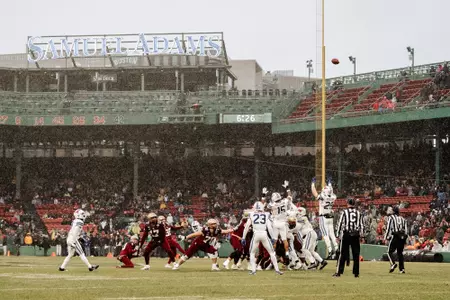
That said, playing through the elements are part of the region's history and are a vivid part of Boston College's experience in a sport that begins during a bright summer's harsh heat before ending in the bitter and dark cold of the Thanksgiving season. The 1986 win over Holy Cross, for example, became infamously known as the "Mud Bowl" after a rapid melting of a snowstorm resulted in Fitton Field's conversion into a thick and primeval mud pack, and a 2023 win at a saturated West Point neatly bookended run-heavy, rain-prepared game plan from the Fenway Bowl victory over SMU.
Not to be outdone, the 1996 game against Notre Dame involved gusting winds and pelting rain akin to a nor'easter, and the 2001 loss to Miami essentially grounded the high-powered Hurricanes under similar conditions. The next year's win over Syracuse turned a cold and raw day into second half snow squalls, and a 2005 win over Wake Forest delivered the program its second ACC victory under nasty conditions. In 2006, a monsoon game dropped nearly three inches of rain on the Buffalo game, conditions that were replicated in 2016 when steady rain created a dreary backdrop for the blowout win that held the Bulls to 67 yards of total offense, while 2007 brought sadness when Florida State marched out of Alumni Stadium in its galoshes during a 27-17 win over No. 2 BC. One game earlier, the Eagles had their rain-soaked comeback over Virginia Tech and exorcised the shutout loss on a rainy night in Chestnut Hill from 1998 which doubled as the event that retired the numbers of both Doug Flutie and Mike Ruth.
"It's definitely going to be different," said linebacker Anthony Palano. "It's not going to be sunny outside [on Saturday]. There's a nor'easter, and that's something we have to embrace. It just brings back a little bit of backyard football [when] it would be raining outside or snow and mud. Obviously, it's on turf [on Saturday], but I think it'll be a good time, and I'm excited for the challenge."
Leaves are starting to change, and apples are appearing more frequently ripe. The unmistakable sounds of leaf blowers yield the crisp tang of drier air. Heating units are burning through their idle dust. Pumpkin spice everything is, well, everywhere.
It sounds perfect, but New England's overall autumn is set to deliver a harsh reality check to the region when a nor'easter lands over its landscape for the upcoming weekend. The storm typically synonymous with winter blizzards and heavy snow backs has a consensus for its weekend arrival, and its expected lingering is going to impact the season with inches of rain and blustery winds.
Throughout the region, outdoor activities are being pushed more readily indoors, but football is known for its ability to embrace the conditions. Its hardening and special atmosphere possesses a rich history of powering through the elements, and on Saturday, a unique experience awaits Boston College and Virginia Tech that will link the game to a rich New England history unlike any other region in the country.
"We always take the weather into account," said head coach Bill O'Brien. "Playing outdoors, we embrace it. We're going to play in any type of weather or whatever it is. We practice outside as much as we can. The heat, the rain, the snow, that's the weather you have to deal with. So this is what it is. We embrace this stuff."
The textbook definition of a nor'easter storm trends an extratropical cyclone that swirls up the eastern coastline in a north-east direction between North Carolina and New England. They can develop hurricane-force winds by drawing energy from warmer ocean waters, which is why they tend to occur in the winter months when the atmosphere is more frozen in the Northeast. Cold air lowering from Canada at a time when the northeast is typically warmer then rightfully stalls or remains in place until the jet stream can replace it with clearer conditions, and coastal erosion occurs while low-lying areas are more susceptible to flooding waters.
"Bad weather is something you have to deal with," said wide receiver Javarius Green. "If you end up in the NFL, you're going to play in cold places. You're going to play in hot places. You're going to play in rain, all of that stuff. So to adapt is something that you have to pride yourself on, and being able to go out there in the rain, a lot of times you still have to put your best foot forward and hit somebody to help running backs get open, help the quarterback run. The weather's not going to go your way, but nothing's going to go your way in life."
That said, playing through the elements are part of the region's history and are a vivid part of Boston College's experience in a sport that begins during a bright summer's harsh heat before ending in the bitter and dark cold of the Thanksgiving season. The 1986 win over Holy Cross, for example, became infamously known as the "Mud Bowl" after a rapid melting of a snowstorm resulted in Fitton Field's conversion into a thick and primeval mud pack, and a 2023 win at a saturated West Point neatly bookended run-heavy, rain-prepared game plan from the Fenway Bowl victory over SMU.
Not to be outdone, the 1996 game against Notre Dame involved gusting winds and pelting rain akin to a nor'easter, and the 2001 loss to Miami essentially grounded the high-powered Hurricanes under similar conditions. The next year's win over Syracuse turned a cold and raw day into second half snow squalls, and a 2005 win over Wake Forest delivered the program its second ACC victory under nasty conditions. In 2006, a monsoon game dropped nearly three inches of rain on the Buffalo game, conditions that were replicated in 2016 when steady rain created a dreary backdrop for the blowout win that held the Bulls to 67 yards of total offense, while 2007 brought sadness when Florida State marched out of Alumni Stadium in its galoshes during a 27-17 win over No. 2 BC. One game earlier, the Eagles had their rain-soaked comeback over Virginia Tech and exorcised the shutout loss on a rainy night in Chestnut Hill from 1998 which doubled as the event that retired the numbers of both Doug Flutie and Mike Ruth.
"It's definitely going to be different," said linebacker Anthony Palano. "It's not going to be sunny outside [on Saturday]. There's a nor'easter, and that's something we have to embrace. It just brings back a little bit of backyard football [when] it would be raining outside or snow and mud. Obviously, it's on turf [on Saturday], but I think it'll be a good time, and I'm excited for the challenge."


Players Mentioned

WR
/ Football
LB
/ FootballSaturday, October 24
Saturday, October 24
Saturday, October 24
Saturday, October 24