Boston College Athletics
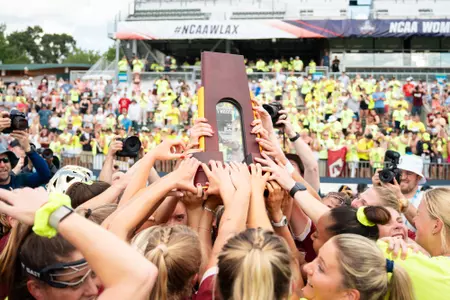
Photo by: Eddie Shabomardenly
May 27, 2024 | Lacrosse, #ForBoston Files
The champs ascend the elite peak few are lucky to occupy.
The story surrounding Boston College lacrosse entrenches the Eagles among college sports' greatest and most elite dynasties. Their seven consecutive national championship appearances are second to the two most historic programs within their sport, but the sheer volume of individual accomplishments on an annual basis place them in a palace normally reserved for the most powerful and valuable brands at either the amateur or professional level. With a second title secured, the Eagles have officially earned their spot in the tier reserved for the sport's most respected programs.
Head coach Acacia Walker-Weinstein's reputation for building a program capable of competing at an elite level on an annual basis is unprecedented for a team that started with humble Big East roots, but the new head coach of the United States national team transformed into a certified superstar because of the team's overall success. She shattered that thick glass ceiling that supposedly existed between BC and the programs at places like North Carolina, and her coaching tree - the one that started under Northwestern's Kelly Amonte-Hiller and continued when understudy Syracuse's Kayla Treanor became the head coach of her alma mater - is flourishing to unheard levels.
All of it centered around BC and the commitment to build a power program, but even Walker-Weinstein couldn't deny the unfortunate fact that the all-mighty Eagles' one national championship kept them from reaching the heights of a Northwestern or a Maryland. The eras differed, but the six previous trips to the national championship game served as a launchpad for national titles by Maryland, by James Madison, by North Carolina and, as of last year, Northwestern.
BC owned a scudetto, but the lone championship banner was from a season with no Ivy League teams as COVID-19 began to trail into the past. The six-goal win over Syracuse started after games against Albany and New Hampshire felt the sagging impact of an unprecedented pandemic, and much of the schedule endured impacts in some capacity. The five-win postseason that ended against the Orange featured the fourth game of the year against the No. 3 team in the nation after the season ended with two road games at the Carrier Dome.
Winning a national championship is impossible to dispute under any circumstances, but the narrative of its lone success during a run featuring unprecedented success was obliterated by a win that made BC the eighth program to ever win multiple NCAA championships in women's lacrosse. The Eagles had been the most recent team to win their first national championship after the James Madison win in 2018 broke a five-year stretch that dated back to North Carolina's first title in 2013, but stretches of national dominance are largely owned by teams that won previous titles. The Tar Heels that won their first championship by beating Maryland in triple overtime eventually repeated in 2016 by again beating the Terrapins, but the other four championships between UNC and JMU belonged to a program with more titles than any other team in the sport's history - the latter of which was at BC's expense in the Eagles' first-ever Final Four appearance.
"I'm so proud of our team and all the people that make something like this happen," Walker-Weinstein said. "This sport has come a long way from when I started, and we have so much support from our administration and from our community and from our schools, and we've just come a long way."
Winning a national championship in women's lacrosse is one of the hardest accomplishments in college sports because of the strength of programs like Maryland and Northwestern. They're the only teams with more than three national championships, and after six different teams won championships in the first six years of the NCAA's sponsorship, an era of dynasties emerged behind Temple, Penn State and, eventually Maryland - teams that were largely successful during the the preceding era of the Association for Intercollegiate Athletics for Women championship.
Teams like Massachusetts, Delaware and New Hampshire all won one championship in those early days, but the inequities associated with women's sports eventually led to Virginia's two championships in three seasons and the seven-year itch that led Maryland into the new century. A two-year span of Princeton titles followed, but Northwestern's five consecutive championships established a tier that teams like BC only dreamed about achieving.
The end result offered few pathways for a team like BC, but the Eagles broke through when Walker-Weinstein built a program around the superstar potential of players like Sam Apuzzo, Kenzie Kent, and others. Apuzzo's Tewaaraton Award in 2018 marked the first time a player not from Maryland or Northwestern won honors since 2005, and Charlotte North's consecutive wins in 2021 and 2022 coincided with the team's national championship win - and it happened after people said, "There will never be another Sam Apuzzo."
Apuzzo is now on Walker-Weinstein's coaching staff, but the overall reinvention of the program at a time when lacrosse is exploding on the national scene makes this championship all the more sweeter. North was in the broadcast booth for the Final Four, but the irony of their presence simultaneously reverberated through a defensive stand in the game's last minute against one of college lacrosse's most prolific attacks. BC's eradication of a six-goal deficit aside, it was the defense and players like Sydney Scales, Shea Baker, Becky Browndorf, and Belle Smith - players who weren't atop the score sheet - who locked down defending Tewaaraton Award winner Izzy Scane and her band of Wildcat scorers.
"We've been in those situations defensively this year at multiple times where close games came down to the wire with a defensive stop," said goalie Shea Dolce. "I think that moment is something I've mentally prepared for ever since I got to college. My defenders had my back for the full first half when I wasn't playing my best game, and I knew [the last minute] was time that I had to give it back. Northwestern has amazing threats, amazing shooters, and they were going to take some shots, and I was ready to see [the ball]."
Dolce's saves in the closing elements of the game sealed BC's breakthrough, and shirts and hats replaced the sticks and goggles that inevitably flew into the air. The moment, not lost on Walker-Weinstein, ended with her hands atop her head as she looked at the bench, the players, her assistant coaches and, finally, the stands, where neon-clad friends and family erupted in jubilant celebration. A trophy that long went to someone else was finally coming back to her hands, and in a post-Covid era, it meant the celebration was truly starting for a team that won its first and second ACC championship over the past two seasons.
"I'm so proud of the girls and so proud of the seniors," she said. "I asked them to lead the way all season, and they did just that. It's so difficult to do what they just did against a team like Northwestern, but I'm just so proud of them. I'm so happy to see their dedication pay off and their unselfishness because winning a championship is the hardest thing to do in team sports. These guys believed from the beginning [and] made a lot of changes to our operation, and they were bought in for the whole time. I'm just really proud."

Players Mentioned

MF
/ Lacrosse
D
/ Lacrosse
GK
/ Lacrosse
M
/ Lacrosse
M
/ LacrosseFootball: Head Coach Bill O'Brien Media Availability (November 24, 2026)
Tuesday, November 24
Football: Mason McKenzie Media Availability (November 24, 2026)
Tuesday, November 24
Football: Anthony Palano Media Availability (November 24, 2026)
Tuesday, November 24
From the Desk of Blake James: Episode 15
Tuesday, November 24