Boston College Athletics
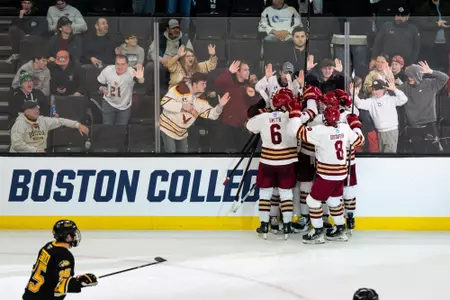
Photo by: Joe Sullivan
April 05, 2024 | Men's Hockey, #ForBoston Files
The four teams in the Frozen Four are among college hockey's greatest historical programs.
The dynasties weren't supposed to survive.
The nouveau and chic conversations around college hockey told us how powerful traditions were a dying breed. The last decade that produced five different first-time national champions made entry to the national tournament more possible after realignment and new conferences supposedly coalesced around stronger programs, and the programs of Boston College, Michigan, Denver, Boston University, North Dakota, and Minnesota - teams that always retained their relevance - lost ground to Union, Providence, UMass and Quinnipiac. Teams like Minnesota-Duluth won repeat championships after winning its first crown in 2011, and parity went from a hopeful word to a more recognizable norm.
The trickle-down economics landed in every conference as "other" teams found their way towards the championship podium, and crews from Merrimack, Minnesota State, Northeastern, UMass-Lowell and others all took their own respective shots at passing traditional powerhouses. They were born in relative and comparative obscurity, but their emergence made even the traditional gatherings at places like the Beanpot felt less relevant as the powers lost more and more of their vaunted territory.
Their success was isolated to individual years, and the droughts extended beyond historic barriers as improvements in facilities and the advent of the transfer portal continued the trend towards the new programs. For the first time, an entire decade's worth of years passed with minimal involvement from the programs situated atop the all-time Frozen Four list as the dynasties slowly found themselves on life support.
Their heartbeats were few and slim. Their time was over…and then 2024 happened.
In the span of one year, four of the six teams holding some of college hockey's largest success stories advanced through their respective regionals to reach a Frozen Four hosted by the State of Hockey in Minnesota. A combined 96 appearances in the national semifinals qualified for a championship weekend, and a combined 28 national championships ensured its next crown is returning to a team with a history of success dating back to the sport's earliest days.
The dynasties were dying? Maybe. But for this year, it seems, they are still very much alive and thriving.
"We're excited to have this opportunity," said Boston College head coach Greg Brown. "The guys have put a lot into this year, they've worked very hard, and the great part for the coaching staff was that they never got complacent when we started to string some wins together. They were always focused on that next win and playing as well as we could, so they've put a lot into [making it to the Frozen Four]. We're excited to be here."
That brand of energy is very real for a BC team that hasn't competed at this level in eight years, but the electricity masks the fact that the Eagles enter next week with the least amount of returning exposure or experience at the game's highest levels. That they haven't been to the mountain's summit since 2016 is one thing, but even the era of the transfer portal hasn't translated to the success usually embedded within the program's DNA. There's just one player who ever skated on the national semifinal field, but Boston University transfer Jamie Armstrong's assist against Minnesota in last year's bracket was lost to the annals of a 6-2 defeat.
No other player skated closer to the sun, and there's a twist of irony that Armstrong's trip came at Jack Malone's expense while the transfer forward skated for Cornell, but nobody else had even been to a national tournament aside from a limited senior class that began its career during the COVID-impacted 2020-2021 season - and even then, none of those players won a game despite advancing to the Regional Final because the opening round game against Notre Dame was canceled due to the Fighting Irish's bout with positive COVID cases. Lake Superior transfer Jacob Bengtsson was in that tournament after the Lakers won the final WCHA championship, but that team lost to UMass in its only game.
So no matter how the cake slices, there really isn't much to go on.
"We'll talk about [the experience of playing in a Frozen Four]," Brown admitted. "You have to be comfortable there because everything's different. There's more media, and the practice schedule is very rigid. You have to be able to adapt and be comfortable in that situation of having everything organized and ready so that we can focus on hockey. If you worry or get distracted by having family there or the media and all that, it's just going to be harder to put your best foot forward on the ice.
"We've been through it as a staff," he explained, "so we'll discuss it and have everybody ready and on the same page."
Ignorance provides a bit of bliss in that regard, but Brown's perspective from the national championships obtained as an assistant coach under Jerry York further stamps the intersection between BC's distant and recent histories. No immediate history matches up with a team like Michigan, for example, which is in its third consecutive Frozen Four, but the Wolverines know all too well about the disappointment associated with a token appearance in the semifinal round because their trips to Boston and Tampa ended before the weekend's final game. In 2021, a team that lost to Denver had three of the top five NHL Draft selections and was heavily favored, and heavy is the head that sleeps on the pillow of those missed opportunities.
"This junior and senior class has been to three Frozen Fours in a row and have won multiple Big Ten championships," head coach Brandon Naurato said. "[The success] goes back to COVID, and it goes back to a geocaching change. It goes back to having Steven Holtz in the ICU and four other players in the hospital this year [after] players like Ethan Edwards had surgery at the beginning of the year. It's always been that next-man-up mentality and the depth of Michigan [is about] guys showing their value and stepping up. It's not one thing. It's been a lot of little things, and the turning point was in the playoffs."
Big Blue hasn't won the national championship since 1998, but this year is at least the team's ninth appearance in the Frozen Four since the start of the 21st century. Not even Denver can surpass that number, and the Pioneers are tied with Michigan for most national championships after winning four titles over the past 20 years. Their most recent title was the one that went through Michigan in 2022 and, in a further twist of the proverbial knife, was won in Boston.
Yet where those two programs illustrate the continued success of the traditional powers, returning BC and Boston University to a national mantle is an altogether different feel despite the Terriers' berth in last year's Frozen Four, where they lost to Minnesota and bookended BC's 2016 loss to Quinnipiac. Just one year earlier, the Terriers were in the national championship game at TD Garden but lost to Providence in the infamous game featuring Matt O'Connors dropped puck, but the two-year stretch between the two teams continued a national championship run that included four-of-five titles between 2008 and 2012.
"You have to learn from [the experiences]," said BU head coach Jay Pandolfo. "I think the biggest thing for us is that this year, we've lost in some of these one-and-done [games]. We've lost the Beanpot and the Hockey East finals, where I know our season wasn't over in either of those, but if we wanted to win the championship, you can't if you don't win that game. The biggest thing for us is to not beat ourselves, and I thought we could learn a little bit from both of those losses."
BC had three of those championships around the decade's changeover, but it's still odd to think that 12 years have passed since either BC or BU won a championship. Even BU, which won a championship 15 years ago, has only been to three Frozen Fours in the 21st century before winning its regional in Sioux Falls, South Dakota this year, and college hockey was more likely to write about Quinnipiac or Yale in its national championship game in recent years.
The names have simply been different, and BC's championship wins over Ferris State and Notre Dame signaled an ongoing trend where a five-year span hung first-time banners during the 2010s. North Dakota won its eighth championship in 2016 by beating Quinnipiac after the Bobcats defeated Boston college, but that's been the only championship for the Fighting Hawks since its two-title run over a four-year span in the late-1990s. UMass has been to the national championship game twice and lost to Minnesota-Duluth before beating St. Cloud State, and Minnesota State - a WCHA-now-CCHA school located in southern Minnesota's town of Mankato, played Denver in the championship game in 2022. Even in the State of Hockey, the deified Golden Gophers haven't won the championship since 2003, and last year's team lost to Quinnipiac.
BC, for what it's worth, hasn't ventured into that conversation in years, but the Frozen Four's descent into Minnesota gives the Eagles an opportunity to revive the dynasty in front of the state's great hockey culture. Two Minnesota teams advanced to TD Garden's Frozen Four in 2022, and two Boston teams returned the favor this year. As other programs look to climb, this year has the potential for greatness among the greatest, some of whom are looking to finish a story and revive their continued traditions.
Players Mentioned


Wednesday, November 04
Wednesday, November 04
Tuesday, November 03
Tuesday, November 03