Boston College Athletics
March 28, 2024 | Men's Hockey, #ForBoston Files
Eagles' face program once backstopped by Tony Esposito in its third consecutive NCAA Tournament.
Hockey is unique to the intercollegiate sports landscape. Less than 70 schools play at the Division I level, but the overall structure lacks the general characteristics of the so-called power conferences regularly seen on national television. A vaster bulk of hockey teams represent athletics programs that are normally Division II or even Division III in some cases, and the fault lines between older geographical limitations of a predominantly cold-weather sport remain the divider between the biggest and brightest programs and newer teams.
Those additions joined programs teeming with culture and history, and the brands of big-time investments throughout the Northeast and Midwest are part of the ties binding cities and regions that are remote to the overall landscape. The realignment of those often makes it seem like bigger teams are attempting to push them out, but new powerhouses are rising from the perceived isolation of their hockey prowess. Among that group, the links sprouting from the Michigan Tech hockey team provides a classic feel for the NCAA Tournament's first round matchup between the Huskies and top-ranked Boston College.
"This is Division I college hockey," said Michigan Tech head coach Joe Shawhan ahead of his team's trip to Rhode Island. "All the teams that are here are good teams. Whether you're playing BC, Michigan State, [Minnesota], at this time, they're all good teams and there isn't going to be any weak team. Every team in the tournament is a good hockey team."
Michigan Tech University represents a common thread between the modern realization of a realigned era and the more traditional times built by the salt-of-the-earth schools at hockey's ground level. The Huskies' 16 NCAA Tournament appearances date back to the earliest days of the bracket's inception, but the 10 Frozen Four appearances and three national championship wins - more than Cornell, Maine, Harvard, Providence, Yale, Quinnipiac, UMass, and the Bowling Green program once coached by Jerry York - all occurred before the sport's growth periods of the 1980s and 1990s.
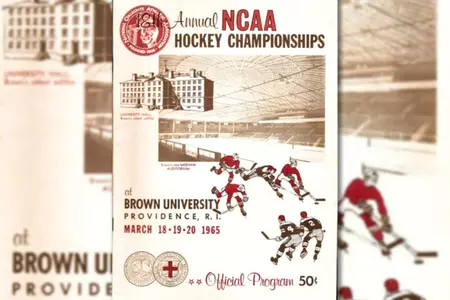
The Huskies unquestionably spent time atop the national stage, but their tournaments involved four teams and not the 16-team bracket flourishing on ESPN's grandest platform. The last championship in 1975 was won by first defeating Jack Parker's Boston University Terriers before a win over the Minnesota program coached by Herb Brooks, but even that championship appearance at the St. Louis Arena, the former home of the Blues, came after the 1965 championship won at Brown University's Meehan Auditorium and the 1962 title held in New York's Utica Memorial Auditorium.
Head coach John MacInnes was well into his third decade as the program's head coach when Tech won those championships, but the history he built by defeating Snooks Kelley's Boston College teams and future Eagles head coach Len Ceglarski's Clarkson team established a history with players like Mike Zuke, Bob D'Alvise, Stuart Ostland, John Young and others. Goalie Tony Esposito was the younger brother of Boston Bruins legend Phil Esposito and a first team All-Tournament choice after the 1965 tournament. In the mid-70s, the three national championship game appearances set a new standard for teams that weren't Vic Heyliger's Michigan squads in the earliest days of the tournament.
The Huskies were a prime example of a team capable of succeeding outside the traditional powers, but the small schools found themselves isolated after the NCAA Tournament expanded in 1981 and again in 1988. Increases to eight and 12 teams allowed other teams like Wisconsin, North Dakota and Michigan State to enter and win the tournament with more regularity, and while smaller schools like Northern Michigan and Lake Superior still won championships, another expansion to 16 teams in 2003 continued a changeover to zero banners won by schools that weren't playing for non-D1 athletics departments.
Shawhan very clearly understood that structure when he carved a trail to his first head coaching position. He played for Lake Superior State during a high-water mark in the 1980s before becoming a volunteer assistant coach for the Lakers, but his later shift to Michigan Tech helped Mel Pearson's successful renaissance of a program undergoing a 34-year national tournament drought. By 2015, the Huskies were in the tournament for the first time since the 1980s by virtue of the No. 2 seed in North Dakota's Fargo Regional, and winning the WCHA's regular season championship produced the team's first hardware win in 40 years. For the next two years, the WCHA postseason championship over Bowling Green and Northern Michigan opened access to the national tournament with Shawhan claiming one title as head coach after Pearson left to coach Michigan.
"When I was here as an assistant, we had really good teams and the crowds were really good," Shawhan said. "You'd have the odd crowd that was a little bit sparse, but even when we didn't have good dates, the students are going to [remember] great crowds. It's been the support that we've gotten from the community and the university, from the students, and our family throughout the country has been off the charts."
An easy argument debunks Michigan Tech's success as a product of realignment, and it's very true that the Huskies' WCHA victories didn't resemble the conference championship wins from the years involving Minnesota and North Dakota. Both teams had left the league in 2013 when the National Collegiate Hockey Conference and the Big Ten formed their respective charters, and their removal, along with Minnesota-Duluth, Omaha, St. Cloud State and Wisconsin more specifically forced the WCHA to merge with the remaining CCHA teams in the wake of further defections.
The resulting league operated under the WCHA banner but involved teams from Bemidji State, Bowling Green, Ferris State, Northern Michigan and Minnesota State-Mankato. Alabama-Huntsville stretched the league's alignment into the Deep South while two Alaska schools pushed its geography into the Great White North, and ensuing struggles left traditional Upper Peninsula schools with a Pairwise Rankings problem after the league sagged to a one-bid league aside from Minnesota State's emergence on the national scale.
The larger chunk of schools effectively jettisoned their geographic outliers to form a new version of the CCHA, but Michigan Tech still had to win a one-bid league to clinch a spot in the national tournament. None of those teams, including Bemidji State, which was the top Pairwise team, was heading for a seed better than No. 16 unless RIT lost the Atlantic Hockey Association postseason championship, and even then, other AHA teams remained ahead of the Beavers and the rest of the conference.
"We just want to play with [better-seeded teams]," Shawhan said. "There's a lot of similarities in structure to the two teams that we're seeing, so a lot of what they do is what we see every day in practice. I believe in our guys, and our guys believe in their ability to play. We just want to have a good hockey game. We had a little bit of hangover from last year that stuck with us a little bit in the first half, but in the second half, there was a whole new dynamic around the locker room."
The situation makes it impossible to read just how Michigan Tech stacks up against Boston College. The Eagles are, without question, the undisputed No. 1 team as the tournament begins, but the Huskies are a revived brand carrying the flag for a league that's significantly better than the statistics and numbers imply. Tech is the No. 16 team in the tournament, but it's also played the entire postseason in an elimination mode that didn't exist when BC clinched the No. 1 spot before the championship weekend. Going through top-seeded Bemidji on the road for the championship didn't hurt to sharpen that iron, and the semifinal comeback over Minnesota State knocked the league's most recent and top-flight powerhouse out of the postseason conversation.
The team had to win a pair of one-goal games while staring the end of its season directly in the face, and for BC and all its accolades, that's something that makes this team as dangerous as anyone ahead of Friday's puck drop.
"Our leaders have done a phenomenal job," said Shawhan, "and what I'm saying by that, I think our team is made up of leaders. I don't think we have a ton of passengers. We have all guys that have personalities to want to perform. What I like right now is how the team is coming together as a group, as a family, and how they've played for each other."

Thursday, November 05
Thursday, November 05
Wednesday, November 04
Wednesday, November 04