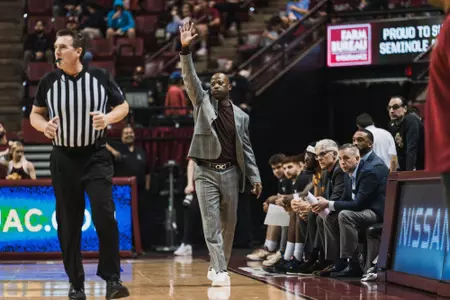
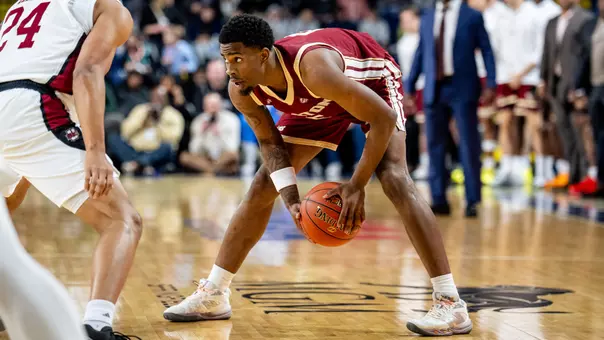
Photo by: Eddie Shabomardenly
Thursday Three-Pointer: Feb. 22, 2024
February 22, 2024 | Men's Basketball, #ForBoston Files
Sunshine splits for BC as the trip to NC State hangs on the horizon.
CHESTNUT HILL, Mass. -- Jerry Tarkanian inherited one of college basketball's most barren outposts when he accepted a job offer to lead the University of Nevada, Las Vegas in 1973. The team's infamous "Tumbleweed Tech" nickname had been earned by the program's lack of national following at a time when the sport was exploding onto the national scene, and it lived on a campus and city that resembled nothing of its current form. Home games were played at the Las Vegas Convention Center - away from the old Vegas Strip that lacked much of the flash and glitz that eventually arrived with the huge resort experiences established in the 1980s - and its spot in the NCAA College Division put it on par with the current Division II until a reclassification into the Division I ranks in 1970.
Hiring Tarkanian added a bit of legitimacy. He'd led Long Beach State to consecutive Elite Eights at a time when UCLA ruled western college basketball, and his 1970-1971 49ers came within a two-point loss of derailing John Wooden's fifth of seven consecutive national championships. He was known as a renegade in college basketball, but embracing everything about a Wild West attitude in Vegas laid the foundation for the newly-christened "Runnin' Rebels" to build a Final Four-caliber team that eventually won the 1990 national championship by obliterating Duke by 30 points.
That team remains a cultural phenomenon thanks to the overall attitude provided by players like Larry Johnson, Stacey Augmon, Anderson Hunt, Greg Anthony and David Butler, but Tarkanian harnessed UNLV's overall talent by devising a defensive system built around gambling on steals and fast breaks. Its ultra-aggressive nature wreaked havoc on opponents to the degree that the team's per-game steal and block averages were just under three more than opponents, to which seven extra assists per game allowed the national champions to average over 93 points per game with a plus-15 scoring advantage. Those numbers exploded even higher during the undefeated 1990-1991 season, but a Final Four rematch loss to Duke gave the 34-1 Rebels an ignominious nickname as the greatest team never to win a championship.
Regardless of accolades, that defense became part of college basketball parlance because of its effectiveness in creating open opportunities for UNLV's offense. The "amoeba defense," as it became known, used the two most athletic players on the court to guard the half-court entry while the remaining two players guarded the interior lanes. The last defender guarded the basket by playing as low as the lowest offensive player.
The idea centered around closing out every shooting and passing lane with some type of shifty motion. It mimicked the 2-3 zone by having the players move across the paint, but the close-outs went to the ball by slamming and cramming play into low percentage areas. Continually denying paths to the basket created passing lanes for the steal and gamble, but the constant shifting and fluid motion looked like one of those single-cell organisms that started life in prehistoric times.
More than 30 years later, the amoeba resurfaced in the post-game press conference following Boston College's 85-77 win over Miami last weekend.
"We had a defense that went to the amoeba," said head coach Earl Grant. "We went to a match-up zone with a 2-2-1 before going back to the amoeba. And I thought we got three or four critical stops - back-to-back-back-to-back - where they lost some of their rhythm. They had been weaving and playing off ball screens that were hard to deal with, and I think we changed the rhythm of the game to a way that really helped us."
Amoeba defenses require intense teamwork and communication because players have to understand who is moving to which area. It's not a true zone in the sense of the word but is unique for how the one-on-one matchups utilize a switch in space. Being able to execute the amoeba and shift into the 2-2-1 zone forced players like Bensley Joseph to turn the ball over more frequently, and BC used the 13 Hurricane turnovers to create 17 points. The six-point difference within that situational stat - combined with the plus-5 differential on fast break points - created the gap that padded the eight-point win.
"At the end, we made life hard," said center Quinten Post. "We changed up some of our sets and switched from zone to man, and I don't think they knew how to respond. What was great was how we talked a lot on defense, and guys had effort by pointing and talking. It showed what we're like when we hunker down."
The week ultimately ended with BC losing its 11th game of the season with an eight-point defeat at Florida State, but the creativity involved within its defense sets a tone for the rest of the season, starting Saturday with NC State.
More from the week:
1) Be a goldfish. -Ted Lasso
BC's postseason prospects took a hit on Tuesday when the Eagles lost a tough road game to the Seminoles, but the game's outcome was far from an indicator of the team's ability to overcome a gritty and tough opponent after both halves ended with near-identical statistical outputs. BC went so far as to outplay the Seminoles for stretches of both halves, but the final score bitterly fell into a situation where the Eagles simply turned the ball over too frequently against an opponent that made them pay.
"We're usually great with ball care," Grant said in his postgame remarks. "They did a good job of turning us over. You have to give them credit, I don't want to take that away from them."
The turnovers plagued BC and turned the scoreboard into situational numbers that didn't favor the Eagles. Sixteen giveaways were totaled, and a team that was 8-0 when cresting 80 points instead fell four points short of the mark while an opponent broke that same number for the fifth time this season. Prior to Tuesday, teams were 3-1 against BC when scoring that many points compared to BC's 7-10 record when scoring 80 or less, and the subsequent struggles forced the Eagles to play from behind in the last five minutes when they'd previously been 13-1 when leading into the last five minutes or regulation and 2-9 when trailing. BC also broke a three-game stretch of committing less than 10 turnovers after the four-game span from Virginia Tech to Duke saw the team go over 15 in each game. Prior to that, the Eagles only hit 10 turnovers in six of their first 18 games.
2) Don't you dare settle for fine. -Roy Kent
The offense was otherwise fine against FSU, but the issue facing BC is that the standard and bar had been raised significantly over its previous half-dozen games. The Eagles still shot 51 percent from the floor, but having gone 26-for-53 on three-pointers in the previous two games - including the infamous seven-spot by Mason Madsen - created mythical proportions for the trip to Tallahassee. The fact that a 9-for-22 night from outside would be considered a down night is a statement unto itself, but the turnovers illustrated how BC's offense keyed so much off its ability to run the floor when the outside shots went 3-for-11 after going 6-for-11 in the first half.
"We've been talking about trying to get out to good starts and not be on the other side of it," Grant said after the Miami game. "We were happy to be up 11 and not down 11 [in the first half], and I was really proud that we were able to do that. I'll give our guys credit because Miami didn't go away. They got loose for open threes, but that's very typical. They make a lot of threes when a game gets up-tempo and fast."
BC is at its most dangerous when playing complementary basketball, so both Miami and FSU, despite the different results, became perfect illustrations of the same conversation. The Hurricanes shot better from outside than any opponent dating back to Thanksgiving weekend's matchup against Loyola Chicago but failed to utilize a volume of shots because of the Eagles' ability to create turnovers and both blocks and steals. They didn't have the same success rate as Duke, which went 10-for-30 from outside, but the Blue Devils won by limiting offensive inefficiencies compared to Miami's overall turnover margin.
In a world that's built around the three-ball, it's not terribly difficult to illustrate the margin between winning and losing. If BC hadn't been able to force Miami into turnovers, an eight-point game would have been closer or lost. If BC had been able to limit its own mistakes - which is more typical than what happened against FSU on Tuesday - then the result could have flipped back in its favor.
3) There's something so sad about a suitcase. Do you know what I mean? It's like a drawer without a home. -Jamie Tartt
Recency bias leans into the notion that BC left an opportunity on the floor in Florida. Beating the Seminoles would have given the Eagles one more step towards a first round bye while moving within a whisker of Syracuse, NC State and Pittsburgh with a game against the Wolfpack looming on Saturday afternoon, so the loss instead dropped the team back towards Miami and Notre Dame as the ACC continues its inevitable march towards the conference tournament.
The irony of it all is that BC is still very much in that aforementioned fight if it beats NC State. The parity within the ACC has Virginia Tech sitting one game ahead of BC with Syracuse a half-game ahead of that, and a four-team logjam at 8-7 in conference play means there's still a path to within shouting distance of one of the top-four seeds. As crazy as that sounds, it's true that the 11th place team can still very much attack fourth place Wake Forest after the Demon Deacons dropped a 49-47 loss to Virginia on Saturday before drubbing Pittsburgh at home.
It also doesn't hurt that BC has home games on the horizon. Virginia's Wednesday matchup at 9 p.m. will be exceptionally tough sledding for a Cavalier side that's 4-5 away from the John Paul Jones Coliseum, and a future game against Pittsburgh starts March with the Eagles' Senior Day festivities.
At 4-5, BC is actually one of the league's better road teams. Wake Forest is 14-0 at home but just 2-7 on the road, and the best road teams in the league are barely three games over .500 on the road. North Carolina tops out at 6-2, but nobody has more than six wins away from their respective buildings.
Post-Game Huddle: Bubble Watch
My faith in court-storming was fully restored on Tuesday night when Creighton beat top-ranked UConn by 19. That said, not much else is changing in most bracket predictions, which indicates - to me, at least - that the road is either still wide open or is starting to shore itself up a bit with respect to the at-large bids coming out of other conferences.
The ACC is still not getting enough respect compared to other leagues, but before anyone throws water balloons at me for making that statement, let's compare some of the statistical anomalies facing some of the other leagues, namely the Mountain West Conference. Currently on ESPN's Bracketology prediction, six bids are going to the MWC while four stay with the ACC, but omitting Wake Forest as one of the First Four Out puts a top-30 team in the current NCAA NET rankings into the NIT. Nevada, meanwhile, is in the tournament as one of the last four byes, but the Wolfpack are a full 20 spots below the Demon Deacons.
Seton Hall, meanwhile, is one of the last four teams in the tournament and would hypothetically draw Ole Miss in the First Four while Butler plays Gonzaga in the other play-in round game, but the two Big East schools are situated slightly below Virginia Tech, a team left out of ESPN's most recent Bracketology. Even the Ole Miss team out of the SEC is 70th in KenPom and 68th in the NET while Wake Forest is No. 21 in KenPom.
I don't like taking umbrage with prognosticators - and I also don't have a window into the selection committee's line of thinking - but I still wholeheartedly believe the ACC, which won the ACC-SEC Challenge this year in its first iteration, deserves more bids. The league is strong, and I'd like to think that finishing eighth with 19 or 20 overall wins is enough for an ACC team to get into the national tournament when the league's rich history and tradition of winning at the highest level is easily referenced.
Then again, I'm not on the committee, so I guess we'll need to wait to do some more court-stormin'.
Hiring Tarkanian added a bit of legitimacy. He'd led Long Beach State to consecutive Elite Eights at a time when UCLA ruled western college basketball, and his 1970-1971 49ers came within a two-point loss of derailing John Wooden's fifth of seven consecutive national championships. He was known as a renegade in college basketball, but embracing everything about a Wild West attitude in Vegas laid the foundation for the newly-christened "Runnin' Rebels" to build a Final Four-caliber team that eventually won the 1990 national championship by obliterating Duke by 30 points.
That team remains a cultural phenomenon thanks to the overall attitude provided by players like Larry Johnson, Stacey Augmon, Anderson Hunt, Greg Anthony and David Butler, but Tarkanian harnessed UNLV's overall talent by devising a defensive system built around gambling on steals and fast breaks. Its ultra-aggressive nature wreaked havoc on opponents to the degree that the team's per-game steal and block averages were just under three more than opponents, to which seven extra assists per game allowed the national champions to average over 93 points per game with a plus-15 scoring advantage. Those numbers exploded even higher during the undefeated 1990-1991 season, but a Final Four rematch loss to Duke gave the 34-1 Rebels an ignominious nickname as the greatest team never to win a championship.
Regardless of accolades, that defense became part of college basketball parlance because of its effectiveness in creating open opportunities for UNLV's offense. The "amoeba defense," as it became known, used the two most athletic players on the court to guard the half-court entry while the remaining two players guarded the interior lanes. The last defender guarded the basket by playing as low as the lowest offensive player.
The idea centered around closing out every shooting and passing lane with some type of shifty motion. It mimicked the 2-3 zone by having the players move across the paint, but the close-outs went to the ball by slamming and cramming play into low percentage areas. Continually denying paths to the basket created passing lanes for the steal and gamble, but the constant shifting and fluid motion looked like one of those single-cell organisms that started life in prehistoric times.
More than 30 years later, the amoeba resurfaced in the post-game press conference following Boston College's 85-77 win over Miami last weekend.
"We had a defense that went to the amoeba," said head coach Earl Grant. "We went to a match-up zone with a 2-2-1 before going back to the amoeba. And I thought we got three or four critical stops - back-to-back-back-to-back - where they lost some of their rhythm. They had been weaving and playing off ball screens that were hard to deal with, and I think we changed the rhythm of the game to a way that really helped us."
Amoeba defenses require intense teamwork and communication because players have to understand who is moving to which area. It's not a true zone in the sense of the word but is unique for how the one-on-one matchups utilize a switch in space. Being able to execute the amoeba and shift into the 2-2-1 zone forced players like Bensley Joseph to turn the ball over more frequently, and BC used the 13 Hurricane turnovers to create 17 points. The six-point difference within that situational stat - combined with the plus-5 differential on fast break points - created the gap that padded the eight-point win.
"At the end, we made life hard," said center Quinten Post. "We changed up some of our sets and switched from zone to man, and I don't think they knew how to respond. What was great was how we talked a lot on defense, and guys had effort by pointing and talking. It showed what we're like when we hunker down."
The week ultimately ended with BC losing its 11th game of the season with an eight-point defeat at Florida State, but the creativity involved within its defense sets a tone for the rest of the season, starting Saturday with NC State.
More from the week:
1) Be a goldfish. -Ted Lasso
BC's postseason prospects took a hit on Tuesday when the Eagles lost a tough road game to the Seminoles, but the game's outcome was far from an indicator of the team's ability to overcome a gritty and tough opponent after both halves ended with near-identical statistical outputs. BC went so far as to outplay the Seminoles for stretches of both halves, but the final score bitterly fell into a situation where the Eagles simply turned the ball over too frequently against an opponent that made them pay.
"We're usually great with ball care," Grant said in his postgame remarks. "They did a good job of turning us over. You have to give them credit, I don't want to take that away from them."
The turnovers plagued BC and turned the scoreboard into situational numbers that didn't favor the Eagles. Sixteen giveaways were totaled, and a team that was 8-0 when cresting 80 points instead fell four points short of the mark while an opponent broke that same number for the fifth time this season. Prior to Tuesday, teams were 3-1 against BC when scoring that many points compared to BC's 7-10 record when scoring 80 or less, and the subsequent struggles forced the Eagles to play from behind in the last five minutes when they'd previously been 13-1 when leading into the last five minutes or regulation and 2-9 when trailing. BC also broke a three-game stretch of committing less than 10 turnovers after the four-game span from Virginia Tech to Duke saw the team go over 15 in each game. Prior to that, the Eagles only hit 10 turnovers in six of their first 18 games.
2) Don't you dare settle for fine. -Roy Kent
The offense was otherwise fine against FSU, but the issue facing BC is that the standard and bar had been raised significantly over its previous half-dozen games. The Eagles still shot 51 percent from the floor, but having gone 26-for-53 on three-pointers in the previous two games - including the infamous seven-spot by Mason Madsen - created mythical proportions for the trip to Tallahassee. The fact that a 9-for-22 night from outside would be considered a down night is a statement unto itself, but the turnovers illustrated how BC's offense keyed so much off its ability to run the floor when the outside shots went 3-for-11 after going 6-for-11 in the first half.
"We've been talking about trying to get out to good starts and not be on the other side of it," Grant said after the Miami game. "We were happy to be up 11 and not down 11 [in the first half], and I was really proud that we were able to do that. I'll give our guys credit because Miami didn't go away. They got loose for open threes, but that's very typical. They make a lot of threes when a game gets up-tempo and fast."
BC is at its most dangerous when playing complementary basketball, so both Miami and FSU, despite the different results, became perfect illustrations of the same conversation. The Hurricanes shot better from outside than any opponent dating back to Thanksgiving weekend's matchup against Loyola Chicago but failed to utilize a volume of shots because of the Eagles' ability to create turnovers and both blocks and steals. They didn't have the same success rate as Duke, which went 10-for-30 from outside, but the Blue Devils won by limiting offensive inefficiencies compared to Miami's overall turnover margin.
In a world that's built around the three-ball, it's not terribly difficult to illustrate the margin between winning and losing. If BC hadn't been able to force Miami into turnovers, an eight-point game would have been closer or lost. If BC had been able to limit its own mistakes - which is more typical than what happened against FSU on Tuesday - then the result could have flipped back in its favor.
3) There's something so sad about a suitcase. Do you know what I mean? It's like a drawer without a home. -Jamie Tartt
Recency bias leans into the notion that BC left an opportunity on the floor in Florida. Beating the Seminoles would have given the Eagles one more step towards a first round bye while moving within a whisker of Syracuse, NC State and Pittsburgh with a game against the Wolfpack looming on Saturday afternoon, so the loss instead dropped the team back towards Miami and Notre Dame as the ACC continues its inevitable march towards the conference tournament.
The irony of it all is that BC is still very much in that aforementioned fight if it beats NC State. The parity within the ACC has Virginia Tech sitting one game ahead of BC with Syracuse a half-game ahead of that, and a four-team logjam at 8-7 in conference play means there's still a path to within shouting distance of one of the top-four seeds. As crazy as that sounds, it's true that the 11th place team can still very much attack fourth place Wake Forest after the Demon Deacons dropped a 49-47 loss to Virginia on Saturday before drubbing Pittsburgh at home.
It also doesn't hurt that BC has home games on the horizon. Virginia's Wednesday matchup at 9 p.m. will be exceptionally tough sledding for a Cavalier side that's 4-5 away from the John Paul Jones Coliseum, and a future game against Pittsburgh starts March with the Eagles' Senior Day festivities.
At 4-5, BC is actually one of the league's better road teams. Wake Forest is 14-0 at home but just 2-7 on the road, and the best road teams in the league are barely three games over .500 on the road. North Carolina tops out at 6-2, but nobody has more than six wins away from their respective buildings.
Post-Game Huddle: Bubble Watch
My faith in court-storming was fully restored on Tuesday night when Creighton beat top-ranked UConn by 19. That said, not much else is changing in most bracket predictions, which indicates - to me, at least - that the road is either still wide open or is starting to shore itself up a bit with respect to the at-large bids coming out of other conferences.
The ACC is still not getting enough respect compared to other leagues, but before anyone throws water balloons at me for making that statement, let's compare some of the statistical anomalies facing some of the other leagues, namely the Mountain West Conference. Currently on ESPN's Bracketology prediction, six bids are going to the MWC while four stay with the ACC, but omitting Wake Forest as one of the First Four Out puts a top-30 team in the current NCAA NET rankings into the NIT. Nevada, meanwhile, is in the tournament as one of the last four byes, but the Wolfpack are a full 20 spots below the Demon Deacons.
Seton Hall, meanwhile, is one of the last four teams in the tournament and would hypothetically draw Ole Miss in the First Four while Butler plays Gonzaga in the other play-in round game, but the two Big East schools are situated slightly below Virginia Tech, a team left out of ESPN's most recent Bracketology. Even the Ole Miss team out of the SEC is 70th in KenPom and 68th in the NET while Wake Forest is No. 21 in KenPom.
I don't like taking umbrage with prognosticators - and I also don't have a window into the selection committee's line of thinking - but I still wholeheartedly believe the ACC, which won the ACC-SEC Challenge this year in its first iteration, deserves more bids. The league is strong, and I'd like to think that finishing eighth with 19 or 20 overall wins is enough for an ACC team to get into the national tournament when the league's rich history and tradition of winning at the highest level is easily referenced.
Then again, I'm not on the committee, so I guess we'll need to wait to do some more court-stormin'.
Players Mentioned

G
/ Men's Basketball
F/C
/ Men's BasketballBC Men's Hockey All-Access
Saturday, December 27
Men's Basketball: FDU Postgame Press Conference (Dec. 22, 2025)
Tuesday, December 23
Men's Basketball: UMass Postgame Press Conference (Dec. 10, 2025)
Thursday, December 11
Women's Basketball: Bryant Postgame Press Conference (Dec. 9, 2025)
Wednesday, December 10