Boston College Athletics
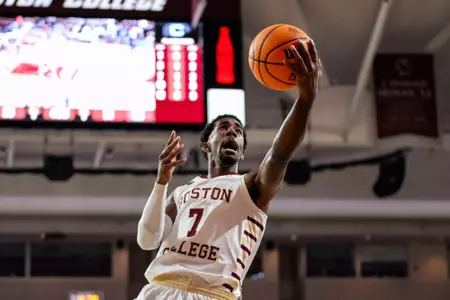
Photo by: Meg Kelly
Thursday Three-Pointer: Dec. 19, 2024
December 19, 2024 | Men's Basketball, #ForBoston Files
Let's wrap up Stonehill before moving onto a fun history lesson
CHESTNUT HILL, Mass. -- Basketball just ain't the same these days.
Some apologies are in order. Hickory High School head coach Normal Dale once put Ollie on Strap's shoulders with a measuring tape to prove how the basketball court at Butler's Hinkle Fieldhouse possessed the same dimensions as the little gym in the cornfields, but my statement goes well beyond the kiddie hoop currently next to my desk. Courts are still 94-x-50 with a 3-point arc situated 22 feet from the basket, and the painted area extends 19 feet into the middle of a circle with a six-foot radius. The baskets are still 10-feet tall, and rims are 18 inches in diameter unless you're doing the hoops game at a carnival.
Basketball, though, isn't the same, and last Sunday's game between Boston College and Stonehill drove incontrovertible supporting evidence directly through purist mentalities. For the second time this season, a team built around the 3-point shot entered Conte Forum and levied its best tax against a bigger and more athletic team from a power conference, and even though the Skyhawks failed in their four-point loss to the Eagles, they offered lessons for a BC team still climbing through its own mountainous journey through college basketball's rugged terrain.
"I'm glad that we got the job done," said head coach Earl Grant. "I'm happy for our guys. I knew Stonehill was an older team with a lot of seniors, a lot of juniors and a lot of graduate transfers, and they executed and weathered and did some good stuff. We got the game into a place where we could open up, and we made some unforced turnovers down the stretch that we'll learn from. We had a lot of freshmen [in comparison], and we'll learn from it and grow them up."
Stonehill utilized a progressive system developed during the team's Division II roots and further applied its decades-long tradition by augmenting the outside shot to a bombs-away mentality from a four-time national tournament team at the Division II level. A 2012 Final Four program, the Skyhawks built their team mentality by swamping opponents through an outside shooting mentality kept in place ahead of the 2022-2023 season move to Division I, and Sunday reached an apex when the team shot 10-for-23 from beyond the arc.
BC is too much of an interior-based team to match those numbers, but the Eagles understood how their own shortcomings caused the Skyhawks to adjust to their double-down defense. What started as a five-out strategy shifted to a high-low with an inside-out passing mentality built similar to the Triangle offense, and BC, more built to protect the rim, instead let the Skyhawks use the kick-outs to keep dropping shots.
"We decided to switch on their ball screen coverages," said Chas Kelley III. "They would do a lot of pick-and-pop stuff, but then they started switching and started to post-up. They started to go high-low, but when we adjusted to that, they kind of got loose on some broken and busted plays, and they were able to hit a couple of [threes] down the stretch."
That's just basketball during an era known as the "3-point revolution." The average game features more than double the number of three-point shots from the 2009-2010 season, and even old-school teams hoist more outside shots than their ancient counterparts. Grant admittedly wants his team to take around 25 three-point shots per game, and hitting at a 30 percent rate - essentially the national average - expected BC to score seven or eight different buckets over a 40-minute game.
Those of us who grew up in an older era still shutter at those numbers, but that's reality. Stonehill shot the three-pointer to perfection for a team that went 10-for-23 from outside, and catching BC on a slower night was enough to edge the scoreboard within a manageable deficit. Despite all of that, the Eagles still won, and a return to ACC play looms large on Saturday.
Here are some more fishes to feast on as Christmas lurks on the horizon:
1) The 3-point line changed everything, and the players' ability to be able to make three-pointers changed how you attacked the basket. -Mike D'Antoni
It's often forgotten how much Mike D'Antoni changed basketball during his years in Phoenix. He never replicated his success after heading to New York and Houston, but the Suns' four-year stretch during the mid-2000s offered a complete counter-culture to Gregg Popovich's plodding and fundamental San Antonio Spurs. It didn't hurt that Steve Nash reinvented the wheel as a point guard after arriving from Dallas, but the Suns also scored 108 points per game during an era averaging just over 97 points per game per team.
Those Suns teams are largely forgotten, though, because they never advanced to the NBA Finals while the Spurs won three championships in five years and later spiked an NBA Final appearance in 2013 with a fourth banner in 2014. Having already won a title during the lockout-shortened year in 1999, the defensive-minded team wasn't nearly as fun as Phoenix's flashier roster, but slowing down the game ultimately proved successful.
So let's go back, now, to Sunday's game against Stonehill because the Skyhawks successfully bogged BC with their defense. I mentioned the numbers and expectations behind Grant's system, but the Eagles failed to shoot their desired pace on three-pointers because Kraus' team attempted every measure to turn the game into a half-court offense with virtually no fast-break points for either side.
"We would've liked to have had more opportunities in the open court," admitted Grant. "The game was going at a good pace, and we wanted to clean up a few breakdowns. It was 36-30 at halftime, and they should have had 24 points with us leaving some points on the table. If they were at 24 and we were at 38, the game would've been different, but that's a possession game. The pace was fine, but our wings could have gotten out more, and we could have pitched it ahead with a few more baskets."
Ironically, BC shot a similar number of field goals to its last five games, but the number of three-pointers and the overall percentage dove under 30 percent after the Eagles arguably outplayed Wake Forest outside of their inability to prevent the Demon Deacons from advancing to the free throw line.
"Sometimes we can play games and I can look at the scoreboard and figure out if it's our pace," said Grant. "In this game, it was our pace, but we needed to execute it a little bit better and clean up a few defensive breakdowns. If we'd have done that, we'd have been up by 14."
2) There's one thing in life that nobody is ever truly prepared for: twins. -Josh Billings
I once joked to someone that the videotape from the Dartmouth game is currently at the bottom of a firepit where we'd hopefully never have to discuss it, but Stonehill's arrival at Conte Forum dredged some horrid memories from the earlier loss to the Big Green. Whether we like it or not, the Skyhawks are a certified spitting image of their northern Ivy League neighbors due in no small order to head coach Dave McLaughlin, the current head coach at Dartmouth.
McLaughlin is one of college basketball's all-time great humans, so it's strange to refer to him as a tongue-in-cheek villain in local circles. But McLaughlin, the current head coach at Dartmouth, spent nine seasons building Stonehill into a Division II powerhouse before he left the program to join Bill Coen's staff at Northeastern. In his place, Chris Kraus, a former member of the 2006 team that advanced to the Division II Final Four and a three-year assistant under McLaughlin, took over for seven consecutive winning seasons (the 2020-2021 season was canceled due to COVID-19) until the team transitioned to the Northeast Conference - where it promptly went 10-6 and finished second in its first year.
But let's go back to McLaughlin for a second. Coaching alongside Coen placed him on a coaching tree with a former understudy to Al Skinner, the former Rhode Island and Boston College head coach who legendarily built the Eagles into a national powerhouse and who still occasionally can be sighted at Conte Forum during Grant's tenure.
"Dave's a really good coach," Grant said. "He's a really good guy, and I like him a lot. His son and my son play AAU together, and he worked with Bill Coen. Bill and I had wars for seven years in the CAA. So I was very familiar with how Stonehill was going to play. But the thing that jumped out at me was that they had five seniors and multiple graduate transfers, and they were an experienced team that made us beat them. They weren't going to beat themselves."
Nearly all of these programs see each other on a regular basis, and while it's been 16 years since the Eagles faced Northeastern, they played Harvard last season and previously faced Cornell, Dartmouth, Stonehill and Fairfield over the past five years. Holy Cross is an ancient rival who played at BC for the 2021-2022 season, and Rhode Island occupied a spot in two consecutive seasons.
"There's a lot of guys up here and a lot of programs up [in New England]," said Grant. "We play a lot of the local teams. We've played Harvard and some of those teams, and there are some really good coaches. A lot of times when you're the team that's 'in the higher level league,' everybody expects you to beat those teams, but there's parity. You can't go into any game assuming anything in college basketball."
3) Some folks look at me and see a certain swagger. In Texas, it's called 'walking.' -George W. Bush
The Boston sports scene rippled with wildfire on the morning of December 20, 1986. Julius Erving and Charles Barkley led the Philadelphia 76ers past Celtics to snap a four-game losing streak, a complete upset given the exalted status of a Boston team considered arguably the greatest of all time. The Sixers also signed World B. Free to a second stint with the franchise after he spent the previous eight seasons traveling the NBA world. Elsewhere, the Boston Red Sox were in danger of losing catcher Rich Gedman after he rejected a free agent contract bid, but he'd eventually re-up with the Sox before a 1990 trade sent him to Houston.
Boston College landed in Florida for the Hall of Fame Bowl after Jack Bicknell and quarterback Shawn Halloran surprisingly delivered a nine-win season to the post-Flutie era, and the 10-win New England Patriots were on the verge of qualifying for the postseason after spending the previous five seasons out of the playoffs (save for the strike-shortened year in 1982).
Halfway across the world, the Suntory Ball Tournament offered NCAA basketball teams their only shot at an international playing court, and after falling behind by 15 points in the first half, Boston College lost its opening round game to Southern Methodist by a 62-49 final at the Tokyo Dome.
One year earlier, a 20-win BC team earned the No. 11 seed in the Midwest Regional and advanced to the Sweet Sixteen before losing to second-seeded Memphis State by two. SMU was the No. 5 seed in the East Regional but wouldn't advance out of the first weekend after losing to No. 4 Loyola-Chicago.
Both teams were among the best in their respective leagues - BC was a regular season Big East champion in its first season under Gary Williams - but SMU head coach Dave Bliss outfoxed the Eagles in their first-ever meeting. After a weird odyssey, Saturday is the first time the teams will meet on a basketball court since that game, but it's safe to say that their histories went in different directions after that fateful meeting in Japan.
SMU found itself relegated by its football program. The team had three NCAA Tournament berths in the late-1980s and another Southwest Conference championship in 1993 but wouldn't participate in another NCAA Tournament until Larry Brown led the Mustangs to the American Athletic Conference championship in 2015. Two years later, Tim Jankovich won 30 games for SMU, but the Mustangs only advanced to the NIT in three of their last four seasons before Andy Enfield's arrival.
The Eagles, meanwhile, entered the ACC as a powerhouse Big East team but haven't been to the national tournament since 2009.
Layup Line: Just keep having fun. It's basketball. So that's what I'm going to do. -Jayson Tatum
It's easy to forget about the rest of the college basketball country when the Atlantic Coast Conference is an 18-team conference with several national powerhouses, but this year's top-25 is seemingly more chaotic than the usual December shuffle. Several consistent contenders are near or at the top of the poll - Tennessee is chief among them at No. 1 with Auburn sitting second in the Associated Press Top 25 - but Florida's reappearance in the top-10 dabbled the Gators into the upper echelon for the first time since the 2019-2020 team started the year sixth before losing its second game to Florida State.
Beyond that, few spots are occupied by teams outside of the so-called "Power Five," and nobody is higher than No. 13 Gonzaga. The Big East occupies a couple of top slots with Marquette and UConn, but Memphis, Dayton and San Diego State are the lone block of non-P5 schools before Drake, which is well out of the top-25 with 52 votes.
According to ESPN's Joe Lunardi, the early NCAA bracket pushes Nebraska, Brigham Young and Indiana out of the tournament with UC-Irvine, and SMU - BC's next opponent - is on the Next Four Out radar despite winning its last five games. Having only lost to Butler and Mississippi State, the Mustangs are still only at No. 57 in the Torvik rankings and at No. 48 in the KenPom poll because the adjusted strength of schedule ranks 252nd in the nation. Comparatively speaking, this is a game that would go a long way for the Eagles as a result because the game against Stonehill drove BC down to No. 152 with a strength-of-schedule rating that's in the bottom-15.
BC and SMU will tip-off at Conte Forum on Saturday afternoon at 12 p.m. The game can be seen on the ACC's regional CW Network coverage with Evan Lepler and Brian Oliver on game broadcast coverage. It can also be heard on the Boston College Sports Network with Kevin Collins handling play-by-play duties.
Some apologies are in order. Hickory High School head coach Normal Dale once put Ollie on Strap's shoulders with a measuring tape to prove how the basketball court at Butler's Hinkle Fieldhouse possessed the same dimensions as the little gym in the cornfields, but my statement goes well beyond the kiddie hoop currently next to my desk. Courts are still 94-x-50 with a 3-point arc situated 22 feet from the basket, and the painted area extends 19 feet into the middle of a circle with a six-foot radius. The baskets are still 10-feet tall, and rims are 18 inches in diameter unless you're doing the hoops game at a carnival.
Basketball, though, isn't the same, and last Sunday's game between Boston College and Stonehill drove incontrovertible supporting evidence directly through purist mentalities. For the second time this season, a team built around the 3-point shot entered Conte Forum and levied its best tax against a bigger and more athletic team from a power conference, and even though the Skyhawks failed in their four-point loss to the Eagles, they offered lessons for a BC team still climbing through its own mountainous journey through college basketball's rugged terrain.
"I'm glad that we got the job done," said head coach Earl Grant. "I'm happy for our guys. I knew Stonehill was an older team with a lot of seniors, a lot of juniors and a lot of graduate transfers, and they executed and weathered and did some good stuff. We got the game into a place where we could open up, and we made some unforced turnovers down the stretch that we'll learn from. We had a lot of freshmen [in comparison], and we'll learn from it and grow them up."
Stonehill utilized a progressive system developed during the team's Division II roots and further applied its decades-long tradition by augmenting the outside shot to a bombs-away mentality from a four-time national tournament team at the Division II level. A 2012 Final Four program, the Skyhawks built their team mentality by swamping opponents through an outside shooting mentality kept in place ahead of the 2022-2023 season move to Division I, and Sunday reached an apex when the team shot 10-for-23 from beyond the arc.
BC is too much of an interior-based team to match those numbers, but the Eagles understood how their own shortcomings caused the Skyhawks to adjust to their double-down defense. What started as a five-out strategy shifted to a high-low with an inside-out passing mentality built similar to the Triangle offense, and BC, more built to protect the rim, instead let the Skyhawks use the kick-outs to keep dropping shots.
"We decided to switch on their ball screen coverages," said Chas Kelley III. "They would do a lot of pick-and-pop stuff, but then they started switching and started to post-up. They started to go high-low, but when we adjusted to that, they kind of got loose on some broken and busted plays, and they were able to hit a couple of [threes] down the stretch."
That's just basketball during an era known as the "3-point revolution." The average game features more than double the number of three-point shots from the 2009-2010 season, and even old-school teams hoist more outside shots than their ancient counterparts. Grant admittedly wants his team to take around 25 three-point shots per game, and hitting at a 30 percent rate - essentially the national average - expected BC to score seven or eight different buckets over a 40-minute game.
Those of us who grew up in an older era still shutter at those numbers, but that's reality. Stonehill shot the three-pointer to perfection for a team that went 10-for-23 from outside, and catching BC on a slower night was enough to edge the scoreboard within a manageable deficit. Despite all of that, the Eagles still won, and a return to ACC play looms large on Saturday.
Here are some more fishes to feast on as Christmas lurks on the horizon:
1) The 3-point line changed everything, and the players' ability to be able to make three-pointers changed how you attacked the basket. -Mike D'Antoni
It's often forgotten how much Mike D'Antoni changed basketball during his years in Phoenix. He never replicated his success after heading to New York and Houston, but the Suns' four-year stretch during the mid-2000s offered a complete counter-culture to Gregg Popovich's plodding and fundamental San Antonio Spurs. It didn't hurt that Steve Nash reinvented the wheel as a point guard after arriving from Dallas, but the Suns also scored 108 points per game during an era averaging just over 97 points per game per team.
Those Suns teams are largely forgotten, though, because they never advanced to the NBA Finals while the Spurs won three championships in five years and later spiked an NBA Final appearance in 2013 with a fourth banner in 2014. Having already won a title during the lockout-shortened year in 1999, the defensive-minded team wasn't nearly as fun as Phoenix's flashier roster, but slowing down the game ultimately proved successful.
So let's go back, now, to Sunday's game against Stonehill because the Skyhawks successfully bogged BC with their defense. I mentioned the numbers and expectations behind Grant's system, but the Eagles failed to shoot their desired pace on three-pointers because Kraus' team attempted every measure to turn the game into a half-court offense with virtually no fast-break points for either side.
"We would've liked to have had more opportunities in the open court," admitted Grant. "The game was going at a good pace, and we wanted to clean up a few breakdowns. It was 36-30 at halftime, and they should have had 24 points with us leaving some points on the table. If they were at 24 and we were at 38, the game would've been different, but that's a possession game. The pace was fine, but our wings could have gotten out more, and we could have pitched it ahead with a few more baskets."
Ironically, BC shot a similar number of field goals to its last five games, but the number of three-pointers and the overall percentage dove under 30 percent after the Eagles arguably outplayed Wake Forest outside of their inability to prevent the Demon Deacons from advancing to the free throw line.
"Sometimes we can play games and I can look at the scoreboard and figure out if it's our pace," said Grant. "In this game, it was our pace, but we needed to execute it a little bit better and clean up a few defensive breakdowns. If we'd have done that, we'd have been up by 14."
2) There's one thing in life that nobody is ever truly prepared for: twins. -Josh Billings
I once joked to someone that the videotape from the Dartmouth game is currently at the bottom of a firepit where we'd hopefully never have to discuss it, but Stonehill's arrival at Conte Forum dredged some horrid memories from the earlier loss to the Big Green. Whether we like it or not, the Skyhawks are a certified spitting image of their northern Ivy League neighbors due in no small order to head coach Dave McLaughlin, the current head coach at Dartmouth.
McLaughlin is one of college basketball's all-time great humans, so it's strange to refer to him as a tongue-in-cheek villain in local circles. But McLaughlin, the current head coach at Dartmouth, spent nine seasons building Stonehill into a Division II powerhouse before he left the program to join Bill Coen's staff at Northeastern. In his place, Chris Kraus, a former member of the 2006 team that advanced to the Division II Final Four and a three-year assistant under McLaughlin, took over for seven consecutive winning seasons (the 2020-2021 season was canceled due to COVID-19) until the team transitioned to the Northeast Conference - where it promptly went 10-6 and finished second in its first year.
But let's go back to McLaughlin for a second. Coaching alongside Coen placed him on a coaching tree with a former understudy to Al Skinner, the former Rhode Island and Boston College head coach who legendarily built the Eagles into a national powerhouse and who still occasionally can be sighted at Conte Forum during Grant's tenure.
"Dave's a really good coach," Grant said. "He's a really good guy, and I like him a lot. His son and my son play AAU together, and he worked with Bill Coen. Bill and I had wars for seven years in the CAA. So I was very familiar with how Stonehill was going to play. But the thing that jumped out at me was that they had five seniors and multiple graduate transfers, and they were an experienced team that made us beat them. They weren't going to beat themselves."
Nearly all of these programs see each other on a regular basis, and while it's been 16 years since the Eagles faced Northeastern, they played Harvard last season and previously faced Cornell, Dartmouth, Stonehill and Fairfield over the past five years. Holy Cross is an ancient rival who played at BC for the 2021-2022 season, and Rhode Island occupied a spot in two consecutive seasons.
"There's a lot of guys up here and a lot of programs up [in New England]," said Grant. "We play a lot of the local teams. We've played Harvard and some of those teams, and there are some really good coaches. A lot of times when you're the team that's 'in the higher level league,' everybody expects you to beat those teams, but there's parity. You can't go into any game assuming anything in college basketball."
3) Some folks look at me and see a certain swagger. In Texas, it's called 'walking.' -George W. Bush
The Boston sports scene rippled with wildfire on the morning of December 20, 1986. Julius Erving and Charles Barkley led the Philadelphia 76ers past Celtics to snap a four-game losing streak, a complete upset given the exalted status of a Boston team considered arguably the greatest of all time. The Sixers also signed World B. Free to a second stint with the franchise after he spent the previous eight seasons traveling the NBA world. Elsewhere, the Boston Red Sox were in danger of losing catcher Rich Gedman after he rejected a free agent contract bid, but he'd eventually re-up with the Sox before a 1990 trade sent him to Houston.
Boston College landed in Florida for the Hall of Fame Bowl after Jack Bicknell and quarterback Shawn Halloran surprisingly delivered a nine-win season to the post-Flutie era, and the 10-win New England Patriots were on the verge of qualifying for the postseason after spending the previous five seasons out of the playoffs (save for the strike-shortened year in 1982).
Halfway across the world, the Suntory Ball Tournament offered NCAA basketball teams their only shot at an international playing court, and after falling behind by 15 points in the first half, Boston College lost its opening round game to Southern Methodist by a 62-49 final at the Tokyo Dome.
One year earlier, a 20-win BC team earned the No. 11 seed in the Midwest Regional and advanced to the Sweet Sixteen before losing to second-seeded Memphis State by two. SMU was the No. 5 seed in the East Regional but wouldn't advance out of the first weekend after losing to No. 4 Loyola-Chicago.
Both teams were among the best in their respective leagues - BC was a regular season Big East champion in its first season under Gary Williams - but SMU head coach Dave Bliss outfoxed the Eagles in their first-ever meeting. After a weird odyssey, Saturday is the first time the teams will meet on a basketball court since that game, but it's safe to say that their histories went in different directions after that fateful meeting in Japan.
SMU found itself relegated by its football program. The team had three NCAA Tournament berths in the late-1980s and another Southwest Conference championship in 1993 but wouldn't participate in another NCAA Tournament until Larry Brown led the Mustangs to the American Athletic Conference championship in 2015. Two years later, Tim Jankovich won 30 games for SMU, but the Mustangs only advanced to the NIT in three of their last four seasons before Andy Enfield's arrival.
The Eagles, meanwhile, entered the ACC as a powerhouse Big East team but haven't been to the national tournament since 2009.
Layup Line: Just keep having fun. It's basketball. So that's what I'm going to do. -Jayson Tatum
It's easy to forget about the rest of the college basketball country when the Atlantic Coast Conference is an 18-team conference with several national powerhouses, but this year's top-25 is seemingly more chaotic than the usual December shuffle. Several consistent contenders are near or at the top of the poll - Tennessee is chief among them at No. 1 with Auburn sitting second in the Associated Press Top 25 - but Florida's reappearance in the top-10 dabbled the Gators into the upper echelon for the first time since the 2019-2020 team started the year sixth before losing its second game to Florida State.
Beyond that, few spots are occupied by teams outside of the so-called "Power Five," and nobody is higher than No. 13 Gonzaga. The Big East occupies a couple of top slots with Marquette and UConn, but Memphis, Dayton and San Diego State are the lone block of non-P5 schools before Drake, which is well out of the top-25 with 52 votes.
According to ESPN's Joe Lunardi, the early NCAA bracket pushes Nebraska, Brigham Young and Indiana out of the tournament with UC-Irvine, and SMU - BC's next opponent - is on the Next Four Out radar despite winning its last five games. Having only lost to Butler and Mississippi State, the Mustangs are still only at No. 57 in the Torvik rankings and at No. 48 in the KenPom poll because the adjusted strength of schedule ranks 252nd in the nation. Comparatively speaking, this is a game that would go a long way for the Eagles as a result because the game against Stonehill drove BC down to No. 152 with a strength-of-schedule rating that's in the bottom-15.
BC and SMU will tip-off at Conte Forum on Saturday afternoon at 12 p.m. The game can be seen on the ACC's regional CW Network coverage with Evan Lepler and Brian Oliver on game broadcast coverage. It can also be heard on the Boston College Sports Network with Kevin Collins handling play-by-play duties.
Players Mentioned
G
/ Men's BasketballMen's Basketball: SMU Postgame Press Conference (Feb. 21, 2026)
Sunday, February 22
Men's Hockey: UConn Press Conference (Feb. 20, 2026)
Saturday, February 21
Women's Basketball: SMU Postgame Press Conference (Feb. 19, 2026)
Friday, February 20
Men's Basketball: Florida State Postgame Press Conference (Feb. 17, 2026)
Thursday, February 19