Boston College Athletics
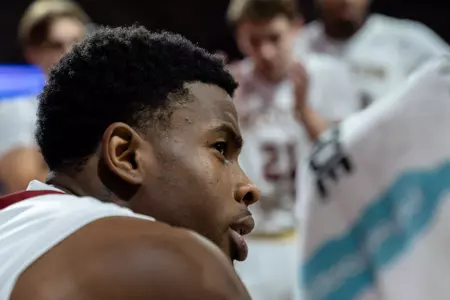
Photo by: Meg Kelly
The Return: How Fred Payne Bolstered BC
November 22, 2024 | Men's Basketball, #ForBoston Files
Robbed of last year, the second-year Eagle is back from a knee injury with a new outlook on his game
CHESTNUT HILL, Mass. -- Fred Payne didn't immediately know that anything went wrong when he went for a rebound in Boston College's 14-point win over Central Connecticut last year.
Then a freshman guard, Payne was focused more on his playing time and how the improvements he was making to his game helped the team compete in practice and through the first nine games, to which he well-earned an 11-minute day against the Blue Devils. When he checked into the game, he knew enough to crash the boards for rebounds ahead of fast breaks, and with three boards already in his back pocket, he didn't quite know about the horrible outcome of landing awkwardly on his right leg.
The pain, it was unlike anything he had ever experienced. As the doctors and training staff helped him to the locker room, his worst fears were confirmed. Torn knee ligaments. Even a torn hamstring. In that instant, his freshman season was over just as it was starting.
Nearly one year later, that memory hangs thick on the returning guard, but the appreciation of a journey built through the Boston College basketball program elevated a comeback performance that spurred the Eagles to their 82-61 win over Loyola. On a team predominantly built around new faces and new chemistry, the second-year rookie and vet illustrated one area where the continuity within the program helped reconstruct a new type of player poised to excel within Earl Grant's overall system.
"This team aligned into a good spot for me," said Payne. "At first, I'll admit that I was a little bit timid, but I knew that adding to this team, over time, I couldn't rush it. But we have a lot of great guys and a lot of great pieces that can score and do everything that you want, at will. Coach Grant can throw out different lineups, and I feel like I can fit in wherever and that's a great feeling."
Payne's perseverance in readjusting to BC's overall lineup was never in doubt, but his work to return from the injury included an impressive sweat equity indicative of the player once recruited out of Louisiana's northern recesses. A native of Grambling, he'd traveled the western Deep South basketball territories extending between Kansas and Texas on an odyssey that eventually landed him at the Legacy School of Sport Sciences in Houston's suburb of Spring. A three-star recruit, he rated among the top-25 products within the state and chose to travel northeast for college after committing to BC over a host of southern-based offers.
He wasn't expected to make an immediate starting impact, but bringing his toughness to the backcourt bridged the gap created by Makai Ashton-Langford's departure. Serving a one-year apprenticeship would then enable him to convert from a primary ballhandler to a more conservative and well-rounded shooter capable of unleashing a ferociousness around the rim.
He saw seven minutes in the season-opening win over Fairfield but more regularly competed in practice with fellow freshmen Elijah Strong and Jayden Hastings. Their games were often unseen to the public eye, but the off-court work in the Hoag Basketball Pavilion built a kinship with fellow depth player Chas Kelley III that started to inch into the minutes column as they continued lifting Payne through his injury rehab.
"Elijah kept my head in the right place," said Payne. "DJ Hand had been hurt before me and went through the same thing, so I watched what he was doing and how he worked towards being better. I focused on his knee and was learned about the whole process by watching him.
"Coach Grant was a big supporter," he added. "It always meant a lot to me because he was always checking on me and making sure I was good while I was off the court. It wasn't in a basketball coach-type of way. He wanted to make sure that I was becoming a mature man before the basketball situation and he always told me to keep my mind right. He got injured right before we went overseas last summer and he told me what he went through. He helped put me in situations to not overdo it."
Nobody saw the blood, the work, the tears and the dedication of a player who sat on the bench in street clothes during the game. Even at a surface level, Payne simply appeared to support his teammates, but he trained his basketball mind to study the game and look for gaps where he could adjust his game as he worked towards an eventual return. While he couldn't immediately contribute physically, Payne compensated for the lost time by watching film and analyzing the game to raise his Basketball IQ when it came time to return to the court.
Doctors told Payne the process to return to play would take longer than a year and that timeline struck a chord with how he was physically feeling. No matter how well he was doing, no matter how much better he felt, he understood that the process required him to pour himself into the training and rehab as a full-time job. When he needed it, he let himself endure the frustration of his first major injury, but when the it was time to work, he went into attack mode.
"I always talked to the coaching staff and [athletic trainer] Nick Gallotto, who told me to take it step-by-step," Payne admitted. "They told me to focus on the little details on the court and to focus on little things that prevent injuries. You can't look at it as trying to prevent injuries all the time, but I needed to put myself in the right position."
One such position was an 11-minute performance against VCU in game two and another 11-minute outing in the win over Loyola. Playing off the bench, his double-figures against the Greyhounds produced more points per minute than any player on the court, and his 4-for-7 shooting night included splashing a pair of 3-pointers. It became apparent how Payne, for first time, started to look more and more like a new version of himself.
"I'm a way different player," he admitted. "I make better reads and see a lot of stuff that other people can't see because I watched the game all year, last year. I can see stuff that people don't look for while they're off the court, but just watching it and picking up the small details of interesting guards and what they do, makes me more of a complete player. It's not just defense or scoring. I can give BC a variety of things, and I've become a better overall player."
Through pain, Payne has made progress. And it is starting to pay off.
Standing at 4-1 on the season, BC heads to the Cayman Islands for the Cayman Islands Classic. The eight-team tournament begins over the weekend with the Eagles playing three games in three days, beginning with Old Dominion on Sunday night at the John Gray Gymnasium. Tip-off is slotted for 7:30 p.m. and can be seen on FloCollege, a subscription streaming service available on most Internet and mobile devices.
Then a freshman guard, Payne was focused more on his playing time and how the improvements he was making to his game helped the team compete in practice and through the first nine games, to which he well-earned an 11-minute day against the Blue Devils. When he checked into the game, he knew enough to crash the boards for rebounds ahead of fast breaks, and with three boards already in his back pocket, he didn't quite know about the horrible outcome of landing awkwardly on his right leg.
The pain, it was unlike anything he had ever experienced. As the doctors and training staff helped him to the locker room, his worst fears were confirmed. Torn knee ligaments. Even a torn hamstring. In that instant, his freshman season was over just as it was starting.
Nearly one year later, that memory hangs thick on the returning guard, but the appreciation of a journey built through the Boston College basketball program elevated a comeback performance that spurred the Eagles to their 82-61 win over Loyola. On a team predominantly built around new faces and new chemistry, the second-year rookie and vet illustrated one area where the continuity within the program helped reconstruct a new type of player poised to excel within Earl Grant's overall system.
"This team aligned into a good spot for me," said Payne. "At first, I'll admit that I was a little bit timid, but I knew that adding to this team, over time, I couldn't rush it. But we have a lot of great guys and a lot of great pieces that can score and do everything that you want, at will. Coach Grant can throw out different lineups, and I feel like I can fit in wherever and that's a great feeling."
Payne's perseverance in readjusting to BC's overall lineup was never in doubt, but his work to return from the injury included an impressive sweat equity indicative of the player once recruited out of Louisiana's northern recesses. A native of Grambling, he'd traveled the western Deep South basketball territories extending between Kansas and Texas on an odyssey that eventually landed him at the Legacy School of Sport Sciences in Houston's suburb of Spring. A three-star recruit, he rated among the top-25 products within the state and chose to travel northeast for college after committing to BC over a host of southern-based offers.
He wasn't expected to make an immediate starting impact, but bringing his toughness to the backcourt bridged the gap created by Makai Ashton-Langford's departure. Serving a one-year apprenticeship would then enable him to convert from a primary ballhandler to a more conservative and well-rounded shooter capable of unleashing a ferociousness around the rim.
He saw seven minutes in the season-opening win over Fairfield but more regularly competed in practice with fellow freshmen Elijah Strong and Jayden Hastings. Their games were often unseen to the public eye, but the off-court work in the Hoag Basketball Pavilion built a kinship with fellow depth player Chas Kelley III that started to inch into the minutes column as they continued lifting Payne through his injury rehab.
"Elijah kept my head in the right place," said Payne. "DJ Hand had been hurt before me and went through the same thing, so I watched what he was doing and how he worked towards being better. I focused on his knee and was learned about the whole process by watching him.
"Coach Grant was a big supporter," he added. "It always meant a lot to me because he was always checking on me and making sure I was good while I was off the court. It wasn't in a basketball coach-type of way. He wanted to make sure that I was becoming a mature man before the basketball situation and he always told me to keep my mind right. He got injured right before we went overseas last summer and he told me what he went through. He helped put me in situations to not overdo it."
Nobody saw the blood, the work, the tears and the dedication of a player who sat on the bench in street clothes during the game. Even at a surface level, Payne simply appeared to support his teammates, but he trained his basketball mind to study the game and look for gaps where he could adjust his game as he worked towards an eventual return. While he couldn't immediately contribute physically, Payne compensated for the lost time by watching film and analyzing the game to raise his Basketball IQ when it came time to return to the court.
Doctors told Payne the process to return to play would take longer than a year and that timeline struck a chord with how he was physically feeling. No matter how well he was doing, no matter how much better he felt, he understood that the process required him to pour himself into the training and rehab as a full-time job. When he needed it, he let himself endure the frustration of his first major injury, but when the it was time to work, he went into attack mode.
"I always talked to the coaching staff and [athletic trainer] Nick Gallotto, who told me to take it step-by-step," Payne admitted. "They told me to focus on the little details on the court and to focus on little things that prevent injuries. You can't look at it as trying to prevent injuries all the time, but I needed to put myself in the right position."
One such position was an 11-minute performance against VCU in game two and another 11-minute outing in the win over Loyola. Playing off the bench, his double-figures against the Greyhounds produced more points per minute than any player on the court, and his 4-for-7 shooting night included splashing a pair of 3-pointers. It became apparent how Payne, for first time, started to look more and more like a new version of himself.
"I'm a way different player," he admitted. "I make better reads and see a lot of stuff that other people can't see because I watched the game all year, last year. I can see stuff that people don't look for while they're off the court, but just watching it and picking up the small details of interesting guards and what they do, makes me more of a complete player. It's not just defense or scoring. I can give BC a variety of things, and I've become a better overall player."
Through pain, Payne has made progress. And it is starting to pay off.
Standing at 4-1 on the season, BC heads to the Cayman Islands for the Cayman Islands Classic. The eight-team tournament begins over the weekend with the Eagles playing three games in three days, beginning with Old Dominion on Sunday night at the John Gray Gymnasium. Tip-off is slotted for 7:30 p.m. and can be seen on FloCollege, a subscription streaming service available on most Internet and mobile devices.
Players Mentioned
F
/ Men's Basketball
G
/ Men's Basketball
G
/ Men's Basketball
F
/ Men's BasketballNo. 24 Baseball Defeats Duke (April 18, 2026) - Game 2
Sunday, April 19
No. 24 Baseball Defeats Duke - April 18, 2026 Game 1
Saturday, April 18
No. 24 Baseball Defeats Duke (April 17, 2026)
Friday, April 17
#24 Baseball Defeats UConn (April 15, 2026)
Wednesday, April 15