Boston College Athletics
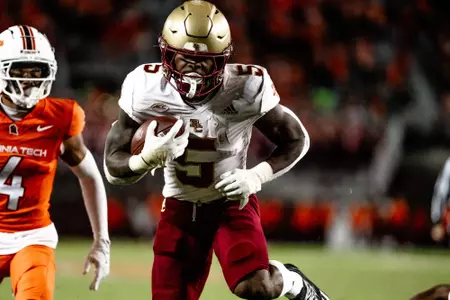
Photo by: Joe Sullivan
October 24, 2024 | Football, #ForBoston Files
Getting back on track requires BC to revisit its identity against Louisville.
Boston College head coach Bill O'Brien spent the first moments after last week's loss to Virginia Tech in an incredulous state of disbelief. The 42-21 outcome at the hands of the Hokies felt like a reality check for anyone who watched the Eagles attempt to stage a miracle rally from their initial 28-0 deficit, but O'Brien's immediate look-back failed to avoid a weighted disbelief. He couldn't understand, in particular, how the team's preparation failed to translate into pure execution when practice effort felt successful, and promptly offering analysis didn't change the need to alter or improve processes ahead of the next matchup against Louisville.
Having the benefit of 20-20 hindsight, Monday and Tuesday opened the gates on BC's overall preparation, and after stressing the improvements, the Eagles entered the final stages of their short week with newfound ideas of how to fix the issues plaguing them through the last two weeks.
"These are tough games," said O'Brien of the upcoming schedule. "All of them are tough, and we have to limit our mistakes. That's the thing about us. If we can limit our turnovers and penalties, [if we can] stop the run better, then we'll be in these games. If we don't, then we won't, so we have to do a good job of correcting the mistakes and being ready to go - and I believe these guys will [be better]."
BC always required synchronization to delineate its wins from its losses in any given year, but the four victories from the start of 2024 offer a clear contrast to the performances offered specifically over the last two games. A defense that produced eight interceptions against Florida State, Duquesne, Michigan State and Western Kentucky failed to grab a pick against Missouri and Virginia, and the lone pick against Virginia Tech came during the third quarter comeback that nearly toppled the Hokies' 28-0 halftime lead.
Likewise, a case of fumblitis reared its head over the last two games over the limited giveaways across September. Virginia Tech, for example, notably recovered three balls while Virginia had a 40-yard fumble recovery for a touchdown, whereas the fumbles lost against Michigan State and Western Kentucky produced little to no surrendered yardage.
"We have got to take care of the ball," said O'Brien. "We have 13 takeaways and 12 turnovers, so if we could take care of the ball better, we could really be in good shape because we take the ball away pretty well. That's a big thing, and [it's next to] needing to do a better job in the running ame and stopping the run. Those are things we've worked hard on, and hopefully we can get better at it."
Understanding the correlation between BC's ability to produce turnovers and dominate the ground game offers the clear path forward for the team's future. Louisville, in particular, surrenders close to six yards per play on defense but limits opponents to less than four yards per carry on the ground. Like BC, the results on the Cardinal schedule offer a crystallized viewpoint of a team that holds teams to less than three yards per carry in its wins while surrendering close to five yards per carry in losses. That, in turn, produced the margin between the team's record since eight of the 11 defensive rushing touchdowns occurred within Louisville's defensive red zone.
The opening game against Austin Peay aside, this then represents a golden opportunity for BC to attack an aggressive defense that's sustained a bit of damage over the past month. Even the victories over Jacksonville State and Virginia offered running games with four yards per carry after the FCS-level Governors failed to average more than one yard per rush on their 34 carries, but the one-score games against Notre Dame, Southern Methodist and Miami all fell victim to an inability either to stop the run altogether or to prevent it from producing points after each team scored multiple rushing touchdowns.
"We just need to see secondary pressure," said offensive lineman Jude Bowry, "things like dog blitzes and things like that. But the main thing is trying to block the guys up front and maintain control at the end of the day. [Offensive line coach Matt Applebaum] does a really good job of making sure we're all on the same page, that we all know what we're doing. With a long week of preparation, we just have to make sure that we're getting [to the game]."
BC, meanwhile, lost the delicate balance between its running game and its ability to control pace in each of those three losses. The poor yardage against Missouri and Virginia were outliers compared to the 167 yards against Virginia Tech, but the multiple turnovers and fumbles against the Hokies minimized whatever damage the yardage inflicted. In each of the four victories, the ability to pound a defense into submission reared its head with multiple touchdowns on the ground, a fact reflected in stark situational numbers.
In the four victories, for example, the Eagles scored nine times on the ground while averaging 4.70 yards per carry, but the three losses meandered to one rushing touchdown with less than three yards per rush. Third down intermediate situations, once the bread and butter of an offense capable of gaining five yards per play, are failing to gain more than two yards per rush on average - a number nearly equal to the third-and-super-short situations that call for plowing through the line of scrimmage. Like Louisville, eight of BC's 10 touchdowns are inside an opponent's red zone, but the number of explosive plays are heavily weighted to times when BC is pounding the scoreboard with a lead, a fact that O'Brien emphasized with the team as it sought to correct the issues ahead of Friday's matchup.
"When you carry the football," O'Brien said, "you're carrying the hopes and dreams of BC, the hopes and dreams of the football team, the school, the city, the fans in the city, your family - their hopes and dreams when you carry the football for Boston College."
BC and Louisville kick off at 7:30 p.m. on Friday night from Alumni Stadium in Chestnut Hill, Massachusetts. The game can be seen on national television via ESPN2 with online streaming available through the network's family of Internet and online mobile device apps.
Players Mentioned

OL
/ FootballThursday, October 22
Thursday, October 22
Wednesday, October 21
Wednesday, October 21