Boston College Athletics
October 14, 2026 | Football, #ForBoston Files
The statement win over the Panthers launched the Coughlin Era into full gear.
Boston College and Pittsburgh weren't the tightest of rivals when the Big East formed its football conference in the early 1990s. Western Pennsylvania was more likely to open the doors to matchups against Syracuse and West Virginia while Massachusetts overlapped with New York and the downeastern schools of the greater Philadelphia marketplace. Both possessed in-state rivalries capable of superseding the remainder of their schedules.
Both were members of the Big East's basketball league since its earliest days, but the creation of the football league reorganized those hardwood rivalries into a more structured gridiron schedule. A matchup between Pittsburgh and Penn State was ultimately lost, but the addition of regular games against Virginia Tech and the powerhouse program at Miami centered a rotation that included the program's primary rival at West Virginia. Boston College was initially on the outskirts of that scheduling arrangement outside of the 1970s before the post-Flutie era provided the Eagles with a trio of victories over the program once quarterbacked by Dan Marino.
Sponsorship of the Big East's football league bridged the gap between those teams, and the final year of independence coincided with a home-and-home split of victories that helped define the league's nascent identity. Years later, that membership came full circle for two teams continuing to define the underbelly of an Atlantic Coast Conference now possessing a nationwide identity.
On Saturday, it's that identity that will bubble to the surface when the Eagles and Panthers once again step onto the gridiron against one another.
"Those guys were huge," recalled quarterback Glenn Foley ahead of the 1991 meeting between the two programs. "They were monsters, that's for sure. They had guys who were big and could run. And they've got all the same guys back, so I'm sure they didn't get any smaller."
Foley's first career appearance came one year earlier when the Eagles suffered a demoralizing loss at Pitt Stadium, but his ability to lead BC on two scoring drives after subbing in for Willie Hicks was an undercurrent to the six interceptions grabbed by the defense.
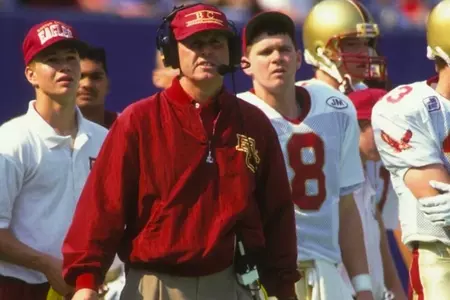
To be fair, Foley had more reason to embrace optimism in 1991 after BC rode its improvements to some under-the-radar success. New head coach Tom Coughlin had blown up the internal mechanisms by employing a much more rugged style during that season, and the Eagles had nearly upset No. 10 Penn State during a late September road trip to Happy Valley. They crushed Louisville, 33-3, for their first win of the season in mid-October, and the Army game sandwiched a second win around a near-miss against West Virginia.
None of that, though, changed the perception that Pitt was the better team. The Eagles romped to 250 yards rushing in their win over the Cadets, but the 148 yards by Chuckie Dukes occurred over a team that previously beat Division I-AA opponents from Colgate and Harvard before losing to The Citadel. The Panthers, on the other hand, had been ranked as high as No. 12 in the national polls after starting the year with five straight wins, and their losses to Notre Dame, Syracuse and East Carolina all came at the hands of nationally-ranked teams. They'd slipped out of the rankings, but ending the year with Rutgers and BC before the final game of the year against Penn State opened the door for national relevance if things broke correctly.
"Glenn's going to have to get away from the line of scrimmage," said Coughlin of his plan to beat the Panthers. "But we've been in the fray now. We've seen some excellent defenses in Penn State, Georgia Tech and Michigan. And West Virginia really came after us, so our game experiences have been against the best, and this game will be no different."
That's what made the 38-12 win resound so clearly with the new Big East. BC hadn't won its other Big East game during a year in which the teams didn't play a full scale round robin, but the Eagles found a way to rally past the Panthers by utilizing a newfound toughness. The defense had held Pitt to a field goal after Dukes fumbled in the early first quarter, and Jay McGillis later caused a safety that turned a potential 7-0 game into a 3-2 deficit. Mark Chmura then caught a touchdown pass to give the Eagles the lead, and a later Panther drive was held out of the end zone before Pete Mitchell grabbed a 13-yard touchdown pass to extend the score to 17-6.
Foley was exceptional, and he turned the previous year's four-interception performance into a 12-for-21 game that included four touchdowns and no picks. He connected with Clarence Cannon on five balls for 66 yards and two scores, and Mitchell, Chmura, Clint Kuboyama, Joe DeNucci and Darnell Campbell for individual passes longer than 20 yards.
Campbell, meanwhile, gained the fourth-most yards in program history at the time with 227 yards on 29 carries. A Brockton, Mass. native, he ran for a 24-yard touchdown in the fourth quarter to amass as many yards as Pitt quarterback Alex Van Pelt completed to his receivers.
"What it was, was everybody coming up and making plays beyond the X's and O's," said Coughlin. "All week we stressed that our players had to do that against this Pitt team, and that's what we got."
Pitt ultimately launched the Eagles into their next era under Coughlin and generated forward motion for the first time since the 1986 team unexpectedly mauled its way to the Hall of Fame Bowl. A win at Temple one week later pushed them closer to a near-upset over Miami in late November, and the next season began with an eight-game unbeaten streak and the first nationally-ranked season since the 1987 season started with a 2-0 record and wins over TCU and Temple.
"That was a team that did a fabulous job, just fabulous," admitted Pitt head coach Paul Hackett after the loss. "What are these guys? Mostly sophomores and freshmen? Now there's a sobering thought."

Men's Basketball: NJIT Postgame Press Conference (Nov. 22, 2026)
Monday, November 23
Men's Basketball: Colby Duggan 22 Points & 7 Rebounds (Nov. 22, 2026)
Monday, November 23
Men's Basketball: NJIT Highlights (Nov. 22, 2026)
Monday, November 23
Men's Basketball: Colby Duggan Joins ACC Network (Nov. 22, 2026)
Monday, November 23