Boston College Athletics
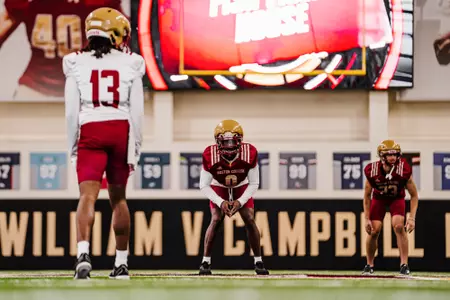
Photo by: Ethan Roy
Smart and Surgical Defensive Backfield Rounding Into Form
August 27, 2023 | Football, #ForBoston Files
A rebuilt DB group remains the bread-and-butter of BC football.
Much has been made this preseason about the returning production on both sides of the Boston College football program. The Eagles only won three games last season, but injury and attrition forced head coach Jeff Hafley to slot dozens of newcomers and young players into featured roles on a weekly basis. The sheer volume of freshmen and sophomores ballooned into trials by fire, and nearly every position featured a different name atop the depth chart by the last whistle of November's finale against Syracuse.
Having that many young players allowed Hafley to return nearly three-quarters of last year's production, and the main storyline around the 2023 preseason is the growth and development of his recruiting pipeline. The entire coaching staff spent last season preparing unready athletes for their respective shots at big time college football, and the evident struggles from 2022 released the team into a well-rounded spring and summer cycle prior to the start of training camp earlier this month.
The returning names and hopeful outlook converted BC's struggles into an oft-stated belief, but one area of conversation felt overlooked as analysts and fans debated the strengths of the Eagles' offensive and defensive units. The defensive backfield lost nearly every productive player from last season, but the bread-and-butter of Hafley's regime is reason enough for nobody to question the unit's ability to shut down opposing passing games with regularity.
"We came into spring and just really wanted our kids to play hard and fast," said defensive backs coach Aazaar Abdul-Rahim. "We wanted to be relentless, and how we did that was by simplifying as much as possible. There's no indecisiveness during a play, and I think that as a staff, we've done a great job of simplifying what we wanted taught and how we were going to teach it. We're really seeing the effects of that in our kids because they're playing hard and extremely fast."
Abdul-Rahim is one of the coaches who joined Hafley from the beginning, but adding co-defensive coordinator responsibilities expanded his collaboration with a head coach known for his backfield prowess. The unit excelled even as BC struggled in other areas last year, and a top-50 defense held opponents to just over five yards per play while getting off the field on almost three-quarters of its third down opportunities.
Opposing passing attacks were nearly a half-yard better per play against the BC defense, but the Eagles held teams to less yardage than the 2021 season in games played on the Alumni Stadium turf. They lacked synergy within their own balanced scheme offense, but they were better than both Syracuse and Wake Forest in holding opponents to less time of possession. Both Oklahoma and Tennessee had more than three to four minutes more time on the field as a team defense.
"There are levels to anything," said defensive backs coach Aazaar Abdul-Rahim. "It starts off by being able to communicate effectively and align effectively while knowing your assignment. It's not just the pass responsibility but your run as well, and after that, it's really about focusing on where you're putting your eyes and your initial footwork. What's probably most important is the situational aptitude."
Stout, strong, smart defensive play is a long staple of the BC program, but the axioms and pillars of this year's camp are reinforcing just how the Eagles are capable of taking the shape of the world around them. They are no longer a standard 4-3 defense that rushes the passer from the interior defensive line, but football itself doesn't call for a five-man line blowing holes open for rushing linebackers. More types of coverage are required, and hard-hitting safeties and nickel corners now call for several different skill sets.
Lockdown corners are still required to shut down a top, elite receiver, but other players beyond Elijah Jones' sixth turn in a BC uniform are filling the different, fluid positions in the defensive backfield. To find that skill set, Hafley and company recruited graduate transfers Alex Washington and John Pupel from the Ivy League, with Washington receiving the prestigious Jay McGillis Memorial Scholarship Fund after his 27-game crosstown career with Harvard produced six interceptions and an appearance on last year's edition of Phil Steele's Preseason Second-Team FCS All-America team.
"We recruit the right type of kids that fit our schemes," Abdul-Rahim said, "but you have to be an intelligent guy [to play for BC]. You have to like school. So we actually look at transcripts and see if guys can process our playbook because of the details. We get guys like John Pupel from Dartmouth and Victor Nelson, who is a pre-med student [who transferred from] Long Island. Khari Johnson is a local kid who transferred from Arkansas, and Alex Washington played at Harvard. So we were able to meet all of our marks as to what we're looking for with players who are willing to work. The type of kid we recruited goes hand-in-hand with why they're up to speed for us."
"John Pupel is a guy," Hafley said. "He's a really good football player. He's tough. He's instinctive. He keeps finding the football. He's really smart. That guy, when we talk about a safety, you can get a team lined up against him, but he can run. He's probably one of the biggest surprises for me."
How BC deploys the different defensive backs then changes the way the defense attacks a quarterback. Having agile linebackers allows hard-hitting backs to rush the line and stop the run, and having downfield zone coverage dupes quarterbacks into searching for safety valves that don't exist. Strong, agile defensive linemen can stand up and sift backwards to confuse offensive blockers, which in turn opens holes for the fast, violent finishes coming from the second level.
It's impossible to track schematically, and even in the first couple of weeks, the game film is going to look different based on the situation and the personnel on the field. The cohesion with the linebackers and defensive linemen never really went away last season anyways, but building different components into the gaps allow for players to cover for one another with more fluid conversation and communication. The intelligence factor is off-the-charts, even for a unit coached by Abdul-Rahim, Hafley, safeties coach Matt Thurin and others, and it's why the hallmark of this year's team shouldn't stray too far from its past resurgence on the back end.
"We get into all of the little nuggets," Abdul-Rahim said. "You have myself, Coach Hafley, Coach Thurin, [and others], and there are a lot of nuggets being given out. Once you give those out, you have to taper it back and really focus on the nuts and bolts first. As they start to understand, you'll see them thinking and anticipating and realizing their position on the field, their boundaries between the safeties and the corners, and the layers and levels."
Having that many young players allowed Hafley to return nearly three-quarters of last year's production, and the main storyline around the 2023 preseason is the growth and development of his recruiting pipeline. The entire coaching staff spent last season preparing unready athletes for their respective shots at big time college football, and the evident struggles from 2022 released the team into a well-rounded spring and summer cycle prior to the start of training camp earlier this month.
The returning names and hopeful outlook converted BC's struggles into an oft-stated belief, but one area of conversation felt overlooked as analysts and fans debated the strengths of the Eagles' offensive and defensive units. The defensive backfield lost nearly every productive player from last season, but the bread-and-butter of Hafley's regime is reason enough for nobody to question the unit's ability to shut down opposing passing games with regularity.
"We came into spring and just really wanted our kids to play hard and fast," said defensive backs coach Aazaar Abdul-Rahim. "We wanted to be relentless, and how we did that was by simplifying as much as possible. There's no indecisiveness during a play, and I think that as a staff, we've done a great job of simplifying what we wanted taught and how we were going to teach it. We're really seeing the effects of that in our kids because they're playing hard and extremely fast."
Abdul-Rahim is one of the coaches who joined Hafley from the beginning, but adding co-defensive coordinator responsibilities expanded his collaboration with a head coach known for his backfield prowess. The unit excelled even as BC struggled in other areas last year, and a top-50 defense held opponents to just over five yards per play while getting off the field on almost three-quarters of its third down opportunities.
Opposing passing attacks were nearly a half-yard better per play against the BC defense, but the Eagles held teams to less yardage than the 2021 season in games played on the Alumni Stadium turf. They lacked synergy within their own balanced scheme offense, but they were better than both Syracuse and Wake Forest in holding opponents to less time of possession. Both Oklahoma and Tennessee had more than three to four minutes more time on the field as a team defense.
"There are levels to anything," said defensive backs coach Aazaar Abdul-Rahim. "It starts off by being able to communicate effectively and align effectively while knowing your assignment. It's not just the pass responsibility but your run as well, and after that, it's really about focusing on where you're putting your eyes and your initial footwork. What's probably most important is the situational aptitude."
Stout, strong, smart defensive play is a long staple of the BC program, but the axioms and pillars of this year's camp are reinforcing just how the Eagles are capable of taking the shape of the world around them. They are no longer a standard 4-3 defense that rushes the passer from the interior defensive line, but football itself doesn't call for a five-man line blowing holes open for rushing linebackers. More types of coverage are required, and hard-hitting safeties and nickel corners now call for several different skill sets.
Lockdown corners are still required to shut down a top, elite receiver, but other players beyond Elijah Jones' sixth turn in a BC uniform are filling the different, fluid positions in the defensive backfield. To find that skill set, Hafley and company recruited graduate transfers Alex Washington and John Pupel from the Ivy League, with Washington receiving the prestigious Jay McGillis Memorial Scholarship Fund after his 27-game crosstown career with Harvard produced six interceptions and an appearance on last year's edition of Phil Steele's Preseason Second-Team FCS All-America team.
"We recruit the right type of kids that fit our schemes," Abdul-Rahim said, "but you have to be an intelligent guy [to play for BC]. You have to like school. So we actually look at transcripts and see if guys can process our playbook because of the details. We get guys like John Pupel from Dartmouth and Victor Nelson, who is a pre-med student [who transferred from] Long Island. Khari Johnson is a local kid who transferred from Arkansas, and Alex Washington played at Harvard. So we were able to meet all of our marks as to what we're looking for with players who are willing to work. The type of kid we recruited goes hand-in-hand with why they're up to speed for us."
"John Pupel is a guy," Hafley said. "He's a really good football player. He's tough. He's instinctive. He keeps finding the football. He's really smart. That guy, when we talk about a safety, you can get a team lined up against him, but he can run. He's probably one of the biggest surprises for me."
How BC deploys the different defensive backs then changes the way the defense attacks a quarterback. Having agile linebackers allows hard-hitting backs to rush the line and stop the run, and having downfield zone coverage dupes quarterbacks into searching for safety valves that don't exist. Strong, agile defensive linemen can stand up and sift backwards to confuse offensive blockers, which in turn opens holes for the fast, violent finishes coming from the second level.
It's impossible to track schematically, and even in the first couple of weeks, the game film is going to look different based on the situation and the personnel on the field. The cohesion with the linebackers and defensive linemen never really went away last season anyways, but building different components into the gaps allow for players to cover for one another with more fluid conversation and communication. The intelligence factor is off-the-charts, even for a unit coached by Abdul-Rahim, Hafley, safeties coach Matt Thurin and others, and it's why the hallmark of this year's team shouldn't stray too far from its past resurgence on the back end.
"We get into all of the little nuggets," Abdul-Rahim said. "You have myself, Coach Hafley, Coach Thurin, [and others], and there are a lot of nuggets being given out. Once you give those out, you have to taper it back and really focus on the nuts and bolts first. As they start to understand, you'll see them thinking and anticipating and realizing their position on the field, their boundaries between the safeties and the corners, and the layers and levels."

Players Mentioned

DB
/ Football
DB
/ Football
DB
/ Football
DB
/ Football
DB
/ FootballThursday, September 24
Thursday, September 24
Thursday, September 24
Thursday, September 24