Boston College Athletics
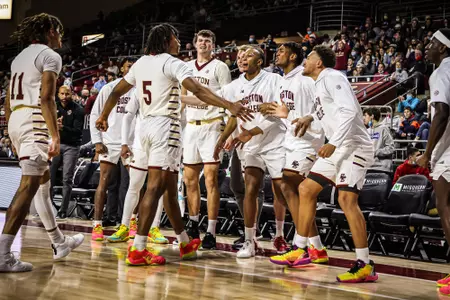
Photo by: Joe Sullivan
Saturday Slam Dunk: Week IV
December 11, 2021 | Men's Basketball, #ForBoston Files
Let's wrap up that ND win and prep for a trip to the the Gateway Arch, shall we?
CHESTNUT HILL, Mass. -- It's been a minute, hasn't it?
Eight days ago, Boston College celebrated its hardwood heroes for their grit and toughness. The Eagles had walked off their Conte Forum home court to celebrate with their fans, a group affectionately known as "The Sickos," after beating Notre Dame, 73-57, to improve to 6-3. The first official ACC game of the season, the win moved BC into a tongue-in-cheek first place for the night while temporarily putting the Maroon and Gold into NCAA Tournament predictions that automatically slotted "league champions" from regular season standings.
Nobody took that seriously. It's impossible to crown a conference or regular season champion in November, and head coach Earl Grant specifically emphasized the program's climb over its one win in a conference opener. It was a good night, but it was a single night built into a long season.
The week off let the one, good night simmer and linger for a few more days, but now, finally, the opportunity to create another solid evening on the court is finally approaching tonight when BC plays Saint Louis in the return match of the Billikens' 10-point win the Gotham Classic two years ago.
Local fans with longer memories likely remember that game for more than just Saint Louis' unique mascot or its head coach, former Kentucky guard Travis Ford. BC was coming off a stinging defeat to DePaul and was two games removed from surrendering 100 points to Belmont and needed a turnaround win over the Billikens to shift momentum heading into a road game at Richmond. Instead, Saint Louis shot just over 44 percent in the second half and scored 40 points after the break to win by 10.
It created a backslide before a stingy stretch of basketball against both Richmond and Northwestern, and BC skated backwards before finally beating Notre Dame, 73-72. Some of that was a tall order against four good basketball teams, but that loss to Saint Louis was a game where the Eagles played well and fell short. Absorbing the consecutive losses blew wind into BC's sails from the wrong direction, and it was part of why it struggled to score against Richmond and struggled to defend against Northwestern. From a season-long standpoint, it didn't impact the long term prognosis of the team, especially after wins piled up around the holidays, but it collectively formed a bad snippet of days.
Now BC heads to play the Billikens on their court, and they do so with the trades blowing at their backs. The win over USF shifted the breeze into a gust after the Columbia win, but beating Notre Dame decisively pushed gale forces forward. Enjoying that push is what nautical sailing is all about, but any good skipper knows there's a need to keep moving the jib to attract more wind.
1) Put a little Windex on it.
I get a kick out of situational statistics and how they tell a game story at its face value. Basketball tends to offer those windows better than other sports, and last week's numbers illustrated exactly why BC walked off the Conte Forum court with a 16-point win over Notre Dame.
The Eagles had 14 second chance points and 18 points off turnovers and owned sizable advantages in both categories after the Fighting Irish only grabbed two second chance points and 10 points off turnovers. That 20-point swing essentially moved the middle bar of the game in favor of BC and stamped the final score after the home side went plus-12 and plus-9 in points in the paint and fast break points.
"I have a thing where I don't miss when DeMarr passes [me the basketball]," center James Karnik joked. "I don't know, for some reason, I always get DeMarr assists. But I just get open for opportunities, and it just kind of flows. I've been working a lot with the coaches and just having more confidence in my game with repetitions. That's something that we're really working to constantly get in that groove."
Most of this served as a reminder why the BC front court was so effective and further enhanced the individual performances of Karnik, T.J. Bickerstaff and Quinten Post, but the eight boards grabbed by the brothers Langford were more than the combined numbers of Blake Wesley and Dane Goodwin.
But even further analysis of the box score numbers showed how deep BC's performance went. Prentiss Hubb was the only Notre Dame player with more assists than turnovers, and he unsurprisingly finished as the team's best offensive player. The rest of the Irish either matched a 1:1 ratio or had more turnovers than assists, an unkind fact considering Wesley's 12 points came off 4-for-13 shooting. That he had four turnovers to three assists diminished his overall performance, whereas Trey Wertz enhanced his minimal offensive output by offering four assists to zero turnovers in 31 minutes.
2) I've got the power!
College sports is all too often viewed through a football lens, but the term "power conference," which applies in football to the five leagues with direct access to the New Year's Six postseason game, means something altogether different in football because of the volume of Division I basketball teams and the proven track records of the smaller, regionally-based conferences situated throughout the national landscape.
The Atlantic 10 has long been one of those leagues and consistently sent multiple teams to the NCAA Tournament in the years prior to COVID-19's arrival. Two teams went to the tournament last year, the same number as the 2019 tournament in the year before COVID, but the A-10 had multiple at-large bids annually in the years leading up to the last bracket before the cancelled year. The 2014 tournament had a whopping six teams advance out of the league, including Dayton, which beat three "power conference" teams to get to the Elite Eight as a No. 11 seed.
Not every team has the Flyers' stroke of good fortune, though I think the only person who had them beating Ohio State was my wife, who frequently reminds me how she's the basketball brain in this family, but beating Syracuse and Stanford before bowing out against top-seeded Florida is a reminder of how the conference's top-to-bottom structure is as good as any league in the country.
Even after the A-10 lost Butler and Xavier to conference realignment, the additions of VCU, George Mason and Davidson constructed a basketball footprint rivaling the defectors' new home in the Big East. Its geography stretches from the New England-based UMass and Rhode Island through a Pennsylvania gateway at Duquesne and Saint Josephs, and the southern roads to Richmond, VCU and Davidson split from the western path to the outer reaches of Saint Louis and, starting in a few years, Loyola Chicago. It's a very, very good basketball league, and its tests often harden squads from one of the power leagues.
3) Study Break
Last week's win over Notre Dame was the largest impact of the Earl Grant effect at BC, but a glance down the first half numbers of the team versus the individual show just how far the Eagles are coming as a collective unit of players willing to sacrifice for the benefit of the team. Only two players are lodged into individual numbers, but the rebounding from T.J. Bickerstaff and the assists and assist-to-turnover ratio of Makai Ashton-Langford are byproducts of the new style shown over the first nine games of the season.
BC is in possession of the third-best defense in the ACC with a 59.78 points per game average that ranks alongside the vaunted Virginia unit, but the Eagles hold the fourth-best scoring margin in the conference compared to the Cavaliers' 10th-place standing. Though they rank in the middle of the league at both shooting and defending field goals, BC is atop the ACC in rebounding defense and the only conference team surrendering less than 30 boards per game. The Eagles own the second-best rebounding margin but are less than a board per game behind North Carolina, but their rebounding percentage is both No. 1 and No. 3 on the defensive and offensive ends.
Grant came to BC with a defensive mindset, but nobody foresaw the initial returns being this good as the team prepares to play a Saint Louis team with better numbers. The Billikens average more rebounds on both ends, though their margin is exactly the same as BC, and their turnover ratio is better on average than the Eagles. None of that likely matters to how Grant will prepare his charges, but it's worth noting since past years saw BC dominated at times by good rebounding teams.
Layup Line: It's beginning to look a lot like the ACC…
BC's win over Notre Dame improved the team's power index standards, but the idle week pushed the Eagles backwards as games around them improved other teams' standings. Saint Louis, for example, lost its two games against UAB and Belmont, but the wins over Boise State and Stephen F. Austin kept the Billikens above the Top-100 in both the NCAA Net and KenPom rankings. ESPN's Basketball Power Index, meanwhile, exacerbated the differences between the two teams and split SLU almost 50 spots above the Eagles, who are at No. 100 in the statistical breakdown.
A win on Saturday almost surely would average the two squads closer together. A 7-3 BC team should rank equal to a 7-3 team out of the A-10 even though the next game is against another Patriot League opponent, and the ACC's overall power index will eventually help all of those numbers.
This hypothetically would occur because of the ACC's overall dominance, but the only league team in Ken Pomeroy's top 25 is Duke. North Carolina is at No. 28, but the league itself has some key losses despite beating the Big Ten in the annual challenge between the two conferences. Clemson lost to Rutgers and Pitt lost to Minnesota, and Purdue crushed Florida State before it lost to the Scarlet Knights in a Big Ten league game.
BC wasn't a part of the ACC-Big Ten Challenge this year, but it will feel the impact if some of its conference mates slide down the polls. Four teams are clumped in the 28-40 tier in the KenPom rankings, and another five are between 50-60. BC, which started the season in the lower rankings, is up to No. 115 but can't fully climb into that tier unless it eventually beats those teams with regularity. Like anything else, statistical rankings measure head-to-heads based on weighted averages, and the Eagles, despite their 6-3 record, haven't fully clobbered teams in the upper weight classes. That can change on Saturday with the game against the Billikens in a non-league setting.
Boston College and Saint Louis tip off at 5 p.m. on Saturday from the Chaifetz Arena in St. Louis, Missouri. The game can be seen on national television via the NBC Sports Network with Steve Schlanger and Tim McCormick on the call, while the Boston College Sports Network from Learfield handles the radio broadcast with Josh Maurer and Danya Abrams. It can be heard locally on WEEI 850 AM with satellite radio broadcast available on Sirius XM channel 381, Online channel 971 and via The Varsity Network.
Eight days ago, Boston College celebrated its hardwood heroes for their grit and toughness. The Eagles had walked off their Conte Forum home court to celebrate with their fans, a group affectionately known as "The Sickos," after beating Notre Dame, 73-57, to improve to 6-3. The first official ACC game of the season, the win moved BC into a tongue-in-cheek first place for the night while temporarily putting the Maroon and Gold into NCAA Tournament predictions that automatically slotted "league champions" from regular season standings.
Nobody took that seriously. It's impossible to crown a conference or regular season champion in November, and head coach Earl Grant specifically emphasized the program's climb over its one win in a conference opener. It was a good night, but it was a single night built into a long season.
The week off let the one, good night simmer and linger for a few more days, but now, finally, the opportunity to create another solid evening on the court is finally approaching tonight when BC plays Saint Louis in the return match of the Billikens' 10-point win the Gotham Classic two years ago.
Local fans with longer memories likely remember that game for more than just Saint Louis' unique mascot or its head coach, former Kentucky guard Travis Ford. BC was coming off a stinging defeat to DePaul and was two games removed from surrendering 100 points to Belmont and needed a turnaround win over the Billikens to shift momentum heading into a road game at Richmond. Instead, Saint Louis shot just over 44 percent in the second half and scored 40 points after the break to win by 10.
It created a backslide before a stingy stretch of basketball against both Richmond and Northwestern, and BC skated backwards before finally beating Notre Dame, 73-72. Some of that was a tall order against four good basketball teams, but that loss to Saint Louis was a game where the Eagles played well and fell short. Absorbing the consecutive losses blew wind into BC's sails from the wrong direction, and it was part of why it struggled to score against Richmond and struggled to defend against Northwestern. From a season-long standpoint, it didn't impact the long term prognosis of the team, especially after wins piled up around the holidays, but it collectively formed a bad snippet of days.
Now BC heads to play the Billikens on their court, and they do so with the trades blowing at their backs. The win over USF shifted the breeze into a gust after the Columbia win, but beating Notre Dame decisively pushed gale forces forward. Enjoying that push is what nautical sailing is all about, but any good skipper knows there's a need to keep moving the jib to attract more wind.
1) Put a little Windex on it.
I get a kick out of situational statistics and how they tell a game story at its face value. Basketball tends to offer those windows better than other sports, and last week's numbers illustrated exactly why BC walked off the Conte Forum court with a 16-point win over Notre Dame.
The Eagles had 14 second chance points and 18 points off turnovers and owned sizable advantages in both categories after the Fighting Irish only grabbed two second chance points and 10 points off turnovers. That 20-point swing essentially moved the middle bar of the game in favor of BC and stamped the final score after the home side went plus-12 and plus-9 in points in the paint and fast break points.
"I have a thing where I don't miss when DeMarr passes [me the basketball]," center James Karnik joked. "I don't know, for some reason, I always get DeMarr assists. But I just get open for opportunities, and it just kind of flows. I've been working a lot with the coaches and just having more confidence in my game with repetitions. That's something that we're really working to constantly get in that groove."
Most of this served as a reminder why the BC front court was so effective and further enhanced the individual performances of Karnik, T.J. Bickerstaff and Quinten Post, but the eight boards grabbed by the brothers Langford were more than the combined numbers of Blake Wesley and Dane Goodwin.
But even further analysis of the box score numbers showed how deep BC's performance went. Prentiss Hubb was the only Notre Dame player with more assists than turnovers, and he unsurprisingly finished as the team's best offensive player. The rest of the Irish either matched a 1:1 ratio or had more turnovers than assists, an unkind fact considering Wesley's 12 points came off 4-for-13 shooting. That he had four turnovers to three assists diminished his overall performance, whereas Trey Wertz enhanced his minimal offensive output by offering four assists to zero turnovers in 31 minutes.
2) I've got the power!
College sports is all too often viewed through a football lens, but the term "power conference," which applies in football to the five leagues with direct access to the New Year's Six postseason game, means something altogether different in football because of the volume of Division I basketball teams and the proven track records of the smaller, regionally-based conferences situated throughout the national landscape.
The Atlantic 10 has long been one of those leagues and consistently sent multiple teams to the NCAA Tournament in the years prior to COVID-19's arrival. Two teams went to the tournament last year, the same number as the 2019 tournament in the year before COVID, but the A-10 had multiple at-large bids annually in the years leading up to the last bracket before the cancelled year. The 2014 tournament had a whopping six teams advance out of the league, including Dayton, which beat three "power conference" teams to get to the Elite Eight as a No. 11 seed.
Not every team has the Flyers' stroke of good fortune, though I think the only person who had them beating Ohio State was my wife, who frequently reminds me how she's the basketball brain in this family, but beating Syracuse and Stanford before bowing out against top-seeded Florida is a reminder of how the conference's top-to-bottom structure is as good as any league in the country.
Even after the A-10 lost Butler and Xavier to conference realignment, the additions of VCU, George Mason and Davidson constructed a basketball footprint rivaling the defectors' new home in the Big East. Its geography stretches from the New England-based UMass and Rhode Island through a Pennsylvania gateway at Duquesne and Saint Josephs, and the southern roads to Richmond, VCU and Davidson split from the western path to the outer reaches of Saint Louis and, starting in a few years, Loyola Chicago. It's a very, very good basketball league, and its tests often harden squads from one of the power leagues.
3) Study Break
Last week's win over Notre Dame was the largest impact of the Earl Grant effect at BC, but a glance down the first half numbers of the team versus the individual show just how far the Eagles are coming as a collective unit of players willing to sacrifice for the benefit of the team. Only two players are lodged into individual numbers, but the rebounding from T.J. Bickerstaff and the assists and assist-to-turnover ratio of Makai Ashton-Langford are byproducts of the new style shown over the first nine games of the season.
BC is in possession of the third-best defense in the ACC with a 59.78 points per game average that ranks alongside the vaunted Virginia unit, but the Eagles hold the fourth-best scoring margin in the conference compared to the Cavaliers' 10th-place standing. Though they rank in the middle of the league at both shooting and defending field goals, BC is atop the ACC in rebounding defense and the only conference team surrendering less than 30 boards per game. The Eagles own the second-best rebounding margin but are less than a board per game behind North Carolina, but their rebounding percentage is both No. 1 and No. 3 on the defensive and offensive ends.
Grant came to BC with a defensive mindset, but nobody foresaw the initial returns being this good as the team prepares to play a Saint Louis team with better numbers. The Billikens average more rebounds on both ends, though their margin is exactly the same as BC, and their turnover ratio is better on average than the Eagles. None of that likely matters to how Grant will prepare his charges, but it's worth noting since past years saw BC dominated at times by good rebounding teams.
Layup Line: It's beginning to look a lot like the ACC…
BC's win over Notre Dame improved the team's power index standards, but the idle week pushed the Eagles backwards as games around them improved other teams' standings. Saint Louis, for example, lost its two games against UAB and Belmont, but the wins over Boise State and Stephen F. Austin kept the Billikens above the Top-100 in both the NCAA Net and KenPom rankings. ESPN's Basketball Power Index, meanwhile, exacerbated the differences between the two teams and split SLU almost 50 spots above the Eagles, who are at No. 100 in the statistical breakdown.
A win on Saturday almost surely would average the two squads closer together. A 7-3 BC team should rank equal to a 7-3 team out of the A-10 even though the next game is against another Patriot League opponent, and the ACC's overall power index will eventually help all of those numbers.
This hypothetically would occur because of the ACC's overall dominance, but the only league team in Ken Pomeroy's top 25 is Duke. North Carolina is at No. 28, but the league itself has some key losses despite beating the Big Ten in the annual challenge between the two conferences. Clemson lost to Rutgers and Pitt lost to Minnesota, and Purdue crushed Florida State before it lost to the Scarlet Knights in a Big Ten league game.
BC wasn't a part of the ACC-Big Ten Challenge this year, but it will feel the impact if some of its conference mates slide down the polls. Four teams are clumped in the 28-40 tier in the KenPom rankings, and another five are between 50-60. BC, which started the season in the lower rankings, is up to No. 115 but can't fully climb into that tier unless it eventually beats those teams with regularity. Like anything else, statistical rankings measure head-to-heads based on weighted averages, and the Eagles, despite their 6-3 record, haven't fully clobbered teams in the upper weight classes. That can change on Saturday with the game against the Billikens in a non-league setting.
Boston College and Saint Louis tip off at 5 p.m. on Saturday from the Chaifetz Arena in St. Louis, Missouri. The game can be seen on national television via the NBC Sports Network with Steve Schlanger and Tim McCormick on the call, while the Boston College Sports Network from Learfield handles the radio broadcast with Josh Maurer and Danya Abrams. It can be heard locally on WEEI 850 AM with satellite radio broadcast available on Sirius XM channel 381, Online channel 971 and via The Varsity Network.

Players Mentioned

G
/ Men's Basketball
F
/ Men's Basketball
F/C
/ Men's Basketball
F
/ Men's BasketballSaturday, August 22
Saturday, August 22
Friday, August 21
Thursday, August 20