Boston College Athletics

Once An Eagle, Always An Eagle: Stephen Sauter '16
September 18, 2020 | Baseball, #ForBoston Files
The former Birdball catcher graduated from Naval flight school last weekend.
The Class of 2016 will forever be remembered as the one that rewrote a historical direction of Boston College baseball. Its successful build of a program, which culminated in a trip to the NCAA Super Regionals, is a legendary story among its peers. It's the focus of why Birdball is consistently recognized for its rising potential, and the underdog story draws a direct line to the team's newfound, top-flight status.
The student-athletes changed the face of their team by defining their success both on and off the field. They epitomized the concepts of service, and they levied their Jesuit mission through their sport. For many, it was a calling that remained long after their playing days at Shea Field ended.
For Stephen Sauter, service went beyond anything on the diamond and led him to a different calling after his playing days ended. He enlisted in the United States Navy and bore the flag of his nation on his sleeve. Last weekend, he graduated from flight school to embark on a career as a naval aviator.
"We're all committed to the same cause," he said. "Some people have their different reasons for joining, but at the end of the day, they all signed the piece of paper for a huge commitment. No matter their background or what they believe in, everyone here wants to serve their country. In aviation, there's a whole other level. We all need to take care of each other to ensure our (collective) safety. The Navy is all about history, so it's pretty cool to join that elite group of aviators, knowing that we're just getting started with our career."
Sauter is still one of the quintessential Eagles of his era. He grew up in Fullerton, California, the hometown of a college baseball powerhouse, but enrolled in college on the complete opposite coast. Immediately thrust into game action, he played in 40 games in his freshman season with 31 starts, including 12 behind the plate. He hit .226 with nine RBI, but displayed a propensity for getting on base with a .318 on-base percentage, and Sauter set a standard by bashing a home run in his first career start against Ohio. Later in the year, he tallied three hits twice, including once during a two-run performance against St. John's.
The success continued through his sophomore season when he started 21 games behind the dish and recorded a .250 average with nearly a hit per game in ACC action. His on-base percentage dipped, but his cagey eye came out at the biggest possible moments. In the season's last weekend, he went 3-for-9 against Clemson and drew four walks as the Eagles took a win and pushed a nationally-ranked Tiger squad to extra innings in the series' third game.
It set the stage for a breakout in 2015 when Sauter evenly split 26 starts between the catcher and designated hitter role. His average exploded to .272, and he recorded a career-high 17 RBI, while lowering his strikeouts-to-walks ratio to a career low. He developed into a true situational threat by going 7-for-11 with a runner on third and less than two outs, and his 10 multi-hit games included his first career triple in an April game against Harvard. He further damaged big time pitchers by hitting a two-run homer against Clemson and going 2-for-4 against Florida State.
He additionally recorded a perfect defensive fielding percentage and threw out three runners on the paths in what was his finest season behind the plate. It helped turn BC into a late-season bubble contender before the team slipped to a .500 overall record.
Sauter's overall performance set a tone, though, as part of his class's overall attitude. By the end of the 2016 season, BC was a 35-win team with a national ranking in the top 16, and its ability to push Miami to a third game in the Super Regionals provided the NCAA with its series of the tournament.
"It was really special, especially for that senior class," Sauter said. "It was bonkers how we turned into a team that went to the Supers. To have it all happen so fast, we didn't know what was happening. We didn't have time to think about that we were one of the worst teams ever a couple of years before. That we got it done was incredibly special and the time of our lives."
Following his graduation, Sauter returned home to California but still fostered an aspiration for a higher calling. He attended law school for a year but wasn't, as he put it, "fully committed to it." He felt like he wanted to aspire to something more, and having harbored an interest in military service, he decided to visit a recruit. He assumed his law experience and background would translate into the Judge Advocate General branch, but his recruiter recognized his unique physical and mental skill as suited for something altogether different.
"I always knew that I wanted to serve my country in some capacity," he said. "I didn't know it would wind up as a pilot. I went into the recruiting office, and I thought I would be a JAG officer because my sister is an attorney. My recruiter told me to look into it but asked if I ever thought about being a pilot.
"It was only something that you would see in movies or on television," he continued, "but my recruiter told me that former student-athletes usually do really well in the training. He told me to look into it, so I asked questions of friends and family. I eventually walked back to my recruiter and went through the process, which was pretty rigorous with exams and physical training."
Now having graduated from flight school, Sauter will head to Jacksonville, Florida for his first full-time assignment for the next year. Though unsure of where he lands after that, there is palpable passion and excitement in his future as he embarks on a career serving and protecting his home nation.
"It was something that had been on my mind for a while," he said, "and I was more excited than anything. It was something for me to look forward to, and I knew it would be an adventure. It has been in the first two years, and I'm just getting started."
Still, he very much remains the definition of what Birdball players aspire to become. He was a standout catcher who helped build a championship-caliber team, and his team is very much a reason why BC is now playing at a new stadium with a new practice facility ready to open. The unprecedented success of building a winner reverberated through that season and captured the hearts of both die-hard and casual observers, and its ability to connect with fans and families is one of the more endearing stories in the Boston College history books.
Yet that class is bound by something deeper and greater. Service was always a piece of the Boston College baseball experience for that team, and it remains a component in all that those players do. The clubhouse was incredibly tight-knit and united in singular purpose, and the players remained friends long after they graduated.
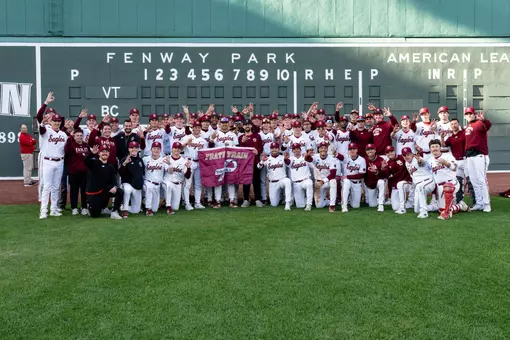
Additionally, their link to Pete Frates is still felt in how each approaches their day-to-day lives. That team was one of the last teams to hear Pete's voice, and it stamped the Team Frate Train flag into the national conscience at every turn. It left a lasting impression, one that goes into the field with players like Justin Dunn and Joe Cronin but also takes to the skies with Stephen Sauter.
"Baseball prepared me immensely (for military service)," he said. "The student-athlete life prepared you really well because you have to manage a bunch of tasks in a short amount of time with short and long term goals. Baseball prepared me for that by working with others as part of a team.
"Life, in general, I've learned throughout my career," he continued. "Teams don't go away. I'm going to be working with dozens of people in a crew, with a squadron of pilots, all working for one goal. Everything that I've experienced, baseball translated really well. In aviation, that's why pilots with student-athletes do really well."
The student-athletes changed the face of their team by defining their success both on and off the field. They epitomized the concepts of service, and they levied their Jesuit mission through their sport. For many, it was a calling that remained long after their playing days at Shea Field ended.
For Stephen Sauter, service went beyond anything on the diamond and led him to a different calling after his playing days ended. He enlisted in the United States Navy and bore the flag of his nation on his sleeve. Last weekend, he graduated from flight school to embark on a career as a naval aviator.
"We're all committed to the same cause," he said. "Some people have their different reasons for joining, but at the end of the day, they all signed the piece of paper for a huge commitment. No matter their background or what they believe in, everyone here wants to serve their country. In aviation, there's a whole other level. We all need to take care of each other to ensure our (collective) safety. The Navy is all about history, so it's pretty cool to join that elite group of aviators, knowing that we're just getting started with our career."
Sauter is still one of the quintessential Eagles of his era. He grew up in Fullerton, California, the hometown of a college baseball powerhouse, but enrolled in college on the complete opposite coast. Immediately thrust into game action, he played in 40 games in his freshman season with 31 starts, including 12 behind the plate. He hit .226 with nine RBI, but displayed a propensity for getting on base with a .318 on-base percentage, and Sauter set a standard by bashing a home run in his first career start against Ohio. Later in the year, he tallied three hits twice, including once during a two-run performance against St. John's.
The success continued through his sophomore season when he started 21 games behind the dish and recorded a .250 average with nearly a hit per game in ACC action. His on-base percentage dipped, but his cagey eye came out at the biggest possible moments. In the season's last weekend, he went 3-for-9 against Clemson and drew four walks as the Eagles took a win and pushed a nationally-ranked Tiger squad to extra innings in the series' third game.
It set the stage for a breakout in 2015 when Sauter evenly split 26 starts between the catcher and designated hitter role. His average exploded to .272, and he recorded a career-high 17 RBI, while lowering his strikeouts-to-walks ratio to a career low. He developed into a true situational threat by going 7-for-11 with a runner on third and less than two outs, and his 10 multi-hit games included his first career triple in an April game against Harvard. He further damaged big time pitchers by hitting a two-run homer against Clemson and going 2-for-4 against Florida State.
He additionally recorded a perfect defensive fielding percentage and threw out three runners on the paths in what was his finest season behind the plate. It helped turn BC into a late-season bubble contender before the team slipped to a .500 overall record.
Sauter's overall performance set a tone, though, as part of his class's overall attitude. By the end of the 2016 season, BC was a 35-win team with a national ranking in the top 16, and its ability to push Miami to a third game in the Super Regionals provided the NCAA with its series of the tournament.
"It was really special, especially for that senior class," Sauter said. "It was bonkers how we turned into a team that went to the Supers. To have it all happen so fast, we didn't know what was happening. We didn't have time to think about that we were one of the worst teams ever a couple of years before. That we got it done was incredibly special and the time of our lives."
Following his graduation, Sauter returned home to California but still fostered an aspiration for a higher calling. He attended law school for a year but wasn't, as he put it, "fully committed to it." He felt like he wanted to aspire to something more, and having harbored an interest in military service, he decided to visit a recruit. He assumed his law experience and background would translate into the Judge Advocate General branch, but his recruiter recognized his unique physical and mental skill as suited for something altogether different.
"I always knew that I wanted to serve my country in some capacity," he said. "I didn't know it would wind up as a pilot. I went into the recruiting office, and I thought I would be a JAG officer because my sister is an attorney. My recruiter told me to look into it but asked if I ever thought about being a pilot.
"It was only something that you would see in movies or on television," he continued, "but my recruiter told me that former student-athletes usually do really well in the training. He told me to look into it, so I asked questions of friends and family. I eventually walked back to my recruiter and went through the process, which was pretty rigorous with exams and physical training."
Now having graduated from flight school, Sauter will head to Jacksonville, Florida for his first full-time assignment for the next year. Though unsure of where he lands after that, there is palpable passion and excitement in his future as he embarks on a career serving and protecting his home nation.
"It was something that had been on my mind for a while," he said, "and I was more excited than anything. It was something for me to look forward to, and I knew it would be an adventure. It has been in the first two years, and I'm just getting started."
Still, he very much remains the definition of what Birdball players aspire to become. He was a standout catcher who helped build a championship-caliber team, and his team is very much a reason why BC is now playing at a new stadium with a new practice facility ready to open. The unprecedented success of building a winner reverberated through that season and captured the hearts of both die-hard and casual observers, and its ability to connect with fans and families is one of the more endearing stories in the Boston College history books.
Yet that class is bound by something deeper and greater. Service was always a piece of the Boston College baseball experience for that team, and it remains a component in all that those players do. The clubhouse was incredibly tight-knit and united in singular purpose, and the players remained friends long after they graduated.
Additionally, their link to Pete Frates is still felt in how each approaches their day-to-day lives. That team was one of the last teams to hear Pete's voice, and it stamped the Team Frate Train flag into the national conscience at every turn. It left a lasting impression, one that goes into the field with players like Justin Dunn and Joe Cronin but also takes to the skies with Stephen Sauter.
"Baseball prepared me immensely (for military service)," he said. "The student-athlete life prepared you really well because you have to manage a bunch of tasks in a short amount of time with short and long term goals. Baseball prepared me for that by working with others as part of a team.
"Life, in general, I've learned throughout my career," he continued. "Teams don't go away. I'm going to be working with dozens of people in a crew, with a squadron of pilots, all working for one goal. Everything that I've experienced, baseball translated really well. In aviation, that's why pilots with student-athletes do really well."
#23 Baseball Defeats Virginia Tech (April 11,2026
Saturday, April 11
Football: Zeke Moore Media Availability (April 10, 2026)
Friday, April 10
Football: Bill O'Brien Media Availability (April 10, 2026)
Friday, April 10
Football: Favor Bate Media Availability (April 10, 2026)
Friday, April 10