Boston College Athletics
Big League Birdballers: Justin Dunn Can Shine As Seattle's Sixth Man
July 20, 2020 | Baseball, #ForBoston Files
The Mariners' six-man rotation will benefit the former BC first round pick.
The purest sound in baseball occurs when a pitcher pounds a catcher's mitt. It's a distinctive echo, a sudden stop to freight train velocity. It's difficult to explain the combination of speed and finesse, but anyone who watches the sport can easily identify it. It's a lingering perfection and an indicator of a special player capable of developing at the next level.
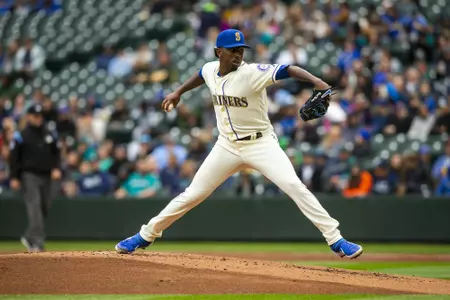
Justin Dunn created that sound at Boston College, and it happened in April 2016 in a game against Virginia. It was his first start of the season, but the flamethrower began a transition into something greater. He spun a two-hit shutout over five innings and used 72 pitches to shut down the defending national champions.
Dunn's story is well-known from there. A dominant 2016 season led directly into the MLB Entry Draft, and the New York Mets selected him 19th overall. Four years later, he's primed for a breakout with the Seattle Mariners as an abbreviated regular season opens this week as his presence bolsters his team through one of the most awkward seasons in baseball history.
Back in March, Dunn was the odd man out as the Mariners locked in players for a potential run at the American League West. The team returned Marco Gonzalez and Yusei Kikuchi from last year's roster, and it signed both Kendall Graveman and Taijuan Walker in the offseason. That left one rotation spot open for either Dunn or Justus Sheffield, another young prospect acquired last year in the James Paxton trade with the New York Yankees.
Sheffield struck out 37 hitters in seven starts last year to establish himself in that fifth starter's role. Dunn, who earned Texas League Pitcher of the Year honors last year in Double A, would've been optioned to Tacoma to start the season or been moved to the bullpen in a more-unlikely scenario.
That changed when baseball shut down in March during the COVID-19 pandemic. The sport went completely awry and missed its original Opening Day, and a three-month layoff, riddled with a labor dispute, surrounded a return to play. At the end of June, the owners officially announced a 60-game regular season, but a preseason "Summer Camp" didn't formally start until early-July.
It posed a unique challenge to big league managers as genuine fear clouded pitching staffs. In any given season, a five-man rotation falls into a steady cycle. Pitchers throw every fifth game, and the four games in between starts provide enough time for bullpen sessions and rest. Off days occasionally add an extra day into the mix, and pitchers, on average, make anywhere between 30-35 starts in a season.
MLB's short sprint changes the complexion of that race. Pitchers often gear up for the season with a month-long Spring Training, and the first month or two of the season stretch their arms for a long haul. That won't happen this year because the 60-game season translates into approximately a dozen starts per rotation slot, and the three-week Summer Camp doesn't provide nearly as much time for arms to condition for extended appearances.
It led management into the development of unusual thinking. In Seattle, Scott Servais clarified that impact when he announced his intention to develop a six-man rotation for the 2020 season.
"I think the six-man rotation is a great thing for where we're at right now," Servais said at the start of Summer Camp. "It's really, really important to keep these guys healthy. And we do know the impact that they'll be able to make by having an extra day off. All these guys throw better when they have an extra day. So because we're using a shortened season, let's stay with it."
It throws Dunn back into the mix. Seattle acquired him in 2018 with Jarred Kelenic when it traded Robinson Cano and Edwin Diaz to the New York Mets, and he's been on a fast track to the big leagues ever since.
He had already advanced to Double A with the Mets, but retained that position with the Mariners' affiliate in Arkansas last season. When rosters expanded in September, the fifth-place roster purchased his contract, and he debuted in the big leagues as pennant races concluded elsewhere.
He wound up making five appearances. He surrendered two runs to Cincinnati in his debut, but Dunn was dominant afterwards. He threw six scoreless innings over three subsequent turns and capped a dominant year spent mostly with the Travelers. He was the best arm in the Texas League last year and won the strikeout crown, but he won nine games with a league-best, 1.19 WHIP.
He continued to develop nasty pitches, including a slider out pitch he first flashed at Chestnut Hill. He command, which once painted Shea Field corners, continued to evolve with his fastball and offspeed pitches, and his strikeouts-to-walks ratio was better than 5:1 during his time in the minors last year.
"It's been a good year for me," Dunn said in an interview with 710 ESPN Seattle last year. "I mean, (there's) a couple things I'm nitpicky about - I'd say I've given up too many runs. I like to think of myself as being dominant at times, and I feel like there were a couple games where I didn't dominate."
It makes him an intriguing option for the Mariners this season. In college, Dunn stretched his pitch counts on short notice in order to pitch one game per week. He entered the 2016 season as BC's closer, but head coach Mike Gambino discussed moving him to the rotation during a midseason conversation with then-pitching coach Jim Foster.
He threw 72 pitches in that first start, but it took two more weeks before they unleashed the full potential of his arm. He remained capped with 80-pitch turns against Notre Dame and Louisville, but he fired 111 pitches in a victory over Virginia Tech after the interval concluded.
He morphed into BC's "Friday night starter" as a result and threw one game per week in a situation very similar to the expectations of this year in Seattle. He refined himself as a pitcher and further developed his pitch selection and approach. In his last regular season appearance, he dominated Georgia Tech with a trip to the ACC Tournament hanging in the balance and completed his first complete game with nine strikeouts and no walks.
Two weeks later, he cruised past Tulane in the NCAA Tournament with 11 strikeouts and one walk over seven innings. In total, the Eagles won seven of his nine starts, and he earned a first round draft selection prior to the Super Regionals against Miami.
"He wasn't a pitcher when he got here," Gambino said in 2016. "He was an infielder who got up on the mound a few times and could just throw. He was a super athletic kid with a good arm. His freshman year, he didn't have command and was just trying to throw every fastball as hard as he could.
"(But) there was a baseball maturity," he continued, "and there was a personal maturity after that freshman year. He learned how to work, both on the field and in the classroom, and that's what that whole freshman year was. That set him up to start diving into it during his sophomore year."
It leaves a juicy proposition on the table in Seattle because a six-man rotation enables starting pitchers to make one appearance per week. It opens the door to the future of the Mariners' prospect tandem of Sheffield and Dunn where it previously would have forced the franchise to choose one over the other for the time being.
They can pair the youngsters with Gonzalez and Kikuchi while retaining Graveman and Walker through this year. That could benefit Dunn's arm with an experience bridge for the mental and physical grind of a Major League Baseball season, even as he has the option to shine in a one-outing-per-week experience that he once dominated in college.
This year's baseball season is going to be one of the most unique and awkward experiences in the sport's history. The typical season built on repetition and longevity is gone, an impact blast from the ravaging effects of COVID-19. In its place, a short season will establish a wildcard for any pitcher willing to grab a brass ring. It's a situation designed to create a new hero, one whose journey began in New York and Boston before traveling to the Pacific Northwest.
Justin Dunn created that sound at Boston College, and it happened in April 2016 in a game against Virginia. It was his first start of the season, but the flamethrower began a transition into something greater. He spun a two-hit shutout over five innings and used 72 pitches to shut down the defending national champions.
Dunn's story is well-known from there. A dominant 2016 season led directly into the MLB Entry Draft, and the New York Mets selected him 19th overall. Four years later, he's primed for a breakout with the Seattle Mariners as an abbreviated regular season opens this week as his presence bolsters his team through one of the most awkward seasons in baseball history.
Back in March, Dunn was the odd man out as the Mariners locked in players for a potential run at the American League West. The team returned Marco Gonzalez and Yusei Kikuchi from last year's roster, and it signed both Kendall Graveman and Taijuan Walker in the offseason. That left one rotation spot open for either Dunn or Justus Sheffield, another young prospect acquired last year in the James Paxton trade with the New York Yankees.
Sheffield struck out 37 hitters in seven starts last year to establish himself in that fifth starter's role. Dunn, who earned Texas League Pitcher of the Year honors last year in Double A, would've been optioned to Tacoma to start the season or been moved to the bullpen in a more-unlikely scenario.
That changed when baseball shut down in March during the COVID-19 pandemic. The sport went completely awry and missed its original Opening Day, and a three-month layoff, riddled with a labor dispute, surrounded a return to play. At the end of June, the owners officially announced a 60-game regular season, but a preseason "Summer Camp" didn't formally start until early-July.
It posed a unique challenge to big league managers as genuine fear clouded pitching staffs. In any given season, a five-man rotation falls into a steady cycle. Pitchers throw every fifth game, and the four games in between starts provide enough time for bullpen sessions and rest. Off days occasionally add an extra day into the mix, and pitchers, on average, make anywhere between 30-35 starts in a season.
MLB's short sprint changes the complexion of that race. Pitchers often gear up for the season with a month-long Spring Training, and the first month or two of the season stretch their arms for a long haul. That won't happen this year because the 60-game season translates into approximately a dozen starts per rotation slot, and the three-week Summer Camp doesn't provide nearly as much time for arms to condition for extended appearances.
It led management into the development of unusual thinking. In Seattle, Scott Servais clarified that impact when he announced his intention to develop a six-man rotation for the 2020 season.
"I think the six-man rotation is a great thing for where we're at right now," Servais said at the start of Summer Camp. "It's really, really important to keep these guys healthy. And we do know the impact that they'll be able to make by having an extra day off. All these guys throw better when they have an extra day. So because we're using a shortened season, let's stay with it."
It throws Dunn back into the mix. Seattle acquired him in 2018 with Jarred Kelenic when it traded Robinson Cano and Edwin Diaz to the New York Mets, and he's been on a fast track to the big leagues ever since.
He had already advanced to Double A with the Mets, but retained that position with the Mariners' affiliate in Arkansas last season. When rosters expanded in September, the fifth-place roster purchased his contract, and he debuted in the big leagues as pennant races concluded elsewhere.
He wound up making five appearances. He surrendered two runs to Cincinnati in his debut, but Dunn was dominant afterwards. He threw six scoreless innings over three subsequent turns and capped a dominant year spent mostly with the Travelers. He was the best arm in the Texas League last year and won the strikeout crown, but he won nine games with a league-best, 1.19 WHIP.
He continued to develop nasty pitches, including a slider out pitch he first flashed at Chestnut Hill. He command, which once painted Shea Field corners, continued to evolve with his fastball and offspeed pitches, and his strikeouts-to-walks ratio was better than 5:1 during his time in the minors last year.
"It's been a good year for me," Dunn said in an interview with 710 ESPN Seattle last year. "I mean, (there's) a couple things I'm nitpicky about - I'd say I've given up too many runs. I like to think of myself as being dominant at times, and I feel like there were a couple games where I didn't dominate."
It makes him an intriguing option for the Mariners this season. In college, Dunn stretched his pitch counts on short notice in order to pitch one game per week. He entered the 2016 season as BC's closer, but head coach Mike Gambino discussed moving him to the rotation during a midseason conversation with then-pitching coach Jim Foster.
He threw 72 pitches in that first start, but it took two more weeks before they unleashed the full potential of his arm. He remained capped with 80-pitch turns against Notre Dame and Louisville, but he fired 111 pitches in a victory over Virginia Tech after the interval concluded.
He morphed into BC's "Friday night starter" as a result and threw one game per week in a situation very similar to the expectations of this year in Seattle. He refined himself as a pitcher and further developed his pitch selection and approach. In his last regular season appearance, he dominated Georgia Tech with a trip to the ACC Tournament hanging in the balance and completed his first complete game with nine strikeouts and no walks.
Two weeks later, he cruised past Tulane in the NCAA Tournament with 11 strikeouts and one walk over seven innings. In total, the Eagles won seven of his nine starts, and he earned a first round draft selection prior to the Super Regionals against Miami.
"He wasn't a pitcher when he got here," Gambino said in 2016. "He was an infielder who got up on the mound a few times and could just throw. He was a super athletic kid with a good arm. His freshman year, he didn't have command and was just trying to throw every fastball as hard as he could.
"(But) there was a baseball maturity," he continued, "and there was a personal maturity after that freshman year. He learned how to work, both on the field and in the classroom, and that's what that whole freshman year was. That set him up to start diving into it during his sophomore year."
It leaves a juicy proposition on the table in Seattle because a six-man rotation enables starting pitchers to make one appearance per week. It opens the door to the future of the Mariners' prospect tandem of Sheffield and Dunn where it previously would have forced the franchise to choose one over the other for the time being.
They can pair the youngsters with Gonzalez and Kikuchi while retaining Graveman and Walker through this year. That could benefit Dunn's arm with an experience bridge for the mental and physical grind of a Major League Baseball season, even as he has the option to shine in a one-outing-per-week experience that he once dominated in college.
This year's baseball season is going to be one of the most unique and awkward experiences in the sport's history. The typical season built on repetition and longevity is gone, an impact blast from the ravaging effects of COVID-19. In its place, a short season will establish a wildcard for any pitcher willing to grab a brass ring. It's a situation designed to create a new hero, one whose journey began in New York and Boston before traveling to the Pacific Northwest.

#24 Baseball Defeats Northeastern in Beanpot Championship (April 14, 2026)
Wednesday, April 15
#23 Baseball Defeats Virginia Tech (April 12, 2026)
Tuesday, April 14
#23 Baseball Defeats Virginia Tech (April 11,2026
Saturday, April 11
Football: Zeke Moore Media Availability (April 10, 2026)
Friday, April 10