Boston College Athletics
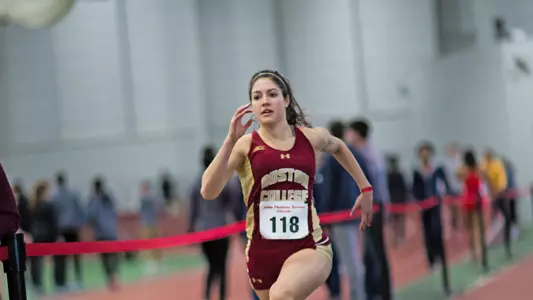
Photo by: Doug Hyde
Taking It To The "Bank"
February 22, 2017 | Women's Track & Field, #ForBoston Files
Emma Taylor and Julia Lyons never ran on a banked track before this year. No problem.
For Boston College track stars Julia Lyons and Emma Taylor, it's a story they could've only hoped to write in college. As freshmen, they've excelled, landing among the Eagles' most elite competitors.
For Taylor, it's been in the 60-meter hurdles. In her first season contesting the event, she's already among the top 10 in Boston College program history, laying the groundwork for what could be a celebrated career. For Lyons, it's been as a dual-threat, posting the best 200-meter run time for the team this year while producing the best long jump mark in over six seasons.
It would be enough to make any coach proud of two rookies, but it comes with one added layer. Taylor is a native of Kamuela, Hawaii. Lyons is from Lafayette, California. Neither hometown is from a climate requiring track athletes to consistently race indoors. As a result, it means neither athlete came to Boston College with familiarity on the indoor, banked tracks.
"I didn't even know tracks could be banked," Emma Taylor said. "I showed up for my first meet at Harvard, and I had no idea what was happening. I looked at my teammates and asked if I had to run up and down a hill."
Having gone to high schools on the West Coast, the athletes only competed outdoors, meaning they only ran on flat tracks. Flat tracks require runners to redirect motion and turn, changing direction as they enter a curve and exit onto a straightaway, making it more difficult to maintain full speed.
Banked tracks, more common to indoor arenas like the ones Boston College competes on, allow a runner to maintain more speed, but it does so with a unique challenge. Instead of redirecting their bodies, runners instead have to deal with different, sharper angles, all while running at a faster rate of speed.
"The banking was difficult to start," Lyons said, "and they definitely took some work (to get used to). I had to adjust to starting on blocks that were uphill, and I'm still a little uncomfortable with the start. There is more momentum on banking when running the 200, especially at the end. But it's faster and now that I've adjusted, I've learned to really enjoy running a banked track over a flat track."
The adjustment came with a deeper commitment to training than anything they've experienced in the past. Taylor, a former three-sport athlete in high school, described the change to running year round. A former volleyball athlete in the fall and soccer player in the winter at home, she's now dedicated into a much more intense training regiment, which she said now includes running more all year.
For Lyons, it's a little different, balancing the track against her field event in the long jump. "There's a difference in technique, and there's a lot of prep to distinguish the form," she said. "It's different running the 200 versus running down a runway for the long jump. I have to keep in mind what event I'm preparing for, but the coaching staff has done a great job of helping me balance the two events."
Both are contributing to the foundation of success Boston College track sets out to be. NCAA Track and Field is dominated by big-name, recognizable programs like Oregon or Arkansas, and while Boston College might not have the same amount of national champions, it's about a more well-rounded experience that appealed to two student-athletes who flew across the country to work in unfamiliar surroundings.
"We compete with teams that are very, very competitive," Lyons said. "It's always fun to run or compete against those athletes because it makes you want to be better than you are. It makes you want to work harder. You're checking numbers, seeing where athletes are and what they're doing."
"It's a world of difference," Taylor said. "High school sports in Hawaii, not just in track and field, are far behind the mainland, so I had to adjust to the speed. It's great to have that level of competition. When I came to BC, I knew that I would be competing against people who could be future Olympians."
It's that level of competition that combines with a different attitude at BC, one that has an appeal to people willing to come and work hard for that extra second. "My goal was always to come to the East Coast (for college)," Taylor said. "And Boston was as far east for me as possible. I remember seeing thinking that the geography was different, that it was further south than where we actually are.
"But this is a special program," she continued. "And it's the team that makes it special. Everyone on the team is here for the school's academics because at BC, it's important to be a good student. It pushes me to be better as a student in addition to being better as a runner.
"The coaching staff and the team makes being (at BC) special," Lyons added. "We're under the radar as a program because the track program doesn't just emphasize being a track athlete. There's an emphasis on character and academics that makes us different from other teams. That lets you grow within yourself in addition to a runner, and you can achieve success through that mold."
For Taylor, it's been in the 60-meter hurdles. In her first season contesting the event, she's already among the top 10 in Boston College program history, laying the groundwork for what could be a celebrated career. For Lyons, it's been as a dual-threat, posting the best 200-meter run time for the team this year while producing the best long jump mark in over six seasons.
It would be enough to make any coach proud of two rookies, but it comes with one added layer. Taylor is a native of Kamuela, Hawaii. Lyons is from Lafayette, California. Neither hometown is from a climate requiring track athletes to consistently race indoors. As a result, it means neither athlete came to Boston College with familiarity on the indoor, banked tracks.
"I didn't even know tracks could be banked," Emma Taylor said. "I showed up for my first meet at Harvard, and I had no idea what was happening. I looked at my teammates and asked if I had to run up and down a hill."
Having gone to high schools on the West Coast, the athletes only competed outdoors, meaning they only ran on flat tracks. Flat tracks require runners to redirect motion and turn, changing direction as they enter a curve and exit onto a straightaway, making it more difficult to maintain full speed.
Banked tracks, more common to indoor arenas like the ones Boston College competes on, allow a runner to maintain more speed, but it does so with a unique challenge. Instead of redirecting their bodies, runners instead have to deal with different, sharper angles, all while running at a faster rate of speed.
"The banking was difficult to start," Lyons said, "and they definitely took some work (to get used to). I had to adjust to starting on blocks that were uphill, and I'm still a little uncomfortable with the start. There is more momentum on banking when running the 200, especially at the end. But it's faster and now that I've adjusted, I've learned to really enjoy running a banked track over a flat track."
The adjustment came with a deeper commitment to training than anything they've experienced in the past. Taylor, a former three-sport athlete in high school, described the change to running year round. A former volleyball athlete in the fall and soccer player in the winter at home, she's now dedicated into a much more intense training regiment, which she said now includes running more all year.
For Lyons, it's a little different, balancing the track against her field event in the long jump. "There's a difference in technique, and there's a lot of prep to distinguish the form," she said. "It's different running the 200 versus running down a runway for the long jump. I have to keep in mind what event I'm preparing for, but the coaching staff has done a great job of helping me balance the two events."
Both are contributing to the foundation of success Boston College track sets out to be. NCAA Track and Field is dominated by big-name, recognizable programs like Oregon or Arkansas, and while Boston College might not have the same amount of national champions, it's about a more well-rounded experience that appealed to two student-athletes who flew across the country to work in unfamiliar surroundings.
"We compete with teams that are very, very competitive," Lyons said. "It's always fun to run or compete against those athletes because it makes you want to be better than you are. It makes you want to work harder. You're checking numbers, seeing where athletes are and what they're doing."
"It's a world of difference," Taylor said. "High school sports in Hawaii, not just in track and field, are far behind the mainland, so I had to adjust to the speed. It's great to have that level of competition. When I came to BC, I knew that I would be competing against people who could be future Olympians."
It's that level of competition that combines with a different attitude at BC, one that has an appeal to people willing to come and work hard for that extra second. "My goal was always to come to the East Coast (for college)," Taylor said. "And Boston was as far east for me as possible. I remember seeing thinking that the geography was different, that it was further south than where we actually are.
"But this is a special program," she continued. "And it's the team that makes it special. Everyone on the team is here for the school's academics because at BC, it's important to be a good student. It pushes me to be better as a student in addition to being better as a runner.
"The coaching staff and the team makes being (at BC) special," Lyons added. "We're under the radar as a program because the track program doesn't just emphasize being a track athlete. There's an emphasis on character and academics that makes us different from other teams. That lets you grow within yourself in addition to a runner, and you can achieve success through that mold."
Players Mentioned

Jumps/Sprints
/ Women's Track & Field
Hurdles/Sprints
/ Women's Track & FieldWomen's Basketball: Head Coach Kate Popovec-Goss on ACCPM (April 2, 2026)
Friday, April 03
#22 Baseball Defeats #6 North Carolina (April 2, 2026)
Friday, April 03
Kate Popovec-Goss Introductory Press Conference
Thursday, April 02
Football: Bill O'Brien Media Availability (April 1, 2026)
Wednesday, April 01