Boston College Athletics
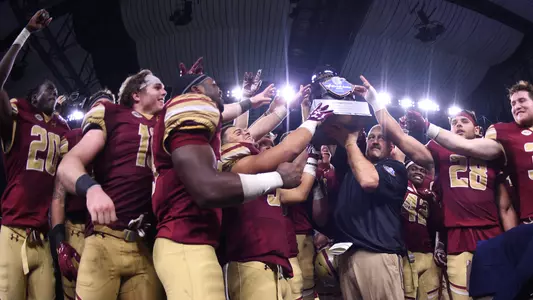
Photo by: Ben Solomon
Looking Back While Glancing Forward
January 04, 2017 | Football, #ForBoston Files
The future is bright, thanks to the improvements made in 2016.
Late in the fourth quarter of the 2016 Quick Lane Bowl, Boston College broke its huddle to victory formation. Graduate quarterback Patrick Towles took the snap, took a knee and watched the rest of the clock tick off the Ford Field scoreboard. It hit zero, signaling the end of the Eagles' first bowl victory since 2007.
It was a triumphant end to what was one of the craziest and most surreal seasons in BC football history. At its surface level, the Eagles finished 7-6, their third winning season of the Steve Addazio era. There were triumphant, exulting victories to contrast with disappointing defeats. In the end, BC broke free of the shadow hanging from the season prior while establishing the work left to do.
From the beginning of the season, there was always one overarching storyline encapsulating the Eagles: development. In 2016, we learned that development can have many different meanings.
Playing with a new quarterback and new offensive scheme, BC started the season young in many different forms. Towles was a fifth-year graduate transfer but he was young because he hadn't taken snaps in the new offense. That contrasted with the youth development of players who hadn't played many snaps with him or in the pro-style offense, namely on the offensive line and in the receiving corps.
As a result, the offense's season wound up taking on a look that was, as the coach described midseason, "herky-jerky." A decent performance against Georgia Tech led to a dominating step forward against Massachusetts, but it ran into a brick wall against Virginia Tech. Dominating performances against Wagner and Buffalo led to another brick wall in Clemson.
A flash of greatness in a comeback win over NC State might've been publicly stunted by big losses to Louisville and Florida State, but a three-game winning streak to end the season invigorated and reenergized the program heading into the offseason.
If there's one thing we did learn about with the offense, it's that there's a very real synergy between its performance and the defense. The bad losses snowballed mainly due to the team's inability to help itself on either side of the ball. When the offense couldn't move the ball against Virginia Tech and Clemson, the defense spent too much time on the field, resulting in explosive plays against the Eagles. When the defense couldn't stop quick explosives, the offense would need to gamble more to come back, resulting in more errors or busted plays.
If there's a huge positive to take away, it's that the synergy was truly on display in the season's last two games. At Wake Forest, BC ran a scoring drive of over four minutes in the fourth quarter to take the lead. The defense forced a punt and a long field goal attempt that was missed before ending the game with an interception.
Against Maryland in the Quick Lane Bowl, the offense scored nearly 30 points in the first half thanks to a 23-points second quarter. In the fourth quarter, Maryland's last 22 plays included four drives, two of which ended on downs, one of which ended in a fumble and one major stand deep in Boston College territory that led to a Terps field goal. Detroit showed the progress against similar teams that started with a defeat in Dublin.
There's no questioning that the Eagles entered this season coming off of an entirely disappointing 2015. The reasons - injuries, youth, inexperience, lack of development - didn't matter. It served, though, as a reboot and the 2016 season saw BC move up the bar in terms of performance.
In many ways, the Eagles aren't where they need to be, but there's no questioning that they've moved ahead. The ACC is the toughest conference in the nation. The leaguge boasts college football's best eight bowl victories, including one in the College Football Playoff. The league champion will compete for the national championship for the third straight season.
Going back to the bowl system, remember that the games are designed to match similar teams against similar opponents from across college football. Teams that go 7-5 or 8-4 face Power Five teams with similar resumes or strong Group of Five teams. It serves as a litmus test for where those programs are against the rest of the nation.
Seven of BC's eight ACC opponents qualified for bowl games. Six of the seven won their game, proving that the bar in the ACC is stronger than it is across other conferences in 2016. That shows just how hard it is to rebuild and win in the conference and it shows how hard it is to reach the next level.
The 2016 season proved the BC offense could compete and have some success against teams in the middle of the pack (Georgia Tech, NC State and Wake Forest). It also proved that the top of the conference is a ways away. The Eagles have turned the corner and they're springboarding into the future, thanks to a season in which they proved they were ready to compete once more.
It was a triumphant end to what was one of the craziest and most surreal seasons in BC football history. At its surface level, the Eagles finished 7-6, their third winning season of the Steve Addazio era. There were triumphant, exulting victories to contrast with disappointing defeats. In the end, BC broke free of the shadow hanging from the season prior while establishing the work left to do.
From the beginning of the season, there was always one overarching storyline encapsulating the Eagles: development. In 2016, we learned that development can have many different meanings.
Playing with a new quarterback and new offensive scheme, BC started the season young in many different forms. Towles was a fifth-year graduate transfer but he was young because he hadn't taken snaps in the new offense. That contrasted with the youth development of players who hadn't played many snaps with him or in the pro-style offense, namely on the offensive line and in the receiving corps.
As a result, the offense's season wound up taking on a look that was, as the coach described midseason, "herky-jerky." A decent performance against Georgia Tech led to a dominating step forward against Massachusetts, but it ran into a brick wall against Virginia Tech. Dominating performances against Wagner and Buffalo led to another brick wall in Clemson.
A flash of greatness in a comeback win over NC State might've been publicly stunted by big losses to Louisville and Florida State, but a three-game winning streak to end the season invigorated and reenergized the program heading into the offseason.
If there's one thing we did learn about with the offense, it's that there's a very real synergy between its performance and the defense. The bad losses snowballed mainly due to the team's inability to help itself on either side of the ball. When the offense couldn't move the ball against Virginia Tech and Clemson, the defense spent too much time on the field, resulting in explosive plays against the Eagles. When the defense couldn't stop quick explosives, the offense would need to gamble more to come back, resulting in more errors or busted plays.
If there's a huge positive to take away, it's that the synergy was truly on display in the season's last two games. At Wake Forest, BC ran a scoring drive of over four minutes in the fourth quarter to take the lead. The defense forced a punt and a long field goal attempt that was missed before ending the game with an interception.
Against Maryland in the Quick Lane Bowl, the offense scored nearly 30 points in the first half thanks to a 23-points second quarter. In the fourth quarter, Maryland's last 22 plays included four drives, two of which ended on downs, one of which ended in a fumble and one major stand deep in Boston College territory that led to a Terps field goal. Detroit showed the progress against similar teams that started with a defeat in Dublin.
There's no questioning that the Eagles entered this season coming off of an entirely disappointing 2015. The reasons - injuries, youth, inexperience, lack of development - didn't matter. It served, though, as a reboot and the 2016 season saw BC move up the bar in terms of performance.
In many ways, the Eagles aren't where they need to be, but there's no questioning that they've moved ahead. The ACC is the toughest conference in the nation. The leaguge boasts college football's best eight bowl victories, including one in the College Football Playoff. The league champion will compete for the national championship for the third straight season.
Going back to the bowl system, remember that the games are designed to match similar teams against similar opponents from across college football. Teams that go 7-5 or 8-4 face Power Five teams with similar resumes or strong Group of Five teams. It serves as a litmus test for where those programs are against the rest of the nation.
Seven of BC's eight ACC opponents qualified for bowl games. Six of the seven won their game, proving that the bar in the ACC is stronger than it is across other conferences in 2016. That shows just how hard it is to rebuild and win in the conference and it shows how hard it is to reach the next level.
The 2016 season proved the BC offense could compete and have some success against teams in the middle of the pack (Georgia Tech, NC State and Wake Forest). It also proved that the top of the conference is a ways away. The Eagles have turned the corner and they're springboarding into the future, thanks to a season in which they proved they were ready to compete once more.
Players Mentioned

QB
/ FootballWomen's Basketball: Head Coach Kate Popovec-Goss on ACCPM (April 2, 2026)
Friday, April 03
#22 Baseball Defeats #6 North Carolina (April 2, 2026)
Friday, April 03
Kate Popovec-Goss Introductory Press Conference
Thursday, April 02
Football: Bill O'Brien Media Availability (April 1, 2026)
Wednesday, April 01