Boston College Athletics
Bobby Swigert: Road to Redemption
September 16, 2015 | Football
CHESTNUT HILL, Mass. – You would think Boston College had just won a championship.
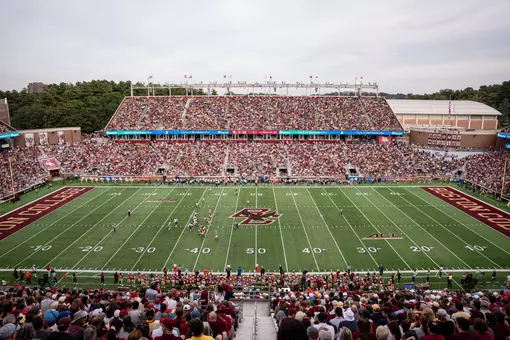
As wide receiver Bobby Swigert emerged from the end zone with the football raised high above him, the Eagles faithful exploded with a roar that reverberated around Alumni Stadium a little louder than any that came before it. The senior's animated celebration as he walked towards the sideline was only trumped by the reaction from his teammates, who raced erratically onto the field to mob him.
No, there wasn't an ACC title or bowl game victory at stake. It was merely a go-ahead touchdown against FCS foe Maine in the season-opener.
Still, there was no denying that this wasn't just any touchdown catch.
This was a touchdown catch nearly three years in the making.
Players weren't expected to arrive for another hour, but here Swigert sat in an empty film room on a cold November morning in 2012.
The darkness engulfed him. The anticipation clenched him in a vise-grip. His heartbeat accelerated, echoing throughout the emptiness.
Swigert's hand shook as he reached out to hit play on the tape.
"It's kind of like when you're passing a wreck on the side of the road," he explained. "You don't want to look, but you can't turn away. I was curious to see exactly how bad it was."
Only a day before, Swigert was on the field for Boston College, lining up against an undefeated Notre Dame.
With the Eagles trailing early in the third quarter, he hauled in a routine catch that quickly proved to be anything but. As Swigert planted to make a cut—a move he's made thousands of times before—his right knee buckled.
The color rushed from Swigert's face as he relived the moment on screen. He instinctively reached down to his knee. He could feel that unbearable pain all over again.
This was one curiosity crawl Swigert couldn't simply put in the rearview mirror.
"I watched it and immediately felt sick to my stomach," he admitted. "It would play in my mind for weeks, every time I closed my eyes. It was just really gruesome."
An MRI would later show that he tore his ACL, MCL, LCL, patella tendon and both menisci.
Such a diagnosis would be a tough card for anyone to be dealt. But for someone who had made it no difficult task to root for him over his first two seasons at the Heights, it all seemed like a cruel twist of fate.
A happy-go-lucky kid out of Louisville, Ohio, Swigert had splashed onto the scene during his freshman and sophomore seasons, racking up a combined 975 yards and seven touchdowns on 83 grabs. It was rare to find Swigert without a smile plastered across his face, and even rarer to see him fail to come down with a football thrown in his direction.
Suddenly, both of those qualities were being put in danger.
"You just automatically begin thinking, 'Why me? Why does this happen now?'' Swigert recalled. "I had just battled back from my other knee bothering me earlier in the season and I just wanted to finish out the season and keep rolling. But everything happens for a reason."
Since the patella tendon was ripped in half, doctors wanted to operate within days to prevent the tendon from curling up.
An initial surgery would repair the MCL, LCL and patella tendon while a second surgery would take care of the ACL. After that, only months of rehab stood between Swigert and a return to the field.
Or so he thought.
Soon after the first surgery, Swigert felt an itch coming from underneath his cast. Feeling something wasn't right, he immediately told his doctors.
Swigert didn't know it yet, but things were about to go from bad to worse.
"As you sit in that chair, I hope there's disappointment," Steve Addazio said, addressing a room full of bright-eyed football players. "I hope it hurts. I hope there's a hunger. I hope there's a drive. I hope that you understand that you came to Boston College to win championships."
If you didn't know any better, you'd think Addazio had been working with those kids for years.
In reality, the Farmington, Conn., native was only a couple hours away from being officially introduced as the next head coach at Boston College. In fact, this was his first time meeting with many of the players.
But while many of his teammates beamed with excitement and enthusiasm, Swigert could only feign a smile, doing his best to cover up his growing fear and concerns.
"You'd like to think you're safe, but it's a new guy coming in who had no idea what I do or what I could do," he said. "And the first day [Addazio] is here, I'm in a cast through my right leg and I'm wheeling around in a wheelchair when I shake his hand. So I don't think his initial thoughts were, 'This guy is going to help me out, let me give him a scholarship.'"
Fortunately, Addazio was a little more understanding than Swigert gave him credit for.
"When I got here, I never really got a chance to know [Swigert]," said Addazio, now in his third year with the Eagles. "But I had heard of what a great player he was, what a great competitor he was and how much I would love him as a player and a person. So I wanted to get a chance to meet him and know him and let him know we were behind him."
He would get the chance to back those words up when Swigert's itch turned out to be a persistent staph infection, one that would require one surgery after another.
Summoned back to life in a hospital bed at New England Baptist, Swigert spent his days fearing that the infection would be the final nail in the coffin of his playing career. It certainly didn't help that his doctors had no idea as to why the infection kept recurring.
Addazio did his part in helping to comfort his wide receiver, visiting the hospital frequently. Many times he would come over unannounced, doing whatever he could to boost the spirits of Swigert.
It was compassion that stretched far beyond the reach of the hospital walls, as Addazio took a recruiting trip to Ohio as an opportunity to visit the home of Swigert's parents.
"[Addazio] barely knew Bobby, but he was there for him," said Kerry Swigert, Bobby's mother, per ESPN's Andrea Adelson. "He told Bobby that he had had staph in his knee. He said, 'I've been through this, you'll get through this. You're one of my kids.'
"It's always been like that with him."
So when the doctors finally figured out what was wrong—the infection had begun eating away at the bone in his knee—nobody was happier for Swigert than Addazio.
The sweat trickled down Swigert's nose, forming a small puddle on the ground in between his feet.
He sat at the edge of the bench press, watching enviously as others wrapped up their workouts and exited the gym. Swigert contemplated following suit. His arms felt like jello; his muscles were saying uncle. But then he remembered.
He remembered the inconvenience of being fed a constant stream of antibiotics through a peripherally inserter catheter in his arm. He remembered the frustration of struggling with the most miniscule of tasks, such as taking a shower and walking from class to class. He remembered the hopeless feeling of watching his bodyweight shrink from 200 pounds to just under 160.
After all, it was because he remembered that he was here.
Without hesitation, Swigert wiped the sweat from his brow, leaned back down and picked up the barbell. And with one deep breath, he was off again.
"Everybody else doubted if he was ever going to play again and how effective he could be if he did," recalled Boston College head strength and conditioning coach Frank Piraino. "Nobody gave him a shot, but he never blinked. He knew that he was going to be out there again."
Under Piraino's guidance, Swigert pushed himself to limits he never knew he had.
He would work out twice a day: once in the morning and once at night. When he wasn't in the gym, he was doing exercises in the pool and running on the zero gravity treadmill.
Slowly but surely, Swigert got his weight back up to 196 pounds, shredding nearly eight percent of body fat in the process.
"Ever since I remember, all I wanted to do was play football," said Swigert. "My family is a football family, my town is a football town. I wasn't going to let this take that away from me."
Still ways away from a return to the football field, Swigert did the next best thing.
Every practice and every game—rain or shine; home or away—Swigert would be there. He kept himself mentally football ready, learning the game from a different perspective while offering up his experience and leadership as a teaching tool for then-wide receivers coach Todd Fitch.
"[Swigert] did a really good job in the locker room, during good times and bad times," said Fitch, now the Eagles' offensive coordinator and quarterbacks coach. "He was a good soundboard for the younger guys. And his experience was invaluable to have on the sidelines."
It was an eye-opening experience for Swigert.
He watched in admiration as Addazio's coaching style immediately paid dividends, leading Boston College to back-to-back 7-6 campaigns and two bowl game appearances in his first two years. It was a breath of fresh air for Swigert, who had witnessed almost the complete opposite during his three years playing for the Eagles from 2010-12; the team was just 13-24 during that span.
Needless to say, Swigert was eager to join in on the fun.
"There's not too many guys that'd go through three years of rehab and miss two full seasons then decide to come back and try to play," said Piraino. "After a year, most guys would say enough is enough and move on with their lives. But for [Swigert] to put that time in, it just shows you the type of kid he is and how badly he wanted it."
It had been almost three years, countless setbacks and 11 knee surgeries since Swigert's cleats last touched the Alumni Stadium turf on game day.
It had been even longer since he last hauled in a touchdown pass. In between, Swigert had logged more hours in an operating room than he had in a film room.
So can you really blame Swigert and his teammates for getting a little rowdy over his first touchdown catch in his first game back?
"When he caught that pass, I was in shock," said junior running back Tyler Rouse. "When I first got [to Boston College] he was recovering from one of his last surgeries, so I really got to see him grind. It's just so great to see someone who put in so much effort succeed."
Swigert deserved this celebration. He earned it.
This was the culmination of three years of blood, sweat and tears he put in just to be able to once again play the game he grew up loving.
"I didn't come back because I wanted to try and get drafted in the NFL," said Swigert. "I came back because of what happened [against Maine]. I love that feeling of being in the huddle with your teammates and scoring in front of screaming fans.
"Without football, and without the support I've received, none of this would have been possible."