Boston College Athletics
Dave Spina: A 20-Minute Circle
November 24, 2003 | Men's Hockey
by Will Shapiro
Boston College Media Relations
Nov. 24, 2003
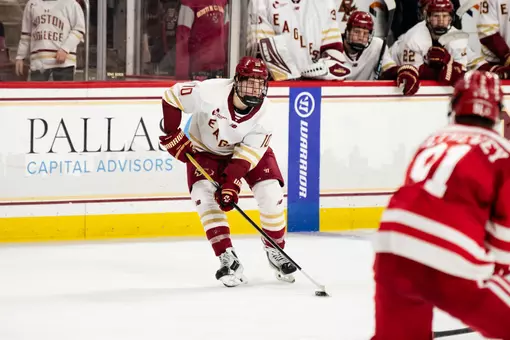
In poring over the hometowns on the 2003-04 Boston College hockey roster, you see players from all kinds of hockey hotbeds. Of the 26 current Eagles, 10 hail from New England, four from New York, four from Minnesota and three from New Jersey. Ty Hennes comes from North Dakota, by way of Washington, Peter Harrold is from Ohio and goaltender Matti Kaltiainen comes from Espoo, Finland. All of those places have been producing hockey talent for generations. Then there is Dave Spina, the junior forward who hails from Mesa, Arizona, just outside of Phoenix. Arizona? Spina's story does not begin in the desert, but that is certainly where it develops. But we begin in Seattle, Washington, where Spina laced up his first pair of skates.
"I started playing when I was 3 years old. We lived in Seattle and my mom couldn't take all the bad weather. Just too much gray sky and rain," said the forward. "She needed to go someplace bright and white and the ice rink was the first thing that caught her attention, so she signed my older sister up for figure skating. I was always at the rink with them, so I started playing."
When Dave (his birth certificate reads "Dave Andrew Spina" and he does not answer to David) was 9, Linda and Tom Spina were preparing to move the family to Phoenix and they thought that perhaps Dave might like to try another sport, one more conducive to the area in which he would be living. His parents signed him up for soccer.
"I had a great time playing soccer. I'd come off the field and my mom would ask me how it was and I'd always tell her it was 'the second funnest thing I've ever done.' Obviously, my love was hockey."
So Dave played hockey. And it was no small task. There were only two ice rinks in the Phoenix area, and only one on which it was possible to get significant ice time. The Spinas were prepared to help their son excel at his passion and made the appropriate arrangements. In fact, most would say they went above and beyond.
"When we were moving to Phoenix, my parents took a map and drew a 20-minute circle around the ice rink and that's how we picked our house," Spina said.
With a house within 20 minutes of the rink and a team for their son to play on, the Spinas realized that their son's situation was not unique. Many of the families in Phoenix at the time were recently relocated, just as theirs was, and Dave does not remember more than two kids on his team who were actually born in Phoenix. Even his coach was from Michigan, a man who had grown up around the game and had played it his whole life.
Hockey teams are known for their bizarre practice hours, but that was taken to a new level in Phoenix. Ice time in Phoenix was expensive, given the scarcity of practice sheets, and the house programs (i.e., the older teams that generated money) got first dibs. Thus, Dave's team found itself getting on the ice for just three hours a week, with most of the practices being held either at midnight or four in the morning. It was a grind, but it was an experience that would prove valuable for Spina down the road.
Still, with such limited ice time, Dave and his teammates had to find some way to work on their skills. The answer? Street hockey.
"We played street hockey forever out there because the weather is phenomenal in the winter. We probably played nine hours a day. I think that's why a lot of the kids who come from Phoenix are good skaters and well-skilled players. Maybe they don't understand the game as well as the kids who grew up around it, but their skills are pretty honed because that's what we grew up doing, playing in each other's driveways for hours at a time."
By age 16, it was clear that Dave was more than just a kid who loved hockey. He had talent and for his junior year of high school, he moved to Texas and played the 1999-2000 season with the Texas Tornado of the North American Hockey League. Everyone else on the team was at least 19, but 16-year-old Dave managed to record 51 points in 61 games that season, a performance that caught the eye of U.S. National Under-18 Team coach Mike Eaves.
"I had a great relationship with Coach Eaves (father of current BC teammates Ben and Patrick). He's an intense, straightforward guy and that's what I grew up with. In Phoenix, we were only given three hours of ice time a week, so we had to make the most of it," the 5-foot-11-inch, 185-pound forward said. "Coach Eaves coaches like that, making the most of every minute, and I respect that. He also gave me a chance, and I respect that as well. I think I made the most of being in the National Team program."
Dave played the 2000-2001 season with the Under-18 Team and it was during that season that it came time for him to decide what was next. He knew he wanted to play college hockey, but where would he go?
"The easiest thing to do would've been to go to school and play close to home, maybe at Denver. Don't think I didn't look at places like that. But when I took my visit here I thought the campus was beautiful and the place just had everything going for it, but I still wasn't very sure," Dave said. "So, when I went back to Ann Arbor, I asked Pat (Eaves) 'Pat, are you going to BC?' He told me he was going to play with his brother. That made my decision a whole lot easier. Pat's a great person and a great player. His wanting to go there showed me that BC was going to continue to get kids of that caliber."
The only player on the Under-18 Team younger than Spina also had ties to Boston College: Stephen Gionta knew that he would follow his brother Brian's path to the Heights and Spina took that into consideration as well.
"Brian Gionta is a great role model," he said. "Between Ben and Patrick Eaves, the Giontas and Coach York, I knew BC was the place."
And so BC is the place. In his first two seasons in Chestnut Hill, Spina has racked up 63 points on 30 goals and 33 assists and he fully expects to continue to improve his game. After all, around these parts, you don't have to draw a 20-minute circle to find an ice rink.