Boston College Athletics
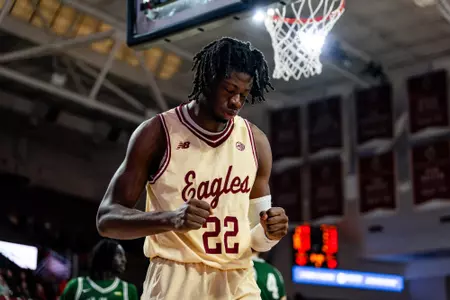
Photo by: Chris Remick
The Opening Tip: Georgia Tech
January 02, 2026 | Men's Basketball, #ForBoston Files
ACC play kicks off with a trip to Atlanta.
The ACC's decision to expand conference membership at the start of the 21st century was solely steeped in the desire for a lucrative football championship game. NCAA rules at the time required leagues to split into two divisions, and regulations subsequently needed 12 teams in order to create the required format. Led by then-commissioner John Swofford, the nine-team league used its 2003 vote to expand as the impetus to initially investigate Big East membership, and Miami, Syracuse and Boston College quickly emerged as the initial targets before Virginia Tech inserted its name into the conversation.
The ensuing legal conversation revolved primarily around the football schools. Miami was an obvious choice because of its gridiron success and relative geographic location, but Virginia Tech emerged after Virginia governor Mark Warner pressured the conference to invite an athletics department that hadn't even full Big East membership until 2000. Syracuse and Boston College remained behind, and their jockeying and campaigning ultimately ended with the Eagles leaving the Big East one year after the Hurricanes and Hokies.
Nobody really questioned the ACC's motives or its 12-team endgame. Football steamrolled towards the same type of conference championship game as the SEC and Big 12, and the three-team expansion solidified a football conference that largely operated behind Florida State's overall dominance. The hardwoods weren't totally in the equation.
Yet any decision required the ACC to protect the integrity of a basketball conference with a successful history predating anything football-related. Miami and Virginia Tech weren't the answer in that regard, so adding BC struck at the very soul of the regionalized conferences by adding a university that helped form the nucleus of the northeast basketball movement.
"It was pretty intense in the league we came from," said then-head coach Al Skinner in the aftermath of the Eagles' 73-71 loss to the Terrapins, "so once the game got started, it was no different than any game we played last year. If anything, we just have to get adjusted to the personnel and the coaching styles."
Clear-cut runs through the NCAA Tournament in the 1980s and 1990s added heavyweight cache to BC's case for admission into the ACC. Football rolled through bowl wins after Tom O'Brien rebuilt the program from its mid-1990s doldrums while baseball posted multiple 30-win seasons after missing the Big East baseball tournament on a regular basis, but basketball was the ACC's bread-and-butter and Miami and Virginia Tech were not perennial powerhouses. Beyond even the aforementioned league membership with the Hokies, at least the Hurricanes had been to the NCAA Tournament under Leonard Hamilton and Perry Clark. The Hokies were nowhere near that level and missed March Madness in their last nine seasons in the Metro Conference before routinely slipping through the Atlantic-10 and the Big East.
BC was altogether different. The 2000-2001 team won 27 games and the Big East tournament championship before earning a No. 3 seed in the national tournament, and the last year in the conference included a 20-0 start and No. 3 overall national ranking. The Eagles had advanced to four tournaments in the 1980s, three in the 1990s and four-out-of-five between 2001 and the realignment decision. That first game at Maryland in 2005 carried a March-type atmospheric feel, and a Sweet Sixteen appearance followed a trip to the ACC Tournament championship game.
"For BC fans, [the semifinal win over North Carolina] was truly magical, with touches of irony," wrote The Boston Globe during that inaugural ACC Tournament trek. "...nor was there anything other than satisfaction when Craig Smith pointed at the small group of BC fans in the ocean of blue during the celebration."
For 20 years, various forms of realignment and expansion watered down or quieted the impact of BC's arrival in the ACC. The different waves were geared towards different outlets and goals before eventually reuniting the Eagles with former Big East foes from Syracuse, Pittsburgh and Notre Dame. The conference footprint stretches from New England to Florida to Texas to California.
Saturday's game is a reminder, though, of a time when BC upset college basketball's apple cart by bringing Northeast basketball to Tobacco Road. No matter how much things have changed, the road back to that point is still the North Star of a program that's now been in the ACC for almost as many years as the Big East.
Here's what to expect from Saturday's matchup against Georgia Tech:
****
Georgia Tech Storylines (Jimmy Carter Edition)
We must adjust to changing times and still hold to unchanging principles.
Georgia Tech's loss to Duke on New Year's Eve highlighted the perfect example of a Yellow Jacket team that swings between both ends of the spectrum. The team that lost to Georgia by five points later dropped double-digit defeats to DePaul and Drake before regaining its stroke with a four-game winning streak over mid-major opponents, so battling the Blue Devils to a halftime lead illustrated the growth aspects of a tempo-based attack that can swarm an opposing defense. A 68 percent field goal percentage brought the house down on Cameron Indoor Stadium by complementing a defense that held Duke below 40 percent, and a multi-dimensional top-ranked team appeared more boxed into Cameron Boozer's ample toolkit than usual.
That flow, though, was interrupted by a second half shooting percentage that cratered to a more manageable 39 percent, and Georgia Tech ultimately fell out of sync by failing to control the window against Boozer and a dominant front court. Getting to the line with more regularity didn't help, and Duke's starting five broke out while the Yellow Jacket offense was forced to become more one-dimensional around Kowacie Reeves.
In other words, Georgia Tech looked remarkably similar to a Boston College team that illustrated its best and worst when it's able to dictate the pace and play from a position of strength.
"You have to keep showing up and trying to come up with a good game plan," said head coach Earl Grant. "If you can coach the game all the way to the end and hope that you have a good process to play the right way, [then] you have a chance to be successful. For us, it's kind of weird because in most games, we'll find a certain lineup that's been [good] for that day, and then we'll break through. It was that way [against Le Moyne] where we had [different] guys [playing well] at the same time."
Duke bottled Georgia Tech in the second half by impacting the ball movement in and around Reeves. His play in the frontcourt produced a 1-for-4 clip on two-point shots despite his ability to consistently land shots from the outside, but the Blue Devils understood that preventing Reeves from getting good looks at the basket required more of an attack towards ball handler Lamar Washington and fellow facilitator Akai Fleming.
You can do what you have to do, and sometimes you can do it even better than you think you can.
Removing options around the primary shooter was a big part of Boston College's defensive strategy in the second half of its win over Le Moyne. Having been surprised by the offensive quickness and inside-out looks to Shilo Jackson left the Eagles with a first half struggle to stop Tennessee Rainwater's looks from outside, but they were able to clamp the majority of outer looks by bottling Jackson to few field goal attempts in the second half. He was still able to grab rebounds on the defensive window, but his ability to help his offense slipped into obscurity after BC made its own adjustment.
"We watched [the Le Moyne] game at St. Bonaventure, and they were ahead with six to 10 minutes to go," said Grant. "We saw that and thought that this team was pretty good. We knew it was going to be a challenge, and I think the parity in college basketball exists because guys can transfer to a place like Le Moyne. I wasn't shocked by the film, especially with two games of prep coming out of Christmas, that [the game] would be tough, but I'm glad we had a good enough plan, and the staff and players were able to lock in and get done what they needed to get done."
Statistical polls are calculated in a way that removes emotional bias from a team's performance, so NEC teams - reclassifying Division II teams, in particular – are measured by their results against particular schedules. The large bulk of games are against lower-tiered programs, which results in them falling through the cracks as a lighter or less regarded team, but their rosters are lined with former Division I talents who are looking for a new opportunity for their own personal reasons.
Jackson, for example, played at Texas A&M-Corpus Christi and twice scored in double-figures against Mountain West Conference opponents before transferring to the Dolphins. Modest as that seems, one of those games was against a New Mexico team that went 27-8 with a regular season championship under head coach Richard Pitino.
"We've been battle tested," said Donald Hand, Jr. "We lost some really close games, some games that we should have won, but we've been battle tested. A couple of us who were in the ACC last year, we know what to expect [from opponents]."
If you are honest with yourself and can look into a mirror and believe that you have given 100 percent, you should feel proud. If you cannot, then there is more work to be done.
Those built-in assumptions about a team's position in an analytics poll makes it easy to discount BC's wins over Le Moyne and Fairleigh Dickinson. Neither team sat on the level of an ACC opponent, and coming on the heels of the four-point win over New Haven and the loss to UMass makes criticism especially easy for a team that hadn't won two straight games since mid-November.
The metrics, though, are weighted in a way that illustrates BC's growth over the first 13 games of the 2025-2026 season. The ninth-best three-point defense in the nation is a lethal weapon in a game built increasingly by the outside shot, and a top-50 two-point defensive efficiency doesn't exist without developing trends against big men. Whatever and wherever the adjustments occurred, BC hasn't been a bad team, and the luck factor - the part of a schedule that explains how points scored and allowed don't impact a team's record - is exactly why the seven-win team is dangerous as it enters its ACC schedule.
"When a game gets tight, you have to embrace it," said Grant. "We've been in a lot of tight games, and I think we are finding a lot about our team, the character of our group. We're not at our potential yet, which is exciting, so hopefully we can continue to improve and keep moving towards the maximum potential of our team."
*****
Question Box
Who wins the turnover battle?
BC enters Saturday with a decisive advantage towards creating and avoiding turnover numbers, while Georgia Tech is on the lower end in its ability to attack the ball against an opponent. The Yellow Jackets are approximately one turnover per game less than the national average while facing a BC offense that's a full 2.5 turnovers behind the national average, which points towards the Eagles while the Georgia Tech offense produces nearly two extra turnovers per game.
BC's defense doesn't necessarily excel in the area where it needs to create those extra possessions, but timely ball attacks are incredibly disruptive. Given its overall issues with protecting the basketball, this is an area to watch, especially in the first half when either team is attempting to employ a particular pace on the game flow.
Can BC get to the line against a stingy Georgia Tech defense?
Georgia Tech's game against Duke sent the Yellow Jackets spiraling towards the extreme end of the free throw line after the Blue Devils shot 24-for-35 from the stripe. That they shot 11-for-13 from the line produced a full 50 percent less points in a game decided by six points, so preventing Duke from getting to the line or producing more opportunities for shooting fouls would have closed or extended the gap to a degree that could have altered the final score.
BC, meanwhile, is one of the top teams at preventing opponents from getting to the line, and its 36.7 percent ratio of free throw attempts to field goal attempts kept the Eagles in a position to defeat UMass and LSU after their shooting percentage started slipping. Like the Georgia Tech game against Duke, being able to stop an opponent from getting to the stripe therefore provides a backdrop for BC's need to both get to the line for free points while preventing Georgia Tech from operating as its own outlier.
Will I ever stop coughing?
I caught the flu before Christmas, so I'm living with this residual dry cough that refuses to go away. I'm totally healthy, but getting past the contagious state did little to stop the weird looks when I started unexpectedly hacking at the supermarket. I had that burning sensation that people were staring at me because I was wheezing through a fit in front of the deli, and I didn't really even blame anyone because I'd probably do the same thing to someone else.
I hadn't had the flu for years, so this is all new territory for a 40-year old man. I'll be honest, though: I hate the cough. I could live without it. I'm actually kind of sick of being sick…and I'm not sick. I'm just that weird aftermath of the flu.
Maybe next time I feel this way, I'll just blame it on some pizza before playing 40 minutes of a basketball game.
*****
BC-Georgia Tech X Factor
The secret of getting ahead is getting started. -Mark Twain
Both Boston College and Georgia Tech had their own respective issues with starting games on time during the first half of the season. Both got better as games advanced, but both teams absorbed losses because they stumbled out of the starting blocks against a tough or stingy opponent. For BC, the Tulane loss stuck out as a particularly thorny start because the team played so well ahead of the stretch run, but the start was slow enough to result in the Eagles burning through their energy to even grab the lead. Against Florida Atlantic, the slow start in the first half of the first half put them down eight before they wound up in overtime against the Owls, a similar situation to what would eventually occur against the Green Wave.
Georgia Tech likewise struggled through the early minutes of its game against Mississippi State, and an exceptionally slow start sunk the end of the first half comeback against DePaul. A slow start against Georgia prevented them from overcoming the Bulldogs despite strong finishes to both halves.
Strong starts haven't been in the cards for either team. Their last games were better after BC opened strong against Le Moyne and Georgia Tech rattled Duke through the first 10 minutes, but the games eventually landed on grueling affairs against teams from opposite ends of the basketball spectrum. Plotting a chart for Saturday therefore makes it imperative for both teams to open quickly and enforce their style of play against their opponent.
"We found a lot of ourselves with high adversity," admitted Grant, 'and I'm thankful that we showed great character through the adversity. We're 7-6, and ideally, it'd be nice if we were five points better so we could be 10-3. That'd be amazing, but we're not. We're not a 7-6 team, and we're not a 10-3 team. We're somewhere in between, but we've got to learn from these situations and those games."
*****
Scoreboard Watching
I spent part of New Year's Eve in the car after I drove one of my daughters home from my parents' house, and her ability to fall asleep in the first 15 minutes of the ride allowed me to listen to the majority of Virginia Tech's triple overtime win over Virginia. A phenomenal game, in my opinion, that included a couple of last second shots and plays by both teams in front of a sold-out crowd at Cassell Coliseum.
Considering no ranked teams played on New Year's Day, that game headlined the start of a phenomenal night of college basketball. ACC play got underway in earnest with No. 6 Duke barely squeaking by the Georgia Tech team hosting BC on Saturday afternoon, and both St. John's and Villanova were pushed by Georgetown and DePaul in Big East play. Five teams hit triple digits - three of which involved Division I opponents - and Florida Atlantic dropped 110 points in a 40-point win over UTSA as it began American play.
Friday brought some of the heavy hitters back to the hardwood for games at No. 3 Iowa State and No. 7 Gonzaga, and the game between No. 9 Michigan State and No. 13 Nebraska added flair to a late night schedule that saw the ACC go through its after dark motions with Notre Dame's trip to Cal.
Saturday, though, is where college basketball's traditional slate takes center stage. In the ACC, even with their loss to the Hokies, the No. 21 Cavaliers are at NC State at 11 a.m. before Virginia Tech tips off at Wake Forest at noon. Clemson is at Pittsburgh at noon as well while No. 12 UNC is in Texas for a 2:15 tip-off against SMU. In the early evening, CBS national coverage brings No. 6 Duke to Florida State.
On the national radar, No. 14 Alabama hosts Kentucky at noon before No. 15 Texas Tech hosts Oklahoma State and No. 23 Georgia hosts Auburn, both at 1 p.m. They precede nationally-televised games for No. 8 Houston, No. 10 BYU, No. 11 Vanderbilt and No. 17 Kansas that all start between the hour-window separating 1:30-2:30 p.m. A later 3 p.m. start features No. 19 Tennessee and No. 18 Arkansas in a battle of heavy hitters in the SEC.
A sneaky tough matchup at Wisconsin for No. 5 Purdue headlines primetime, and Boise State's trip to San Diego State is part of the late night brigade, and on Sunday, No. 4 UConn hosts Marquette during the NFL's early afternoon window.
*****
This Random Day In History
I very clearly remember every detail about the night that the Curse of the Bambino ended. I remember running out of my dorm room to hug my roommate after Keith Foulke tossed the last out to first, and I remember calling both my dad and my grandfather before I sauntered onto the UMass-Dartmouth residential quad for late night celebrations. I still remember my grandfather not believing that the Boston Red Sox won the World Series.
For years, he and my dad talked about Bobby Orr and Larry Bird in reverential tones. They'd been original season ticket holders when the Boston Patriots played their first games at Harvard Stadium. I'd watched every sport with them, and I'd been to Fenway Park with them for a couple of Red Sox family outings (back when that was affordable).
We never really talked about the Red Sox because everyone carried a general malaise and sadness about them. They were never good, and they always found a way to mess up winning. The Curse of the Bambino was a real thing that Boston folk believed, and it fomented more deeply as I got more and more into baseball as a teenager.
The story went that Red Sox owner Harry Frazee sold Babe Ruth to the New York Yankees for $125,000 in cash and a $350,000 loan that we were taught was used to finance a Broadway play called No, No Nanette.
That sale happened on January 3, 1920.
It took 86 years for the Red Sox to win the World Series after their 1918 championship. The Curse lasted for 84 official years after they sold Ruth to the Yankees. If I had a time machine, even knowing how 2004, 2007, 2013 and 2018 were going to go, I'd probably go back in time and stop that from happening before I do a number of different things.
*****
Pregame Quote and Final Thoughts
Life is easy when you're hot. But what happens when the ball bounces the other way? You just keep getting back up and climbing up. -Bill Walton
Boston College arrived in the ACC as a national powerhouse after winning the Big East's regular season and postseason tournament through the early years of the 21st century. The Eagles were miscast, a Northeast-based power team in a southern blue-blood league. They were called outsiders, and they weren't expected to upend the power structure of Tobacco Road's infamous basketball insulation.
Twenty years later, BC's success helped the ACC expand beyond its wildest geographic limitations, and while the Eagles haven't been to the NCAA Tournament in 17 years, there's a hunger to build and construct the program in a way that's different from its past. Time isn't always a popular factor in the modern college era, but the patience, love and dedication of the BC program kept it afloat through several different upheavals.
This Boston College team is better than its record, but proof is required to showcase the progression that's occurred through those early growing pains. A trip to Georgia Tech for the first game of the season is the first step in a long journey that's only truly starting to begin, on a mountain that doesn't care about adversity.
Boston College and Georgia Tech tip-off at 2:00 p.m. on Saturday from McCamish Pavilion in Atlanta, Georgia. National television coverage is available on the ACC Network with streaming available through ESPN's direct-to-consumer platform for subscribers with access to the network while radio coverage is available through WEEI 850 AM.
The ensuing legal conversation revolved primarily around the football schools. Miami was an obvious choice because of its gridiron success and relative geographic location, but Virginia Tech emerged after Virginia governor Mark Warner pressured the conference to invite an athletics department that hadn't even full Big East membership until 2000. Syracuse and Boston College remained behind, and their jockeying and campaigning ultimately ended with the Eagles leaving the Big East one year after the Hurricanes and Hokies.
Nobody really questioned the ACC's motives or its 12-team endgame. Football steamrolled towards the same type of conference championship game as the SEC and Big 12, and the three-team expansion solidified a football conference that largely operated behind Florida State's overall dominance. The hardwoods weren't totally in the equation.
Yet any decision required the ACC to protect the integrity of a basketball conference with a successful history predating anything football-related. Miami and Virginia Tech weren't the answer in that regard, so adding BC struck at the very soul of the regionalized conferences by adding a university that helped form the nucleus of the northeast basketball movement.
"It was pretty intense in the league we came from," said then-head coach Al Skinner in the aftermath of the Eagles' 73-71 loss to the Terrapins, "so once the game got started, it was no different than any game we played last year. If anything, we just have to get adjusted to the personnel and the coaching styles."
Clear-cut runs through the NCAA Tournament in the 1980s and 1990s added heavyweight cache to BC's case for admission into the ACC. Football rolled through bowl wins after Tom O'Brien rebuilt the program from its mid-1990s doldrums while baseball posted multiple 30-win seasons after missing the Big East baseball tournament on a regular basis, but basketball was the ACC's bread-and-butter and Miami and Virginia Tech were not perennial powerhouses. Beyond even the aforementioned league membership with the Hokies, at least the Hurricanes had been to the NCAA Tournament under Leonard Hamilton and Perry Clark. The Hokies were nowhere near that level and missed March Madness in their last nine seasons in the Metro Conference before routinely slipping through the Atlantic-10 and the Big East.
BC was altogether different. The 2000-2001 team won 27 games and the Big East tournament championship before earning a No. 3 seed in the national tournament, and the last year in the conference included a 20-0 start and No. 3 overall national ranking. The Eagles had advanced to four tournaments in the 1980s, three in the 1990s and four-out-of-five between 2001 and the realignment decision. That first game at Maryland in 2005 carried a March-type atmospheric feel, and a Sweet Sixteen appearance followed a trip to the ACC Tournament championship game.
"For BC fans, [the semifinal win over North Carolina] was truly magical, with touches of irony," wrote The Boston Globe during that inaugural ACC Tournament trek. "...nor was there anything other than satisfaction when Craig Smith pointed at the small group of BC fans in the ocean of blue during the celebration."
For 20 years, various forms of realignment and expansion watered down or quieted the impact of BC's arrival in the ACC. The different waves were geared towards different outlets and goals before eventually reuniting the Eagles with former Big East foes from Syracuse, Pittsburgh and Notre Dame. The conference footprint stretches from New England to Florida to Texas to California.
Saturday's game is a reminder, though, of a time when BC upset college basketball's apple cart by bringing Northeast basketball to Tobacco Road. No matter how much things have changed, the road back to that point is still the North Star of a program that's now been in the ACC for almost as many years as the Big East.
Here's what to expect from Saturday's matchup against Georgia Tech:
****
Georgia Tech Storylines (Jimmy Carter Edition)
We must adjust to changing times and still hold to unchanging principles.
Georgia Tech's loss to Duke on New Year's Eve highlighted the perfect example of a Yellow Jacket team that swings between both ends of the spectrum. The team that lost to Georgia by five points later dropped double-digit defeats to DePaul and Drake before regaining its stroke with a four-game winning streak over mid-major opponents, so battling the Blue Devils to a halftime lead illustrated the growth aspects of a tempo-based attack that can swarm an opposing defense. A 68 percent field goal percentage brought the house down on Cameron Indoor Stadium by complementing a defense that held Duke below 40 percent, and a multi-dimensional top-ranked team appeared more boxed into Cameron Boozer's ample toolkit than usual.
That flow, though, was interrupted by a second half shooting percentage that cratered to a more manageable 39 percent, and Georgia Tech ultimately fell out of sync by failing to control the window against Boozer and a dominant front court. Getting to the line with more regularity didn't help, and Duke's starting five broke out while the Yellow Jacket offense was forced to become more one-dimensional around Kowacie Reeves.
In other words, Georgia Tech looked remarkably similar to a Boston College team that illustrated its best and worst when it's able to dictate the pace and play from a position of strength.
"You have to keep showing up and trying to come up with a good game plan," said head coach Earl Grant. "If you can coach the game all the way to the end and hope that you have a good process to play the right way, [then] you have a chance to be successful. For us, it's kind of weird because in most games, we'll find a certain lineup that's been [good] for that day, and then we'll break through. It was that way [against Le Moyne] where we had [different] guys [playing well] at the same time."
Duke bottled Georgia Tech in the second half by impacting the ball movement in and around Reeves. His play in the frontcourt produced a 1-for-4 clip on two-point shots despite his ability to consistently land shots from the outside, but the Blue Devils understood that preventing Reeves from getting good looks at the basket required more of an attack towards ball handler Lamar Washington and fellow facilitator Akai Fleming.
You can do what you have to do, and sometimes you can do it even better than you think you can.
Removing options around the primary shooter was a big part of Boston College's defensive strategy in the second half of its win over Le Moyne. Having been surprised by the offensive quickness and inside-out looks to Shilo Jackson left the Eagles with a first half struggle to stop Tennessee Rainwater's looks from outside, but they were able to clamp the majority of outer looks by bottling Jackson to few field goal attempts in the second half. He was still able to grab rebounds on the defensive window, but his ability to help his offense slipped into obscurity after BC made its own adjustment.
"We watched [the Le Moyne] game at St. Bonaventure, and they were ahead with six to 10 minutes to go," said Grant. "We saw that and thought that this team was pretty good. We knew it was going to be a challenge, and I think the parity in college basketball exists because guys can transfer to a place like Le Moyne. I wasn't shocked by the film, especially with two games of prep coming out of Christmas, that [the game] would be tough, but I'm glad we had a good enough plan, and the staff and players were able to lock in and get done what they needed to get done."
Statistical polls are calculated in a way that removes emotional bias from a team's performance, so NEC teams - reclassifying Division II teams, in particular – are measured by their results against particular schedules. The large bulk of games are against lower-tiered programs, which results in them falling through the cracks as a lighter or less regarded team, but their rosters are lined with former Division I talents who are looking for a new opportunity for their own personal reasons.
Jackson, for example, played at Texas A&M-Corpus Christi and twice scored in double-figures against Mountain West Conference opponents before transferring to the Dolphins. Modest as that seems, one of those games was against a New Mexico team that went 27-8 with a regular season championship under head coach Richard Pitino.
"We've been battle tested," said Donald Hand, Jr. "We lost some really close games, some games that we should have won, but we've been battle tested. A couple of us who were in the ACC last year, we know what to expect [from opponents]."
If you are honest with yourself and can look into a mirror and believe that you have given 100 percent, you should feel proud. If you cannot, then there is more work to be done.
Those built-in assumptions about a team's position in an analytics poll makes it easy to discount BC's wins over Le Moyne and Fairleigh Dickinson. Neither team sat on the level of an ACC opponent, and coming on the heels of the four-point win over New Haven and the loss to UMass makes criticism especially easy for a team that hadn't won two straight games since mid-November.
The metrics, though, are weighted in a way that illustrates BC's growth over the first 13 games of the 2025-2026 season. The ninth-best three-point defense in the nation is a lethal weapon in a game built increasingly by the outside shot, and a top-50 two-point defensive efficiency doesn't exist without developing trends against big men. Whatever and wherever the adjustments occurred, BC hasn't been a bad team, and the luck factor - the part of a schedule that explains how points scored and allowed don't impact a team's record - is exactly why the seven-win team is dangerous as it enters its ACC schedule.
"When a game gets tight, you have to embrace it," said Grant. "We've been in a lot of tight games, and I think we are finding a lot about our team, the character of our group. We're not at our potential yet, which is exciting, so hopefully we can continue to improve and keep moving towards the maximum potential of our team."
*****
Question Box
Who wins the turnover battle?
BC enters Saturday with a decisive advantage towards creating and avoiding turnover numbers, while Georgia Tech is on the lower end in its ability to attack the ball against an opponent. The Yellow Jackets are approximately one turnover per game less than the national average while facing a BC offense that's a full 2.5 turnovers behind the national average, which points towards the Eagles while the Georgia Tech offense produces nearly two extra turnovers per game.
BC's defense doesn't necessarily excel in the area where it needs to create those extra possessions, but timely ball attacks are incredibly disruptive. Given its overall issues with protecting the basketball, this is an area to watch, especially in the first half when either team is attempting to employ a particular pace on the game flow.
Can BC get to the line against a stingy Georgia Tech defense?
Georgia Tech's game against Duke sent the Yellow Jackets spiraling towards the extreme end of the free throw line after the Blue Devils shot 24-for-35 from the stripe. That they shot 11-for-13 from the line produced a full 50 percent less points in a game decided by six points, so preventing Duke from getting to the line or producing more opportunities for shooting fouls would have closed or extended the gap to a degree that could have altered the final score.
BC, meanwhile, is one of the top teams at preventing opponents from getting to the line, and its 36.7 percent ratio of free throw attempts to field goal attempts kept the Eagles in a position to defeat UMass and LSU after their shooting percentage started slipping. Like the Georgia Tech game against Duke, being able to stop an opponent from getting to the stripe therefore provides a backdrop for BC's need to both get to the line for free points while preventing Georgia Tech from operating as its own outlier.
Will I ever stop coughing?
I caught the flu before Christmas, so I'm living with this residual dry cough that refuses to go away. I'm totally healthy, but getting past the contagious state did little to stop the weird looks when I started unexpectedly hacking at the supermarket. I had that burning sensation that people were staring at me because I was wheezing through a fit in front of the deli, and I didn't really even blame anyone because I'd probably do the same thing to someone else.
I hadn't had the flu for years, so this is all new territory for a 40-year old man. I'll be honest, though: I hate the cough. I could live without it. I'm actually kind of sick of being sick…and I'm not sick. I'm just that weird aftermath of the flu.
Maybe next time I feel this way, I'll just blame it on some pizza before playing 40 minutes of a basketball game.
*****
BC-Georgia Tech X Factor
The secret of getting ahead is getting started. -Mark Twain
Both Boston College and Georgia Tech had their own respective issues with starting games on time during the first half of the season. Both got better as games advanced, but both teams absorbed losses because they stumbled out of the starting blocks against a tough or stingy opponent. For BC, the Tulane loss stuck out as a particularly thorny start because the team played so well ahead of the stretch run, but the start was slow enough to result in the Eagles burning through their energy to even grab the lead. Against Florida Atlantic, the slow start in the first half of the first half put them down eight before they wound up in overtime against the Owls, a similar situation to what would eventually occur against the Green Wave.
Georgia Tech likewise struggled through the early minutes of its game against Mississippi State, and an exceptionally slow start sunk the end of the first half comeback against DePaul. A slow start against Georgia prevented them from overcoming the Bulldogs despite strong finishes to both halves.
Strong starts haven't been in the cards for either team. Their last games were better after BC opened strong against Le Moyne and Georgia Tech rattled Duke through the first 10 minutes, but the games eventually landed on grueling affairs against teams from opposite ends of the basketball spectrum. Plotting a chart for Saturday therefore makes it imperative for both teams to open quickly and enforce their style of play against their opponent.
"We found a lot of ourselves with high adversity," admitted Grant, 'and I'm thankful that we showed great character through the adversity. We're 7-6, and ideally, it'd be nice if we were five points better so we could be 10-3. That'd be amazing, but we're not. We're not a 7-6 team, and we're not a 10-3 team. We're somewhere in between, but we've got to learn from these situations and those games."
*****
Scoreboard Watching
I spent part of New Year's Eve in the car after I drove one of my daughters home from my parents' house, and her ability to fall asleep in the first 15 minutes of the ride allowed me to listen to the majority of Virginia Tech's triple overtime win over Virginia. A phenomenal game, in my opinion, that included a couple of last second shots and plays by both teams in front of a sold-out crowd at Cassell Coliseum.
Considering no ranked teams played on New Year's Day, that game headlined the start of a phenomenal night of college basketball. ACC play got underway in earnest with No. 6 Duke barely squeaking by the Georgia Tech team hosting BC on Saturday afternoon, and both St. John's and Villanova were pushed by Georgetown and DePaul in Big East play. Five teams hit triple digits - three of which involved Division I opponents - and Florida Atlantic dropped 110 points in a 40-point win over UTSA as it began American play.
Friday brought some of the heavy hitters back to the hardwood for games at No. 3 Iowa State and No. 7 Gonzaga, and the game between No. 9 Michigan State and No. 13 Nebraska added flair to a late night schedule that saw the ACC go through its after dark motions with Notre Dame's trip to Cal.
Saturday, though, is where college basketball's traditional slate takes center stage. In the ACC, even with their loss to the Hokies, the No. 21 Cavaliers are at NC State at 11 a.m. before Virginia Tech tips off at Wake Forest at noon. Clemson is at Pittsburgh at noon as well while No. 12 UNC is in Texas for a 2:15 tip-off against SMU. In the early evening, CBS national coverage brings No. 6 Duke to Florida State.
On the national radar, No. 14 Alabama hosts Kentucky at noon before No. 15 Texas Tech hosts Oklahoma State and No. 23 Georgia hosts Auburn, both at 1 p.m. They precede nationally-televised games for No. 8 Houston, No. 10 BYU, No. 11 Vanderbilt and No. 17 Kansas that all start between the hour-window separating 1:30-2:30 p.m. A later 3 p.m. start features No. 19 Tennessee and No. 18 Arkansas in a battle of heavy hitters in the SEC.
A sneaky tough matchup at Wisconsin for No. 5 Purdue headlines primetime, and Boise State's trip to San Diego State is part of the late night brigade, and on Sunday, No. 4 UConn hosts Marquette during the NFL's early afternoon window.
*****
This Random Day In History
I very clearly remember every detail about the night that the Curse of the Bambino ended. I remember running out of my dorm room to hug my roommate after Keith Foulke tossed the last out to first, and I remember calling both my dad and my grandfather before I sauntered onto the UMass-Dartmouth residential quad for late night celebrations. I still remember my grandfather not believing that the Boston Red Sox won the World Series.
For years, he and my dad talked about Bobby Orr and Larry Bird in reverential tones. They'd been original season ticket holders when the Boston Patriots played their first games at Harvard Stadium. I'd watched every sport with them, and I'd been to Fenway Park with them for a couple of Red Sox family outings (back when that was affordable).
We never really talked about the Red Sox because everyone carried a general malaise and sadness about them. They were never good, and they always found a way to mess up winning. The Curse of the Bambino was a real thing that Boston folk believed, and it fomented more deeply as I got more and more into baseball as a teenager.
The story went that Red Sox owner Harry Frazee sold Babe Ruth to the New York Yankees for $125,000 in cash and a $350,000 loan that we were taught was used to finance a Broadway play called No, No Nanette.
That sale happened on January 3, 1920.
It took 86 years for the Red Sox to win the World Series after their 1918 championship. The Curse lasted for 84 official years after they sold Ruth to the Yankees. If I had a time machine, even knowing how 2004, 2007, 2013 and 2018 were going to go, I'd probably go back in time and stop that from happening before I do a number of different things.
*****
Pregame Quote and Final Thoughts
Life is easy when you're hot. But what happens when the ball bounces the other way? You just keep getting back up and climbing up. -Bill Walton
Boston College arrived in the ACC as a national powerhouse after winning the Big East's regular season and postseason tournament through the early years of the 21st century. The Eagles were miscast, a Northeast-based power team in a southern blue-blood league. They were called outsiders, and they weren't expected to upend the power structure of Tobacco Road's infamous basketball insulation.
Twenty years later, BC's success helped the ACC expand beyond its wildest geographic limitations, and while the Eagles haven't been to the NCAA Tournament in 17 years, there's a hunger to build and construct the program in a way that's different from its past. Time isn't always a popular factor in the modern college era, but the patience, love and dedication of the BC program kept it afloat through several different upheavals.
This Boston College team is better than its record, but proof is required to showcase the progression that's occurred through those early growing pains. A trip to Georgia Tech for the first game of the season is the first step in a long journey that's only truly starting to begin, on a mountain that doesn't care about adversity.
Boston College and Georgia Tech tip-off at 2:00 p.m. on Saturday from McCamish Pavilion in Atlanta, Georgia. National television coverage is available on the ACC Network with streaming available through ESPN's direct-to-consumer platform for subscribers with access to the network while radio coverage is available through WEEI 850 AM.
Thursday, July 02
Tuesday, June 30
Wednesday, June 10
Saturday, June 06