Boston College Athletics
October 15, 2024 | Football, #ForBoston Files
Don't think this is a rivalry? Let's talk about what happened in 1993.
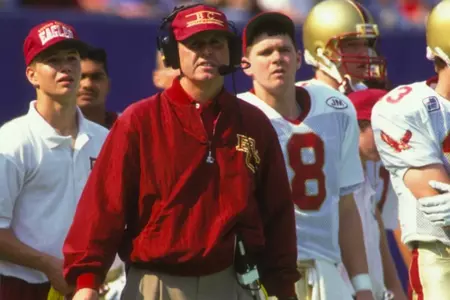
The 1993 season was one of Boston College's finest years on a football field. Memories are largely confined to the 41-39 victory over top-ranked Notre Dame or the Carquest Bowl victory over Virginia, but punctuation for the nine-win season offered one of the truest capstones to the post-Doug Flutie era. Combined with the 1992 season that went 8-3-1 with a temporary return to the national top-10, 1993 capped a two-year stretch that arguably stood alone against any other bridge thanks to the breakthrough efforts of head coach Tom Coughlin and quarterback Glenn Foley.
The highlights of that season remain a massive part of BC's overall identity, but the success associated with David Gordon's kick against the Irish occasionally threatens to overshadow the foundational success constructed by the team's eight-game winning streak in September, October and early November. Having lost their preseason No. 20 spot in the Associated Press poll with losses to Miami and Northwestern, the Eagles weren't a postseason team. They were a .500 team after beating Temple, Rutgers, Tulane and Army, but not even a win over No. 13 Syracuse boosted their reputation at a time when .500 teams weren't guaranteed a neutral site bowl berth.
BC was, to put it mildly, lost in the shuffle, but a thrilling 48-34 victory over 25th-ranked Virginia Tech ruined any predilections about keeping the Eagles out of the bowl conversation. Until that point, the league had been a two-horse race pulling away from the pesky and plucky Hokies, but the first-ever matchup against the Big East's geographical outlier resurrected the postseason conversation for a team bound for nine wins - and one of its greatest season-ending storylines to ever occur in Chestnut Hill.
"This game just keeps you available for opportunities," said BC head coach Tom Coughlin ahead of that 1993 matchup. "But it's been like this for us for the last four or five games."
College football looked considerably different in the early 1990s. The Big East was a conduit for northeast-based basketball teams to better their standing for the NCAA Tournament when it joined the landscape in the early 1980s, but a philosophical split with its football-playing schools forced its hand into admitting several "football-only" schools with an eye towards future expansion. Those schools - Temple, Rutgers, Virginia Tech and West Virginia - all carried ties to the Atlantic-10 for basketball, but aside from the Hokies, all had ties to the media markets or rivalries already embedded within the Big East's footprint. Temple, for example, was part of the Philadelphia scene dominated by Villanova, and Rutgers maintained a presence in the New York-New Jersey area that long dominated the entire Big East conference. West Virginia, meanwhile, owned a constant rivalry with Pittsburgh, an original all-sports Big East member.
Virginia Tech was, well, an oddity. The Hokies weren't a football powerhouse in any of Frank Beamer's early seasons, especially when lined up against Miami, and Blacksburg's location in the Virginia mountains was the antithesis of the gritty urban setting associated with the Big East. An embedded rivalry with West Virginia helped, but the 1991 and 1992 Hokies failed to finish .500 during years when the league didn't play a typical round robin schedule.
All of that shifted during the 1993 season, and Beamer's teams started developing a reputation as one of the Big East's toughest outs after losing to West Virginia by one. A two-back approach brought them to the top-25 with 1,000 combined yards and an average of over 250 yards per game, and pairing both Dwayne Thomas and Tommy Edwards with quarterback Maurice DeShazo created an offense that was downright gawdy by early-90s standards. Combined with an equally-rugged defense that held teams to 20 points per game by creating turnovers and tilting clock possession all of a sudden changed the dynamic after Syracuse faltered, and by November, the 1993 Hokies occupied the slot directly below Miami and West Virginia in a year when the Carquest Bowl committed to taking a third Big East team to a postseason game - even if it wasn't the official third place team.
"They [the numbers] were incredibly close on the part of both teams," said Coughlin. "So, let's be realistic, there wasn't going to be much of a chance to shut anyone down. I just thought it would be a tough-and-nail game that would go 60 minutes, and there would be scoring."
BC offered the perfect foil to the late season matchup, but nobody could have possibly hyped the BC-Virginia Tech game as much as it actually produced. By the time the game ended, quarterback Glenn Foley had the fourth-most passing yards in program history, and he'd thrown eight incompletions on a 448-yard performance that featured three touchdowns without an interception. Receiver Ivan Boyd twice went for 50 yards en route to a 162-yard day with five catches, and Keith Miller and Pete Mitchell barely missed joining him in the 100-yard club after each gained 90-plus yards through the air.
Even to this day, Foley is near or at the top of the BC record books because this singular performance produced well over 70 percent of the offense's 617 yards. It was the first 600-yard day by the offense since Flutie's 622 yards against Miami, and Foley's yardage remains the second-most yards thrown by a quarterback in a BC victory, again second to the Hail Flutie game. The numbers pushed him through 2,000 yards on the season, which in turn made him the first-ever quarterback to ever throw for 2,000 yards in each of his four seasons.
"You like to talk about being humble in victory," said Coughlin after the Virginia Tech game, "and I hope we're realistic about that…we're playing well because we've prepared well because our attitude's been good and because football's played with a mind and a heart and we're doing a lot of that now."
Yet the biggest history lesson came when pollsters moved the Eagles back into that No. 22 spot they vacated with the Northwestern loss. Virginia Tech eventually moved back into the top-25 after its own victory down the season's stretch run, but BC placed itself in the frontrunner seat for the Carquest Bowl by staying ahead of the Hokies. A win over Pittsburgh one week later moved the Eagles inside the top-20 for the first time since their late-1992 tumbles, and it generated enough momentum to keep them grooving right through the Notre Dame win, which in turn preceded a loss to West Virginia that, had BC won, would have clinched a share of the Big East championship.
In its place, BC-Virginia Tech became a rivalry game that's often overshadowed by more intense matchups on either side. It's been 30-plus years since Foley dazzled his way past the Hokies, but the years after the win brought a 1995 victory over a nationally-ranked Virginia Tech team in between the September losses to Ohio State and Michigan. Michael Vick's arrival at the turn of the century thrust the Hokies onto a completely different plane while BC fought through consecutive bowl berths, but even the 2003 game ahead of Virginia Tech's realignment to the ACC saw the Eagles defeat the nationally-ranked Hokies before joining them two years later.
Even at the supposedly unbeatable Lane Stadium, half of BC's 11 overall wins against Virginia Tech were on the road. The 2007 "Matt Ryan Game" that made Lane Stadium go silent ranks chief among them, but the memories are very real and very vivid for people who remember when the tides consistently turned. Even now, as the Eagles ready for their final trip to Blacksburg through at least the end of the decade, there's still that feeling that this game is special because it's on a Thursday night - a night that, by all accounts, is usually Virginia Tech's time to shine.
"I've played there before," said current Eagle Kam Arnold, "so I know how loud it gets. I'm pretty prepared for what we're getting into, but I think we'll be fine. I just have to be an excellent communicator like I've been doing all season, and I just have to make sure that I get all the guys the calls so let them know what they're doing."
The highlights of that season remain a massive part of BC's overall identity, but the success associated with David Gordon's kick against the Irish occasionally threatens to overshadow the foundational success constructed by the team's eight-game winning streak in September, October and early November. Having lost their preseason No. 20 spot in the Associated Press poll with losses to Miami and Northwestern, the Eagles weren't a postseason team. They were a .500 team after beating Temple, Rutgers, Tulane and Army, but not even a win over No. 13 Syracuse boosted their reputation at a time when .500 teams weren't guaranteed a neutral site bowl berth.
BC was, to put it mildly, lost in the shuffle, but a thrilling 48-34 victory over 25th-ranked Virginia Tech ruined any predilections about keeping the Eagles out of the bowl conversation. Until that point, the league had been a two-horse race pulling away from the pesky and plucky Hokies, but the first-ever matchup against the Big East's geographical outlier resurrected the postseason conversation for a team bound for nine wins - and one of its greatest season-ending storylines to ever occur in Chestnut Hill.
"This game just keeps you available for opportunities," said BC head coach Tom Coughlin ahead of that 1993 matchup. "But it's been like this for us for the last four or five games."
College football looked considerably different in the early 1990s. The Big East was a conduit for northeast-based basketball teams to better their standing for the NCAA Tournament when it joined the landscape in the early 1980s, but a philosophical split with its football-playing schools forced its hand into admitting several "football-only" schools with an eye towards future expansion. Those schools - Temple, Rutgers, Virginia Tech and West Virginia - all carried ties to the Atlantic-10 for basketball, but aside from the Hokies, all had ties to the media markets or rivalries already embedded within the Big East's footprint. Temple, for example, was part of the Philadelphia scene dominated by Villanova, and Rutgers maintained a presence in the New York-New Jersey area that long dominated the entire Big East conference. West Virginia, meanwhile, owned a constant rivalry with Pittsburgh, an original all-sports Big East member.
Virginia Tech was, well, an oddity. The Hokies weren't a football powerhouse in any of Frank Beamer's early seasons, especially when lined up against Miami, and Blacksburg's location in the Virginia mountains was the antithesis of the gritty urban setting associated with the Big East. An embedded rivalry with West Virginia helped, but the 1991 and 1992 Hokies failed to finish .500 during years when the league didn't play a typical round robin schedule.
All of that shifted during the 1993 season, and Beamer's teams started developing a reputation as one of the Big East's toughest outs after losing to West Virginia by one. A two-back approach brought them to the top-25 with 1,000 combined yards and an average of over 250 yards per game, and pairing both Dwayne Thomas and Tommy Edwards with quarterback Maurice DeShazo created an offense that was downright gawdy by early-90s standards. Combined with an equally-rugged defense that held teams to 20 points per game by creating turnovers and tilting clock possession all of a sudden changed the dynamic after Syracuse faltered, and by November, the 1993 Hokies occupied the slot directly below Miami and West Virginia in a year when the Carquest Bowl committed to taking a third Big East team to a postseason game - even if it wasn't the official third place team.
"They [the numbers] were incredibly close on the part of both teams," said Coughlin. "So, let's be realistic, there wasn't going to be much of a chance to shut anyone down. I just thought it would be a tough-and-nail game that would go 60 minutes, and there would be scoring."
BC offered the perfect foil to the late season matchup, but nobody could have possibly hyped the BC-Virginia Tech game as much as it actually produced. By the time the game ended, quarterback Glenn Foley had the fourth-most passing yards in program history, and he'd thrown eight incompletions on a 448-yard performance that featured three touchdowns without an interception. Receiver Ivan Boyd twice went for 50 yards en route to a 162-yard day with five catches, and Keith Miller and Pete Mitchell barely missed joining him in the 100-yard club after each gained 90-plus yards through the air.
Even to this day, Foley is near or at the top of the BC record books because this singular performance produced well over 70 percent of the offense's 617 yards. It was the first 600-yard day by the offense since Flutie's 622 yards against Miami, and Foley's yardage remains the second-most yards thrown by a quarterback in a BC victory, again second to the Hail Flutie game. The numbers pushed him through 2,000 yards on the season, which in turn made him the first-ever quarterback to ever throw for 2,000 yards in each of his four seasons.
"You like to talk about being humble in victory," said Coughlin after the Virginia Tech game, "and I hope we're realistic about that…we're playing well because we've prepared well because our attitude's been good and because football's played with a mind and a heart and we're doing a lot of that now."
Yet the biggest history lesson came when pollsters moved the Eagles back into that No. 22 spot they vacated with the Northwestern loss. Virginia Tech eventually moved back into the top-25 after its own victory down the season's stretch run, but BC placed itself in the frontrunner seat for the Carquest Bowl by staying ahead of the Hokies. A win over Pittsburgh one week later moved the Eagles inside the top-20 for the first time since their late-1992 tumbles, and it generated enough momentum to keep them grooving right through the Notre Dame win, which in turn preceded a loss to West Virginia that, had BC won, would have clinched a share of the Big East championship.
In its place, BC-Virginia Tech became a rivalry game that's often overshadowed by more intense matchups on either side. It's been 30-plus years since Foley dazzled his way past the Hokies, but the years after the win brought a 1995 victory over a nationally-ranked Virginia Tech team in between the September losses to Ohio State and Michigan. Michael Vick's arrival at the turn of the century thrust the Hokies onto a completely different plane while BC fought through consecutive bowl berths, but even the 2003 game ahead of Virginia Tech's realignment to the ACC saw the Eagles defeat the nationally-ranked Hokies before joining them two years later.
Even at the supposedly unbeatable Lane Stadium, half of BC's 11 overall wins against Virginia Tech were on the road. The 2007 "Matt Ryan Game" that made Lane Stadium go silent ranks chief among them, but the memories are very real and very vivid for people who remember when the tides consistently turned. Even now, as the Eagles ready for their final trip to Blacksburg through at least the end of the decade, there's still that feeling that this game is special because it's on a Thursday night - a night that, by all accounts, is usually Virginia Tech's time to shine.
"I've played there before," said current Eagle Kam Arnold, "so I know how loud it gets. I'm pretty prepared for what we're getting into, but I think we'll be fine. I just have to be an excellent communicator like I've been doing all season, and I just have to make sure that I get all the guys the calls so let them know what they're doing."

Players Mentioned
LB
/ FootballSaturday, October 24
Saturday, October 24
Saturday, October 24
Saturday, October 24