Boston College Athletics
That Same Old South End Ground Feeling
August 31, 2023 | Football, #ForBoston Files
Season 125 kicks off with BC retaining many of the same characteristics as that first home win over BU.
Located deep within the heart of Northeastern University's campus, a renovated Ruggles Station stands as one of Boston's most important transportation hubs. The connection point for the Mission Hill, Kenmore and South End neighborhoods, it intertwines the Commuter Rail and the MBTA's Orange Line with several different bus routes, and the station itself is a tribute to the old Arts on the Line program installed in the 1970s by the newly-created successor to the Metropolitan Transit Authority.
The station is one of the most well-known parts of the Roxbury and Jamaica Plain regions, but it masks lost ghosts that once patrolled the Boston sports scene. Located south of the site once occupied by the Huntington Avenue Grounds, the station stands in place of the old South End Grounds, the former home of the Red Stockings, who later became known as the Boston Braves.
The stadium itself featured a distinct grandstand and dimensions to rival the oddly-shaped Polo Grounds, and Northeastern's current campus stands on the grounds where the 1892 Boston baseball club won the World Series by beating the Cleveland Spiders five times over a six-game series. Hugh Duffy batted .462 in that series, and two years later, his .440 batting average with a league-high 18 home runs and 145 RBI set a record that even dwarfs Ted Williams' legendary .406 average in 1941.
It was shaped like a bathtub, but the South End Grounds owned the Boston sports landscape at a time when the city hit its first stride as the home of champions. It was a local home, and its purpose stretched well beyond the baseball diamond to the gridiron of the new sport emerging among the city's vast educational institutions.
In 1878, the third-ever matchup between Harvard and Yale resulted in the second straight loss for the Cambridge-based side, an outcome repeated two years later, and a decade later, the two schools representing the city played their first game against one another. Buried below Tufts' loss to Brown and well below the Harvard-Yale preview, a center column story in late November's Boston Daily Globe outlined how College defeated University following a controversial delay that stemmed from University's objection to College's roster. Following losses to Newton High School and West Roxbury High School, it ended BC's season with a 3-3 record, though it regrettably didn't end with a Beanpot even though there's something to be said for beating BU on grounds now occupied by Northeastern at a stadium where Harvard lost twice to Yale.
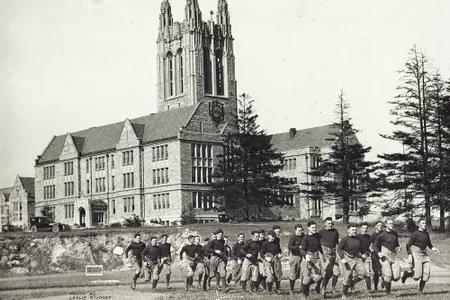
Over a century later, the 2023 team kicks off on Saturday for Boston College's 125th season as a football program with a home game against Northern Illinois. Far from the minimal thousands who traversed Boston to watch College defeat University at the South End Grounds, the Eagles' towering on-campus stadium kicks off a celebration that started when Joseph Drum founded a program as its unpaid coach and quarterback.
"This is a very special season," current head coach Jeff Hafley told For the Podcast this week. "It's the 125th season at a place with great tradition, great players, and great coaches. I mean, Boston College football is way bigger than me, and I'm just proud to be a part of that [tradition]. Hopefully we can make all of the alumni and the fans and all the people who really care and went here and really made that tradition what it is, we need to carry that forward and make sure that this is a special year for that and for them. For me to be part of this tradition, it's incredible, and I hope our players feel the same way because they should."
Football itself evolved from those early days when scoring goals and touchdowns didn't line up with the current format, but the pride that existed at college institutions never really changed. Something special always existed whenever students played specifically for their school, and the parochialism in a city like Boston united the student body as scheduling included more intercollegiate models.
The South End Grounds remained a fixture through the turn of the century, but BC gradually started moving closer to Chestnut Hill with games at Fenway Park. Rivalries formed, specifically against Holy Cross and other local sides, and in 1915, Alumni Field was dedicated as a new, on-campus home. Five years later, Frank Cavanaugh's team went undefeated for the first time in program history with a year that culminated in a 14-0 win over Holy Cross before 40,000 fans at Braves Field, the successor to the South End Grounds.
The overall success drew more eyeballs, and the popularity grew. More than 50,000 fans packed Braves Field for the Holy Cross game in 1922, and the 1928 team again went undefeated behind captain Warren McGuirk, who later became a high school head coach in Malden before serving as athletic director at UMass, where his name now adorns the football stadium. The relevance stretched clear through the Great Depression, and in 1940, as World War II raged across the Atlantic Ocean, Frank Leahy's team went 11-0 and won national championship recognition after beating Tennessee before 73,181 fans in the Sugar Bowl.
The names that passed through the gates built into that tradition in the years after Leahy's successor, Denny Myers, went to the Orange Bowl , and his return from America's participation in World War II kept BC relevant until a change to Mike Holovak in the 1950s. Later the head coach of the American Football League's fledgling Boston Patriots, the succeeding years brought rise to the Joe Yukica era and Ed Chlebek's seven-win season in 1980 before Jack Bicknell's arrival with Doug Flutie in 1981.
"It's all about the people," Hafley said. "It's the toughness. It's the grittiness. It's being the underdog and how it feeds that tradition, that it's the big special moments that you capture. That comes with the students and the alumni and the excitement, but that's how BC needs to play football, and that's how we're going to play football."
Hafley's Boston College resembles nothing of those teams from the early days of the Northeast's independence, but fighting for an Atlantic Coast Conference championship in one of college football's remaining power conferences is because of how each era flowed into one another. Flutie's Heisman Trophy win in 1984 doesn't happen without Chuckin' Charlie O'Rourke's win over Tennessee in the 1940 Sugar Bowl, and the Big East doesn't happen if his Hail Mary pass falls into Gerard Phelan's hands on a wet Thanksgiving weekend date against the Hurricanes in Miami's Orange Bowl stadium.
David Gordon's kick against Notre Dame legitimized BC as a national powerhouse in the new era, and the records allowed the Eagles to schedule teams from the Big Ten and the SEC during those mid-1990s seasons. The exposure steadied Tom O'Brien's constant bowl appearances, and wins in those games made BC a viable option when the ACC expanded in the first round of realignment before Matt Ryan brought an undefeated team to No. 2 nationally by making Lane Stadium go silent in 2007.
The connections are too obvious, and they link generations to one another. The world class institution with a student base from every corner of the globe retains a homey familiarity by staying true to its blue-collar, Catholic roots, and the bedrock is easily seen whenever crowds appear on Saturday. As much as Boston College represents the city, it represents itself, and when the Eagles take the field for their game against Northern Illinois, they will do so in a world that's changed from that first home game at the South End Grounds while simultaneously retaining the same parochialism that made the team identify most when it plays for Boston.
"Campus right now looks very different than it did in August," Hafley said. "Everyone's walking around. If anyone came to our games last year, our student section, despite where we were at the end of the year, they showed up and that is incredible. It says a lot about them. So I expect it [again]. It's a noon game, and I expect people will be tailgating as soon as they get up in the morning. They'll get everything out of their system and get into the stadium and cheer these players on when they come out of the tunnel.
"We need them," he said. "The players need them, and we're going to give them a lot to cheer about by doing the best that we can."
The station is one of the most well-known parts of the Roxbury and Jamaica Plain regions, but it masks lost ghosts that once patrolled the Boston sports scene. Located south of the site once occupied by the Huntington Avenue Grounds, the station stands in place of the old South End Grounds, the former home of the Red Stockings, who later became known as the Boston Braves.
The stadium itself featured a distinct grandstand and dimensions to rival the oddly-shaped Polo Grounds, and Northeastern's current campus stands on the grounds where the 1892 Boston baseball club won the World Series by beating the Cleveland Spiders five times over a six-game series. Hugh Duffy batted .462 in that series, and two years later, his .440 batting average with a league-high 18 home runs and 145 RBI set a record that even dwarfs Ted Williams' legendary .406 average in 1941.
It was shaped like a bathtub, but the South End Grounds owned the Boston sports landscape at a time when the city hit its first stride as the home of champions. It was a local home, and its purpose stretched well beyond the baseball diamond to the gridiron of the new sport emerging among the city's vast educational institutions.
In 1878, the third-ever matchup between Harvard and Yale resulted in the second straight loss for the Cambridge-based side, an outcome repeated two years later, and a decade later, the two schools representing the city played their first game against one another. Buried below Tufts' loss to Brown and well below the Harvard-Yale preview, a center column story in late November's Boston Daily Globe outlined how College defeated University following a controversial delay that stemmed from University's objection to College's roster. Following losses to Newton High School and West Roxbury High School, it ended BC's season with a 3-3 record, though it regrettably didn't end with a Beanpot even though there's something to be said for beating BU on grounds now occupied by Northeastern at a stadium where Harvard lost twice to Yale.
Over a century later, the 2023 team kicks off on Saturday for Boston College's 125th season as a football program with a home game against Northern Illinois. Far from the minimal thousands who traversed Boston to watch College defeat University at the South End Grounds, the Eagles' towering on-campus stadium kicks off a celebration that started when Joseph Drum founded a program as its unpaid coach and quarterback.
"This is a very special season," current head coach Jeff Hafley told For the Podcast this week. "It's the 125th season at a place with great tradition, great players, and great coaches. I mean, Boston College football is way bigger than me, and I'm just proud to be a part of that [tradition]. Hopefully we can make all of the alumni and the fans and all the people who really care and went here and really made that tradition what it is, we need to carry that forward and make sure that this is a special year for that and for them. For me to be part of this tradition, it's incredible, and I hope our players feel the same way because they should."
Football itself evolved from those early days when scoring goals and touchdowns didn't line up with the current format, but the pride that existed at college institutions never really changed. Something special always existed whenever students played specifically for their school, and the parochialism in a city like Boston united the student body as scheduling included more intercollegiate models.
The South End Grounds remained a fixture through the turn of the century, but BC gradually started moving closer to Chestnut Hill with games at Fenway Park. Rivalries formed, specifically against Holy Cross and other local sides, and in 1915, Alumni Field was dedicated as a new, on-campus home. Five years later, Frank Cavanaugh's team went undefeated for the first time in program history with a year that culminated in a 14-0 win over Holy Cross before 40,000 fans at Braves Field, the successor to the South End Grounds.
The overall success drew more eyeballs, and the popularity grew. More than 50,000 fans packed Braves Field for the Holy Cross game in 1922, and the 1928 team again went undefeated behind captain Warren McGuirk, who later became a high school head coach in Malden before serving as athletic director at UMass, where his name now adorns the football stadium. The relevance stretched clear through the Great Depression, and in 1940, as World War II raged across the Atlantic Ocean, Frank Leahy's team went 11-0 and won national championship recognition after beating Tennessee before 73,181 fans in the Sugar Bowl.
The names that passed through the gates built into that tradition in the years after Leahy's successor, Denny Myers, went to the Orange Bowl , and his return from America's participation in World War II kept BC relevant until a change to Mike Holovak in the 1950s. Later the head coach of the American Football League's fledgling Boston Patriots, the succeeding years brought rise to the Joe Yukica era and Ed Chlebek's seven-win season in 1980 before Jack Bicknell's arrival with Doug Flutie in 1981.
"It's all about the people," Hafley said. "It's the toughness. It's the grittiness. It's being the underdog and how it feeds that tradition, that it's the big special moments that you capture. That comes with the students and the alumni and the excitement, but that's how BC needs to play football, and that's how we're going to play football."
Hafley's Boston College resembles nothing of those teams from the early days of the Northeast's independence, but fighting for an Atlantic Coast Conference championship in one of college football's remaining power conferences is because of how each era flowed into one another. Flutie's Heisman Trophy win in 1984 doesn't happen without Chuckin' Charlie O'Rourke's win over Tennessee in the 1940 Sugar Bowl, and the Big East doesn't happen if his Hail Mary pass falls into Gerard Phelan's hands on a wet Thanksgiving weekend date against the Hurricanes in Miami's Orange Bowl stadium.
David Gordon's kick against Notre Dame legitimized BC as a national powerhouse in the new era, and the records allowed the Eagles to schedule teams from the Big Ten and the SEC during those mid-1990s seasons. The exposure steadied Tom O'Brien's constant bowl appearances, and wins in those games made BC a viable option when the ACC expanded in the first round of realignment before Matt Ryan brought an undefeated team to No. 2 nationally by making Lane Stadium go silent in 2007.
The connections are too obvious, and they link generations to one another. The world class institution with a student base from every corner of the globe retains a homey familiarity by staying true to its blue-collar, Catholic roots, and the bedrock is easily seen whenever crowds appear on Saturday. As much as Boston College represents the city, it represents itself, and when the Eagles take the field for their game against Northern Illinois, they will do so in a world that's changed from that first home game at the South End Grounds while simultaneously retaining the same parochialism that made the team identify most when it plays for Boston.
"Campus right now looks very different than it did in August," Hafley said. "Everyone's walking around. If anyone came to our games last year, our student section, despite where we were at the end of the year, they showed up and that is incredible. It says a lot about them. So I expect it [again]. It's a noon game, and I expect people will be tailgating as soon as they get up in the morning. They'll get everything out of their system and get into the stadium and cheer these players on when they come out of the tunnel.
"We need them," he said. "The players need them, and we're going to give them a lot to cheer about by doing the best that we can."
Sunday, October 18
Saturday, October 17
Saturday, October 17
Saturday, October 17