Boston College Athletics
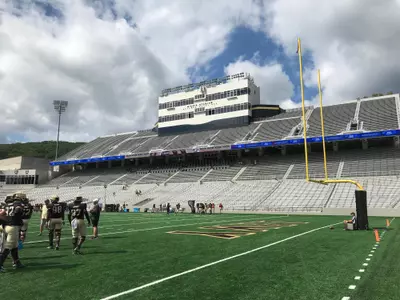
Photo by: Ken McMillan / USA TODAY NETWORK
New Look Army Offense Still Capable Of Cutting Down Defenses
October 05, 2023 | Football, #ForBoston Files
Drew Thatcher's scheme is a hybrid of the air raid and triple option.
Service academy football has long been a throwback to an older era of football. Where the world around them swirled with changes around overall philosophy and scheme, the advent of rules changes forcing older mentalities to adapt never really touched Army, Navy, and Air Force, and the military schools representing the three branches all survived and thrived by committing to methods that might have once been called unsuccessful relics.
At West Point, that meant the incorporation of formations and ideas that never existed under head coach Jeff Monken. A dedicated student of triple option under former Navy and Georgia Tech head coach Paul Johnson, he'd run the same offense to success as Georgia Southern's head coach and revitalized Army with the Black Knights' first win over Navy in 15 years. He beat Air Force in 2017 without attempting a pass, and his program finished the 2018 season with 11 wins and a national ranking.
Removing the cut block from his arsenal was a possible death knell, but Army's evolution changed this offseason when Monken hired Nebraska-Kearney offensive coordinator Drew Thatcher, a coach that's changed Army into the new era by merging triple option into the high-flying passing attack once loathed to exist on the banks of the Hudson River.
"I know about [him] from reading about him," said BC head coach Jeff Hafley. "His background and all the points he's scored and the success he's had, I have a ton of respect for him in his career. Obviously what he's doing now, there are variances in every single game out of every personnel grouping, and they run a lot of different run plays. They're mixing in the pass."
The triple option is one of college football's oldest and most effective ways to dissect an opponent. It forces defenses to determine who is going to actually carry the ball, but the ability to pitch or handoff to any one of several different options makes it impossible to predict the play before it happens. The scheme itself disorients aggressive defenses by suckering the ends or tackles and linebackers towards the ball, and the sheer number of things that could happen in any single play further challenges a defense to play outside of its comfort zone.
Their success rate varied by the team installing triple option, but utilizing the scheme played directly into the service academies' size requirements and restrictions. Unable to utilize mammoth offensive linemen, the triple option - and veer formation in particular - counteracted high-flying, fast-paced passing games by bleeding the game clock behind nine-minute drives, while the constant running game allowed bigger, more stout running backs removed the need to recruit huge, fast wide receivers who took the top off defenses.
But even service academy football felt the pinch when new rules started targeting cut blocks. A staple of the flexbone triple option, it allowed offensive linemen or motion runners to charge at the lower bodies of bigger, faster defensive players, which would, in turn, spring runners for yardage. In March of last year, an NCAA Football Rules Committee legislation banned all below-the-belt blocking outside of the tackle box, and any player who wasn't a lineman or a "stationary" back within the tackle box was denied the ability to throw a cut block at all.
"Cut blocking has changed," Hafley said, "and there are certain rules [dictating] where you can go up and cut backers on what angles. Back in the day, when I was at Pitt and we used to play Army and Navy [regularly], it was brutal. You'd have to prepare for it and defend it, and it was all legal at the time."
"It's about the rules," linebacker Vinny DePalma said. "The rule changes have certainly helped defenses from that perspective because when you're playing military academies or triple option teams, you're playing defense, but in the back of your mind, you know that you can get cut from any angle. That gets on you fast because those guys are low to the ground and coming right at your shins, and regardless of how much you drill it, once you get in the game, the speed is different."
At West Point, removing cut blocking within the tackle box all but ended the main component of flexbone motion, but Monken quickly moved to a new blend by hiring Thatcher, whose offense with the Lopers revolutionized the game at the Division II level. His 2019 season at UNK set a new school record for rushing yards and touchdowns with over 4,000 yards and 45 scores on the ground, and the school recorded two 1,000-yard rushers for the first time in its history when quarterback TJ Davis and running back David Goodwin both breached the ceiling.
The option under Thatcher was virtually unidentifiable to the flexbone, and it drew its roots from his time on the New Mexico State program in the mid-2000s. A wide receiver by trade, he played for Hal Mumme, whose coaching tree includes branches out to Mike Leach, Dana Holgorsen, Sonny Dykes, Kliff Kingsbury, and Dino Babers, before coaching at the New Mexico Military Institute and Nebraska-Kearney.
"They have a lot of quarterback-design runs," Hafley said. "It's not as many scrambles, and what we've seen in the past, whether it's the quarterback, lead plays, quarterback-power plays, they have it all. If you look at Army's first four games and run through the run plays, they pretty much have every run that you're ever going to see. There's still the triple option element with some condensed spacing that reminds you of when they were in the wishbone, but it's just out of the shotgun now."
Using shotgun snaps opens a whole host of motion options, and the BC defense is going to find itself tracking players on Saturday that are moving from the slot to the backfield and back across the formation. A week after pinning its ears back for aggressive rushes to the quarterback, the Eagles are instead looking at an offense that knows how to counteract its pass rush with pitches, motions and timely passes while simultaneously maintaining the blocking scheme within the tackles that made Monken's offense so effective.
"You have to give them credit for what they were doing and how they were doing it," Hafley said. "They've always played hard, and there are still some cuts on the backside in college football. People now will cut on stretch plays on the back side, but there are rules with running backs that a guy has to be coming straight at you to legally cut. You can't cut on the perimeter, and it's really straight ahead. I know there are still teams doing it, but you can't run as many cut blocks as you once could."
Boston College and Army kick off at noon on Saturday from Michie Stadium in West Point, New York. The game can be seen on CBS Sports Network with radio coverage available from the BC Learfield IMG Sports Network.
At West Point, that meant the incorporation of formations and ideas that never existed under head coach Jeff Monken. A dedicated student of triple option under former Navy and Georgia Tech head coach Paul Johnson, he'd run the same offense to success as Georgia Southern's head coach and revitalized Army with the Black Knights' first win over Navy in 15 years. He beat Air Force in 2017 without attempting a pass, and his program finished the 2018 season with 11 wins and a national ranking.
Removing the cut block from his arsenal was a possible death knell, but Army's evolution changed this offseason when Monken hired Nebraska-Kearney offensive coordinator Drew Thatcher, a coach that's changed Army into the new era by merging triple option into the high-flying passing attack once loathed to exist on the banks of the Hudson River.
"I know about [him] from reading about him," said BC head coach Jeff Hafley. "His background and all the points he's scored and the success he's had, I have a ton of respect for him in his career. Obviously what he's doing now, there are variances in every single game out of every personnel grouping, and they run a lot of different run plays. They're mixing in the pass."
The triple option is one of college football's oldest and most effective ways to dissect an opponent. It forces defenses to determine who is going to actually carry the ball, but the ability to pitch or handoff to any one of several different options makes it impossible to predict the play before it happens. The scheme itself disorients aggressive defenses by suckering the ends or tackles and linebackers towards the ball, and the sheer number of things that could happen in any single play further challenges a defense to play outside of its comfort zone.
Their success rate varied by the team installing triple option, but utilizing the scheme played directly into the service academies' size requirements and restrictions. Unable to utilize mammoth offensive linemen, the triple option - and veer formation in particular - counteracted high-flying, fast-paced passing games by bleeding the game clock behind nine-minute drives, while the constant running game allowed bigger, more stout running backs removed the need to recruit huge, fast wide receivers who took the top off defenses.
But even service academy football felt the pinch when new rules started targeting cut blocks. A staple of the flexbone triple option, it allowed offensive linemen or motion runners to charge at the lower bodies of bigger, faster defensive players, which would, in turn, spring runners for yardage. In March of last year, an NCAA Football Rules Committee legislation banned all below-the-belt blocking outside of the tackle box, and any player who wasn't a lineman or a "stationary" back within the tackle box was denied the ability to throw a cut block at all.
"Cut blocking has changed," Hafley said, "and there are certain rules [dictating] where you can go up and cut backers on what angles. Back in the day, when I was at Pitt and we used to play Army and Navy [regularly], it was brutal. You'd have to prepare for it and defend it, and it was all legal at the time."
"It's about the rules," linebacker Vinny DePalma said. "The rule changes have certainly helped defenses from that perspective because when you're playing military academies or triple option teams, you're playing defense, but in the back of your mind, you know that you can get cut from any angle. That gets on you fast because those guys are low to the ground and coming right at your shins, and regardless of how much you drill it, once you get in the game, the speed is different."
At West Point, removing cut blocking within the tackle box all but ended the main component of flexbone motion, but Monken quickly moved to a new blend by hiring Thatcher, whose offense with the Lopers revolutionized the game at the Division II level. His 2019 season at UNK set a new school record for rushing yards and touchdowns with over 4,000 yards and 45 scores on the ground, and the school recorded two 1,000-yard rushers for the first time in its history when quarterback TJ Davis and running back David Goodwin both breached the ceiling.
The option under Thatcher was virtually unidentifiable to the flexbone, and it drew its roots from his time on the New Mexico State program in the mid-2000s. A wide receiver by trade, he played for Hal Mumme, whose coaching tree includes branches out to Mike Leach, Dana Holgorsen, Sonny Dykes, Kliff Kingsbury, and Dino Babers, before coaching at the New Mexico Military Institute and Nebraska-Kearney.
"They have a lot of quarterback-design runs," Hafley said. "It's not as many scrambles, and what we've seen in the past, whether it's the quarterback, lead plays, quarterback-power plays, they have it all. If you look at Army's first four games and run through the run plays, they pretty much have every run that you're ever going to see. There's still the triple option element with some condensed spacing that reminds you of when they were in the wishbone, but it's just out of the shotgun now."
Using shotgun snaps opens a whole host of motion options, and the BC defense is going to find itself tracking players on Saturday that are moving from the slot to the backfield and back across the formation. A week after pinning its ears back for aggressive rushes to the quarterback, the Eagles are instead looking at an offense that knows how to counteract its pass rush with pitches, motions and timely passes while simultaneously maintaining the blocking scheme within the tackles that made Monken's offense so effective.
"You have to give them credit for what they were doing and how they were doing it," Hafley said. "They've always played hard, and there are still some cuts on the backside in college football. People now will cut on stretch plays on the back side, but there are rules with running backs that a guy has to be coming straight at you to legally cut. You can't cut on the perimeter, and it's really straight ahead. I know there are still teams doing it, but you can't run as many cut blocks as you once could."
Boston College and Army kick off at noon on Saturday from Michie Stadium in West Point, New York. The game can be seen on CBS Sports Network with radio coverage available from the BC Learfield IMG Sports Network.
Players Mentioned
LB
/ FootballFootball: Zeke Moore Media Availability (April 10, 2026)
Friday, April 10
Football: Bill O'Brien Media Availability (April 10, 2026)
Friday, April 10
Football: Favor Bate Media Availability (April 10, 2026)
Friday, April 10
#23 Baseball Defeats Darmouth (April 8, 2026)
Thursday, April 09