Boston College Athletics
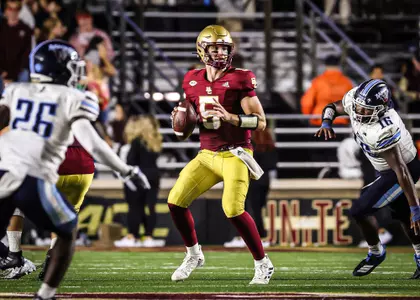
Photo by: John Quackenbos
Eagles Zeroing Its Cover Against Aggressive Cardinals
September 28, 2022 | Football, #ForBoston Files
I thought everyone was supposed to use Cover-2!
In the 1990s, Tampa Bay Buccaneers head coach Tony Dungy and defensive coordinator Monte Kiffin installed a new style of defense in their team. It utilized concepts employed from Dungy's time as a safety on the Pittsburgh Steelers in the 1970s and built itself around the simple coverage of two players capable of covering routes over the top. The remaining personnel played either zone or man-to-man against their assignments, but the two players who aligned atop the formation were known as "two-deep," or "Cover-2."
The theory forever changed football and helped build championship winners in Tampa Bay and Indianapolis in a league that was known at the time for its downfield passing. It wasn't until the spread emerged and teams started requiring more man-to-man coverage that Cover-2's effectiveness was slightly diminished, but it remains one of the most popular schemes in football because of its ease to install and adaptability to different formations.
Every team has some variation of a Cover-2 defense because it's safe, but on Saturday, Louisville arrives at Boston College with a very different attitude baked into a physical, aggressive, high-risk defense that's willing to play a more radical, Cover Zero scheme hell-bent on making passers' lives miserable.
"There's a lot of odd spacing," said Boston College head coach Jeff Hafley. "There's a lot of three-down stuff, and we'll see a guy lined up over center. They'll do quite a lot of movement up front [because] they're aggressive. Their safeties will get down into the box, and there's going to be times when it looks like Cover Zero, which means there are no safeties in the middle of the field."
Safeties play a unique role on a defense because they combine the speedy coverage skills of a defensive back with a linebacker's hard-hitting violence. Their ability to step up into the box requires them to get square to ball-carriers while running blitz packages at quarterbacks, but they still have to protect a team's deep coverage area against wide receivers who either break coverage or shake away from would-be tacklers.
Because of that duality, they're often given the space to step up towards the line or shadow back towards a deeper area as either a diversion or a giveaway of their assignment, but their alignment in relation to the offense and the tight end in particular divides the position into two unique groups. The player covering the strong side of the offense - the strong safety - needs to have the size and power to cover the tight end in man-to-man coverage while the player on the weak side of the field - or free safety - is smaller, more flexible and covers receivers opposite their blitz and tackle responsibilities.
Nearly every team has two-safety formations in its toolbox, but how they deploy each player is unique to the package of players designed to isolate matchups against either the run or pass. In Cover-2, for example, the two safeties are deep, but Cover-1 would only position its deep defender for coverage down the gut while everyone else plays as part of the zone coverage or man-assignment. At Louisville, defensive coordinator Bryan Brown opts for looks that include Cover Zero, an incredibly aggressive concept that either sends the house or lines everyone up in man-to-man coverage.
"Sometimes they get very aggressive and get guys down into the box," said Hafley, "so they play a lot of man coverage. They'll mix in some zones and play some Cover-3 and Tampa-2, but [defensive coordinator Bryan Brown] is really aggressive."
Brown was with head coach Scott Satterfield at Appalachian State and helped turn the Mountaineers into one of the best defenses in the nation. He coached defensive backs prior to becoming the defensive coordinator in 2018, and his unit produced the second-most interceptions in 2015 before the entire defense ranked third in the nation in passing defense and sixth in total defense when he was in charge. His first season at Louisville improved the defense enough to win the Music City Bowl, and each of the last two seasons produced top-half finishes in the football bowl subdivision after the 2018 team finished third-to-last in the nation.
Louisville averages five yards allowed per play, but the Cardinals already have five interceptions through four games and are dominating the middle portions of the game to the tune of a two-touchdown cumulative advantage in the second and third quarters. They have twice held quarterbacks to less than 150 yards passing and twice produced four sacks before adding three more in last week's win over South Florida while converting 10 tackles-for-loss against Florida State with another nine against the Bulls.
Formationally, it's owed to the outbreak in performance by outside linebacker Ben Perry and free safety Kenderick Duncan, the team's leading tacklers.
Formationally, the improvements are due to the aggressiveness built into the program's fabric. Leading tackler Kenderick Duncan is a fifth-year, redshirt senior who plays free safety, while complementary pieces at linebacker have allowed outside backer Ben Perry, a redshirt freshman to enjoy a breakout campaign next to senior middle linebacker Momo Sanogo. Fellow senior Yasir Abdullah is a massive stand-up presence on the outside.
All of it is built around a three-man front that utilizes two big defensive ends to set the edge around nose tackle Dezmond Tell. Both ends - Ashton Gillotte and YaYa Diaby - are built like bigger linebackers, but both can neutralize the outer offensive line to create shootable gaps for the linebackers and safeties.
"It takes time in practice to get used to it," Hafley said. "A lot of your offensive line rules are built on four-down fronts, so when you get into the odd-spacing stuff, there are some nuances that you have to go through."
"On paper, it looks like you should be able to have a bunch of shots," he continued, "but then there's risk-reward because there's a lot of pressure [on the quarterback]. So a lot of times you don't have the time to push the ball down the field."
The chess match between Brown and the BC is going to underline the game flow on Saturday largely by pitting that unorthodox, aggressive style against an offense that's struggled with early mistakes, but with the offensive line starting to gel, the spotlight is more going to center on what happens between those gaps. No deep safety coverages means Phil Jurkovec is going to have opportunities to create plays for Zay Flowers, Jaden Williams and, perhaps most importantly, George Takacs, while the running game will have to identify the gaps and holes where Louisville isn't attacking - if they even exist.
"You do have to try to make these teams pay if they do," Hafley said, "but making them pay isn't necessarily throwing it 50 yards down the field. There are some catch-and-run opportunities where, if you catch the ball and get vertical, there's no one back there to erase any mistakes. But it's an aggressive style of defense where you might have to get rid of the ball quickly at times. They'll mix it in and put some safeties [deep], and they'll run five-man pressures like everybody else, but I think he does a really good job."
Boston College and Louisville will kick off on Saturday at noon from Alumni Stadium in Chestnut Hill, Massachusetts. The game can be seen on national television via ACC Network with streaming available through ESPN's online platform for television subscribers with access to the channel. Radio broadcast is also available via the BC Learfield IMG Sports Network and can be heard locally in Boston on WEEI 850 AM/93.7 FM.
The theory forever changed football and helped build championship winners in Tampa Bay and Indianapolis in a league that was known at the time for its downfield passing. It wasn't until the spread emerged and teams started requiring more man-to-man coverage that Cover-2's effectiveness was slightly diminished, but it remains one of the most popular schemes in football because of its ease to install and adaptability to different formations.
Every team has some variation of a Cover-2 defense because it's safe, but on Saturday, Louisville arrives at Boston College with a very different attitude baked into a physical, aggressive, high-risk defense that's willing to play a more radical, Cover Zero scheme hell-bent on making passers' lives miserable.
"There's a lot of odd spacing," said Boston College head coach Jeff Hafley. "There's a lot of three-down stuff, and we'll see a guy lined up over center. They'll do quite a lot of movement up front [because] they're aggressive. Their safeties will get down into the box, and there's going to be times when it looks like Cover Zero, which means there are no safeties in the middle of the field."
Safeties play a unique role on a defense because they combine the speedy coverage skills of a defensive back with a linebacker's hard-hitting violence. Their ability to step up into the box requires them to get square to ball-carriers while running blitz packages at quarterbacks, but they still have to protect a team's deep coverage area against wide receivers who either break coverage or shake away from would-be tacklers.
Because of that duality, they're often given the space to step up towards the line or shadow back towards a deeper area as either a diversion or a giveaway of their assignment, but their alignment in relation to the offense and the tight end in particular divides the position into two unique groups. The player covering the strong side of the offense - the strong safety - needs to have the size and power to cover the tight end in man-to-man coverage while the player on the weak side of the field - or free safety - is smaller, more flexible and covers receivers opposite their blitz and tackle responsibilities.
Nearly every team has two-safety formations in its toolbox, but how they deploy each player is unique to the package of players designed to isolate matchups against either the run or pass. In Cover-2, for example, the two safeties are deep, but Cover-1 would only position its deep defender for coverage down the gut while everyone else plays as part of the zone coverage or man-assignment. At Louisville, defensive coordinator Bryan Brown opts for looks that include Cover Zero, an incredibly aggressive concept that either sends the house or lines everyone up in man-to-man coverage.
"Sometimes they get very aggressive and get guys down into the box," said Hafley, "so they play a lot of man coverage. They'll mix in some zones and play some Cover-3 and Tampa-2, but [defensive coordinator Bryan Brown] is really aggressive."
Brown was with head coach Scott Satterfield at Appalachian State and helped turn the Mountaineers into one of the best defenses in the nation. He coached defensive backs prior to becoming the defensive coordinator in 2018, and his unit produced the second-most interceptions in 2015 before the entire defense ranked third in the nation in passing defense and sixth in total defense when he was in charge. His first season at Louisville improved the defense enough to win the Music City Bowl, and each of the last two seasons produced top-half finishes in the football bowl subdivision after the 2018 team finished third-to-last in the nation.
Louisville averages five yards allowed per play, but the Cardinals already have five interceptions through four games and are dominating the middle portions of the game to the tune of a two-touchdown cumulative advantage in the second and third quarters. They have twice held quarterbacks to less than 150 yards passing and twice produced four sacks before adding three more in last week's win over South Florida while converting 10 tackles-for-loss against Florida State with another nine against the Bulls.
Formationally, it's owed to the outbreak in performance by outside linebacker Ben Perry and free safety Kenderick Duncan, the team's leading tacklers.
Formationally, the improvements are due to the aggressiveness built into the program's fabric. Leading tackler Kenderick Duncan is a fifth-year, redshirt senior who plays free safety, while complementary pieces at linebacker have allowed outside backer Ben Perry, a redshirt freshman to enjoy a breakout campaign next to senior middle linebacker Momo Sanogo. Fellow senior Yasir Abdullah is a massive stand-up presence on the outside.
All of it is built around a three-man front that utilizes two big defensive ends to set the edge around nose tackle Dezmond Tell. Both ends - Ashton Gillotte and YaYa Diaby - are built like bigger linebackers, but both can neutralize the outer offensive line to create shootable gaps for the linebackers and safeties.
"It takes time in practice to get used to it," Hafley said. "A lot of your offensive line rules are built on four-down fronts, so when you get into the odd-spacing stuff, there are some nuances that you have to go through."
"On paper, it looks like you should be able to have a bunch of shots," he continued, "but then there's risk-reward because there's a lot of pressure [on the quarterback]. So a lot of times you don't have the time to push the ball down the field."
The chess match between Brown and the BC is going to underline the game flow on Saturday largely by pitting that unorthodox, aggressive style against an offense that's struggled with early mistakes, but with the offensive line starting to gel, the spotlight is more going to center on what happens between those gaps. No deep safety coverages means Phil Jurkovec is going to have opportunities to create plays for Zay Flowers, Jaden Williams and, perhaps most importantly, George Takacs, while the running game will have to identify the gaps and holes where Louisville isn't attacking - if they even exist.
"You do have to try to make these teams pay if they do," Hafley said, "but making them pay isn't necessarily throwing it 50 yards down the field. There are some catch-and-run opportunities where, if you catch the ball and get vertical, there's no one back there to erase any mistakes. But it's an aggressive style of defense where you might have to get rid of the ball quickly at times. They'll mix it in and put some safeties [deep], and they'll run five-man pressures like everybody else, but I think he does a really good job."
Boston College and Louisville will kick off on Saturday at noon from Alumni Stadium in Chestnut Hill, Massachusetts. The game can be seen on national television via ACC Network with streaming available through ESPN's online platform for television subscribers with access to the channel. Radio broadcast is also available via the BC Learfield IMG Sports Network and can be heard locally in Boston on WEEI 850 AM/93.7 FM.
Players Mentioned


Wednesday, June 10
Saturday, June 06
Thursday, June 04
Thursday, June 04