Boston College Athletics
How Pro Corners Have Their Fingerprints On BC
October 14, 2021 | Football, #ForBoston Files
Tired of talking defense? Yeah, we aren't either.
There was a time when Jeff Hafley once traveled to learn something from Dave Doeren. It preceded Saturday's matchup between Boston College and NC State and was one of those moments when a young coach wanted to learn from one of the game's best defensive minds. Doeren, the defensive coordinator for Bret Bielema's Wisconsin teams, was the architect of a team that finished in the top-10 nationally, so it was the perfect opportunity for a fresh face to connect and meet another coach as much as it was a chance to simply learn something.
That feels like eons ago, but on Saturday night, the coaches who once likely had a conversation and answered questions of one another will meet at midfield as adversaries in a divisional matchup teeming with Atlantic Coast Conference postseason implications. On one side will be Doeren, the head coach of a resurgent NC State team, while Hafley will stand on the other end as the man responsible for an equally-strong bounceback at Boston College.
It's the first meeting as a head coach since an encounter more than a decade ago, but in many ways, it's that same meeting playing out in real time between two coaches with immense respect for one another.
"I hope people will say that I'm complimenting them on how hard they play and how physical they are," Hafley said of his Wolfpack counterpart. "I'm hoping they would say the same thing [about us]. I don't know how they view us, [but] I think you're going to see two teams [ready to] run the ball, even though there are times when we throw it 60 times."
It's a way in which Hafley's career will come full circle, and it occurs in a game against one of BC's most traditional measuring sticks. Hafley's impression of Doeren was one that left an imprint, and it's the perfect example of a coach impacting the legacy of another program without ever knowing it would lead to that destiny.
The lines are one of the trademarks of the small coaching fraternity, and they dot Hafley's career dating back to those days on staff under Pittsburgh head coach Dave Wannstedt. He worked with Darrelle Revis in those days with the Panthers and eventually reunited with the All-Pro after he landed in Tampa Bay for the 2013 season. It was one year after Hafley worked alongside both Ronde Barber and Eric Wright on a Buccaneers staff that featured defensive assistant Tem Lukabu, now the defensive coordinator for BC.
It was a year before Hafley moved to Cleveland to coach a secondary teeming with both Joe Haden and Donte Whitmer, and it preceded a tenure in San Francisco with both Richard Sherman and Jimmie Ward. Both formed the nucleus of the defensive backfield for the eventual NFC Champions, even though Sherman was an established legend and Ward was a young first round pick who once starred for Dave Doeren's Northern Illinois teams during their BCS buster days.
"I learned more from some of those players than I've ever learned from some coaches," Hafley said. "If you're talking about three-deep and the type of corners that you're looking at, I spent more time picking Richard Sherman's brain in my meeting room or office. We hung out just to see how he would see things. Ronde Barber is another guy, [and] I picked his brain on how to play safety.
"I know I was coaching those guys," Hafley added, "but [Barber] was one of the best nickel [corners] of all time and will be a future Hall of Famer. John Lynch worked with the Niners - I mean are you kidding me? He's a Hall of Famer. I'm not not going to ask him certain questions on how to play safety. I've been really fortunate to watch Revis' press and where his eyes and hands are. I've been so lucky to be around good players."
It taught Hafley how to personalize a defense while not reinventing the wheel, and the lesson plan's fingerprints returned with him to college when he arrived at Ohio State in 2019. He carried it to BC last year but turned on the electricity for a Frankenstein defense this year. Every piece has a different tool or staple from his previous stops and his old mentors and players, and the team taking the field on Saturday now applies those lessons while fusing together new styles constantly absorbed during each and every game.
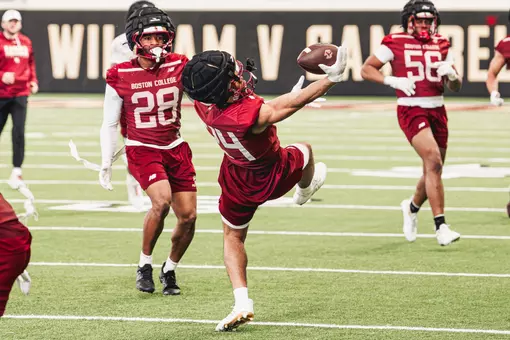
It worked to a fantastic degree in BC's first five games, and the 4-1 Eagles now enter this weekend with a defense leading the nation in most overall and situational categories. They rank fourth in the ACC and 31st in the nation in scoring in Hafley's second season, and the defensive passing efficiency is third in the nation and 32nd in the country. The overall throw game numbers are the best in the league, and the rushing defense fits into both the top tier of both the league and the NCAA.
The red zone defense is among the top percentile of the football bowl subdivision, and the third down consistency is inside the top-10. BC is allowing the second-fewest first downs in the league and 15th-fewest in the nation, and the turnover margin is a net-zero thanks to its ability to produce the sixth-most interceptions in the conference.
"I look at the numbers," Hafley said. "I look at [them] really hard. [The analytics] are really important, but you also have to know what you're playing to is right. Is it an aggressive plan to win or is it less aggressive? [That's] what we need to figure out and calculate. If the chart says to be aggressive on 4th-and-5, then we go for it. We have to figure that out before the game starts with what you want on the call sheet. [But] a lot of it is that I get a feel for the game, and how we are playing. [We ask] how the defense is playing and how the offense is playing, if I really love the way [the play] looks and if I feel good about how [things] look. I'm learning, and I think we're getting better at it."
The Eagles are taught to execute at a high level, and a big chunk of their evaluation is acquired through experience and filtered through the educational aspect of Hafley's coaching regime. Every play builds the database and is supported by both analytics and film, and what happens on any play - both good or bad - goes hand-in-hand with coaches who reinforce fundamentals of both what worked and what didn't work in a unit known for playing on the edge of a 60-minute football game.
"Tackling in general, I don't teach much differently," Hafley said. "It depends on where you are. If you're playing in a phone booth, you want to put a shoulder pad through [the ball carrier's] sternum, and if you can't get your body across, you have to go rock and roll and be violent. It depends on the approach and where you are in relationship to the ball carrier when you have to tackle that guy."
Every position does it a little bit different, but the overall performance is why the defense constantly earns rave reviews while the offense went through a transitional phase. The top tackle numbers are evenly spread through all three levels, and the four players with at least 20 tackles represent the defensive line, the linebackers and the secondary.
Three of those four have more unassisted tackles than group takedowns, and each of the top five tacklers have at least two tackles for loss for a lethal combination capable of beating opposing offenses in every situation. Both Isaiah Graham-Mobley and Kam Arnold patrol the interior of the defensive middle, but Josh DeBerry and Brandon Barlow are leading examples of how the secondary can step up while the defensive line also makes its plays.
Their assignments are different, but everyone works into the play at any given moment. There are substitutions and shift changes, but the juking and stunting is confusing for every offense. Shitta Sillah, for example, is a defensive end but can occupy space for interior linemen like TJ Rayam and Cam Horsley, but their assignments flow into one another to form a criticality against a monstrous offense like the one currently operating at NC State.
"[Their backs] are big and run strong and violent," Hafley said. "They try to run through people, but they make a lot of people miss tackles that add a lot of yards after contact. I think it starts out front, and that's a good complement for how they play football. [The offensive line] is strong and patient, especially in their zone scheme, and they kind of wait for things to open up. Then [the backs] go hit and run violent. They're probably the most violent running backs that we've seen."
The backs are a big reason why NC State is 4-1 with a win over Clemson. Both Zonovan Knight and Rickey Person Jr. gashed South Florida for 100 yards apiece in the opening game, and their combined efforts produced 170 yards in the win over the Tigers. They each hit for a touchdown against Louisiana Tech in the Wolfpack's most recent win, and the only game where they struggled to gain traction was the loss to Mississippi State.
Devin Leary was able to rally the Wolfpack, but his 49 passing attempts couldn't overcome Mike Leach's aerial assault. The Bulldogs built a 14-3 first half lead and led by 21 in the fourth quarter, but Leary still finished with 30 completions and over 300 yards. He threw a touchdown late, but it offset an interception in the team's only loss of the season.
"You better get multiple hats to the ball [to stop the runners]," Hafley said. "Your [tackles] better not be arm tackles, or they'll run through. It's going to be about the approach and about multiple people getting [to the point of attack]. It's about fundamentals and technique and how we teach tackling.
"But I'm not going to reinvent how we tackle based on who he play," he reiterated. "There will be a tackling plan, and we will find the best ways that we think we can get these guys down, and that's what we're talking to the players about."
Boston College will meet the nationally-ranked NC State Wolfpack at Alumni Stadium on Saturday night at 7:30 p.m. The game will be televised nationally via the ACC Network with online streaming available for cable subscribers with access to the channel.
That feels like eons ago, but on Saturday night, the coaches who once likely had a conversation and answered questions of one another will meet at midfield as adversaries in a divisional matchup teeming with Atlantic Coast Conference postseason implications. On one side will be Doeren, the head coach of a resurgent NC State team, while Hafley will stand on the other end as the man responsible for an equally-strong bounceback at Boston College.
It's the first meeting as a head coach since an encounter more than a decade ago, but in many ways, it's that same meeting playing out in real time between two coaches with immense respect for one another.
"I hope people will say that I'm complimenting them on how hard they play and how physical they are," Hafley said of his Wolfpack counterpart. "I'm hoping they would say the same thing [about us]. I don't know how they view us, [but] I think you're going to see two teams [ready to] run the ball, even though there are times when we throw it 60 times."
It's a way in which Hafley's career will come full circle, and it occurs in a game against one of BC's most traditional measuring sticks. Hafley's impression of Doeren was one that left an imprint, and it's the perfect example of a coach impacting the legacy of another program without ever knowing it would lead to that destiny.
The lines are one of the trademarks of the small coaching fraternity, and they dot Hafley's career dating back to those days on staff under Pittsburgh head coach Dave Wannstedt. He worked with Darrelle Revis in those days with the Panthers and eventually reunited with the All-Pro after he landed in Tampa Bay for the 2013 season. It was one year after Hafley worked alongside both Ronde Barber and Eric Wright on a Buccaneers staff that featured defensive assistant Tem Lukabu, now the defensive coordinator for BC.
It was a year before Hafley moved to Cleveland to coach a secondary teeming with both Joe Haden and Donte Whitmer, and it preceded a tenure in San Francisco with both Richard Sherman and Jimmie Ward. Both formed the nucleus of the defensive backfield for the eventual NFC Champions, even though Sherman was an established legend and Ward was a young first round pick who once starred for Dave Doeren's Northern Illinois teams during their BCS buster days.
"I learned more from some of those players than I've ever learned from some coaches," Hafley said. "If you're talking about three-deep and the type of corners that you're looking at, I spent more time picking Richard Sherman's brain in my meeting room or office. We hung out just to see how he would see things. Ronde Barber is another guy, [and] I picked his brain on how to play safety.
"I know I was coaching those guys," Hafley added, "but [Barber] was one of the best nickel [corners] of all time and will be a future Hall of Famer. John Lynch worked with the Niners - I mean are you kidding me? He's a Hall of Famer. I'm not not going to ask him certain questions on how to play safety. I've been really fortunate to watch Revis' press and where his eyes and hands are. I've been so lucky to be around good players."
It taught Hafley how to personalize a defense while not reinventing the wheel, and the lesson plan's fingerprints returned with him to college when he arrived at Ohio State in 2019. He carried it to BC last year but turned on the electricity for a Frankenstein defense this year. Every piece has a different tool or staple from his previous stops and his old mentors and players, and the team taking the field on Saturday now applies those lessons while fusing together new styles constantly absorbed during each and every game.
It worked to a fantastic degree in BC's first five games, and the 4-1 Eagles now enter this weekend with a defense leading the nation in most overall and situational categories. They rank fourth in the ACC and 31st in the nation in scoring in Hafley's second season, and the defensive passing efficiency is third in the nation and 32nd in the country. The overall throw game numbers are the best in the league, and the rushing defense fits into both the top tier of both the league and the NCAA.
The red zone defense is among the top percentile of the football bowl subdivision, and the third down consistency is inside the top-10. BC is allowing the second-fewest first downs in the league and 15th-fewest in the nation, and the turnover margin is a net-zero thanks to its ability to produce the sixth-most interceptions in the conference.
"I look at the numbers," Hafley said. "I look at [them] really hard. [The analytics] are really important, but you also have to know what you're playing to is right. Is it an aggressive plan to win or is it less aggressive? [That's] what we need to figure out and calculate. If the chart says to be aggressive on 4th-and-5, then we go for it. We have to figure that out before the game starts with what you want on the call sheet. [But] a lot of it is that I get a feel for the game, and how we are playing. [We ask] how the defense is playing and how the offense is playing, if I really love the way [the play] looks and if I feel good about how [things] look. I'm learning, and I think we're getting better at it."
The Eagles are taught to execute at a high level, and a big chunk of their evaluation is acquired through experience and filtered through the educational aspect of Hafley's coaching regime. Every play builds the database and is supported by both analytics and film, and what happens on any play - both good or bad - goes hand-in-hand with coaches who reinforce fundamentals of both what worked and what didn't work in a unit known for playing on the edge of a 60-minute football game.
"Tackling in general, I don't teach much differently," Hafley said. "It depends on where you are. If you're playing in a phone booth, you want to put a shoulder pad through [the ball carrier's] sternum, and if you can't get your body across, you have to go rock and roll and be violent. It depends on the approach and where you are in relationship to the ball carrier when you have to tackle that guy."
Every position does it a little bit different, but the overall performance is why the defense constantly earns rave reviews while the offense went through a transitional phase. The top tackle numbers are evenly spread through all three levels, and the four players with at least 20 tackles represent the defensive line, the linebackers and the secondary.
Three of those four have more unassisted tackles than group takedowns, and each of the top five tacklers have at least two tackles for loss for a lethal combination capable of beating opposing offenses in every situation. Both Isaiah Graham-Mobley and Kam Arnold patrol the interior of the defensive middle, but Josh DeBerry and Brandon Barlow are leading examples of how the secondary can step up while the defensive line also makes its plays.
Their assignments are different, but everyone works into the play at any given moment. There are substitutions and shift changes, but the juking and stunting is confusing for every offense. Shitta Sillah, for example, is a defensive end but can occupy space for interior linemen like TJ Rayam and Cam Horsley, but their assignments flow into one another to form a criticality against a monstrous offense like the one currently operating at NC State.
"[Their backs] are big and run strong and violent," Hafley said. "They try to run through people, but they make a lot of people miss tackles that add a lot of yards after contact. I think it starts out front, and that's a good complement for how they play football. [The offensive line] is strong and patient, especially in their zone scheme, and they kind of wait for things to open up. Then [the backs] go hit and run violent. They're probably the most violent running backs that we've seen."
The backs are a big reason why NC State is 4-1 with a win over Clemson. Both Zonovan Knight and Rickey Person Jr. gashed South Florida for 100 yards apiece in the opening game, and their combined efforts produced 170 yards in the win over the Tigers. They each hit for a touchdown against Louisiana Tech in the Wolfpack's most recent win, and the only game where they struggled to gain traction was the loss to Mississippi State.
Devin Leary was able to rally the Wolfpack, but his 49 passing attempts couldn't overcome Mike Leach's aerial assault. The Bulldogs built a 14-3 first half lead and led by 21 in the fourth quarter, but Leary still finished with 30 completions and over 300 yards. He threw a touchdown late, but it offset an interception in the team's only loss of the season.
"You better get multiple hats to the ball [to stop the runners]," Hafley said. "Your [tackles] better not be arm tackles, or they'll run through. It's going to be about the approach and about multiple people getting [to the point of attack]. It's about fundamentals and technique and how we teach tackling.
"But I'm not going to reinvent how we tackle based on who he play," he reiterated. "There will be a tackling plan, and we will find the best ways that we think we can get these guys down, and that's what we're talking to the players about."
Boston College will meet the nationally-ranked NC State Wolfpack at Alumni Stadium on Saturday night at 7:30 p.m. The game will be televised nationally via the ACC Network with online streaming available for cable subscribers with access to the channel.
Players Mentioned
LB
/ Football
DL
/ Football
DB
/ Football
LB
/ Football
DT
/ Football
DE
/ Football#24 Baseball Defeats UConn (April 15, 2026)
Wednesday, April 15
#24 Baseball Defeats Northeastern in Beanpot Championship (April 14, 2026)
Wednesday, April 15
#23 Baseball Defeats Virginia Tech (April 12, 2026)
Tuesday, April 14
#23 Baseball Defeats Virginia Tech (April 11,2026
Saturday, April 11