Boston College Athletics
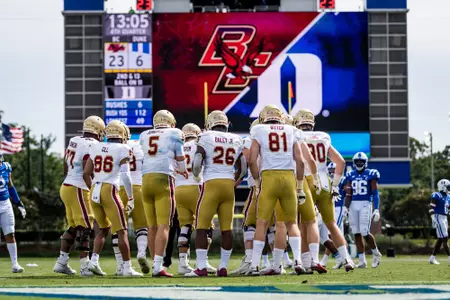
Photo by: Reagan Lunn
Whole Team Treasure Hunt Leads To Individual Success
September 22, 2020 | Football, #ForBoston Files
The passing game's explosiveness was the result of how players played without the ball.
Saturday's season opener lifted the curtain on a new era for Boston College's football program. A new offense debuted a completely different style for the Eagles, and the success it found against Duke lifted an immediate reputation into the national conscience. After leading 7-6 through one quarter and into halftime, quarterback Phil Jurkovec and two receivers - wideout Zay Flowers and tight end Hunter Long - turned on the jets in a 26-6 victory.
The new look for the Eagles was a glimpse into the potential of the former four-star recruit's ability to distribute passes to open receivers. Long was more dominant physically and used his massive frame to haul in seven catches, but Flowers exhibited more explosiveness on his five catches. He destroyed defensive backs in the open field and ended the day with 162 yards and a touchdown and illustrated exactly why his shiftiness is a unique weapon within the Boston College offense.
"To me, whoever gets their hands up (at the line) usually wins, whether the guy is on offense or defense," head coach Jeff Hafley said. "Zay is a guy that is good at the line. He can accelerate and has great movement. He can run away from anybody. In the second half, our coaches isolated him for one-on-one. If you can get him in one-on-one (coverage) in the open field, you saw what he can do with the ball in his hands."
Flowers' performance is a small piece in how Hafley and offensive coordinator Frank Cignetti intend to use his unique skill set. He has incredible forward speed but retains the shifty ability to make any defender miss in small areas. Once in the open field, he can identify blocking arrangements to gain extra yardage.
It was evident in his first explosive play of the afternoon. BC's offense was at midfield with its first third down of the game when Jurkovec connected with Flowers on a slant pass over the middle. The receiver slowed down to juke in and out of blockers, and the sea of blue jerseys couldn't seem to figure out which direction he wanted to move.
Towards the end of the play, though, the Duke secondary missed when receiver CJ Lewis came flying into the play from behind Flowers and absorbed a blow while making a block. It opened a slim hole for Flowers for an extra five yards and set a tone for the other receivers' job in the open field.
A similar play developed when Flowers caught his "roller skate reception" in the third quarter. The receiver made the defensive back fly out of bounds by slamming the brakes along the sideline, but Ethon Williams' block on Michael Carter II opened the downfield run that ended inside the Duke red zone.
"I was more impressed with the way the receivers blocked downfield," Hafley said. "When your corners are running to the ball and getting off blocks, you need your receivers to block down the field. That's how you know that they're playing for each other. I told (wide receivers coach) Joe Dailey how impressive it was that his guys blocked (for their teammates)."
It illustrated a main fundamental concept of Hafley's team-first scheme and highlighted exactly how the Eagles sacrifice and play for the larger objective. Long and Flowers were the only receivers with more than one reception in the game, and only three other wide receivers caught a pass over the four quarters. Of those catches, none went for longer than 15 yards.
That isn't an area of concern, though. This was the first game for the BC offense against real competition, and the relationship between Jurkovec and his receivers is still very much in an infancy. The Eagles attempted a couple of screens throughout the day, but the quarterback found himself more comfortable against the isolated defensive backs.
"Those two receivers were open a lot," Hafley said. "It was a good decision to get them the ball. We had a lot of guys open early, and Phil got into a rhythm to get them the ball. As a head coach and in talking to Coach Cignetti, we'll design plays to get people the ball, no doubt about it. After that, though, nobody cares about who gets the ball. We're going to trust the open guy, and we trust that all the guys can make plays."
The concept itself was very different from the Duke team and its quarterback, Chase Brice. The Blue Devils emptied their backfield more than the Eagles in order to spread out the defenders. Brice then employed a quick-throw mentality to outlet passes to his receivers. He didn't face as much pressure as Jurkovec, but the calls were also designed for him to get rid of the football before any pass rusher would have reached the backfield.
It's a big reason why the average yards per attempt torpedoed for Duke in comparison to BC's numbers. Brice attempted approximately double the number of passes of Jurkovec and completed six more balls, but he only took two sacks en route to 85 less passing yards. Five receivers caught multiple passes, but nobody went for more than 60 yards.
"Duke gets rid of the ball quickly," Hafley said, "which is why we didn't get a lot of pressure on (Brice). They had a lot of empty sets with no backs in the backfield, and it was a lot of catch-step-throw (passing). We had to get in lanes and get our hands up as best as we could because a lot of times, you're not going to get (to the quarterback) in time."
In the end, both quarterbacks intended to spread the ball to multiple receivers. Brice wound up passing to more options over the course of four quarters, but Jurkovec impressed with better numbers. The BC offense did more away from plays to create more yardage, and it all centered around the explosiveness of whoever caught the football. Jurkovec fired more downfield throws and created more with his scrambling because receivers did more away from the ball.
"Joe (Dailey) has done a good job in showing them why it's important," Hafley said. "If a guy catches it on the backside, and you're blocking, he might score. If you catch the ball and he blocks, you might score. If we break a big play and you're blocking downfield, the back might score. It's about not being selfish if you're not getting the ball. That's how we're going to play. Joe demands it, and our staff demands it. These kids have bought in, and we're going to play guys who do the right things. We're going to throw the ball, and we're going to have quick games and screen (pass plays). Those guys have to block."
The new look for the Eagles was a glimpse into the potential of the former four-star recruit's ability to distribute passes to open receivers. Long was more dominant physically and used his massive frame to haul in seven catches, but Flowers exhibited more explosiveness on his five catches. He destroyed defensive backs in the open field and ended the day with 162 yards and a touchdown and illustrated exactly why his shiftiness is a unique weapon within the Boston College offense.
"To me, whoever gets their hands up (at the line) usually wins, whether the guy is on offense or defense," head coach Jeff Hafley said. "Zay is a guy that is good at the line. He can accelerate and has great movement. He can run away from anybody. In the second half, our coaches isolated him for one-on-one. If you can get him in one-on-one (coverage) in the open field, you saw what he can do with the ball in his hands."
Flowers' performance is a small piece in how Hafley and offensive coordinator Frank Cignetti intend to use his unique skill set. He has incredible forward speed but retains the shifty ability to make any defender miss in small areas. Once in the open field, he can identify blocking arrangements to gain extra yardage.
It was evident in his first explosive play of the afternoon. BC's offense was at midfield with its first third down of the game when Jurkovec connected with Flowers on a slant pass over the middle. The receiver slowed down to juke in and out of blockers, and the sea of blue jerseys couldn't seem to figure out which direction he wanted to move.
Towards the end of the play, though, the Duke secondary missed when receiver CJ Lewis came flying into the play from behind Flowers and absorbed a blow while making a block. It opened a slim hole for Flowers for an extra five yards and set a tone for the other receivers' job in the open field.
A similar play developed when Flowers caught his "roller skate reception" in the third quarter. The receiver made the defensive back fly out of bounds by slamming the brakes along the sideline, but Ethon Williams' block on Michael Carter II opened the downfield run that ended inside the Duke red zone.
"I was more impressed with the way the receivers blocked downfield," Hafley said. "When your corners are running to the ball and getting off blocks, you need your receivers to block down the field. That's how you know that they're playing for each other. I told (wide receivers coach) Joe Dailey how impressive it was that his guys blocked (for their teammates)."
It illustrated a main fundamental concept of Hafley's team-first scheme and highlighted exactly how the Eagles sacrifice and play for the larger objective. Long and Flowers were the only receivers with more than one reception in the game, and only three other wide receivers caught a pass over the four quarters. Of those catches, none went for longer than 15 yards.
That isn't an area of concern, though. This was the first game for the BC offense against real competition, and the relationship between Jurkovec and his receivers is still very much in an infancy. The Eagles attempted a couple of screens throughout the day, but the quarterback found himself more comfortable against the isolated defensive backs.
"Those two receivers were open a lot," Hafley said. "It was a good decision to get them the ball. We had a lot of guys open early, and Phil got into a rhythm to get them the ball. As a head coach and in talking to Coach Cignetti, we'll design plays to get people the ball, no doubt about it. After that, though, nobody cares about who gets the ball. We're going to trust the open guy, and we trust that all the guys can make plays."
The concept itself was very different from the Duke team and its quarterback, Chase Brice. The Blue Devils emptied their backfield more than the Eagles in order to spread out the defenders. Brice then employed a quick-throw mentality to outlet passes to his receivers. He didn't face as much pressure as Jurkovec, but the calls were also designed for him to get rid of the football before any pass rusher would have reached the backfield.
It's a big reason why the average yards per attempt torpedoed for Duke in comparison to BC's numbers. Brice attempted approximately double the number of passes of Jurkovec and completed six more balls, but he only took two sacks en route to 85 less passing yards. Five receivers caught multiple passes, but nobody went for more than 60 yards.
"Duke gets rid of the ball quickly," Hafley said, "which is why we didn't get a lot of pressure on (Brice). They had a lot of empty sets with no backs in the backfield, and it was a lot of catch-step-throw (passing). We had to get in lanes and get our hands up as best as we could because a lot of times, you're not going to get (to the quarterback) in time."
In the end, both quarterbacks intended to spread the ball to multiple receivers. Brice wound up passing to more options over the course of four quarters, but Jurkovec impressed with better numbers. The BC offense did more away from plays to create more yardage, and it all centered around the explosiveness of whoever caught the football. Jurkovec fired more downfield throws and created more with his scrambling because receivers did more away from the ball.
"Joe (Dailey) has done a good job in showing them why it's important," Hafley said. "If a guy catches it on the backside, and you're blocking, he might score. If you catch the ball and he blocks, you might score. If we break a big play and you're blocking downfield, the back might score. It's about not being selfish if you're not getting the ball. That's how we're going to play. Joe demands it, and our staff demands it. These kids have bought in, and we're going to play guys who do the right things. We're going to throw the ball, and we're going to have quick games and screen (pass plays). Those guys have to block."

Players Mentioned

WR
/ Football
QB
/ Football
WR
/ Football
TE
/ Football
WR
/ FootballSaturday, September 19
Thursday, September 17
Thursday, September 17
Thursday, September 17