Boston College Athletics
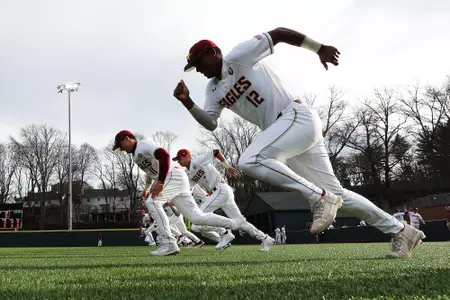
Photo by: John Quackenbos
BC, College Baseball Anticipating Talent Explosion
June 22, 2020 | Baseball, #ForBoston Files
The shortened MLB Draft will likely create an exciting college ball period.
In mid-June, Major League Baseball held its annual First-Year Player Draft. The event, a rite of passage on the sports calendar, kicked off a conversion for journeys dating back to backyard sandlots across the United States. Those who grew up emulating heroes and legends could now step into a process into immortality, reigniting the cycle of creating more boyhood dreams for future generations.
This year's draft, however, was substantially different because it left thousands of potential future big leaguers in limbo. MLB franchises suspended operations during spring training as the COVID-19 pandemic forced baseball to postpone its opening day. Protracted negotiations between owners and the players regarding the sport's return to play exacerbated the situation, and franchises began searching for ways to cut costs throughout an unexpected, extended work stoppage.
As a result, the MLB Entry Draft, normally a 40-round affair featuring thousands of selections from college, junior college, and high school, boiled into a five-round affair with just over 150 selections.
"There's nothing you can do," Joe Suozzi said of baseball's alterations across the board. "At BC, we talked about controlling the controllable, and this was the definition of not being able to control anything. (Signing a contract) is a lifetime goal, to play for the Mets, but it's bittersweet. It stinks how (the season) ended at BC, but there's nothing anyone can do about anything."
Suozzi signed a professional contract with his hometown New York Mets last week, a move generating positive buzz amidst an increasingly-contentious baseball atmosphere. The Long Island native walked onto the BC program three years ago after an unrecruited high school career, a storyline worthy of comparisons to the sport's romantic background. That he signed with the franchise of his childhood dreams only sweetened that pot.
The deeper truth, though, revealed a complete player who would've drawn draft interest. Suozzi finished the 15-game abbreviated season as one of three players with a batting average over .400, and his three triples through 15 games equaled the rest of the roster combined. His .638 slugging percentage stood second to only Cody Morissette among everyday players while his walk and steal numbers exhibited an ability to both move on the base paths after working his way aboard.
The performance earned him a spot among D1Baseball.com's postseason outfielder power rankings. As the No. 65 overall collegiate outfielder, he projected to a middle round draft pick comparable to Donovan Casey, who signed with the Dodgers after Los Angeles picked him in the 20th round in 2017. Casey, whose draft enabled Suozzi to join the BC roster in 2018, advanced to Double A last season and is the kind of value draft pick driven by slot bonus budgets.
Bonus pools are assigned by Major League Baseball and are calculated by a formula consisting of a team's final record, its overall salary situation, and the state of the sport's revenues. In 2019, the Mets were in the middle of the bonus pool after picking 12th and likely would've had less money this year by picking 18th.
Instead of budgeting across their selections, a player like Suozzi instead commanded an undrafted free agent contract, making him a complete steal for the Mets.
"(Signing) was a tough decision because it was between the Mets and a different team," Suozzi said. "Coach Gambino really helped me out, and my family did too. Coach Gambino said that (the Mets offered) the best decision for me, and I respected that. The fact that it was the Mets just put the cherry on top."
The abbreviated draft left hundreds of prospects lingering, but the shunted draft hit BC particularly hard. Jack Cunningham hit .424 with two home runs and a .576 slugging percentage across the 15 games, and Brian Dempsey hit .339. Dante Baldelli was drafted by Philadelphia out of high school and was a four-year contributor and three-year starter for the Eagles. Joey Walsh was one of the team's most reliable arms. All would've entered the draft this year.
Instead, all face a decision to either graduate and move into professional careers or take advantage of the NCAA's ruling regarding spring athletes. The governing body granted student-athletes an extra year of eligibility after COVID-19 abruptly ended their season, and it erased the 35-player roster maximum to allow for peak flexibility among teams and players.
"We conceivably would've lost a number of players to the draft this year," Gambino said. "As a roster, we would've been in a position to absorb that because we did a good job recruiting, but in a year where we think we could be pretty good, it can be really fun (if players return)."
It's designed to do right by athletes robbed by an unquestionably horrible situation, but it will also create a competitive stretch of college baseball unlike any other era in the sport's history. Most teams will return upper-echelon draft prospects to rosters already teeming with talent. Already-eligible players can choose to return to player pools with rising-eligible players even as newer recruiting classes arrive and mature into talents ready to compete at high levels.
"We've been building," Gambino said. "We started transitioning out of the 2016 season right away in 2017, and we finished that season by winning our last six games, seven of the last eight, and 16 of our last 22. Then in 2019, I thought we were a bubble team right up until we made our run in the ACC Tournament, and then I thought we were a tournament team.
"We were going to have a strong case for 2020," he continued. "Our pitching started a little slow, but we had a top 10 offense. We were starting to get innings in place for Evan Moore and Samrath Singh, and we recruited some really good talent like Luke Gold and Daniel Baruch to go with the guys like Sal Frelick, Peter Burns, Lucas Stalman."
Those players will combine with already-entrenched roster assets like Cody Morissette, who became BC's first-ever two-time All-American this year after leading most offensive categories. There's also the prospect of an all-star rotation headlined by Mason Pelio, a flamethrowing right-handed pitcher already projected to an elite level draft slot.
That furthers a juicy storyline bubbling underneath baseball's surface. The ACC lost nearly two dozen players among the 160 draft picks, including some of its most elite talent. The Los Angeles Angels drafted Louisville's Reid Detmers with the No. 10 overall selection, a choice that will likely remove the best pitcher from the No. 1 team in the nation.
The Arizona Diamondbacks drafted Duke's Bryce Jarvis at No. 18, seven picks before Atlanta selected Wake Forest's Jared Shuster. The first round ended with two more ACC picks, including Louisville pitcher Bobby Miller, going off the board.
There is no guarantee every player will sign a professional contract, but the lack of overall picks in this year's draft places pressure on teams to sign their limited numbers. The remainder of players across every program instead can decide what's best for them, all while high school prospects who would've been drafted in those elite early rounds instead head to college for the three-year minimum period.
"It could be really fun for college baseball," Gambino said. "It's a year where good players are going to return, and we're going to see a lot of good players go to college over the next few years. There are going to be a lot of scouting directors watching every single game, and it's going to be a great opportunity for players. It's going to make NCAA baseball really fun to watch because of the talent that's going to be there."
This year's draft, however, was substantially different because it left thousands of potential future big leaguers in limbo. MLB franchises suspended operations during spring training as the COVID-19 pandemic forced baseball to postpone its opening day. Protracted negotiations between owners and the players regarding the sport's return to play exacerbated the situation, and franchises began searching for ways to cut costs throughout an unexpected, extended work stoppage.
As a result, the MLB Entry Draft, normally a 40-round affair featuring thousands of selections from college, junior college, and high school, boiled into a five-round affair with just over 150 selections.
"There's nothing you can do," Joe Suozzi said of baseball's alterations across the board. "At BC, we talked about controlling the controllable, and this was the definition of not being able to control anything. (Signing a contract) is a lifetime goal, to play for the Mets, but it's bittersweet. It stinks how (the season) ended at BC, but there's nothing anyone can do about anything."
Suozzi signed a professional contract with his hometown New York Mets last week, a move generating positive buzz amidst an increasingly-contentious baseball atmosphere. The Long Island native walked onto the BC program three years ago after an unrecruited high school career, a storyline worthy of comparisons to the sport's romantic background. That he signed with the franchise of his childhood dreams only sweetened that pot.
The deeper truth, though, revealed a complete player who would've drawn draft interest. Suozzi finished the 15-game abbreviated season as one of three players with a batting average over .400, and his three triples through 15 games equaled the rest of the roster combined. His .638 slugging percentage stood second to only Cody Morissette among everyday players while his walk and steal numbers exhibited an ability to both move on the base paths after working his way aboard.
The performance earned him a spot among D1Baseball.com's postseason outfielder power rankings. As the No. 65 overall collegiate outfielder, he projected to a middle round draft pick comparable to Donovan Casey, who signed with the Dodgers after Los Angeles picked him in the 20th round in 2017. Casey, whose draft enabled Suozzi to join the BC roster in 2018, advanced to Double A last season and is the kind of value draft pick driven by slot bonus budgets.
Bonus pools are assigned by Major League Baseball and are calculated by a formula consisting of a team's final record, its overall salary situation, and the state of the sport's revenues. In 2019, the Mets were in the middle of the bonus pool after picking 12th and likely would've had less money this year by picking 18th.
Instead of budgeting across their selections, a player like Suozzi instead commanded an undrafted free agent contract, making him a complete steal for the Mets.
"(Signing) was a tough decision because it was between the Mets and a different team," Suozzi said. "Coach Gambino really helped me out, and my family did too. Coach Gambino said that (the Mets offered) the best decision for me, and I respected that. The fact that it was the Mets just put the cherry on top."
The abbreviated draft left hundreds of prospects lingering, but the shunted draft hit BC particularly hard. Jack Cunningham hit .424 with two home runs and a .576 slugging percentage across the 15 games, and Brian Dempsey hit .339. Dante Baldelli was drafted by Philadelphia out of high school and was a four-year contributor and three-year starter for the Eagles. Joey Walsh was one of the team's most reliable arms. All would've entered the draft this year.
Instead, all face a decision to either graduate and move into professional careers or take advantage of the NCAA's ruling regarding spring athletes. The governing body granted student-athletes an extra year of eligibility after COVID-19 abruptly ended their season, and it erased the 35-player roster maximum to allow for peak flexibility among teams and players.
"We conceivably would've lost a number of players to the draft this year," Gambino said. "As a roster, we would've been in a position to absorb that because we did a good job recruiting, but in a year where we think we could be pretty good, it can be really fun (if players return)."
It's designed to do right by athletes robbed by an unquestionably horrible situation, but it will also create a competitive stretch of college baseball unlike any other era in the sport's history. Most teams will return upper-echelon draft prospects to rosters already teeming with talent. Already-eligible players can choose to return to player pools with rising-eligible players even as newer recruiting classes arrive and mature into talents ready to compete at high levels.
"We've been building," Gambino said. "We started transitioning out of the 2016 season right away in 2017, and we finished that season by winning our last six games, seven of the last eight, and 16 of our last 22. Then in 2019, I thought we were a bubble team right up until we made our run in the ACC Tournament, and then I thought we were a tournament team.
"We were going to have a strong case for 2020," he continued. "Our pitching started a little slow, but we had a top 10 offense. We were starting to get innings in place for Evan Moore and Samrath Singh, and we recruited some really good talent like Luke Gold and Daniel Baruch to go with the guys like Sal Frelick, Peter Burns, Lucas Stalman."
Those players will combine with already-entrenched roster assets like Cody Morissette, who became BC's first-ever two-time All-American this year after leading most offensive categories. There's also the prospect of an all-star rotation headlined by Mason Pelio, a flamethrowing right-handed pitcher already projected to an elite level draft slot.
That furthers a juicy storyline bubbling underneath baseball's surface. The ACC lost nearly two dozen players among the 160 draft picks, including some of its most elite talent. The Los Angeles Angels drafted Louisville's Reid Detmers with the No. 10 overall selection, a choice that will likely remove the best pitcher from the No. 1 team in the nation.
The Arizona Diamondbacks drafted Duke's Bryce Jarvis at No. 18, seven picks before Atlanta selected Wake Forest's Jared Shuster. The first round ended with two more ACC picks, including Louisville pitcher Bobby Miller, going off the board.
There is no guarantee every player will sign a professional contract, but the lack of overall picks in this year's draft places pressure on teams to sign their limited numbers. The remainder of players across every program instead can decide what's best for them, all while high school prospects who would've been drafted in those elite early rounds instead head to college for the three-year minimum period.
"It could be really fun for college baseball," Gambino said. "It's a year where good players are going to return, and we're going to see a lot of good players go to college over the next few years. There are going to be a lot of scouting directors watching every single game, and it's going to be a great opportunity for players. It's going to make NCAA baseball really fun to watch because of the talent that's going to be there."
Players Mentioned
OF
/ Baseball
1B/LHP
/ Baseball
C
/ Baseball
OF/RHP
/ Baseball
IF/OF
/ Baseball
INF
/ Baseball
IF/OF
/ Baseball
IF
/ Baseball
RHP
/ Baseball
IF
/ Baseball
RHP
/ Baseball
LHP
/ Baseball
UT
/ Baseball
OF
/ Baseball
LHP
/ BaseballSaturday, September 19
Saturday, September 19
Saturday, September 19
Saturday, September 19