Boston College Athletics
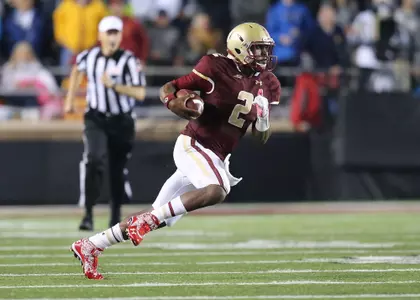
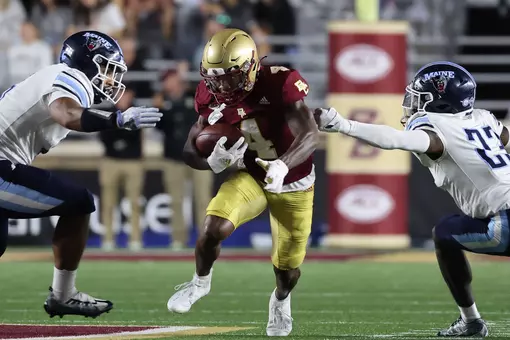
Photo by: John Quackenbos
Four Downs: USC (2014)
May 29, 2020 | Football, #ForBoston Files
The Red Bandanna Game meant so much more than the masterful performance by the Eagles.
The Red Bandanna game always manages to capture magical memories from some mythical game at Alumni Stadium. It conjures images of a reintroduction and connection of a man to his alma mater, and it relays the deeper message of someone who did something extraordinary in the last moments of his life. It's a hero's story, and it triggers emotions connected to Boston College, the Eagles, and, in these instances, the moments of collective joy and exaltation at a sporting event.
I often reflect on Welles Crowther as a beacon for Boston College's core mission. He brought the concept of service to an ultimate level when he saved a dozen lives on 9/11, and his connection broadens our love for what that means as Eagles and how we harbor an obligation to celebrate a heroism truly transcendent to the game.
Every memory is thick and deep in that regard. I still see the details of walking through concourses, and the voices still tell the story about the red bandanna. It's so surreal because it feels like it happened yesterday even as it feels like months or years ago.
I revived those memories while I sat home watching another throwback game on a Thursday night. I thought about how Welles grew up in a close-knit family and how he led the Eagles' former lacrosse program with his own dreams. He eventually moved back to New York City after graduation and took a job at the World Trade Center, but he harbored his childhood fantasies of becoming a firefighter.
It's what triggered his spirit in his moment of calling. He donned his proverbial firefighter helmet when nobody asked him to, and he couldn't see the moment coming until it arrived. Welles simply did the right thing because that instant stirred his courage into action and into service.
It's appropriate to discuss that now more than ever because the current age is in need of service to each other. We're all ordinary people thrust into an extraordinary time in world history. It's an unprecedented era, and the future is confusing and murky. We all want to see it through to completion, but we all need to retain focus on what we can do today in order to guarantee tomorrow.
I thought about it last week during a Red Bandanna Game because I use my bandanna, which I received this year prior to Florida State, as a face covering when social distancing is impossible. I wear it at the supermarket or pharmacy, and it's part of a steady rotation when I need to go out. I think of Welles every time I put it on because it symbolizes the courage he had in that moment.
The current age is our moment of calling to act selflessly for others. Massachusetts "flattened the curve," but our job is far from over. We still need to practice social distancing. We still want to support those who are less fortunate. We are fighting through all of this together as one community, but we want to honor our heroes who seemingly fight harder, day after day.
Most importantly, we wear our masks and face coverings to help stop the spread of the novel coronavirus. We channel Welles' spirit with our own red bandannas - literal or figurative - and for that I thank all of you. I look forward to the day when we can celebrate all of our heroes and collectively mourn the thousands of lives lost during this time at something as simple as a football game.
I don't know when it will be, but I know we will see those days again. From the bottom of my heart, I wish you well as we continue to be "men and women for others."
Now onto the observations from BC's 2014 win over USC:
*****
First Down: Stonewalled
USC manhandled BC in 2013, 35-7, behind over 520 yards of offense. The Trojans led that game, 28-0, in the fourth quarter at one point and held the Eagles to under 200 yards of total offense. Quarterback Chase Rettig threw for 83 yards, a lower total than the running totals of both Tre Madden and Justin Davis. In the game before the teams' 2014 rematch, Pitt running back James Conner gashed BC for over 200 yards.
It wound up being a blessing in disguise because it taught the Eagles to focus on how to stop ground games. The defensive front held Javorious Allen to 31 yards on 15 carries and stopped Justin Davis for 10 yards on six carries. Cody Kessler ripped the secondary for 317 yards, but it was after the Trojans were taken so far away from their balanced game plan.
"We had a lot of scheme in the game," Steve Addazio said. "We were able to free up a lot of unblocked defenders in their run game. But the overarching was we had to win up front, and we did, on both sides of the ball."
It was the first and best example of Addazio's synergistic style of balance. Ryan Day's offensive game plan enabled Don Brown's defense to blitz its hair off by forcing USC into uncomfortable situations. Kessler was normally a game manager against his rushing attack, but needed to score quickly in the fourth quarter. He finished with only 10 incompletions and four touchdowns, but both scoring drives in the late fourth quarter took 10 and nine plays, respectively. He was good, but he needed to be great.
"Our kids played with great energy and great passion," Addazio said. "(USC) is a really good football team. You walk away from that game, you're extremely ecstatic about how your guys responded and how we played."
Stopping the running game required a bombing by BC's front seven, which went into this game without Sean Duggan. Steven Daniels moved inside and turned into a tackle machine with eight takedowns, a number Josh Keyes matched with five solo tackles. The secondary further enabled the motion up front by remaining active against Nelson Agholor and Juju Smith-Shuster, who caught a combined 15 balls but only scored once. Neither took the top off the defense as feared, instead largely held in check underneath by Justin Simmons and Manny Asprilla.
Duggan's absence, meanwhile, was overwritten by Matt Milano and Connor Strachan. Both made their first appearances of the season and combined for seven tackles, five by the sophomore now on the Buffalo Bills.
*****
Second Down: Day Time at Night
Stopping USC required malleability to keep the BC offense on the field, and it paid off in spades. The Eagles gained 506 yards over 31 minutes of game clock to force the Trojans into a hurry-up when they finally regained possession. The game plan stayed slippery, and the constant success of the run-option attack wiped out any advantage USC had over the BC throw game.
Offensive coordinator Ryan Day was especially masterful in dialing up trick plays. He called an option double reverse end-around (or whatever you want to call it) that sprung Sherman Alston for a 54-yard run to the pylon before halftime, and it forced USC to respect both sides of the line when biting on quarterback Tyler Murphy's read. It proved fatal in the fourth quarter when Murphy optioned left and ate the USC defense with his speed for a 66-yard touchdown.
"Our plan going into that game was to try and hit them inside with a few different scheme styles," Addazio said during the next week. "(We wanted to) hit them outside, bring some elements of option, make them run side-to-side and try to wear them down all the way to the fourth quarter. Then run a more physical power attack at them, and I thought we did that."
Day's offensive scheme compensated for Murphy's general lack of passing and used his legs to gain yardage in place of more intermediate throws. The quarterback finished with 13 carries for 191 yards while completing only a handful of his 13 attempts, and it established a new standard for mobile quarterbacks at Boston College, shattering the record for most rushing yards by a signal caller.
More than five years later, Murphy's USC game is still among the all-time great performances in Boston College history. It stands tied with respective performances by Montel Harris and Andre Williams against Florida State and Army, and it's better than AJ Dillon's 2018 performance against Wake Forest and William Green's 182 yards against Pitt in 2001.
In total, he broke Doug Flutie's single-season and career rushing record by a quarterback, doing so in nine games, and finished the 2014 season with 1,184 yards. That's more than a bevy of Eagle greats, including AJ Dillon's 2018 season and William Green's 2000 season. It passed Cedric Washington's 1999 total and David Green's 1994 total easily.
Murphy was never going to be an NFL quarterback because of his limitations as a passer, but his skill set made him a unique option for a professional franchise. He landed in Pittsburgh, a perfect fit given the Steelers' conversions of Hines Ward and Antwaan Randel El, though he didn't stick. He made one NFL reception in the season-opening game in 2015 with time winding down in Pittsburgh's loss to New England; it ironically extended a late Steelers drive that almost gave Ben Roethlisberger a chance to upset the then-defending champions on opening night.
Ryan Day, meanwhile, left BC after the 2014 season to take a job as Chip Kelly's quarterbacks coach with the Philadelphia Eagles and moved to San Francisco with Kelly after one season in the NFC East. In 2017, he returned to college as Urban Meyer's offensive coordinator at Ohio State, ultimately leading the Buckeyes as an interim head coach in 2018 when the university placed Meyer on administrative leave.
After a 3-0 record as interim head coach, Day replaced Meyer on a permanent basis last season and didn't absorb his first head coaching loss until the College Football Playoff semifinal game against Clemson in the Fiesta Bowl.
Day's impact at BC is still being felt. While in San Francisco, he coached on a staff featuring defensive backs coach Jeff Hafley. Hafley eventually migrated to Ohio State last season to coach alongside Day, and the experience played a role in Hafley's decision to come to Boston College. Also on that staff were Vince Oghobaase and Tem Lukabu, both of whom are now on staff with the Eagles, with Lukabu serving as defensive coordinator.
*****
Third Down: More on Milano
Middle linebacker Sean Duggan's injury created a downstream hole at the outside linebacker position. Steven Daniels shifted over to play the middle of the field, but it left the outer play wide open unless a young player stepped up to fill the void with the right amount of tackle. Freshman Connor Strachan made his collegiate debut in that game, but the hero's moment belonged to sophomore Matt Milano.
"In the first four weeks, you're trying to find your chemistry," Addazio said. "You can't have (answers) because you really don't know it until you get against other opponents. A lot of times, you don't hit your stride until game 4 or 5. You don't know until you get tugged on."
Milano played in four games down the stretch of the 2013 season, but it wasn't enough to really make much of an impact. All of that changed with the USC game. He made five tackles and had one sack against the Trojans and stayed in the BC rotation through the end of the season by registering four tackles against Louisville and another four in the Pinstripe Bowl against Penn State.
It springboarded him into two outstanding seasons in 2015 and 2016. He was a menace against Duke in the 2015 season with eight solo tackles, and he matched the nine-tackle output against Virginia Tech on Halloween. In 2016, he opened the season with at least seven tackles in each of the first three games before notching seven against both NC State and Louisville. He further added speed and strength, and it resulted in more than six sacks and a pick six during that final season.
Milano's breakout made him BC's proverbial "next one" in the long list of strong college linebackers, but there wasn't a whole lot of hype surrounding him in the NFL Draft. He had a number of tools, but it felt like he would follow players like Kevin Pierre-Louis and Steven Daniels, who were both very good but didn't stick at the NFL level like Luke Kuechly or Mark Herzlich.
As of 2020, though, he's the standard torchbearer for Boston College linebackers. He was chosen by Buffalo in the fifth round of the 2017 NFL Draft and became the team's starting weakside linebacker as a rookie. After a season-ending injury in 2018, he returned in 2019 to amass more than 100 tackles on a defense widely recognized as one of the best in the league.
*****
Fourth Down: The rest of 2014
The USC win vaulted Boston College back into the national consciousness after a dormancy dating back to the previous decade. The Eagles' win was the first over a nationally-ranked team since November, 2008 and broke a 12-game losing streak against teams inside the polls. It was also the first win over a Top Ten team since Matt Ryan's 2007 comeback against Virginia Tech. Even after Andre Williams rolled to a Heisman Trophy finalist campaign in 2013, beating USC gave BC a respectability that the program seemed to lack on the national scale.
It set the tone for a wild 2014 season. BC easily cruised past Maine in its FCS game one week after beating USC, but a loss to Colorado State hiccuped and derailed the team's hopes for a national ranking. There was a rebound win two weeks later at NC State, and a win over Virginia Tech in early November clinched BC's second consecutive bowl berth.
The herky-jerky season continued with a loss to Louisville before BC dragged No. 1 Florida State into a fourth quarter slugfest in Tallahassee. Despite the loss, the Eagles drew the Seminoles into their closest result of the season until Georgia Tech almost upset them in the ACC Championship.
It wasn't until a final week win over Syracuse that BC finally clinched a Tier One bowl game. The Eagles had a natural fit into the Pinstripe Bowl with the proximity of an alumni base to Yankee Stadium, and the bowl game against Penn State turned into an instant classic for all the wrong reasons. The Nittany Lions, who began the year ineligible for a bowl berth, won in overtime thanks to a missed extra point. It was the final stamp on the team's kicking woes during that season.
The 2014 season, like the year before, stood apart for its ability to rebound the base in the wake of disappointing years in 2011 and 2012, but it didn't truly formulate the foundation for BC's future success. The offensive cupboard went barren into the 2015 season, and the team slogged through a 3-9 campaign despite having one of the best defenses in college football history. That year was more the starting point for the recent success with the freshmen of that season playing through the 2018 and 2019 seasons.
*****
Point After: Why The Red Bandanna
There is one last point worth making about the red bandanna game. The USC game fell right around the anniversary of the 9/11 attacks and added to the emotion of the moment. I felt cathartic in watching Jefferson Crowther salute the Alumni Stadium fans, and the emotion ran rampant through the locker room when he received the game ball after the win. Red bandannas poured onto the field after the game, and it's truly one of the greatest moments in Boston College history.
Welles' story carries that weight and impact, which is why the red bandanna game needs the right opponent annually. Attention fuels the visibility of the game, which is why the date isn't as important. Everyone would love to see the game played as close to 9/11 as humanly possible, but the game atmosphere needs to match the moment to impact as many people with Welles' story.
Now more than ever, the story goes beyond a single day or anniversary. Service to others isn't something we do once in a while at Boston College; it goes so far beyond a single day by reaching well into our soul. Service to others is something we do every day, every month, and every year. It's part of our code or DNA, and it happens every day. Welles' story took place in September, 2001, but his message reaches to May, 2020 or December, 2016 or any other date on the calendar.
Boston College's football players love to talk about their "why." Ben Glines, a captain on last year's team, spent a good chunk of time discussing it with the media last year as a constant reminder of who he played for. For us, the red bandanna is our "why" that keeps us going every single year.
I hope all of you are remaining safe through this trying time. We are each other's why in that regard. We want to beat this together, as one people and one Boston College community, looking out for one another and our fellow man. We are in service to one another, to support and love everyone as our own greater family.
I often reflect on Welles Crowther as a beacon for Boston College's core mission. He brought the concept of service to an ultimate level when he saved a dozen lives on 9/11, and his connection broadens our love for what that means as Eagles and how we harbor an obligation to celebrate a heroism truly transcendent to the game.
Every memory is thick and deep in that regard. I still see the details of walking through concourses, and the voices still tell the story about the red bandanna. It's so surreal because it feels like it happened yesterday even as it feels like months or years ago.
I revived those memories while I sat home watching another throwback game on a Thursday night. I thought about how Welles grew up in a close-knit family and how he led the Eagles' former lacrosse program with his own dreams. He eventually moved back to New York City after graduation and took a job at the World Trade Center, but he harbored his childhood fantasies of becoming a firefighter.
It's what triggered his spirit in his moment of calling. He donned his proverbial firefighter helmet when nobody asked him to, and he couldn't see the moment coming until it arrived. Welles simply did the right thing because that instant stirred his courage into action and into service.
It's appropriate to discuss that now more than ever because the current age is in need of service to each other. We're all ordinary people thrust into an extraordinary time in world history. It's an unprecedented era, and the future is confusing and murky. We all want to see it through to completion, but we all need to retain focus on what we can do today in order to guarantee tomorrow.
I thought about it last week during a Red Bandanna Game because I use my bandanna, which I received this year prior to Florida State, as a face covering when social distancing is impossible. I wear it at the supermarket or pharmacy, and it's part of a steady rotation when I need to go out. I think of Welles every time I put it on because it symbolizes the courage he had in that moment.
The current age is our moment of calling to act selflessly for others. Massachusetts "flattened the curve," but our job is far from over. We still need to practice social distancing. We still want to support those who are less fortunate. We are fighting through all of this together as one community, but we want to honor our heroes who seemingly fight harder, day after day.
Most importantly, we wear our masks and face coverings to help stop the spread of the novel coronavirus. We channel Welles' spirit with our own red bandannas - literal or figurative - and for that I thank all of you. I look forward to the day when we can celebrate all of our heroes and collectively mourn the thousands of lives lost during this time at something as simple as a football game.
I don't know when it will be, but I know we will see those days again. From the bottom of my heart, I wish you well as we continue to be "men and women for others."
Now onto the observations from BC's 2014 win over USC:
*****
First Down: Stonewalled
USC manhandled BC in 2013, 35-7, behind over 520 yards of offense. The Trojans led that game, 28-0, in the fourth quarter at one point and held the Eagles to under 200 yards of total offense. Quarterback Chase Rettig threw for 83 yards, a lower total than the running totals of both Tre Madden and Justin Davis. In the game before the teams' 2014 rematch, Pitt running back James Conner gashed BC for over 200 yards.
It wound up being a blessing in disguise because it taught the Eagles to focus on how to stop ground games. The defensive front held Javorious Allen to 31 yards on 15 carries and stopped Justin Davis for 10 yards on six carries. Cody Kessler ripped the secondary for 317 yards, but it was after the Trojans were taken so far away from their balanced game plan.
"We had a lot of scheme in the game," Steve Addazio said. "We were able to free up a lot of unblocked defenders in their run game. But the overarching was we had to win up front, and we did, on both sides of the ball."
It was the first and best example of Addazio's synergistic style of balance. Ryan Day's offensive game plan enabled Don Brown's defense to blitz its hair off by forcing USC into uncomfortable situations. Kessler was normally a game manager against his rushing attack, but needed to score quickly in the fourth quarter. He finished with only 10 incompletions and four touchdowns, but both scoring drives in the late fourth quarter took 10 and nine plays, respectively. He was good, but he needed to be great.
"Our kids played with great energy and great passion," Addazio said. "(USC) is a really good football team. You walk away from that game, you're extremely ecstatic about how your guys responded and how we played."
Stopping the running game required a bombing by BC's front seven, which went into this game without Sean Duggan. Steven Daniels moved inside and turned into a tackle machine with eight takedowns, a number Josh Keyes matched with five solo tackles. The secondary further enabled the motion up front by remaining active against Nelson Agholor and Juju Smith-Shuster, who caught a combined 15 balls but only scored once. Neither took the top off the defense as feared, instead largely held in check underneath by Justin Simmons and Manny Asprilla.
Duggan's absence, meanwhile, was overwritten by Matt Milano and Connor Strachan. Both made their first appearances of the season and combined for seven tackles, five by the sophomore now on the Buffalo Bills.
*****
Second Down: Day Time at Night
Stopping USC required malleability to keep the BC offense on the field, and it paid off in spades. The Eagles gained 506 yards over 31 minutes of game clock to force the Trojans into a hurry-up when they finally regained possession. The game plan stayed slippery, and the constant success of the run-option attack wiped out any advantage USC had over the BC throw game.
Offensive coordinator Ryan Day was especially masterful in dialing up trick plays. He called an option double reverse end-around (or whatever you want to call it) that sprung Sherman Alston for a 54-yard run to the pylon before halftime, and it forced USC to respect both sides of the line when biting on quarterback Tyler Murphy's read. It proved fatal in the fourth quarter when Murphy optioned left and ate the USC defense with his speed for a 66-yard touchdown.
"Our plan going into that game was to try and hit them inside with a few different scheme styles," Addazio said during the next week. "(We wanted to) hit them outside, bring some elements of option, make them run side-to-side and try to wear them down all the way to the fourth quarter. Then run a more physical power attack at them, and I thought we did that."
Day's offensive scheme compensated for Murphy's general lack of passing and used his legs to gain yardage in place of more intermediate throws. The quarterback finished with 13 carries for 191 yards while completing only a handful of his 13 attempts, and it established a new standard for mobile quarterbacks at Boston College, shattering the record for most rushing yards by a signal caller.
More than five years later, Murphy's USC game is still among the all-time great performances in Boston College history. It stands tied with respective performances by Montel Harris and Andre Williams against Florida State and Army, and it's better than AJ Dillon's 2018 performance against Wake Forest and William Green's 182 yards against Pitt in 2001.
In total, he broke Doug Flutie's single-season and career rushing record by a quarterback, doing so in nine games, and finished the 2014 season with 1,184 yards. That's more than a bevy of Eagle greats, including AJ Dillon's 2018 season and William Green's 2000 season. It passed Cedric Washington's 1999 total and David Green's 1994 total easily.
Murphy was never going to be an NFL quarterback because of his limitations as a passer, but his skill set made him a unique option for a professional franchise. He landed in Pittsburgh, a perfect fit given the Steelers' conversions of Hines Ward and Antwaan Randel El, though he didn't stick. He made one NFL reception in the season-opening game in 2015 with time winding down in Pittsburgh's loss to New England; it ironically extended a late Steelers drive that almost gave Ben Roethlisberger a chance to upset the then-defending champions on opening night.
Ryan Day, meanwhile, left BC after the 2014 season to take a job as Chip Kelly's quarterbacks coach with the Philadelphia Eagles and moved to San Francisco with Kelly after one season in the NFC East. In 2017, he returned to college as Urban Meyer's offensive coordinator at Ohio State, ultimately leading the Buckeyes as an interim head coach in 2018 when the university placed Meyer on administrative leave.
After a 3-0 record as interim head coach, Day replaced Meyer on a permanent basis last season and didn't absorb his first head coaching loss until the College Football Playoff semifinal game against Clemson in the Fiesta Bowl.
Day's impact at BC is still being felt. While in San Francisco, he coached on a staff featuring defensive backs coach Jeff Hafley. Hafley eventually migrated to Ohio State last season to coach alongside Day, and the experience played a role in Hafley's decision to come to Boston College. Also on that staff were Vince Oghobaase and Tem Lukabu, both of whom are now on staff with the Eagles, with Lukabu serving as defensive coordinator.
*****
Third Down: More on Milano
Middle linebacker Sean Duggan's injury created a downstream hole at the outside linebacker position. Steven Daniels shifted over to play the middle of the field, but it left the outer play wide open unless a young player stepped up to fill the void with the right amount of tackle. Freshman Connor Strachan made his collegiate debut in that game, but the hero's moment belonged to sophomore Matt Milano.
"In the first four weeks, you're trying to find your chemistry," Addazio said. "You can't have (answers) because you really don't know it until you get against other opponents. A lot of times, you don't hit your stride until game 4 or 5. You don't know until you get tugged on."
Milano played in four games down the stretch of the 2013 season, but it wasn't enough to really make much of an impact. All of that changed with the USC game. He made five tackles and had one sack against the Trojans and stayed in the BC rotation through the end of the season by registering four tackles against Louisville and another four in the Pinstripe Bowl against Penn State.
It springboarded him into two outstanding seasons in 2015 and 2016. He was a menace against Duke in the 2015 season with eight solo tackles, and he matched the nine-tackle output against Virginia Tech on Halloween. In 2016, he opened the season with at least seven tackles in each of the first three games before notching seven against both NC State and Louisville. He further added speed and strength, and it resulted in more than six sacks and a pick six during that final season.
Milano's breakout made him BC's proverbial "next one" in the long list of strong college linebackers, but there wasn't a whole lot of hype surrounding him in the NFL Draft. He had a number of tools, but it felt like he would follow players like Kevin Pierre-Louis and Steven Daniels, who were both very good but didn't stick at the NFL level like Luke Kuechly or Mark Herzlich.
As of 2020, though, he's the standard torchbearer for Boston College linebackers. He was chosen by Buffalo in the fifth round of the 2017 NFL Draft and became the team's starting weakside linebacker as a rookie. After a season-ending injury in 2018, he returned in 2019 to amass more than 100 tackles on a defense widely recognized as one of the best in the league.
*****
Fourth Down: The rest of 2014
The USC win vaulted Boston College back into the national consciousness after a dormancy dating back to the previous decade. The Eagles' win was the first over a nationally-ranked team since November, 2008 and broke a 12-game losing streak against teams inside the polls. It was also the first win over a Top Ten team since Matt Ryan's 2007 comeback against Virginia Tech. Even after Andre Williams rolled to a Heisman Trophy finalist campaign in 2013, beating USC gave BC a respectability that the program seemed to lack on the national scale.
It set the tone for a wild 2014 season. BC easily cruised past Maine in its FCS game one week after beating USC, but a loss to Colorado State hiccuped and derailed the team's hopes for a national ranking. There was a rebound win two weeks later at NC State, and a win over Virginia Tech in early November clinched BC's second consecutive bowl berth.
The herky-jerky season continued with a loss to Louisville before BC dragged No. 1 Florida State into a fourth quarter slugfest in Tallahassee. Despite the loss, the Eagles drew the Seminoles into their closest result of the season until Georgia Tech almost upset them in the ACC Championship.
It wasn't until a final week win over Syracuse that BC finally clinched a Tier One bowl game. The Eagles had a natural fit into the Pinstripe Bowl with the proximity of an alumni base to Yankee Stadium, and the bowl game against Penn State turned into an instant classic for all the wrong reasons. The Nittany Lions, who began the year ineligible for a bowl berth, won in overtime thanks to a missed extra point. It was the final stamp on the team's kicking woes during that season.
The 2014 season, like the year before, stood apart for its ability to rebound the base in the wake of disappointing years in 2011 and 2012, but it didn't truly formulate the foundation for BC's future success. The offensive cupboard went barren into the 2015 season, and the team slogged through a 3-9 campaign despite having one of the best defenses in college football history. That year was more the starting point for the recent success with the freshmen of that season playing through the 2018 and 2019 seasons.
*****
Point After: Why The Red Bandanna
There is one last point worth making about the red bandanna game. The USC game fell right around the anniversary of the 9/11 attacks and added to the emotion of the moment. I felt cathartic in watching Jefferson Crowther salute the Alumni Stadium fans, and the emotion ran rampant through the locker room when he received the game ball after the win. Red bandannas poured onto the field after the game, and it's truly one of the greatest moments in Boston College history.
Welles' story carries that weight and impact, which is why the red bandanna game needs the right opponent annually. Attention fuels the visibility of the game, which is why the date isn't as important. Everyone would love to see the game played as close to 9/11 as humanly possible, but the game atmosphere needs to match the moment to impact as many people with Welles' story.
Now more than ever, the story goes beyond a single day or anniversary. Service to others isn't something we do once in a while at Boston College; it goes so far beyond a single day by reaching well into our soul. Service to others is something we do every day, every month, and every year. It's part of our code or DNA, and it happens every day. Welles' story took place in September, 2001, but his message reaches to May, 2020 or December, 2016 or any other date on the calendar.
Boston College's football players love to talk about their "why." Ben Glines, a captain on last year's team, spent a good chunk of time discussing it with the media last year as a constant reminder of who he played for. For us, the red bandanna is our "why" that keeps us going every single year.
I hope all of you are remaining safe through this trying time. We are each other's why in that regard. We want to beat this together, as one people and one Boston College community, looking out for one another and our fellow man. We are in service to one another, to support and love everyone as our own greater family.
Players Mentioned
Monday, September 21
Monday, September 21
Saturday, September 19
Saturday, September 19