Boston College Athletics
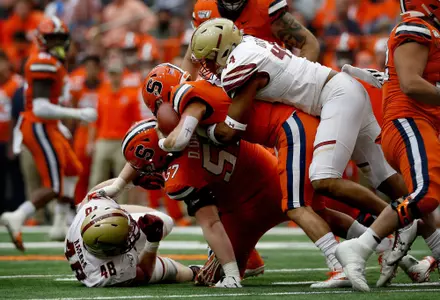
Photo by: John Munson
Old Eastern Rivals To Clash Once More
November 04, 2020 | Football, #ForBoston Files
Northeast parochialism returns in the nationalized ACC.
Once upon a time, in a galaxy far, far away, college football's parochialism forged rivalries amidst the harsh northeast winters.
Teams emerged from the ice and cold to batter one another with tough, rugged football. Deep, bitter rivals engaged in annual battles and never gave an inch to their unbreakable bond. They formed their own reputations and ultimately their own league, and they built their own spirit on a corridor from Massachusetts to New York, from Pennsylvania to New Jersey.
Those rivalries formed the bedrock of Northeast college football. On Saturday, Boston College visits one of its oldest, fiercest matchups when it travels to Syracuse.
"There's a good rivalry between us," BC defensive lineman Brandon Barlow said. "The mentality stays the same (to prepare), but it's a little elevated knowing it's Syracuse. This is always a fun one for me because I get to take a trip back to my home state, especially in the times we're living in now. I haven't been able to go back to New York since I came to Boston (in June), so it'll be nice to breathe in that fresh, cold, brisk New York air and go attack these guys on Saturday."
BC and Syracuse are natural geographic rivals separated by less than five hours, but their history predates the modern, permanent fixtures. They first met on the gridiron in 1924 and split games in 1944 and 1958 before they started annual games in 1961. A brief interlude occurred in 1968, then again in 1970, but the series continued uninterrupted after a 1971 game at Archbold Stadium.
What followed was a natural ebb and flow, the kind that defines a good, solid rivalry. In 1979, a two-win Boston College team scored 20 fourth-quarter points in a 27-10 win and derailed Syracuse's Tangerine Bowl bid. Three years later, Doug Flutie further solidified the rivalry when he completed three passes in the last minute and a half to lead BC over Syracuse, 20-13. The win clinched a bowl bid for the Eagles to that very same Tangerine Bowl even though Flutie failed to complete a pass in the first half and finished the game with a 7-for-23 completion rate.
Syracuse earned its measure of revenge the next year with a 21-10 win over the 13th-ranked Eagles in 1983, but Flutie went out a winner with a 24-16 win at Foxboro Stadium in 1984. That game sent more than 60,000 fans home with smiles six days before the Miracle in Miami.
That back-and-forth defined a generation, and neither team grabbed full momentum until Dick MacPherson's rise at Syracuse in the late 1980s. BC swooned in the post-Flutie era, and Syracuse's 45-17 win at the Carrier Dome in 1987 kicked off six straight wins. During that era, though, the two schools founded the Big East's football league and brought their rivalry under a full conference banner 10 years after they helped supercharge the northeast's basketball conference.
It set a backdrop for the first two years of informal Big East play and created further drama in 1992 when BC lost at home, 27-10, with a potential Fiesta Bowl berth riding on the line. One week after Notre Dame's 54-7 blowout win over the Eagles, it struck a crushing blow and demoted them to the Hall of Fame Bowl, where they lost, 28-23, to Tennessee. The next year, though, BC handed 13th-ranked Syracuse its first loss of the season and ultimately sent a potential national contender into a tailspin.
"Back in the day, it was a moment of pride to dominate the Northeast," BC defensive lineman Brandon Barlow said. "You want to be the team that comes out on top, and that's carried into today. (Former BC assistant coach Paul Pasqualoni) coached Syracuse in the Big East and brought it up to take pride in beating northeastern teams. We compete in all aspects, in recruiting and on the field. We want to gather that fan support and show that we are the team to beat here. It's a big pride thing."
That matchup remained a Big East cornerstone, but it ultimately fell victim to college football's tectonic shift in the mid-2000s when Boston College accepted an invitation to the Atlantic Coast Conference. Many believed the spot would eventually wind up with Syracuse, but the Eagles ended defected in 2005, offering the Orange only one last shot at a win in the last weekend of the 2004 regular season.
In perhaps a fitting tribute, though, Syracuse upset the Eagles, again with the Fiesta Bowl hanging in the balance, in the infamous Diamond Ferri game.
"Truthfully, the one thing I missed about college football when I was in the NFL was the tradition and things like that," BC head coach Jeff Hafley said. "Whether you have a big rivalry, or whether you come out and the band is playing the fight song, or you win a game and you're singing the fight song in the locker room - just that atmosphere and the pageantry of college football."
The rivalry went dormant as college football's continued realignment further broke the Big East apart, but in 2011, one year after Mark Herzlich's interception sealed bowl eligibility for BC in a non-conference matchup against the Orange, Syracuse and Pittsburgh applied for and received ACC membership. It reunited the teams - and, to a lesser degree, brought the Panthers home to Miami and Virginia Tech - and further ensured the revival of the matchup within the Atlantic Division.
"I grew up in New Jersey, (and) Syracuse was all over the place," Hafley said. "(I) remember watching (Donovan) McNabb and all those guys play, and they were awesome. I was at Pitt for a long time, so I was in the Big East. I played against Syracuse for five or six years. When I was at Rutgers, we played Syracuse. I have a lot of memories in that dome.
"There were times in that dome, especially in their press box, I remember having one guy throw a beer at me," he said with a laugh. "It was loud (and) intense (with) people banging on the box. I remember one game someone held up a pizza box. I couldn't even see, I was like, 'This guy's got to get this pizza box down, I can't even see what's going on.' But it got loud. I remember that dome rocking."
The ACC's realignment nationalized the southern league even though it still retains its Tobacco Road roots. The conference's blue bloods are from Georgia, Virginia and the Carolinas, and the first expansion spread to Florida's warm waters, first with Florida State and then with Miami (and, owing to its roots, Virginia Tech). BC came along, but it was always the northern outlier until Syracuse and Pittsburgh's arrival a decade later. On Saturday, though, a little bit of northeast parochialism will return. Two warriors defined by snow and ice will enter the Carrier Dome and battle one more time in a rivalry that is theirs.
It's Boston and New York. It's Boston College and Syracuse. It's the Big East roaring back to life on a football field in the ACC. It's everything that makes college football eternally great.
Teams emerged from the ice and cold to batter one another with tough, rugged football. Deep, bitter rivals engaged in annual battles and never gave an inch to their unbreakable bond. They formed their own reputations and ultimately their own league, and they built their own spirit on a corridor from Massachusetts to New York, from Pennsylvania to New Jersey.
Those rivalries formed the bedrock of Northeast college football. On Saturday, Boston College visits one of its oldest, fiercest matchups when it travels to Syracuse.
"There's a good rivalry between us," BC defensive lineman Brandon Barlow said. "The mentality stays the same (to prepare), but it's a little elevated knowing it's Syracuse. This is always a fun one for me because I get to take a trip back to my home state, especially in the times we're living in now. I haven't been able to go back to New York since I came to Boston (in June), so it'll be nice to breathe in that fresh, cold, brisk New York air and go attack these guys on Saturday."
BC and Syracuse are natural geographic rivals separated by less than five hours, but their history predates the modern, permanent fixtures. They first met on the gridiron in 1924 and split games in 1944 and 1958 before they started annual games in 1961. A brief interlude occurred in 1968, then again in 1970, but the series continued uninterrupted after a 1971 game at Archbold Stadium.
What followed was a natural ebb and flow, the kind that defines a good, solid rivalry. In 1979, a two-win Boston College team scored 20 fourth-quarter points in a 27-10 win and derailed Syracuse's Tangerine Bowl bid. Three years later, Doug Flutie further solidified the rivalry when he completed three passes in the last minute and a half to lead BC over Syracuse, 20-13. The win clinched a bowl bid for the Eagles to that very same Tangerine Bowl even though Flutie failed to complete a pass in the first half and finished the game with a 7-for-23 completion rate.
Syracuse earned its measure of revenge the next year with a 21-10 win over the 13th-ranked Eagles in 1983, but Flutie went out a winner with a 24-16 win at Foxboro Stadium in 1984. That game sent more than 60,000 fans home with smiles six days before the Miracle in Miami.
That back-and-forth defined a generation, and neither team grabbed full momentum until Dick MacPherson's rise at Syracuse in the late 1980s. BC swooned in the post-Flutie era, and Syracuse's 45-17 win at the Carrier Dome in 1987 kicked off six straight wins. During that era, though, the two schools founded the Big East's football league and brought their rivalry under a full conference banner 10 years after they helped supercharge the northeast's basketball conference.
It set a backdrop for the first two years of informal Big East play and created further drama in 1992 when BC lost at home, 27-10, with a potential Fiesta Bowl berth riding on the line. One week after Notre Dame's 54-7 blowout win over the Eagles, it struck a crushing blow and demoted them to the Hall of Fame Bowl, where they lost, 28-23, to Tennessee. The next year, though, BC handed 13th-ranked Syracuse its first loss of the season and ultimately sent a potential national contender into a tailspin.
"Back in the day, it was a moment of pride to dominate the Northeast," BC defensive lineman Brandon Barlow said. "You want to be the team that comes out on top, and that's carried into today. (Former BC assistant coach Paul Pasqualoni) coached Syracuse in the Big East and brought it up to take pride in beating northeastern teams. We compete in all aspects, in recruiting and on the field. We want to gather that fan support and show that we are the team to beat here. It's a big pride thing."
That matchup remained a Big East cornerstone, but it ultimately fell victim to college football's tectonic shift in the mid-2000s when Boston College accepted an invitation to the Atlantic Coast Conference. Many believed the spot would eventually wind up with Syracuse, but the Eagles ended defected in 2005, offering the Orange only one last shot at a win in the last weekend of the 2004 regular season.
In perhaps a fitting tribute, though, Syracuse upset the Eagles, again with the Fiesta Bowl hanging in the balance, in the infamous Diamond Ferri game.
"Truthfully, the one thing I missed about college football when I was in the NFL was the tradition and things like that," BC head coach Jeff Hafley said. "Whether you have a big rivalry, or whether you come out and the band is playing the fight song, or you win a game and you're singing the fight song in the locker room - just that atmosphere and the pageantry of college football."
The rivalry went dormant as college football's continued realignment further broke the Big East apart, but in 2011, one year after Mark Herzlich's interception sealed bowl eligibility for BC in a non-conference matchup against the Orange, Syracuse and Pittsburgh applied for and received ACC membership. It reunited the teams - and, to a lesser degree, brought the Panthers home to Miami and Virginia Tech - and further ensured the revival of the matchup within the Atlantic Division.
"I grew up in New Jersey, (and) Syracuse was all over the place," Hafley said. "(I) remember watching (Donovan) McNabb and all those guys play, and they were awesome. I was at Pitt for a long time, so I was in the Big East. I played against Syracuse for five or six years. When I was at Rutgers, we played Syracuse. I have a lot of memories in that dome.
"There were times in that dome, especially in their press box, I remember having one guy throw a beer at me," he said with a laugh. "It was loud (and) intense (with) people banging on the box. I remember one game someone held up a pizza box. I couldn't even see, I was like, 'This guy's got to get this pizza box down, I can't even see what's going on.' But it got loud. I remember that dome rocking."
The ACC's realignment nationalized the southern league even though it still retains its Tobacco Road roots. The conference's blue bloods are from Georgia, Virginia and the Carolinas, and the first expansion spread to Florida's warm waters, first with Florida State and then with Miami (and, owing to its roots, Virginia Tech). BC came along, but it was always the northern outlier until Syracuse and Pittsburgh's arrival a decade later. On Saturday, though, a little bit of northeast parochialism will return. Two warriors defined by snow and ice will enter the Carrier Dome and battle one more time in a rivalry that is theirs.
It's Boston and New York. It's Boston College and Syracuse. It's the Big East roaring back to life on a football field in the ACC. It's everything that makes college football eternally great.

Players Mentioned

DL
/ FootballFriday, October 16
Friday, October 16
Friday, October 16
Thursday, October 15