Boston College Athletics
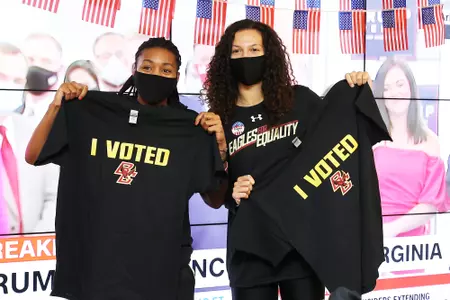
Photo by: John Quackenbos
Student-Athletes Casting Their Voice With Their Vote
November 03, 2020 | Boston College Athletics, Men's Basketball, Women's Basketball, Swimming, Fencing, #ForBoston Files
The NCAA goes dark today as athletes practice their civic duty
In 1971, the United States ratified its 26th Amendment to the Constitution. The fastest amendment passed, it took 100 days from proposal to completion and lowered the age of eligibility from 21 to 18 years. It was the byproduct of a Vietnam era movement but had roots in World War II, during which American law denied draft-eligible soldiers the right to vote on their own behalf.
It instantly intertwined American democracy with the maturation process of young adults. It equalized the levels between old and young voices and stripped the playing field down to its unalienable rights. It fostered independent thought and forced those same young people, many on college campuses, to determine their values on their own.
This year, in an unprecedented American election cycle, those young people are continuing to speak up for their society. On Tuesday, the NCAA will go dark without a single practice or game on the schedule as student-athletes sound their piece of democracy as part of a presidential election for the ages.
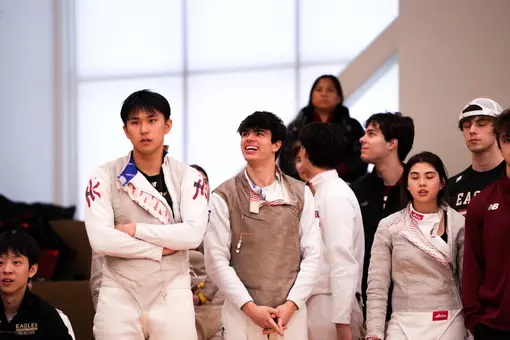
"As student-athletes, we have privileges that people in this country, let alone the world, don't have," said Udaypaul Chilana, a senior on the Boston College fencing team. "I am voting for the people whose voices can't be heard as prominently as mine; this election could be literally life or death for them."
The Election Day holiday concept is an idea occasionally floated to American society, but it gained steam in intercollegiate athletics after the greater issues in 2020 exploded into the national fabric. At Boston College, the Eagles committed to no mandatory activities and further dedicated their teams to voter registration and participation at both the national and local levels. They encouraged fellow students to hold difficult conversations during difficult times.
The NCAA followed suit in September as the Division I Council approved a similar measure proposed by the Student-Athlete Advisory Council. It formally canceled all athletics activities in order to enable students to better civic engagement and was the first piece of student-proposed legislation adopted in six years.
"I was at the ACC SAAC meeting over the summer when November 3 was floated as a nationally-mandated day off from sports," swimmer Ali Kea, a member of the BC SAAC, said. "As soon as I heard that, I believed it was something we needed to bring to Boston College. We don't get a lot of days off, but it really carried the weight that we needed to hear.
"Right away, (athletic director) Patrick Kraft and the rest of the BC community wanted to do it," she said. "It's an NCAA day off, but we were going to do it regardless. That made me proud that our institution took it on so quickly. It showed the athletes how important this day is."
At BC, it turned an idea into a movement to register student-athletes within their respective states. 25 programs achieved 100 percent registration, and the teams worked together to learn about individual state policies regarding absentee or mail-in balloting.
"Sometimes you look at a website, and it's confusing or gives you limited information, so we had to find other websites to help some people register," Kea said. "I learned so much about other states' processes in the troubleshooting process. Different states had different deadlines. Massachusetts had one of the latest deadlines, so people maybe didn't understand that their registration deadlines were a week or two before. Then we had to make sure ballots had to be mailed before the correct deadline in order to be counted. It was a lot of planning, and communications through group meetings, coaches relaying information, table events outside Conte Forum. We wanted to spread the word."
"My biggest thing was that people might complain about situations, but they have the power to do something about it," Clara Ford, a junior on the women's basketball team, said. "Everyone has the right to vote, and I know a lot of young people, especially student-athletes, didn't have a say in the last presidential election. I've just been super impressed by our response. (More than two dozen teams) are 100 percent registered to vote, and I'm impressed by it. People are starting to realize how much weight their one vote can carry."
Voting drove action, but it forced the Eagles deeper into their own individual consciences during a time of hurt in society. The COVID-19 breakout canceled their seasons and forever altered their college experiences, and the George Floyd murder on May 25 spilled common heartache into deep-rooted conversations between teammates aching to understand each other.
"I'm from the Minneapolis area (in Minnesota)," said men's basketball's Steffon Mitchell, "and the George Floyd protests, the things that were said about my state and my city, alarmed me into thinking that I had to vote. This was the first time that I voted, and I felt like it had to be done."
The talks exposed personal vulnerabilities but strengthened people's bonds with one another. They taught spiritual levels of individuality and forced BC student-athletes to confront their world. More importantly, it spurred action as young people sought to protect one another with a simple action.
"We had open conversations, regardless of the topic," Ford said. "I think we're excited to get the chance to vote and participate in the election. We come from all over the country, from Texas, from New Hampshire, from all over. I realized how significant situations are; I am an international studies major, and I do a lot of research on international politics. The past few months, doing research on candidates and watching debates, reading articles, I felt it was (all important). You need to know what you're voting for and what you're standing for. The name that's on the paper will have a big impact on the country."
"Conversations can turn into an echo chamber," Chilana said, "which isn't constructive when we try to talk about what other people are saying or thinking. I tried to approach differences of opinion with the understanding that we are all raised differently, that we have all gone through vastly different things. It can be generational or geographical, but it's important to realize that we don't see what we see as an absolute.
"We bounced ideas off (teammates), and we're motivating one another to talk to family and friends who aren't the most political people," he continued. "We want to register the apolitical people and talk to them about both sides. We want to kickstart them and make it important for them to exercise their right to vote. Some of our teammates are volunteering at the polls. Everyone is registered. The news has been reporting that (our) generation voter turnout is unprecedented, and that's the most important part. It shows that we might be young, but we have a voice."
This election cycle feels urgent and will shift the American landscape. Its resonance will force residents to introspectively look at one another. It will be passionate and stressful - and most likely divisive - but it will leave us with the lasting sound of a new generational movement paved by student-athletes seeking to serve the world as men and women for others.
"We have people (on our team) from all over the country," Mitchell said. "We all got on the phone after George Floyd, and we just had hard conversations. We've been on the same page with what's going on because, when we all watched what happened, we felt it was important to talk and to get on the same page."
"We will have a table at Conte Forum with BC Athletics 'I voted' shirts and 'I voted' stickers," Kea said. "We will have some activities, but we'll be playing music. We got everyone to Election Day, we made it, and everyone voted. We want to boost that morale, together."
It instantly intertwined American democracy with the maturation process of young adults. It equalized the levels between old and young voices and stripped the playing field down to its unalienable rights. It fostered independent thought and forced those same young people, many on college campuses, to determine their values on their own.
This year, in an unprecedented American election cycle, those young people are continuing to speak up for their society. On Tuesday, the NCAA will go dark without a single practice or game on the schedule as student-athletes sound their piece of democracy as part of a presidential election for the ages.
"As student-athletes, we have privileges that people in this country, let alone the world, don't have," said Udaypaul Chilana, a senior on the Boston College fencing team. "I am voting for the people whose voices can't be heard as prominently as mine; this election could be literally life or death for them."
The Election Day holiday concept is an idea occasionally floated to American society, but it gained steam in intercollegiate athletics after the greater issues in 2020 exploded into the national fabric. At Boston College, the Eagles committed to no mandatory activities and further dedicated their teams to voter registration and participation at both the national and local levels. They encouraged fellow students to hold difficult conversations during difficult times.
The NCAA followed suit in September as the Division I Council approved a similar measure proposed by the Student-Athlete Advisory Council. It formally canceled all athletics activities in order to enable students to better civic engagement and was the first piece of student-proposed legislation adopted in six years.
"I was at the ACC SAAC meeting over the summer when November 3 was floated as a nationally-mandated day off from sports," swimmer Ali Kea, a member of the BC SAAC, said. "As soon as I heard that, I believed it was something we needed to bring to Boston College. We don't get a lot of days off, but it really carried the weight that we needed to hear.
"Right away, (athletic director) Patrick Kraft and the rest of the BC community wanted to do it," she said. "It's an NCAA day off, but we were going to do it regardless. That made me proud that our institution took it on so quickly. It showed the athletes how important this day is."
At BC, it turned an idea into a movement to register student-athletes within their respective states. 25 programs achieved 100 percent registration, and the teams worked together to learn about individual state policies regarding absentee or mail-in balloting.
"Sometimes you look at a website, and it's confusing or gives you limited information, so we had to find other websites to help some people register," Kea said. "I learned so much about other states' processes in the troubleshooting process. Different states had different deadlines. Massachusetts had one of the latest deadlines, so people maybe didn't understand that their registration deadlines were a week or two before. Then we had to make sure ballots had to be mailed before the correct deadline in order to be counted. It was a lot of planning, and communications through group meetings, coaches relaying information, table events outside Conte Forum. We wanted to spread the word."
"My biggest thing was that people might complain about situations, but they have the power to do something about it," Clara Ford, a junior on the women's basketball team, said. "Everyone has the right to vote, and I know a lot of young people, especially student-athletes, didn't have a say in the last presidential election. I've just been super impressed by our response. (More than two dozen teams) are 100 percent registered to vote, and I'm impressed by it. People are starting to realize how much weight their one vote can carry."
Voting drove action, but it forced the Eagles deeper into their own individual consciences during a time of hurt in society. The COVID-19 breakout canceled their seasons and forever altered their college experiences, and the George Floyd murder on May 25 spilled common heartache into deep-rooted conversations between teammates aching to understand each other.
"I'm from the Minneapolis area (in Minnesota)," said men's basketball's Steffon Mitchell, "and the George Floyd protests, the things that were said about my state and my city, alarmed me into thinking that I had to vote. This was the first time that I voted, and I felt like it had to be done."
The talks exposed personal vulnerabilities but strengthened people's bonds with one another. They taught spiritual levels of individuality and forced BC student-athletes to confront their world. More importantly, it spurred action as young people sought to protect one another with a simple action.
"We had open conversations, regardless of the topic," Ford said. "I think we're excited to get the chance to vote and participate in the election. We come from all over the country, from Texas, from New Hampshire, from all over. I realized how significant situations are; I am an international studies major, and I do a lot of research on international politics. The past few months, doing research on candidates and watching debates, reading articles, I felt it was (all important). You need to know what you're voting for and what you're standing for. The name that's on the paper will have a big impact on the country."
"Conversations can turn into an echo chamber," Chilana said, "which isn't constructive when we try to talk about what other people are saying or thinking. I tried to approach differences of opinion with the understanding that we are all raised differently, that we have all gone through vastly different things. It can be generational or geographical, but it's important to realize that we don't see what we see as an absolute.
"We bounced ideas off (teammates), and we're motivating one another to talk to family and friends who aren't the most political people," he continued. "We want to register the apolitical people and talk to them about both sides. We want to kickstart them and make it important for them to exercise their right to vote. Some of our teammates are volunteering at the polls. Everyone is registered. The news has been reporting that (our) generation voter turnout is unprecedented, and that's the most important part. It shows that we might be young, but we have a voice."
This election cycle feels urgent and will shift the American landscape. Its resonance will force residents to introspectively look at one another. It will be passionate and stressful - and most likely divisive - but it will leave us with the lasting sound of a new generational movement paved by student-athletes seeking to serve the world as men and women for others.
"We have people (on our team) from all over the country," Mitchell said. "We all got on the phone after George Floyd, and we just had hard conversations. We've been on the same page with what's going on because, when we all watched what happened, we felt it was important to talk and to get on the same page."
"We will have a table at Conte Forum with BC Athletics 'I voted' shirts and 'I voted' stickers," Kea said. "We will have some activities, but we'll be playing music. We got everyone to Election Day, we made it, and everyone voted. We want to boost that morale, together."
Players Mentioned

Epee
/ Fencing
C
/ Women's Basketball
Freestyle
/ Swimming
F
/ Men's BasketballFrom the Desk of Blake James | Episode 8
Friday, April 24
Baseball: 2026 ALS Game vs Virginia Tech Recap
Tuesday, April 21
No. 24 Baseball Defeats Duke (April 18, 2026) - Game 2
Sunday, April 19
No. 24 Baseball Defeats Duke - April 18, 2026 Game 1
Saturday, April 18