Boston College Athletics
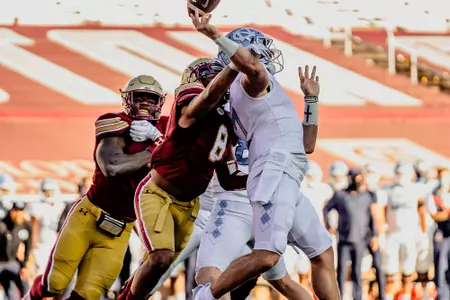
Photo by: Anthony Garro
Despite Loss, BC Cranked Up The Heat
October 06, 2020 | Football, #ForBoston Files
The blitz played a big role in the close outcome on Saturday night.
North Carolina quarterback Sam Howell's enjoyment levels probably shot through the top of the meter by the end of the first quarter of Saturday's game. He had dominated the Boston College defense for just under 100 yards, and he twice burned open field coverage on two different touchdown-scoring drives. He was 5-of-8 passing, and a 14-3 advantage foreshadowed an impending track meet for the Tar Heels.
That deficit, though, illustrated something altogether different on the BC sideline. The Tar Heels had held the ball for less than seven minutes in that quarter and earned big play gains by exposing a couple of holes. Howell was good, but defensive coordinator Tem Lukabu identified an adjustment opportunity after Aaron Boumheri's second field goal cut the lead down to one score.
Lukabu designated Jahmin Muse as a blitzing safety and lined him up on the edge of the line of scrimmage. At the snap, Muse flew untouched by the offensive tackle and easily dusted to the inside of running back Javonte Williams. He snaked to the quarterback, and he popped Howell on the blind side as the quarterback looked away for a pass.
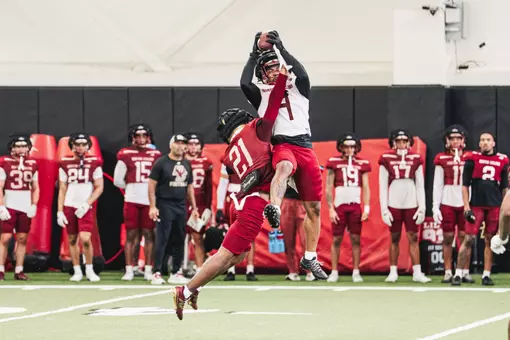
The ball flew into the air, and cornerback Brandon Sebastian outran UNC's Beau Corrales to a spot before he leapt into the air and snagged the interception.
That one moment touched off a swing of energy for the Boston College defense. For the remainder of the game, the defensive front timed its pressures against the high-powered North Carolina offense. It strategically blitzed Howell and rattled his cage in the pocket. It forced him to make plays with his feet and ultimately made him uncomfortable, and though UNC ultimately won the game, that early blowout never materialized because of the chaos induced by the tough, physical playcalls by the BC defense.
"Watching the film closely and studying, I'm really proud of the way our kids played and fought," head coach Jeff Hafley said. "Their effort was outstanding. They played tough and physical and for each other. They bought in and never gave up. They expected to win, and they expected to win (the game) in the fourth (quarter)."
There are a number of ways to defend against high-powered passing attacks, but the goal never changes because a defense either has to take away the quarterback or the receivers. In UNC's case, taking away either would prove exceptionally difficult because Howell is one of the best quarterbacks in the country and can perfectly execute an Air Raid scheme.
He can deliver pinpoint, downfield attacks but possesses the vision to find receivers if they can get open. He then turns those pass catchers into agile ball carriers, all of whom have the necessary speed to separate would-be tacklers or defenders. To get them the ball, he can either stand in the pocket comfortably behind his offensive line, or he can use his legs to break down plays by scrambling. Both of those can be disrupted, but the pass rush package needs both components to avoid being burned by the other option.
"A couple of times we came underneath and got the quarterback off the edge," Hafley said. "Being precise and getting (Howell) down, he didn't stay in the pocket to make throws. At the end of the first down, when the back got out and shot down the field, he threw it to him when he was almost past the line of scrimmage. That was a great play."
On Saturday, Hafley and Lukabu decided to counter that by switching into a blitz and out of zone coverage at strategic moments. They intended to minimize and remove Howell's time through pressure, and the read against the UNC blocking scheme would prevent the prevention of getting the quarterback hit. Instead of giving him time to look downfield or move around to buy time for receivers, they would force quick, ill-advised throws while rattling the pocket with physicality.
"It's a bit of a cat-and-mouse (game) in feeling people out," Hafley said. "We didn't have a lot of film on (teams) from this year. We went in early in the game, with zone (coverage), and pressured, but we couldn't get to the quarterback. So we got aggressive and backed up. If you go on the call sheet, there's a four-man rush, five or six-men (rushes), zero pressures, simulated pressures, and fire zones. You have to feel out when to use them."
It used BC's own offensive observations against UNC and effectively rammed the Tar Heels' defensive game plan back at their offense. Quarterback Phil Jurkovec began the game under duress and suffered consecutive sacks on BC's first drive, but he later adjusted by hitting swing passes to running backs Travis Levy and Patrick Garwo.
"It goes into the right protections," Hafley said. "(You ask) how many guys are in the protection and if the tight end is in protection, if the quarterback is throwing hot. Figuring out pass protection and blitzes are probably the most detailed thing that we spend time with. North Carolina came after us early, but I thought our offensive line did a good job. Phil did a good job keeping his eyes downfield. He scrambled, and I still don't know how he saw some things, but he did."
It gradually opened up the throws to Hunter Long over the middle, and Jurkovec's quick release kept UNC off balance over the course of 56 passing attempts. It increased his ceiling over the course of the game, and even though the Eagles lost, the optimism about his ability to stare down the pressures was palpable in the postgame breakdown.
"There was pressure in the box, so we had to open it up," Hafley said. "Once we opened it up, we found success. Phil was getting rid of the ball quickly. There were some explosive plays that, with experience, he could have hit for a couple of big ones. Guys downfield were open. Phil played a more complete game from start to finish, and some of those throws he made, he has a chance to be a special player."
UNC won the game, but BC walked off the Alumni Stadium gridiron with further situational knowledge. It was of little consequence in the immediate aftermath on Saturday, but there's now a database for how to handle the third down blitz packages - just as much as there is experience in how to dole out the same punishment to an opponent.
"It's a calculated risk on field position," Hafley said. "You have to figure out how aggressive to be, how you can get off the field, if you can get off the field, and if the quarterback is going to scramble. There's a lot of conversation between (defensive coordinator) Tem Lukabu and me when we talk about (blitz situations)."
That deficit, though, illustrated something altogether different on the BC sideline. The Tar Heels had held the ball for less than seven minutes in that quarter and earned big play gains by exposing a couple of holes. Howell was good, but defensive coordinator Tem Lukabu identified an adjustment opportunity after Aaron Boumheri's second field goal cut the lead down to one score.
Lukabu designated Jahmin Muse as a blitzing safety and lined him up on the edge of the line of scrimmage. At the snap, Muse flew untouched by the offensive tackle and easily dusted to the inside of running back Javonte Williams. He snaked to the quarterback, and he popped Howell on the blind side as the quarterback looked away for a pass.
The ball flew into the air, and cornerback Brandon Sebastian outran UNC's Beau Corrales to a spot before he leapt into the air and snagged the interception.
That one moment touched off a swing of energy for the Boston College defense. For the remainder of the game, the defensive front timed its pressures against the high-powered North Carolina offense. It strategically blitzed Howell and rattled his cage in the pocket. It forced him to make plays with his feet and ultimately made him uncomfortable, and though UNC ultimately won the game, that early blowout never materialized because of the chaos induced by the tough, physical playcalls by the BC defense.
"Watching the film closely and studying, I'm really proud of the way our kids played and fought," head coach Jeff Hafley said. "Their effort was outstanding. They played tough and physical and for each other. They bought in and never gave up. They expected to win, and they expected to win (the game) in the fourth (quarter)."
There are a number of ways to defend against high-powered passing attacks, but the goal never changes because a defense either has to take away the quarterback or the receivers. In UNC's case, taking away either would prove exceptionally difficult because Howell is one of the best quarterbacks in the country and can perfectly execute an Air Raid scheme.
He can deliver pinpoint, downfield attacks but possesses the vision to find receivers if they can get open. He then turns those pass catchers into agile ball carriers, all of whom have the necessary speed to separate would-be tacklers or defenders. To get them the ball, he can either stand in the pocket comfortably behind his offensive line, or he can use his legs to break down plays by scrambling. Both of those can be disrupted, but the pass rush package needs both components to avoid being burned by the other option.
"A couple of times we came underneath and got the quarterback off the edge," Hafley said. "Being precise and getting (Howell) down, he didn't stay in the pocket to make throws. At the end of the first down, when the back got out and shot down the field, he threw it to him when he was almost past the line of scrimmage. That was a great play."
On Saturday, Hafley and Lukabu decided to counter that by switching into a blitz and out of zone coverage at strategic moments. They intended to minimize and remove Howell's time through pressure, and the read against the UNC blocking scheme would prevent the prevention of getting the quarterback hit. Instead of giving him time to look downfield or move around to buy time for receivers, they would force quick, ill-advised throws while rattling the pocket with physicality.
"It's a bit of a cat-and-mouse (game) in feeling people out," Hafley said. "We didn't have a lot of film on (teams) from this year. We went in early in the game, with zone (coverage), and pressured, but we couldn't get to the quarterback. So we got aggressive and backed up. If you go on the call sheet, there's a four-man rush, five or six-men (rushes), zero pressures, simulated pressures, and fire zones. You have to feel out when to use them."
It used BC's own offensive observations against UNC and effectively rammed the Tar Heels' defensive game plan back at their offense. Quarterback Phil Jurkovec began the game under duress and suffered consecutive sacks on BC's first drive, but he later adjusted by hitting swing passes to running backs Travis Levy and Patrick Garwo.
"It goes into the right protections," Hafley said. "(You ask) how many guys are in the protection and if the tight end is in protection, if the quarterback is throwing hot. Figuring out pass protection and blitzes are probably the most detailed thing that we spend time with. North Carolina came after us early, but I thought our offensive line did a good job. Phil did a good job keeping his eyes downfield. He scrambled, and I still don't know how he saw some things, but he did."
It gradually opened up the throws to Hunter Long over the middle, and Jurkovec's quick release kept UNC off balance over the course of 56 passing attempts. It increased his ceiling over the course of the game, and even though the Eagles lost, the optimism about his ability to stare down the pressures was palpable in the postgame breakdown.
"There was pressure in the box, so we had to open it up," Hafley said. "Once we opened it up, we found success. Phil was getting rid of the ball quickly. There were some explosive plays that, with experience, he could have hit for a couple of big ones. Guys downfield were open. Phil played a more complete game from start to finish, and some of those throws he made, he has a chance to be a special player."
UNC won the game, but BC walked off the Alumni Stadium gridiron with further situational knowledge. It was of little consequence in the immediate aftermath on Saturday, but there's now a database for how to handle the third down blitz packages - just as much as there is experience in how to dole out the same punishment to an opponent.
"It's a calculated risk on field position," Hafley said. "You have to figure out how aggressive to be, how you can get off the field, if you can get off the field, and if the quarterback is going to scramble. There's a lot of conversation between (defensive coordinator) Tem Lukabu and me when we talk about (blitz situations)."
Players Mentioned

QB
/ Football
RB
/ Football
TE
/ Football
DB
/ Football
DB
/ FootballNo. 24 Baseball Defeats Duke (April 18, 2026) - Game 2
Sunday, April 19
No. 24 Baseball Defeats Duke - April 18, 2026 Game 1
Saturday, April 18
No. 24 Baseball Defeats Duke (April 17, 2026)
Friday, April 17
#24 Baseball Defeats UConn (April 15, 2026)
Wednesday, April 15