Boston College Athletics
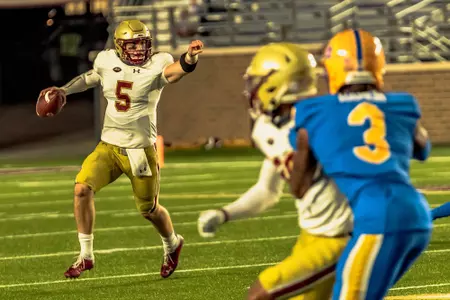
Coaching, Executing One Step Ahead In Victory
October 14, 2020 | Football, #ForBoston Files
It was a one-point win, but BC illustrated how it can stay ahead of opponents on game day.
Jeff Hafley stood on the sidelines and understood exactly what offensive coordinator Frank Cignetti was going to do. Both of them knew Pittsburgh could stop any team's rushing attack, but they equally appreciated what would happen if they pounded the rock enough. The safeties, they reasoned, would cheat further into the box and expose a lack of help over the top. Once that happened, both recognized there would be an opportunity for a downfield, explosive play.
On a second down early in the second quarter, Cignetti made the home run call. He lined the BC offense into a bunch formation and drew the safeties into the box with a clear running formation. Paris Ford crept up instinctively, but he froze when quarterback Phil Jurkovec faked the handoff to David Bailey. It opened the door for Zay Flowers to release inside on defensive back Jason Pinnock, and Flowers sped by on a double move to the outside as Jurkovec delivered a perfect pass for a 44-yard touchdown with room to spare.
Then, for good measure, they did it again at the start of the third quarter with an almost-identical play. Jurkovec again called a play action out of a bunch formation and froze the safeties as they cheated into the box, and Flowers again sped by the defensive backfield. Instead of making the double move this time, he stayed on a streak through the middle of the field, and another bomb landed in his hands for a 77-yard touchdown.
Those two plays offered the perfect indicator of a receiver using both a physical advantage and a play call to beat a defensive back, and both pointed to a primary reason why BC was able to defeat Pitt. The prior week's film study revealed a poker tell in the run defense, and the Eagles bluffed the Panthers into overplaying their hand with too many chips in the middle of the table.
"Zay's speed release is against bigger, longer guys," Hafley said. "Those corners were huge, and he was just releasing fast so they couldn't get their length on him. He was just running away from them. When you're up against bigger and longer (defensive backs), and you're faster and quicker, you use a speed release to get width fast, and you just run away. Then you get back and stack them to run your route. If a DB is covering and you flip his hips, it's harder to recover if you're the DB."
The entire design exploited Pitt's defense and opened up a single coverage opportunity in space for a speedy and agile receiver. On the first touchdown, BC bunched its formation with two tight ends off of the right side of the line, but both stayed into block for Jurkovec. Neither of the two middle linebackers attacked middle of the field as a result, and both Pinnock and Marquis Williams wound up turning inside at Flowers and Jaelen Gill.
Free safety Damar Hamlin turned inside, but he kept his back to Gill and negated the potential for an inside run. Flowers, though, was left alone, and Pinnock's shift left the wide receiver with the whole middle of the field to work with. He could make the double move outside and turn Pinnock around again, which he did with ease as Jurkovec stepped forward and delivered the strike.
"You want to flip a DB's hips as fast as you can," Hafley said. "Once his hips flip, you have an advantage and leverage because a good DB likes to stay as square as possible. If you stay square, you don't open up your hips. If you open up your hips quickly, the receiver can get underneath or go outside (depending on the direction)."
Pitt corrected itself on the second touchdown, but BC's play design adjusted for any changes when it sent both Hunter Long and Spencer Witter out into pass coverage. Instead of covering deep, Hamlin went to the outside sideline to cover Long, and Witter kept Ford closer to the line of scrimmage as an underneath checkdown. Both moves, albeit different from the first play, kept the safeties close to the line of scrimmage as the linebackers blitzed.
Those subtle changes, though, kept Flowers in single coverage, and he once again turned Pinnock's hips with a devastating quickness. He gained a step and turned into the half yard of necessary separation. Without the deep coverage, Flowers was able to catch it away from the tackler and speed away, and the bigger-sized Pinnock lacked the lateral agility to make any kind of shoestring tackle.
"We're a little different every week," Hafley said. "There was an element of tempo this week, and we threw more in Week Three than we did in Week Two or Week One. The staff does a good job of playing cat-and-mouse to stay ahead of (other teams). We had a big play in the second half, and we've been good in the fourth quarter...It's good film study, good anticipation, and good coaching. The more we're around each other, the more we'll improve."
Pittsburgh's inability to remain square in the defensive backfield contrasted with BC's success in doing the same against quarterback Kenny Pickett, who finished 25-for-48 for 266 yards. He averaged a full six yards less per pass than Jurkovec because he lacked the same explosiveness down the deep field, and he further ran into issues against the coverage of both Brandon Sebastian and Josh DeBerry.
"Sebastian was the player of the game," Hafley said. "The poise he plays with at the reception point, he finishes violently and tackles violently. He should have an interception that he dropped. The guy just plays with a ton of energy, and he can run. He's good with the ball in the air, and he's good at tackling and defending."
Sebastian broke up six passes, by far a career best, and nearly recorded an interception. DeBerry, meanwhile, did record a pick in the early fourth quarter and finished with six tackles, including five solos. He additionally broke up a pass and recorded a QB hurry that forced an incomplete pass in overtime. Both completely neutralized the Pitt passing game and only surrendered a touchdown after a collision in coverage, and the Panthers only registered one chunk play in the fourth quarter.
"You want to look at opportunities," Hafley said. "As a corner, if there were six plays, (you ask) how many were caught. If you were 4-for-6, that's a really good day. If you were 0-for-6, but you did everything else right in a game, you didn't have a good day. It's almost like a baseball player with a batting average in a game, (weighing) how many opportunities you get and how many plays did you make."
On a second down early in the second quarter, Cignetti made the home run call. He lined the BC offense into a bunch formation and drew the safeties into the box with a clear running formation. Paris Ford crept up instinctively, but he froze when quarterback Phil Jurkovec faked the handoff to David Bailey. It opened the door for Zay Flowers to release inside on defensive back Jason Pinnock, and Flowers sped by on a double move to the outside as Jurkovec delivered a perfect pass for a 44-yard touchdown with room to spare.
Then, for good measure, they did it again at the start of the third quarter with an almost-identical play. Jurkovec again called a play action out of a bunch formation and froze the safeties as they cheated into the box, and Flowers again sped by the defensive backfield. Instead of making the double move this time, he stayed on a streak through the middle of the field, and another bomb landed in his hands for a 77-yard touchdown.
Those two plays offered the perfect indicator of a receiver using both a physical advantage and a play call to beat a defensive back, and both pointed to a primary reason why BC was able to defeat Pitt. The prior week's film study revealed a poker tell in the run defense, and the Eagles bluffed the Panthers into overplaying their hand with too many chips in the middle of the table.
"Zay's speed release is against bigger, longer guys," Hafley said. "Those corners were huge, and he was just releasing fast so they couldn't get their length on him. He was just running away from them. When you're up against bigger and longer (defensive backs), and you're faster and quicker, you use a speed release to get width fast, and you just run away. Then you get back and stack them to run your route. If a DB is covering and you flip his hips, it's harder to recover if you're the DB."
The entire design exploited Pitt's defense and opened up a single coverage opportunity in space for a speedy and agile receiver. On the first touchdown, BC bunched its formation with two tight ends off of the right side of the line, but both stayed into block for Jurkovec. Neither of the two middle linebackers attacked middle of the field as a result, and both Pinnock and Marquis Williams wound up turning inside at Flowers and Jaelen Gill.
Free safety Damar Hamlin turned inside, but he kept his back to Gill and negated the potential for an inside run. Flowers, though, was left alone, and Pinnock's shift left the wide receiver with the whole middle of the field to work with. He could make the double move outside and turn Pinnock around again, which he did with ease as Jurkovec stepped forward and delivered the strike.
"You want to flip a DB's hips as fast as you can," Hafley said. "Once his hips flip, you have an advantage and leverage because a good DB likes to stay as square as possible. If you stay square, you don't open up your hips. If you open up your hips quickly, the receiver can get underneath or go outside (depending on the direction)."
Pitt corrected itself on the second touchdown, but BC's play design adjusted for any changes when it sent both Hunter Long and Spencer Witter out into pass coverage. Instead of covering deep, Hamlin went to the outside sideline to cover Long, and Witter kept Ford closer to the line of scrimmage as an underneath checkdown. Both moves, albeit different from the first play, kept the safeties close to the line of scrimmage as the linebackers blitzed.
Those subtle changes, though, kept Flowers in single coverage, and he once again turned Pinnock's hips with a devastating quickness. He gained a step and turned into the half yard of necessary separation. Without the deep coverage, Flowers was able to catch it away from the tackler and speed away, and the bigger-sized Pinnock lacked the lateral agility to make any kind of shoestring tackle.
"We're a little different every week," Hafley said. "There was an element of tempo this week, and we threw more in Week Three than we did in Week Two or Week One. The staff does a good job of playing cat-and-mouse to stay ahead of (other teams). We had a big play in the second half, and we've been good in the fourth quarter...It's good film study, good anticipation, and good coaching. The more we're around each other, the more we'll improve."
Pittsburgh's inability to remain square in the defensive backfield contrasted with BC's success in doing the same against quarterback Kenny Pickett, who finished 25-for-48 for 266 yards. He averaged a full six yards less per pass than Jurkovec because he lacked the same explosiveness down the deep field, and he further ran into issues against the coverage of both Brandon Sebastian and Josh DeBerry.
"Sebastian was the player of the game," Hafley said. "The poise he plays with at the reception point, he finishes violently and tackles violently. He should have an interception that he dropped. The guy just plays with a ton of energy, and he can run. He's good with the ball in the air, and he's good at tackling and defending."
Sebastian broke up six passes, by far a career best, and nearly recorded an interception. DeBerry, meanwhile, did record a pick in the early fourth quarter and finished with six tackles, including five solos. He additionally broke up a pass and recorded a QB hurry that forced an incomplete pass in overtime. Both completely neutralized the Pitt passing game and only surrendered a touchdown after a collision in coverage, and the Panthers only registered one chunk play in the fourth quarter.
"You want to look at opportunities," Hafley said. "As a corner, if there were six plays, (you ask) how many were caught. If you were 4-for-6, that's a really good day. If you were 0-for-6, but you did everything else right in a game, you didn't have a good day. It's almost like a baseball player with a batting average in a game, (weighing) how many opportunities you get and how many plays did you make."
Players Mentioned

RB
/ Football
DB
/ Football
WR
/ Football
WR
/ Football
QB
/ Football
TE
/ Football
DB
/ Football
TE
/ Football#24 Baseball Defeats UConn (April 15, 2026)
Wednesday, April 15
#24 Baseball Defeats Northeastern in Beanpot Championship (April 14, 2026)
Wednesday, April 15
#23 Baseball Defeats Virginia Tech (April 12, 2026)
Tuesday, April 14
#23 Baseball Defeats Virginia Tech (April 11,2026
Saturday, April 11