Boston College Athletics
Burke, Ritchie Leading BC Men's Track Revolution
May 23, 2019 | Men's Track & Field, #ForBoston Files
The duo will compete this week at the NCAA East Prelims in Jacksonville
CHESTNUT HILL, Mass. -- There was a time when the track & field community could overlook Boston College. The Eagles would compete among its northeastern brethren, but the team would never seriously compete with the rest of the ACC. Scoring points in the conference meet was out of the question, and only the occasional solo act would appear as part of the NCAA East Regional meet.
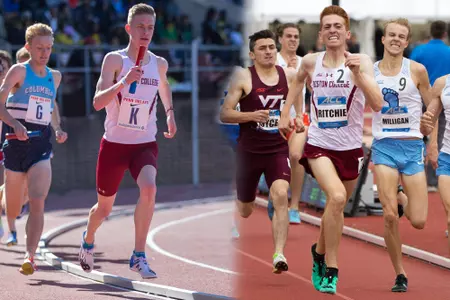
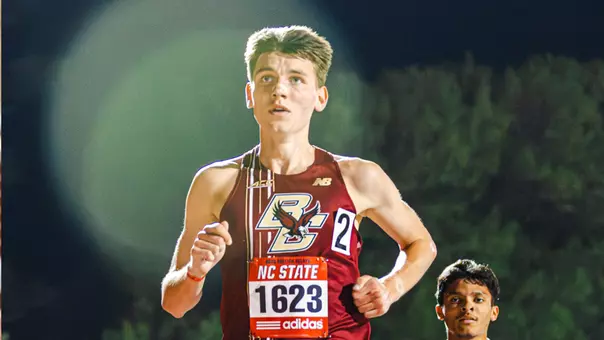
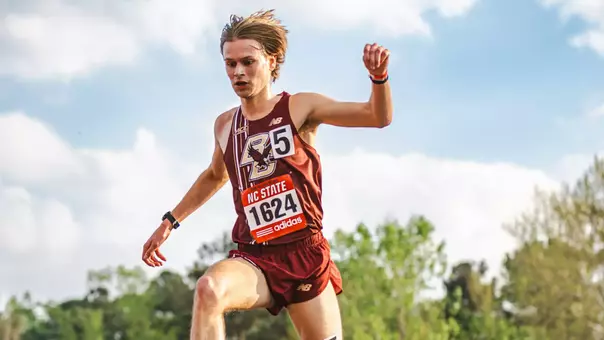
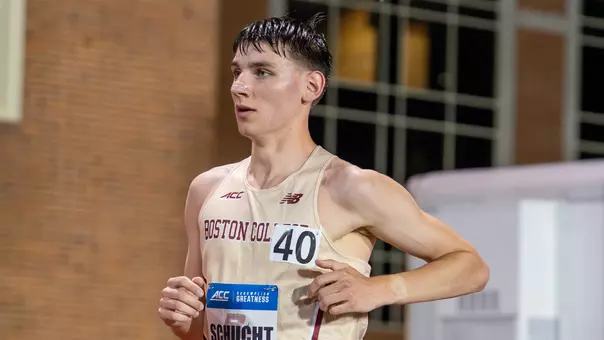
All of that changed two weeks ago at Virginia's Lannigan Field. The Eagles posted the best team finish in program history at the ACC Championship. Across the board, BC student-athletes set personal bests as part of a greater team effort, continuing a trend that started at the beginning of the 2019 outdoor campaign, through the Championship of America section of the Penn Relays, culminating at the conference championship. Two Eagles in particular - seniors Sean Burke and Ian Ritchie - dominated in their respective events.
The performance became part of a larger story taking hold in Chestnut Hill for Burke and Ritchie. The duo qualified for the NCAA East Regional meet this week in Jacksonville, Fla., becoming the first multi-qualifier representation from Boston College since head coach Matt Kerr began building his vision over a decade ago.
"In my 11 years at BC, we've had maybe seven guys go to a national meet," Kerr said. "It's always been a one-off, though. So getting two guys to qualify has been a breakthrough that we've been looking for. Both of these guys come from different backgrounds, but they just work so well together. They do great together from a training perspective, and it's been a lot of fun to watch them become great training partners."
For BC, it's the perfect story to indicate the direction and foundation of the program. Two runners from completely different parts of the country descended on Chestnut Hill with very different backgrounds, only to become friends and training partners capable of pushing each other to the limit and beyond as athletes.
Burke first drew the Eagles' attention when the team began recruiting his twin brother, Colin. Though Colin eventually chose UCLA, Sean landed on Kerr's radar after a senior season in which he flashed his potential as a runner. He had missed time during his high school career due to injuries, but the skill level became immediately apparent to the coach at the 2015 NCAA Division I Northeast Region Cross Country Championship in his freshman year.
He blossomed from there, advancing in 2016 through the Northeast Regional in cross country to become the first BC runner to qualify for the NCAA Championship in nearly a decade. The success spilled over into the outdoor season, when he qualified in the 10K for the East Regional Preliminary Round.
"He had spent little time healthy (in high school), so he didn't develop until later in his career," Kerr said. "So we knew he had some potential, but the goal became to keep him healthy. He ran all four years in cross country but dealt with some injuries (at BC), so our focus this year dealt with him at long distance. Our training plan purely focused on getting him out each and every day without worrying too much about quality. When he's running, he's on top of his game."
Burke agreed. "I focused more on staying healthy and getting more consistency over doing anything crazy in training (this year)," the Pleasanton, Calif. native said. "That's what worked for me in the past, so I didn't want to push every workout or push mileage too quickly. It's a lot like trying to hit singles versus home runs in baseball; it's been a big help over the past nine or ten months, and that's really paid off in my overall fitness."
Ritchie, meanwhile, wasn't even supposed to run in college when he committed to Boston College. He was coming to The Heights strictly as a student when his high school track coach rang up Kerr with a recommendation to meet with the incoming freshman.
"Ian was an unrecruited athlete in high school," Kerr said. "His coach called me in July to mention that he had a student coming to BC that hadn't checked in with the program, but he felt like he could develop. So I had a conversation with Ian, and it lasted about five minutes with him. I asked him if he was willing to work hard for four years, and he gave me a one word answer: 'yes.'"
Though Ritchie wasn't a full-time track athlete in high school, he fit seamlessly into BC's development program. He developed into a strong mid-distance runner during the indoor and outdoor track seasons as a freshman before transitioning into the mile as a sophomore, experiencing a breakout season.
"I had that breakout during my sophomore year when I went under 4:10 in the mile," Ritchie said. "Then last year as a junior, I came close (to qualifying) for NCAA's but was frustrated when I didn't. Then last week at the ACC meet, I improved my mile by five seconds, which is something you don't expect when you get down into the low four-minute mile. I improved by three seconds in the last race, and it wound up being one of the best experiences I've ever had because I don't know how fast I can go."
That development is the product of a collaborative environment fostered by the Boston College program. Track & Field often judges the individual more than the team, but the Eagles shifted the approach by establishing collaboration as one of their pillars. Runners with different skill sets work together to share information and training methods, which in turn help create more well-rounded racers.
"We're always looking for a way to develop and impact talent in different ways," Kerr said. "These guys came from different backgrounds, but it's been a net benefit to work together. Sean clearly comes from strength and endurance, and Ian always had good speed. Training them together rubbed off the strength and endurance on Ian, and it's made Sean stronger and faster. Then vice-versa, Sean's speed has really come around, especially this year, and it's helped make him a better racer because we needed to be able to close out some of these races."
"Working my individual goals into the team goals helped me go past what I ever thought I could do for myself," Burke said. "Ian has more speed, and I have more endurance and distance, but having those strengths in different places helped in training. We train together a decent amount, which helped us both push each other against our weaknesses."
Now both of them look to finish their college careers with success on the grandest college stage. On Thursday (May 23), Burke will run in the first heat of the 5,000m, which advances the top five from two heats plus the next best two times, and is seeded 18th in the 10,000m on Saturday (May 25), which is a single heat race that advanced the top 12 finishers.
"I just try to stay within myself for the first half of the race," he said. "If you start over-exerting, it comes back to hurt later in the race. So I try to run from the back. I can move there early in the race and slowly move up rather than run from the front. You can buffer the lactic acid buildup and overload of pain later in the race if you can go out a little bit slower."
Ritchie will have a different path in the 1,500m when he races in the third of four scheduled heats. The top five finishers from each heat advance out of the preliminaries, along with the next best four finishing times. The remaining 24 runners will then form two further legs, with the top five from each of the two races advancing to the national meet along with the next best two times.
"I thought my top-end potential was sixth place (at the ACC meet)," Ritchie said. "Then I found myself in fifth down the stretch, and I moved up into fourth. Then I was battling a North Carolina runner, and it opened my eyes down the last straightaway that I was racing for the podium. So going into this week, knowing that the top five finishers advance from heats, I can expect either a fast heat or a more tactical race. Heats tend to be slower and can come down to a 400-meter or 500-meter kick at the end. In terms of strategy, I just have to stay out of trouble going into the last lap to get into the finish with a strong place that doesn't rely on time."
It's all part of BC's new track era built by the program's signature toughness. Runners at BC often have to battle conditions that put the team at a distinct disadvantage at times against its conference rivals. In the past, that meant they would approach the meets with the understanding that they wouldn't compete at that level. Simply put, all of that is now changing.
"This is my third time in a regional, and there's always a little shellshock when you face all of these accomplished runners," Burke said. "But everyone who makes it deserves the honor. It's really cool to walk around to see all these runners that are competing in the same place. It's a really cool experience to be a part of, and it makes everything really exciting."
"We could have had anyone (on BC) running on the other ACC teams," Ritchie said. "That's a big deal for us. Getting a second person (into a regional) gets the rest of the team to believe that it can become a goal for the rest of the future. More groups will be able to work into their goals. It's more than just competing."
"My goal has always been to get two or more qualifiers because it's now viewed that anyone can do it," Kerr said. "It's not a fluke anymore when you work hard and develop over four years or even before that. It's opening the door for other athletes. We had two other athletes that were just on the bubble. This year alone is getting our team towards that goal, and we're now seeing it come to fruition."
The 2019 NCAA East Regional will be hosted by North Florida at Hodges Stadium in Jacksonville, Fla. and can be seen on FloTrack's streaming service. Advancing qualifiers will then head to Austin, Texas' Mike A. Myers Stadium for the NCAA Championship on June 5-8.
All of that changed two weeks ago at Virginia's Lannigan Field. The Eagles posted the best team finish in program history at the ACC Championship. Across the board, BC student-athletes set personal bests as part of a greater team effort, continuing a trend that started at the beginning of the 2019 outdoor campaign, through the Championship of America section of the Penn Relays, culminating at the conference championship. Two Eagles in particular - seniors Sean Burke and Ian Ritchie - dominated in their respective events.
The performance became part of a larger story taking hold in Chestnut Hill for Burke and Ritchie. The duo qualified for the NCAA East Regional meet this week in Jacksonville, Fla., becoming the first multi-qualifier representation from Boston College since head coach Matt Kerr began building his vision over a decade ago.
"In my 11 years at BC, we've had maybe seven guys go to a national meet," Kerr said. "It's always been a one-off, though. So getting two guys to qualify has been a breakthrough that we've been looking for. Both of these guys come from different backgrounds, but they just work so well together. They do great together from a training perspective, and it's been a lot of fun to watch them become great training partners."
For BC, it's the perfect story to indicate the direction and foundation of the program. Two runners from completely different parts of the country descended on Chestnut Hill with very different backgrounds, only to become friends and training partners capable of pushing each other to the limit and beyond as athletes.
Burke first drew the Eagles' attention when the team began recruiting his twin brother, Colin. Though Colin eventually chose UCLA, Sean landed on Kerr's radar after a senior season in which he flashed his potential as a runner. He had missed time during his high school career due to injuries, but the skill level became immediately apparent to the coach at the 2015 NCAA Division I Northeast Region Cross Country Championship in his freshman year.
He blossomed from there, advancing in 2016 through the Northeast Regional in cross country to become the first BC runner to qualify for the NCAA Championship in nearly a decade. The success spilled over into the outdoor season, when he qualified in the 10K for the East Regional Preliminary Round.
"He had spent little time healthy (in high school), so he didn't develop until later in his career," Kerr said. "So we knew he had some potential, but the goal became to keep him healthy. He ran all four years in cross country but dealt with some injuries (at BC), so our focus this year dealt with him at long distance. Our training plan purely focused on getting him out each and every day without worrying too much about quality. When he's running, he's on top of his game."
Burke agreed. "I focused more on staying healthy and getting more consistency over doing anything crazy in training (this year)," the Pleasanton, Calif. native said. "That's what worked for me in the past, so I didn't want to push every workout or push mileage too quickly. It's a lot like trying to hit singles versus home runs in baseball; it's been a big help over the past nine or ten months, and that's really paid off in my overall fitness."
Ritchie, meanwhile, wasn't even supposed to run in college when he committed to Boston College. He was coming to The Heights strictly as a student when his high school track coach rang up Kerr with a recommendation to meet with the incoming freshman.
"Ian was an unrecruited athlete in high school," Kerr said. "His coach called me in July to mention that he had a student coming to BC that hadn't checked in with the program, but he felt like he could develop. So I had a conversation with Ian, and it lasted about five minutes with him. I asked him if he was willing to work hard for four years, and he gave me a one word answer: 'yes.'"
Though Ritchie wasn't a full-time track athlete in high school, he fit seamlessly into BC's development program. He developed into a strong mid-distance runner during the indoor and outdoor track seasons as a freshman before transitioning into the mile as a sophomore, experiencing a breakout season.
"I had that breakout during my sophomore year when I went under 4:10 in the mile," Ritchie said. "Then last year as a junior, I came close (to qualifying) for NCAA's but was frustrated when I didn't. Then last week at the ACC meet, I improved my mile by five seconds, which is something you don't expect when you get down into the low four-minute mile. I improved by three seconds in the last race, and it wound up being one of the best experiences I've ever had because I don't know how fast I can go."
That development is the product of a collaborative environment fostered by the Boston College program. Track & Field often judges the individual more than the team, but the Eagles shifted the approach by establishing collaboration as one of their pillars. Runners with different skill sets work together to share information and training methods, which in turn help create more well-rounded racers.
"We're always looking for a way to develop and impact talent in different ways," Kerr said. "These guys came from different backgrounds, but it's been a net benefit to work together. Sean clearly comes from strength and endurance, and Ian always had good speed. Training them together rubbed off the strength and endurance on Ian, and it's made Sean stronger and faster. Then vice-versa, Sean's speed has really come around, especially this year, and it's helped make him a better racer because we needed to be able to close out some of these races."
"Working my individual goals into the team goals helped me go past what I ever thought I could do for myself," Burke said. "Ian has more speed, and I have more endurance and distance, but having those strengths in different places helped in training. We train together a decent amount, which helped us both push each other against our weaknesses."
Now both of them look to finish their college careers with success on the grandest college stage. On Thursday (May 23), Burke will run in the first heat of the 5,000m, which advances the top five from two heats plus the next best two times, and is seeded 18th in the 10,000m on Saturday (May 25), which is a single heat race that advanced the top 12 finishers.
"I just try to stay within myself for the first half of the race," he said. "If you start over-exerting, it comes back to hurt later in the race. So I try to run from the back. I can move there early in the race and slowly move up rather than run from the front. You can buffer the lactic acid buildup and overload of pain later in the race if you can go out a little bit slower."
Ritchie will have a different path in the 1,500m when he races in the third of four scheduled heats. The top five finishers from each heat advance out of the preliminaries, along with the next best four finishing times. The remaining 24 runners will then form two further legs, with the top five from each of the two races advancing to the national meet along with the next best two times.
"I thought my top-end potential was sixth place (at the ACC meet)," Ritchie said. "Then I found myself in fifth down the stretch, and I moved up into fourth. Then I was battling a North Carolina runner, and it opened my eyes down the last straightaway that I was racing for the podium. So going into this week, knowing that the top five finishers advance from heats, I can expect either a fast heat or a more tactical race. Heats tend to be slower and can come down to a 400-meter or 500-meter kick at the end. In terms of strategy, I just have to stay out of trouble going into the last lap to get into the finish with a strong place that doesn't rely on time."
It's all part of BC's new track era built by the program's signature toughness. Runners at BC often have to battle conditions that put the team at a distinct disadvantage at times against its conference rivals. In the past, that meant they would approach the meets with the understanding that they wouldn't compete at that level. Simply put, all of that is now changing.
"This is my third time in a regional, and there's always a little shellshock when you face all of these accomplished runners," Burke said. "But everyone who makes it deserves the honor. It's really cool to walk around to see all these runners that are competing in the same place. It's a really cool experience to be a part of, and it makes everything really exciting."
"We could have had anyone (on BC) running on the other ACC teams," Ritchie said. "That's a big deal for us. Getting a second person (into a regional) gets the rest of the team to believe that it can become a goal for the rest of the future. More groups will be able to work into their goals. It's more than just competing."
"My goal has always been to get two or more qualifiers because it's now viewed that anyone can do it," Kerr said. "It's not a fluke anymore when you work hard and develop over four years or even before that. It's opening the door for other athletes. We had two other athletes that were just on the bubble. This year alone is getting our team towards that goal, and we're now seeing it come to fruition."
The 2019 NCAA East Regional will be hosted by North Florida at Hodges Stadium in Jacksonville, Fla. and can be seen on FloTrack's streaming service. Advancing qualifiers will then head to Austin, Texas' Mike A. Myers Stadium for the NCAA Championship on June 5-8.
Players Mentioned

Distance
/ Men's Track & Field
Distance
/ Men's Track & Field#24 Baseball Defeats UConn (April 15, 2026)
Wednesday, April 15
#24 Baseball Defeats Northeastern in Beanpot Championship (April 14, 2026)
Wednesday, April 15
#23 Baseball Defeats Virginia Tech (April 12, 2026)
Tuesday, April 14
#23 Baseball Defeats Virginia Tech (April 11,2026
Saturday, April 11