Boston College Athletics
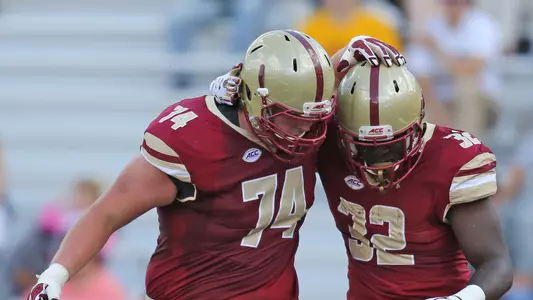
Photo by: John Quackenbos
Building "Blocks" One Play At A Time
September 29, 2016 | Football, #ForBoston Files
There's more to blocking than just hitting someone.
Four games into the football season, there's a couple of consistent storylines developing. There's the continuing dominance of the defense, a unit that's played at elite levels save for the one game against Virginia Tech. There's sophomore Jeff Smith's emergence as a wide receiver, especially after he caught three deep touchdowns from graduate quarterback Patrick Towles. There's Towles himself, a revelation with his ability to scramble and keep plays alive.
Those might be great, but the lack of the running game in the above list is noticeable. Considering Boston College is built as a power football team, it can be downright disconcerting. For that reason, every part of the game, from the playcalling to the execution, falls under a microscope. That's especially true when the running game, expected to be at 200 yards per game, is not averaging that through the first three games of the year.
In particular, the offensive line is under that spotlight.
There is nothing more quintessentially football than an offensive line. Skill positions score all the points and smile for the cameras. Defensive players make big, highlight-making hits. Offensive linemen have nicknames like Stink, Jumbo, and the Hogs. They're big guys who spend every play in a wrestling match against a defensive player. When something goes well, someone else gets a highlight. When something goes wrong or fails to produce, they fall under criticism.
What people sometimes don't realize, however, is how much work and choreography actually goes into offensive line game planning. Everything on every play needs to be in synergy. No group of players operates more in unison, and every play's success hinges on that ability. Even when a play looks like the same play over and over, there are differences, especially on the offensive line.
The offensive line starts with a scheme. At Boston College, that encompasses multiple executions.
"We run multiple schemes," said head coach Steve Addazio. "We run zones and gaps. Gaps are powers and counters, and zones are tight zones and wide zones. And we run a couple of isos. So we have some multiplicity in there, and it's sheer repetitions over and over again so they get the repetitions in each scheme."
Gaps and zones are incredibly different from one another. They are used for different type plays built into the intracacies of the game. That's the simplified version, which gets more and more complex based on the offense installed, game plan for a particular opponent, and execution levels of the players.
The execution levels are based on experience playing in a scheme. For Boston College, that's been the tougher spot. Of the regular offensive linemen, graduate transfer Jimmy Lowery has the most experience, having played 31 prior games. Unfortunately, though, all of Lowery's experience came at Eastern Illinois, meaning even he's been learning a new scheme.
Junior Jon Baker's played in 22 games, but he only made nine starts at his current position (center) last year.
Jim Cashman, a senior, played in 11 games last year, making seven starts, the most experienced player in the Eagle pipeline.
Sophomores Aaron Monteiro and Chris Lindstrom had 14 starts between them last year. Elijah Johnson, who's taken snaps this year, is a true freshman.
That differs greatly from other teams who returned no less than two offensive linemen who started every game last year. It doesn't mean there's less talent, but based on the repetition model where more plays builds more consistent reactions, the bank simply wasn't there for BC to start the season.
"When you're a veteran player," said Addazio, "the game slows down for you. When you're young, it's like this (face in surprise). Then instead of firing off the ball, you take a step and you're trying to grab and catch everything. We still have a fair amount of that going on."
The first four games have been about extremes for BC, and it's been a point of emphasis to drill and coach them up to build the database.
"We went back to some real combination block drill work (this week) that was enlightening to me. With young linemen, inexperienced linemen, they walked away from that like, 'Ah, I got a better understanding, better grasp of that now.' You kind of (go up and down and up and down). You just keep moving and over time, you're getting better."
Building the database is so key, it played a big reason in why the Eagles ran the ball as often as they did last Saturday against Wagner. Sensing the opportunity to call running plays and reset what happens in a game, the Eagles ran 56 rushing plays to just 20 pass plays. With the passing game working out just fine, it was a chance to simply build reactions and muscle memory for those guys up front. Even then, there was an extreme.
"In the Wagner game, it's like the land of firsts," said Addazio. "We got so much movement that the levels were so bizarre that it didn't feel right to them, so they weren't snapping off for the backer. You've got a gap to the backside backer, here comes the backer, and we're late and he's hitting us in the backfield a couple of times."
Adding another layer to everything is the defensive scheme. It would be too easy if BC just played against the same defense every week, but there's different formations, packages, coverages and pressures, all of which have an impact on how the game is played in the trenches. To that extent, practice can only take a team to a point before real time game situations simply take over.
"Last week, (the offense) was going to play some what we call odd - some 3-4 defense," said Addazio. "Even though we saw some of it in training camp, you prep for some it, that was like a revelation. So you're spending two days trying to get ready for that particular front, and then by the end of the week they felt more comfortable in that front. (Then) it shows up in the game and you're not really as comfortable as you think you are. What you realize always is in practice you get to a certain level, but just understand when you get to the game, it's going to change. And that's part of the next evolution we have to do."
For the offensive line, development now comes from being able to enforce technique on their own. Given the conditions that come with a game, the coaches now sense the opportunity to let the team start to develop their own decision making skills in practice.
"I think we need to be in to coach off the tape and let our guys start to problem solve on their own," said Addazio. "(That will) let them learn what it's like in a real game where you've got to make decisions - and sometimes quick decisions - without any help. That's another phase of maturity."
For all the criticism levied at the offensive line, there are noticeable improvements. They've been ahead of the curve in pass protection, and they've been getting better in the running game.
"Each week, we're going to gain," said Addazio. "In pass protection, uniquely enough, we're doing all right. We're getting better. Now we're not exactly where we want to be, obviously, but we're certainly getting better in the run game. We're going to start to piece it together. We're going to have those ups and downs as this thing grows, but the talent level is intriguing because we can physically do it.
"We can physically do all that," he continued. "It's just maintaining playing physical and fast when things are moving really, really quickly like they do at our level. We play some really good football teams in our league and in our side, particularly this year, maybe in the history of the ACC. So the margin for error is small, and we've got to develop in fast fashion."
That's an undertaking that the coaching staff and the players are committed to with gusto, a sign that things will continue to improve. On this trajectory, Boston College should hit its stride at the right time, something that excites the man in charge. "(There was) spirited practice (on Sunday)," said Addazio. "They loved it. They were having a ball out there. We just got done playing on Saturday and we're out there and it's a sign of good things. I'm excited about that."
Those might be great, but the lack of the running game in the above list is noticeable. Considering Boston College is built as a power football team, it can be downright disconcerting. For that reason, every part of the game, from the playcalling to the execution, falls under a microscope. That's especially true when the running game, expected to be at 200 yards per game, is not averaging that through the first three games of the year.
In particular, the offensive line is under that spotlight.
There is nothing more quintessentially football than an offensive line. Skill positions score all the points and smile for the cameras. Defensive players make big, highlight-making hits. Offensive linemen have nicknames like Stink, Jumbo, and the Hogs. They're big guys who spend every play in a wrestling match against a defensive player. When something goes well, someone else gets a highlight. When something goes wrong or fails to produce, they fall under criticism.
What people sometimes don't realize, however, is how much work and choreography actually goes into offensive line game planning. Everything on every play needs to be in synergy. No group of players operates more in unison, and every play's success hinges on that ability. Even when a play looks like the same play over and over, there are differences, especially on the offensive line.
The offensive line starts with a scheme. At Boston College, that encompasses multiple executions.
"We run multiple schemes," said head coach Steve Addazio. "We run zones and gaps. Gaps are powers and counters, and zones are tight zones and wide zones. And we run a couple of isos. So we have some multiplicity in there, and it's sheer repetitions over and over again so they get the repetitions in each scheme."
Gaps and zones are incredibly different from one another. They are used for different type plays built into the intracacies of the game. That's the simplified version, which gets more and more complex based on the offense installed, game plan for a particular opponent, and execution levels of the players.
The execution levels are based on experience playing in a scheme. For Boston College, that's been the tougher spot. Of the regular offensive linemen, graduate transfer Jimmy Lowery has the most experience, having played 31 prior games. Unfortunately, though, all of Lowery's experience came at Eastern Illinois, meaning even he's been learning a new scheme.
Junior Jon Baker's played in 22 games, but he only made nine starts at his current position (center) last year.
Jim Cashman, a senior, played in 11 games last year, making seven starts, the most experienced player in the Eagle pipeline.
Sophomores Aaron Monteiro and Chris Lindstrom had 14 starts between them last year. Elijah Johnson, who's taken snaps this year, is a true freshman.
That differs greatly from other teams who returned no less than two offensive linemen who started every game last year. It doesn't mean there's less talent, but based on the repetition model where more plays builds more consistent reactions, the bank simply wasn't there for BC to start the season.
"When you're a veteran player," said Addazio, "the game slows down for you. When you're young, it's like this (face in surprise). Then instead of firing off the ball, you take a step and you're trying to grab and catch everything. We still have a fair amount of that going on."
The first four games have been about extremes for BC, and it's been a point of emphasis to drill and coach them up to build the database.
"We went back to some real combination block drill work (this week) that was enlightening to me. With young linemen, inexperienced linemen, they walked away from that like, 'Ah, I got a better understanding, better grasp of that now.' You kind of (go up and down and up and down). You just keep moving and over time, you're getting better."
Building the database is so key, it played a big reason in why the Eagles ran the ball as often as they did last Saturday against Wagner. Sensing the opportunity to call running plays and reset what happens in a game, the Eagles ran 56 rushing plays to just 20 pass plays. With the passing game working out just fine, it was a chance to simply build reactions and muscle memory for those guys up front. Even then, there was an extreme.
"In the Wagner game, it's like the land of firsts," said Addazio. "We got so much movement that the levels were so bizarre that it didn't feel right to them, so they weren't snapping off for the backer. You've got a gap to the backside backer, here comes the backer, and we're late and he's hitting us in the backfield a couple of times."
Adding another layer to everything is the defensive scheme. It would be too easy if BC just played against the same defense every week, but there's different formations, packages, coverages and pressures, all of which have an impact on how the game is played in the trenches. To that extent, practice can only take a team to a point before real time game situations simply take over.
"Last week, (the offense) was going to play some what we call odd - some 3-4 defense," said Addazio. "Even though we saw some of it in training camp, you prep for some it, that was like a revelation. So you're spending two days trying to get ready for that particular front, and then by the end of the week they felt more comfortable in that front. (Then) it shows up in the game and you're not really as comfortable as you think you are. What you realize always is in practice you get to a certain level, but just understand when you get to the game, it's going to change. And that's part of the next evolution we have to do."
For the offensive line, development now comes from being able to enforce technique on their own. Given the conditions that come with a game, the coaches now sense the opportunity to let the team start to develop their own decision making skills in practice.
"I think we need to be in to coach off the tape and let our guys start to problem solve on their own," said Addazio. "(That will) let them learn what it's like in a real game where you've got to make decisions - and sometimes quick decisions - without any help. That's another phase of maturity."
For all the criticism levied at the offensive line, there are noticeable improvements. They've been ahead of the curve in pass protection, and they've been getting better in the running game.
"Each week, we're going to gain," said Addazio. "In pass protection, uniquely enough, we're doing all right. We're getting better. Now we're not exactly where we want to be, obviously, but we're certainly getting better in the run game. We're going to start to piece it together. We're going to have those ups and downs as this thing grows, but the talent level is intriguing because we can physically do it.
"We can physically do all that," he continued. "It's just maintaining playing physical and fast when things are moving really, really quickly like they do at our level. We play some really good football teams in our league and in our side, particularly this year, maybe in the history of the ACC. So the margin for error is small, and we've got to develop in fast fashion."
That's an undertaking that the coaching staff and the players are committed to with gusto, a sign that things will continue to improve. On this trajectory, Boston College should hit its stride at the right time, something that excites the man in charge. "(There was) spirited practice (on Sunday)," said Addazio. "They loved it. They were having a ball out there. We just got done playing on Saturday and we're out there and it's a sign of good things. I'm excited about that."

Players Mentioned


OL
/ Football
OL
/ Football
OL
/ Football
OL
/ Football
OL
/ Football
WR
/ Football
QB
/ Football#24 Baseball Defeats Northeastern in Beanpot Championship (April 14, 2026)
Wednesday, April 15
#23 Baseball Defeats Virginia Tech (April 12, 2026)
Tuesday, April 14
#23 Baseball Defeats Virginia Tech (April 11,2026
Saturday, April 11
Football: Zeke Moore Media Availability (April 10, 2026)
Friday, April 10