Boston College Athletics
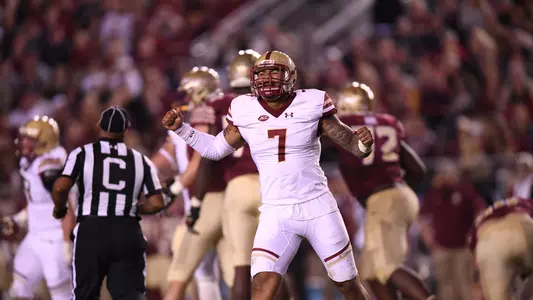
Photo by: John Quackenbos
The Sack Man Cometh
December 14, 2016 | Football, #ForBoston Files
If a sack serves to "devastate cities," Harold Landry is BC's Godzilla
Widely regarded as one of the greatest defensive ends of all time, Deacon Jones knew a thing or two about sacking a quarterback. He recorded a reported 173 sacks over 14 seasons. Though it wasn't an official stat at the time, he made it one of the best known plays in football. Later in life, he described the feeling of making a sack in a simple term when he said it was like "devastating a city."
If that's true, then Boston College's Harold Landry is a certified Godzilla.
"When you have a player like Harold Landry, who can get off the ball and rush the passer, you have a guy who can win a one-on-one rush," defensive line coach Paul Pasqualoni said of his star junior. "That's a great asset for any team to have. It gives you a chance to be disruptive and it always gives you a chance to create an uncomfortable atmosphere for the quarterback."
Landry's done more than just make quarterbacks uncomfortable this year; he's haunted their dreams as an absolute nightmare. A 6-foot-3, 250-pound defensive end, he is atop the nation with 15 sacks on the year, tied with Florida State senior Demarcus Walker. Where both Walker and Landry have 1.25 sacks per game, however, Landry's 133 yards lost is 20 more than the Seminole.
In the last three games of the regular season, Landry destroyed opposing backfields, recording six sacks for 59 yards. That included three sacks for 22 yards in the must-win game against Wake Forest that helped the Eagles clinch bowl eligibility with their sixth victory.
For the BC program, the sack numbers shattered the program record set by Mike Mamula in 1994 and tied by Erik Storz in 1997. His next sack will make him just the fourth player in program history with 20 in his career.
"It means a lot to sack the quarterback in the biggest games, especially playing teams like Florida State and Clemson," Landry said. "You know you're going up against the best (in the ACC), and you want to be able to get in there to beat the best (to get to the QB)."
His breakout junior season brings with it national attention. An All-America second-team selection, he was a finalist for the Ted Hendricks Award, given to the best defensive end in college football. He's a second-team All-ACC selection and the recipient of the George "Bulger" Lowe Award. It's the breakout of a journey that started as a true freshman and continued through development in the Boston College system.
"My sense is that he's put on weight and he's gotten considerably stronger (since he started at bc)," Pasqualoni said. "With strength comes explosiveness, which is how quick you are. He's certainly a much smarter football player at this level after three years and playing a lot of football. He's been in the game and he's done it in the game. He's developed hopefully as the players develop in this program develop to become good, solid Division I players."
In addition, Landry enters the Quick Lane Bowl with 20.5 tackles-for-loss on the season, in front of Chris Hovan's 1999 season for second place and approaching Mathias Kiwanuka's 2004 record of 25.5. With 37.5 in his career, he's bested legends like BJ Raji, Stalin Colinet and Chris Sullivan and is approaching others like Tim Bulman, Hovan and Luke Kuechly. All of those names went onto play on Sundays with franchises in the NFL.
"If it's first or second down, the loss of yardage means a lot," Landry said. "It means we can get our third down package on the field, and that's something that can help out the team tremendously."
It's something that the Boston College coaches develop away from the field in areas not seen on game day.
"It's not so much the scheme than it is how the defensive coaches develop their players, in practice and in the offseason" he said. "With spring ball and in camp, they did a really good job of developing all of the players on this defense (over the past three years). The scheme helps, but it's more about how we develop over time."
The Eagles take on the Maryland Terrapins in the Quick Lane Bowl on Dec. 26 at 2:30 p.m. on ESPN.
If that's true, then Boston College's Harold Landry is a certified Godzilla.
"When you have a player like Harold Landry, who can get off the ball and rush the passer, you have a guy who can win a one-on-one rush," defensive line coach Paul Pasqualoni said of his star junior. "That's a great asset for any team to have. It gives you a chance to be disruptive and it always gives you a chance to create an uncomfortable atmosphere for the quarterback."
Landry's done more than just make quarterbacks uncomfortable this year; he's haunted their dreams as an absolute nightmare. A 6-foot-3, 250-pound defensive end, he is atop the nation with 15 sacks on the year, tied with Florida State senior Demarcus Walker. Where both Walker and Landry have 1.25 sacks per game, however, Landry's 133 yards lost is 20 more than the Seminole.
In the last three games of the regular season, Landry destroyed opposing backfields, recording six sacks for 59 yards. That included three sacks for 22 yards in the must-win game against Wake Forest that helped the Eagles clinch bowl eligibility with their sixth victory.
For the BC program, the sack numbers shattered the program record set by Mike Mamula in 1994 and tied by Erik Storz in 1997. His next sack will make him just the fourth player in program history with 20 in his career.
"It means a lot to sack the quarterback in the biggest games, especially playing teams like Florida State and Clemson," Landry said. "You know you're going up against the best (in the ACC), and you want to be able to get in there to beat the best (to get to the QB)."
His breakout junior season brings with it national attention. An All-America second-team selection, he was a finalist for the Ted Hendricks Award, given to the best defensive end in college football. He's a second-team All-ACC selection and the recipient of the George "Bulger" Lowe Award. It's the breakout of a journey that started as a true freshman and continued through development in the Boston College system.
"My sense is that he's put on weight and he's gotten considerably stronger (since he started at bc)," Pasqualoni said. "With strength comes explosiveness, which is how quick you are. He's certainly a much smarter football player at this level after three years and playing a lot of football. He's been in the game and he's done it in the game. He's developed hopefully as the players develop in this program develop to become good, solid Division I players."
In addition, Landry enters the Quick Lane Bowl with 20.5 tackles-for-loss on the season, in front of Chris Hovan's 1999 season for second place and approaching Mathias Kiwanuka's 2004 record of 25.5. With 37.5 in his career, he's bested legends like BJ Raji, Stalin Colinet and Chris Sullivan and is approaching others like Tim Bulman, Hovan and Luke Kuechly. All of those names went onto play on Sundays with franchises in the NFL.
"If it's first or second down, the loss of yardage means a lot," Landry said. "It means we can get our third down package on the field, and that's something that can help out the team tremendously."
It's something that the Boston College coaches develop away from the field in areas not seen on game day.
"It's not so much the scheme than it is how the defensive coaches develop their players, in practice and in the offseason" he said. "With spring ball and in camp, they did a really good job of developing all of the players on this defense (over the past three years). The scheme helps, but it's more about how we develop over time."
The Eagles take on the Maryland Terrapins in the Quick Lane Bowl on Dec. 26 at 2:30 p.m. on ESPN.
Players Mentioned

DE
/ FootballFootball: Zeke Moore Media Availability (April 10, 2026)
Friday, April 10
Football: Bill O'Brien Media Availability (April 10, 2026)
Friday, April 10
Football: Favor Bate Media Availability (April 10, 2026)
Friday, April 10
#23 Baseball Defeats Darmouth (April 8, 2026)
Thursday, April 09