Boston College Athletics
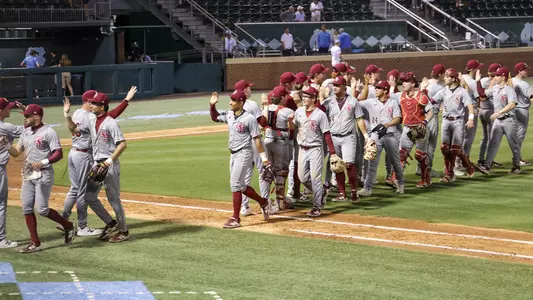
Photo by: Andy Mead
Resume Keeps BC at No. 2 Seed For Athens Regional
May 26, 2026 | Baseball, #ForBoston Files
Debate raged about the landing spot, but a season-long resume kept BC in the top half of Georgia's four-team bracket.
Somewhere in Massachusetts, one erstwhile Boston College baseball supporter who must remain nameless sat at his laptop during Monday's midday and watched the NCAA's baseball selection show with anticipation and baited breath. He watched his laptop screen as his two young daughters battled and brawled over a toy, and he ignored his wife's request to get involved because the bracket was being unveiled in front of him.
The supporter remained locked into the top two seeds and mentally analyzed the regionals hosted by UCLA and Georgia Tech. Then came Georgia's No. 3 national seed and Long Island's arrival in the Deep South as a No. 4 seed. Liberty's 41-win team came next, followed by the long-awaited arrival of the maroon and gold's Boston College program.
He stared at the screen and couldn't believe the bad luck: BC was a No. 3 seed and heading to play the No. 3 national seed?! Liberty was a second-seeded team?! Slowly, his shock subsided into frustration, and he fired two rage-filled tweets into the social media universe before texting several of his colleagues and friends.
A response to an exasperated, "GEORGIA?!" came back with a "Hey, at least we're the No. 2 seed," and instantaneously, he looked again at the bracket.
Whoops.
Four months after the Atlantic Coast Conference's experts and coaches selected Boston College to finish near or at the bottom of the conference, the Eagles are entering the national tournament as one of the 32 best teams in the nation. Four months after few expected anything out of the ragtag group of schools situated in the Northeast, a Birdball team once angling for a No. 1 seed is leading a three-team contingent from Massachusetts. The best-seeded team from a four-team, New England-based grouping, a highly-competitive bracket featuring two conference champions begins on Friday afternoon with a first round matchup against the at-large Flames.
"I thought [the selection] was really accurate," said head coach Todd Interdonato on Monday afternoon. "I thought our draw was really accurate. I thought we deserved to be a two-seed. I thought we deserved to go up against a national seed. I didn't think we were one of the higher two-seeds in the country where we would have [played] against [teams seeded] nine through 16. Selfishly, I'm really glad we're staying on the East Coast."
Few argued BC's spot in the national tournament, but the discussion between landing in a regional as a No. 2 or No. 3 seed didn't develop until the Eagles lost to Miami in the ACC Championship's quarterfinal round. Initial projections at the start of the month locked the team into a No. 2 seed as a top-25 team that was headed for a bracket hosted by the bottom half of the national seeds, and an outside chance at hosting a regional polarized the national lexicon for the second time in four years.
That conversation died, though, when BC lost its series to Clemson and was swept by third-ranked Georgia Tech ahead of its trip to the ACC's postseason tournament in Charlotte. A No. 2 seed remained a strong possibility, but the question remained about a logical landing spot for a team that didn't have a standard dance partner for its regional host. None of the teams hosting a spot had logical ties to Massachusetts, and the only team aligned closely to BC without nearby dance partners involved Oregon, which would serve as a dueling host site in the Pacific Northwest against nearby Oregon State.
The Miami loss catapulted that conversation into no man's land and instantaneously tilted the debate into further unknowns. Moving the ACC's fourth place team to a No. 3 seed was almost sacrosanct to the second-best conference in the country, and even with the losses, almost no justification existed for jumping BC's poor finish with both the fifth-place Hurricanes and sixth-place Wake Forest, which lost to Pitt in the Second Round in Charlotte. Even with the Ratings Performance Index numbers favoring the Demon Deacons at No. 20, the strength of schedule surrounding the Eagles could only work so much against a team with virtually the same number of wins against the top two quadrants.
"There was a chance of us going to UCLA or even to Oregon, with the way things turned out," said Interdonato. "Southern Cal could have hosted as well. So I feel really fortunate that we're in the Eastern time zone. In my short time here at BC, I feel like that is a significant factor, and then for me, personally, I've been on [Foley Field] a bunch and played at Georgia a bunch in my career, so there aren't going to be surprises or anything new. I thought [the selection was accurate], and I think it's great for our [program]."
More surprises emerged in other areas of the country. Within the ACC, Virginia Tech's conference tournament victory over Notre Dame helped clinch a No. 2 seed, albeit at top-ranked UCLA's bracket against three western-based teams, and NC State got into the tournament despite losing to Duke in the First Round. Pitt, which won three straight conference tournament games against Louisville, Wake Forest and Florida State, missed the bracket entirely as one of the proverbial First Four Out.
That omission served as a subtle reminder of the danger of staring at RPI rankings too closely. On paper, the Panthers finished 33-24 and won more games than BC against Q1 and Q2 teams with a better record on neutral ground while the Hokies sat at No. 42 a significantly worse record away from their home stadium at English Field, but finishing in the No. 14 spot in the ACC was too much to overlook in comparison to two stronger in-league resumes. Outside of the ACC, Mercer suffered a similar fate when it won 44 games and finished No. 28, but 28 of its games came against Q4 opponents with a 1-4 record against the top quadrant and a 5-13 record against the top two spots - thereby serving as the impetus for an omission from an at-large spot after fifth place The Citadel twice defeated the Bears in the conference tournament - the last of which was a run-rule, ten-run loss.
"Regionals don't come every year," said pitcher AJ Colarusso. "This special group that we have, we only get to play with for this year, and it's going to be completely different next year, [so that's why] it's a lot of fun. Those regionals, the atmosphere, they're hard to beat, and that's why we play."
"The regional is the most competitive environment that I've ever played in," added infielder Nick Wang. "I'm really proud to be a small part of a BC team that's now been twice. So I'm really proud to represent the team and the program and the school in the postseason again."
Boston College and Liberty kick off the 2026 NCAA Division I Baseball Tournament on Friday afternoon, at 2 p.m., from Foley Field in Athens, Georgia. Television coverage of the first game is available via the ESPN+ streaming service with future television coverage established by the results of the first round.
The supporter remained locked into the top two seeds and mentally analyzed the regionals hosted by UCLA and Georgia Tech. Then came Georgia's No. 3 national seed and Long Island's arrival in the Deep South as a No. 4 seed. Liberty's 41-win team came next, followed by the long-awaited arrival of the maroon and gold's Boston College program.
He stared at the screen and couldn't believe the bad luck: BC was a No. 3 seed and heading to play the No. 3 national seed?! Liberty was a second-seeded team?! Slowly, his shock subsided into frustration, and he fired two rage-filled tweets into the social media universe before texting several of his colleagues and friends.
A response to an exasperated, "GEORGIA?!" came back with a "Hey, at least we're the No. 2 seed," and instantaneously, he looked again at the bracket.
Whoops.
Four months after the Atlantic Coast Conference's experts and coaches selected Boston College to finish near or at the bottom of the conference, the Eagles are entering the national tournament as one of the 32 best teams in the nation. Four months after few expected anything out of the ragtag group of schools situated in the Northeast, a Birdball team once angling for a No. 1 seed is leading a three-team contingent from Massachusetts. The best-seeded team from a four-team, New England-based grouping, a highly-competitive bracket featuring two conference champions begins on Friday afternoon with a first round matchup against the at-large Flames.
"I thought [the selection] was really accurate," said head coach Todd Interdonato on Monday afternoon. "I thought our draw was really accurate. I thought we deserved to be a two-seed. I thought we deserved to go up against a national seed. I didn't think we were one of the higher two-seeds in the country where we would have [played] against [teams seeded] nine through 16. Selfishly, I'm really glad we're staying on the East Coast."
Few argued BC's spot in the national tournament, but the discussion between landing in a regional as a No. 2 or No. 3 seed didn't develop until the Eagles lost to Miami in the ACC Championship's quarterfinal round. Initial projections at the start of the month locked the team into a No. 2 seed as a top-25 team that was headed for a bracket hosted by the bottom half of the national seeds, and an outside chance at hosting a regional polarized the national lexicon for the second time in four years.
That conversation died, though, when BC lost its series to Clemson and was swept by third-ranked Georgia Tech ahead of its trip to the ACC's postseason tournament in Charlotte. A No. 2 seed remained a strong possibility, but the question remained about a logical landing spot for a team that didn't have a standard dance partner for its regional host. None of the teams hosting a spot had logical ties to Massachusetts, and the only team aligned closely to BC without nearby dance partners involved Oregon, which would serve as a dueling host site in the Pacific Northwest against nearby Oregon State.
The Miami loss catapulted that conversation into no man's land and instantaneously tilted the debate into further unknowns. Moving the ACC's fourth place team to a No. 3 seed was almost sacrosanct to the second-best conference in the country, and even with the losses, almost no justification existed for jumping BC's poor finish with both the fifth-place Hurricanes and sixth-place Wake Forest, which lost to Pitt in the Second Round in Charlotte. Even with the Ratings Performance Index numbers favoring the Demon Deacons at No. 20, the strength of schedule surrounding the Eagles could only work so much against a team with virtually the same number of wins against the top two quadrants.
"There was a chance of us going to UCLA or even to Oregon, with the way things turned out," said Interdonato. "Southern Cal could have hosted as well. So I feel really fortunate that we're in the Eastern time zone. In my short time here at BC, I feel like that is a significant factor, and then for me, personally, I've been on [Foley Field] a bunch and played at Georgia a bunch in my career, so there aren't going to be surprises or anything new. I thought [the selection was accurate], and I think it's great for our [program]."
More surprises emerged in other areas of the country. Within the ACC, Virginia Tech's conference tournament victory over Notre Dame helped clinch a No. 2 seed, albeit at top-ranked UCLA's bracket against three western-based teams, and NC State got into the tournament despite losing to Duke in the First Round. Pitt, which won three straight conference tournament games against Louisville, Wake Forest and Florida State, missed the bracket entirely as one of the proverbial First Four Out.
That omission served as a subtle reminder of the danger of staring at RPI rankings too closely. On paper, the Panthers finished 33-24 and won more games than BC against Q1 and Q2 teams with a better record on neutral ground while the Hokies sat at No. 42 a significantly worse record away from their home stadium at English Field, but finishing in the No. 14 spot in the ACC was too much to overlook in comparison to two stronger in-league resumes. Outside of the ACC, Mercer suffered a similar fate when it won 44 games and finished No. 28, but 28 of its games came against Q4 opponents with a 1-4 record against the top quadrant and a 5-13 record against the top two spots - thereby serving as the impetus for an omission from an at-large spot after fifth place The Citadel twice defeated the Bears in the conference tournament - the last of which was a run-rule, ten-run loss.
"Regionals don't come every year," said pitcher AJ Colarusso. "This special group that we have, we only get to play with for this year, and it's going to be completely different next year, [so that's why] it's a lot of fun. Those regionals, the atmosphere, they're hard to beat, and that's why we play."
"The regional is the most competitive environment that I've ever played in," added infielder Nick Wang. "I'm really proud to be a small part of a BC team that's now been twice. So I'm really proud to represent the team and the program and the school in the postseason again."
Boston College and Liberty kick off the 2026 NCAA Division I Baseball Tournament on Friday afternoon, at 2 p.m., from Foley Field in Athens, Georgia. Television coverage of the first game is available via the ESPN+ streaming service with future television coverage established by the results of the first round.
Players Mentioned

INF
/ BaseballTuesday, September 29
Tuesday, September 29
Saturday, September 26
Saturday, September 26