Boston College Athletics
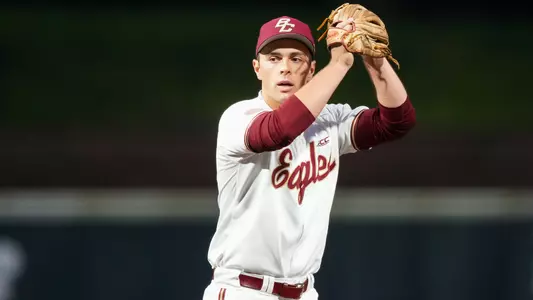
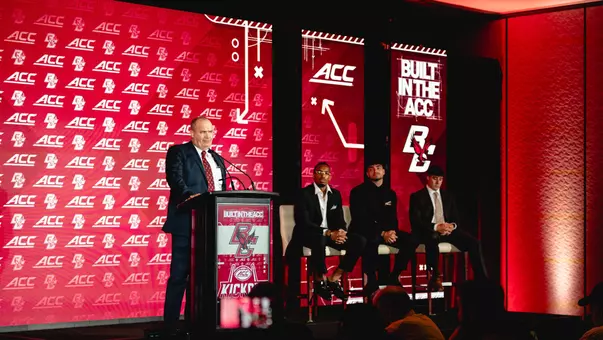
Photo by: Meg Kelly
Success On The Bump Is All In the Numbers
May 20, 2026 | Baseball, #ForBoston Files
The BC pitching staff jumped to one of the best in the ACC because it built on its staggered success.
Last year's trip to the ACC Championship produced a memorable three-round run for Boston College head coach Todd Interdonato. His Eagles were one year removed from missing the conference tournament during its final year as a 12-team entity, and an 8-22 record within the league further mired Birdball into a last place finish in the Atlantic Division. BC and Notre Dame ultimately finished the year within one weekend's worth of work against last-seeded Pittsburgh, but the last year of divisional alignment produced four national tournament teams and more specifically three host sites - all within the top-10 nationally - from the Atlantic Division.
The shift to a single-elimination format allowed BC to flourish under pressure. The Eagles were one game behind Virginia Tech and one weekend series away from catching Notre Dame at the top end of the First Round seeds, and an included expansion to Cal and Stanford handed the league more competitive options for its tiered setup. Drawing a path against the Fighting Irish and both sixth place Virginia and No. 3 North Carolina offered more direct movement into the semifinal round - especially since Birdball previously won its weekend series against Notre Dame and UVA while gaining a one-game win over UNC.
Interdonato understood how to manage his team, and grizzling the squad through Durham Bulls Athletic Park allowed BC to play within the percentages of its shortened roster. Shifting into playoff mode, a one-day break between the Second Round matchup with Virginia and the Quarterfinal game against UNC meant he could pitch Friday ace AJ Colarusso in two games if BC advanced, and his primary options could rest out of the bullpen. A similar situation emerged for secondary starter Brady Miller, and by then, BC would play in a championship game where anything was possible on an inning-by-inning basis.
Even if it didn't come to fruition, Interdonato knew that his team would emerge from the week with a clear-cut expectation of its upcoming season. The culture that withstood a coaching change in 2024 enhanced its toughness and grit throughout his first and second seasons, and a player development model hinging on learned experience would gain more traction into Year No. 3. Becoming BC's reality, he understood, would greatly impact the 2026 season, which sent the Eagles to this year's tournament in Charlotte with a double-bye and clear-cut expectation of extending the season into the championship weekend.
"When you look at it from a baseball standpoint, I think everything on this team comes back to our pitching," said Interdonato in an interview with The Podcast for Boston. "Regardless of a result, win or loss, we're talking about who is in a game [for] a scenario. If everybody goes to bed and we have AJ going or we have [Tyler Mudd] going or we have Brady going, we still have pitchers X, Y and Z in the pen, and we're set up so that guys go to bed and wake up feeling really good about the pitching that's available."
BC finished the regular season with the No. 7 pitching staff among overall ACC performances, but the incremental build of the fifth-best ACC-specific unit began when the team began lowering its negative ratios after Interdonato's first year. Having lost the bulk of its tournament rotation when Chris Flynn and Henry Leake graduated, a retinkered rotation around Colarusso required 340 runs to post 22 wins against 379 runs allowed. Looking more specifically at earned runs allowed, the Eagles played to an expected record that cost them one additional win over the course of the year.
Nothing about that would have changed the outcome of the year, but getting to 22 wins required BC to average approximately 6.4 runs per game while allowing 7.2 runs per game. On pure math, flipping results would occur when the Eagles therefore improved their pitching to the degree that they could gain back that half-run per game.
Using Colarusso as the cornerstone naturally allowed pitching coach Ryan Forrest to develop a rotation and bullpen around a flexible concept, and BC's record improved to 29-28 because of its ability to prevent runs from scoring. Dropping the number by a full half-run per game, the earned run average likewise fell to within a half-run of the total number of runs scored, and the number of hits required to score those runs, a measurement of barreling the ball for extra bases, increased by one-third of a hit per game - a number that essentially added up to one extra hit per every three innings and a pure measurable against a team that remained within one run per game of an opponent's offensive output.
"A guy like Kyle Kipp is a really good example," said Interdonato. "In his first two years here, we tried to start him, and we tried to use him in long relief. He had fits and starts and had these kind-of polarizing successes and polarizing failures. Then he goes to the [Cape Cod Baseball League], and he becomes the best reliever on the Cape for the whole year. So I started thinking to myself that we had been misusing this kid for two years. So you say, 'Hey we're going to do this [because] you went down there and let it rip.'"
This year's team therefore slid naturally into a conversation around BC's peak development. Adhering to a policy of riding guys into excelling roles, Interdonato and Forrest helped spark a breakthrough that maximized the team's performance. Even with outlier games on either end, BC played well enough to statistically expect 36 wins - the exact number that landed them in fourth place in the ACC's regular season standings. Opponents needed nearly two hits to produce a single run over the course of the entire 56-game slate, but holding them to extra bases on 31 percent of their hits marked a three-year low after the 2024 team surrendered extra bases hits on 36 percent of its hits.
Further considering the governance and the number of hits allowed, which in turn dropped from over 10 hits per game to under nine hits per game, BC's pitching staff essentially improved by two hits per game, a result that dropped opponents by two runs per game.
"It all starts with the belief that the players have in the institution," admitted Interdonato. "There was a coaching change, and nobody left. Even the incoming freshmen, guys that were coming in, what you see on the field begins with the belief that our players have in the institution. Any time you're trying to build anything, you want to have a very solid structure and a very solid foundation, and I'm positive that we wouldn't be having the success right now without those older guys that laid the foundation over the first and second year…we have a honing beacon, a north star, of how we want to play, and that wouldn't be as solid as it is without those guys setting the foundation."
The Quarterfinal round of the 2026 ACC Baseball Championship begins on Thursday when top-seeded Georgia Tech plays Virginia. Following that game, a 3 p.m. first pitch awaits Boston College and Miami after the ACC moved games due to inclement weather forecast. All action can be seen on ACC Network with streaming available through the ESPN family of Internet and mobile device apps.
The shift to a single-elimination format allowed BC to flourish under pressure. The Eagles were one game behind Virginia Tech and one weekend series away from catching Notre Dame at the top end of the First Round seeds, and an included expansion to Cal and Stanford handed the league more competitive options for its tiered setup. Drawing a path against the Fighting Irish and both sixth place Virginia and No. 3 North Carolina offered more direct movement into the semifinal round - especially since Birdball previously won its weekend series against Notre Dame and UVA while gaining a one-game win over UNC.
Interdonato understood how to manage his team, and grizzling the squad through Durham Bulls Athletic Park allowed BC to play within the percentages of its shortened roster. Shifting into playoff mode, a one-day break between the Second Round matchup with Virginia and the Quarterfinal game against UNC meant he could pitch Friday ace AJ Colarusso in two games if BC advanced, and his primary options could rest out of the bullpen. A similar situation emerged for secondary starter Brady Miller, and by then, BC would play in a championship game where anything was possible on an inning-by-inning basis.
Even if it didn't come to fruition, Interdonato knew that his team would emerge from the week with a clear-cut expectation of its upcoming season. The culture that withstood a coaching change in 2024 enhanced its toughness and grit throughout his first and second seasons, and a player development model hinging on learned experience would gain more traction into Year No. 3. Becoming BC's reality, he understood, would greatly impact the 2026 season, which sent the Eagles to this year's tournament in Charlotte with a double-bye and clear-cut expectation of extending the season into the championship weekend.
"When you look at it from a baseball standpoint, I think everything on this team comes back to our pitching," said Interdonato in an interview with The Podcast for Boston. "Regardless of a result, win or loss, we're talking about who is in a game [for] a scenario. If everybody goes to bed and we have AJ going or we have [Tyler Mudd] going or we have Brady going, we still have pitchers X, Y and Z in the pen, and we're set up so that guys go to bed and wake up feeling really good about the pitching that's available."
BC finished the regular season with the No. 7 pitching staff among overall ACC performances, but the incremental build of the fifth-best ACC-specific unit began when the team began lowering its negative ratios after Interdonato's first year. Having lost the bulk of its tournament rotation when Chris Flynn and Henry Leake graduated, a retinkered rotation around Colarusso required 340 runs to post 22 wins against 379 runs allowed. Looking more specifically at earned runs allowed, the Eagles played to an expected record that cost them one additional win over the course of the year.
Nothing about that would have changed the outcome of the year, but getting to 22 wins required BC to average approximately 6.4 runs per game while allowing 7.2 runs per game. On pure math, flipping results would occur when the Eagles therefore improved their pitching to the degree that they could gain back that half-run per game.
Using Colarusso as the cornerstone naturally allowed pitching coach Ryan Forrest to develop a rotation and bullpen around a flexible concept, and BC's record improved to 29-28 because of its ability to prevent runs from scoring. Dropping the number by a full half-run per game, the earned run average likewise fell to within a half-run of the total number of runs scored, and the number of hits required to score those runs, a measurement of barreling the ball for extra bases, increased by one-third of a hit per game - a number that essentially added up to one extra hit per every three innings and a pure measurable against a team that remained within one run per game of an opponent's offensive output.
"A guy like Kyle Kipp is a really good example," said Interdonato. "In his first two years here, we tried to start him, and we tried to use him in long relief. He had fits and starts and had these kind-of polarizing successes and polarizing failures. Then he goes to the [Cape Cod Baseball League], and he becomes the best reliever on the Cape for the whole year. So I started thinking to myself that we had been misusing this kid for two years. So you say, 'Hey we're going to do this [because] you went down there and let it rip.'"
This year's team therefore slid naturally into a conversation around BC's peak development. Adhering to a policy of riding guys into excelling roles, Interdonato and Forrest helped spark a breakthrough that maximized the team's performance. Even with outlier games on either end, BC played well enough to statistically expect 36 wins - the exact number that landed them in fourth place in the ACC's regular season standings. Opponents needed nearly two hits to produce a single run over the course of the entire 56-game slate, but holding them to extra bases on 31 percent of their hits marked a three-year low after the 2024 team surrendered extra bases hits on 36 percent of its hits.
Further considering the governance and the number of hits allowed, which in turn dropped from over 10 hits per game to under nine hits per game, BC's pitching staff essentially improved by two hits per game, a result that dropped opponents by two runs per game.
"It all starts with the belief that the players have in the institution," admitted Interdonato. "There was a coaching change, and nobody left. Even the incoming freshmen, guys that were coming in, what you see on the field begins with the belief that our players have in the institution. Any time you're trying to build anything, you want to have a very solid structure and a very solid foundation, and I'm positive that we wouldn't be having the success right now without those older guys that laid the foundation over the first and second year…we have a honing beacon, a north star, of how we want to play, and that wouldn't be as solid as it is without those guys setting the foundation."
The Quarterfinal round of the 2026 ACC Baseball Championship begins on Thursday when top-seeded Georgia Tech plays Virginia. Following that game, a 3 p.m. first pitch awaits Boston College and Miami after the ACC moved games due to inclement weather forecast. All action can be seen on ACC Network with streaming available through the ESPN family of Internet and mobile device apps.
Players Mentioned



Thursday, August 13
Wednesday, August 12
Wednesday, August 12
Wednesday, August 12