Boston College Athletics
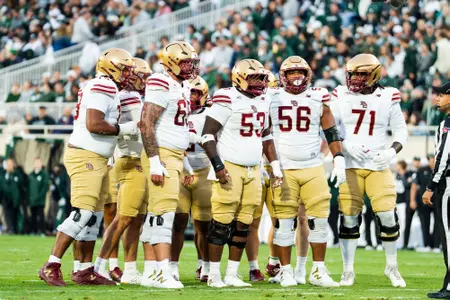
Photo by: Jordan Arnold
The Tailgate: Stanford
September 13, 2025 | Football, #ForBoston Files
BC is back in California for the first time in over a decade.
CHESTNUT HILL, Mass. -- Boston College entered this week as one of the more nuanced teams in the Atlantic Coast Conference. The Eagles had lost last week's game to Michigan State despite taking the Spartans to a double overtime instant classic, but their performance left fans and analysts with a healthy optimism about the team's overall potential. Whatever term could be used to describe a successful defeat fell short of the rocket apparently strapping itself to BC, and this week's game at Stanford offered an opportunity capable of starting ACC play off on the appropriate and victorious foot.
The attitude within Fish Field House did little to oversell that opinion. Throughout the week, from the first practice to the boarding of a flight bound for Silicon Valley, the realization that Saturday's late kickoff started conference play resonated only marginally beyond the now-ingrained attitude of a team seeking to simply improve on a daily basis.
"Every game is big," said head coach Bill O'Brien. "I really have a lot of faith in this team. I think that this team, potentially, can be a really good team, but it only matters what we did [during] practice. I thought they showed up this week. It wasn't perfect, but we were ready to go. We had good meetings, and we're going out [to California] to face a Frank Reich-coached team at Stanford."
The constant drumbeat of a practice-by-practice mentality is ingrained deeply within O'Brien's BC program, so having Reich on Stanford's sideline is nothing more than a quirky subplot that's more indicative of the Cardinal's internal potential. Just five years ago, a team that went 4-2 during the COVID-impacted pandemic season heralded a return to a nine-win and 10-win pedigree from head coach David Shaw's early years in Palo Alto before a pair of three-win seasons and a coaching change preceded the Pac-12 Conference's collapse and a second coaching change during this year's spring practice.
The removal of that noise is more revealing of a program and coach that's incredibly well-equipped to handle trust and development. As a former NFL quarterback and head coach, Reich's earned cache matches O'Brien in unmatched ways. He is, at heart, the quarterback who engineered the largest second half comeback in NFL postseason history, but he's also the coach who brought the Indianapolis Colts into the postseason at a time when the franchise inherited its post-Andrew Luck era.
He matched wits against O'Brien while O'Brien was with the Houston Texans, and their five-game history in the AFC South included a clean four-game split in the regular season. Before that, the offensive coordinator of the Philadelphia Eagles engineered the game plan that won Super Bowl LII over the New England Patriots during the one-year break in O'Brien's four turns as AFC South champion, and he won their only head-to-head postseason meeting in his first year as the Colts head coach.
"Frank's a great coach," said O'Brien. "I have a lot of respect for him. We coached against each other in the NFL. He's a great player and a great coach."
Both coaches bring a legacy of success that sets them apart within the ACC's overall fraternity. Even without the Texans, O'Brien secured a legacy from his success at Penn State while Reich coached the Colts through the post-Luck changeover bridging Jacoby Brissett, Philip Rivers and Carson Wentz to Sam Ehlinger, Nick Foles (after his Super Bowl MVP performance with the Eagles) and the last year of Matt Ryan's career.
There's also that infamous comeback over the Houston Oilers and the lesser-remembered performance that led Maryland to a 42-40 win over Miami less than two weeks before the Hurricanes played Boston College at the end of the 1984 season - also known as the game before the Hail Flutie game.
"This is a big challenge for us," said O'Brien. "We're going to go out to California to play a night game, so we need to get proper sleep this week. We have to understand that a lot of guys have not traveled as far as we're going to travel, so we have to teach them, guide them and be ready to go when it kicks off."
Now onto this week's matchup and BC's first trip to The Farm since 2001:
****
Game Storylines (Back to the Future Edition)
Marty: Doc, we better back up. We don't have enough road to get up to 88.
Doc: Roads? Where we're going, we don't need roads.
Dylan Lonergan's continued establishment within BC's new-age passing attack took a giant leap against Michigan State, but Stanford's defense offers a few different looks and flavors that are bound to challenge the Eagles on Saturday night. There remains the legitimate threat of facing an opponent that's averaging less than 200 yards allowed in the air in its first two games, but even in defeat, the loss to Brigham Young specifically limited a young quarterback to 17-of-27 passing and no touchdowns in the immediate week after the Cougars dominated a football championship subdivision opponent.
"We strive for balance," said Bill O'Brien, "but we also do what we believe it takes to win the game. In that last game [against Michigan State], we had to throw the football to move the ball, but the running game has to improve. We go into every game wanting to be 50-50."
Finding that synergy is a prime objective that's easier said than done. On the surface, Stanford allowed over 125 yards per game on the ground in its first two games, but last week's game against BYU is misleading because LJ Martin's 6.1 yards per carry is halved when his 47-yard carry is removed from his numbers.
In contrast, BC is averaging less than 85 yards per game. Adding even one 20-yard run to that number brings the Eagles over the century mark with a passing attack that's increasingly separating itself from the rest of college football.
"We're getting better," said running back Turbo Richard. "We're just focused on improving every practice, every game. So it's definitely going to improve."
Marty: Wait a minute, wait a minute, Doc. Are you telling me that you built a time machine out of a DeLorean?
Doc: The way I see it, if you're going to be build a time machine, why not do it with some style?
BC's ability to build an explosive run game hinges on penetrating the defensive front listing a five-man front and three defensive tackles with the same size as both the edge rushers and the linebackers in formation. From a logistics standpoint, nobody is built to play a stereotypical position along that front, so an assumption that everyone is bigger and can get to quicker gaps drops different options into coverage.
Options are plentiful for a zone-based defense designed to confuse pass-happy quarterbacks and man-blocking schemes, and co-defensive coordinator Andy Thompson is the same coach that led Sacramento State past Stanford in his first season as the Hornets' head coach. From a statistics standpoint, it's almost like the Cardinal are content to let anyone make the tackle as long as it's made, which would help explain why none of the nine leading tacklers from the BYU game had more than eight total tackles and less than four.
"We have a good quarterback," said Turbo Richard. "Dylan can make some plays in the passing game that, from the run standpoint, continue to let us get better and improve on that."
A defense like Stanford's lends a chess match into Saturday's 11-on-11 matchup against BC's offense. With or without the run, the trick becomes developing a unit that'll have to make the Cardinal second-guess their assignments while tricking the zone with its own blend of football.
Biff: Since you're new here, I'm gonna cut you a break today. So why don't you make a tree and get outta here?
A game between the elite academic institutions at Boston College and Stanford naturally lends itself to intelligent football, and once again, that boils a matchup down to whichever team is less mistake-prone. While that occasionally translates to something more than a turnover margin, Saturday could come down to which team creates a mistake out of either Ben Gulbranson or Dylan Lonergan.
"There are a lot of things that [BYU] did well," said linebacker Bam Crouch. "I couldn't get into too much detail, but we picked up a lot of stuff on [Stanford] that we'll play on Saturday."
By the numbers, Stanford quarterback Ben Gulbranson is averaging less than 130 yards per game without a touchdown and three interceptions while Boston College's Dylan Lonergan has eight scores and no picks. Remember, though, that BC surrendered approximately eight yards per attempt in last week's game, and Reich gained a reputation for coaxing efficiency out of his quarterbacks when he developed offenses around Rivers and Wentz. Even with smaller receivers, Stanford can look to the right play if BC's defensive backs don't cover their areas.
*****
Question Box
Can Lonergan continue developing his vision?
Dylan Lonergan hasn't yet thrown an interception on the season. Most of that is related to pass protection and giving him enough time to find the right receiver through his reads, but his ability to look and check off of defensive backs was key to last week's game against Michigan State. Over the past two weeks, what he's done in game to find the secondary receiver has steadily gotten better over the course of a four-quarter game, and another step forward against Stanford could run the Cardinal defense in circles.
How do the Eagles prepare for the late start time?
Much has been made over the years about the impact of travel on West Coast teams traveling to play early games on the East Coast. East Coast teams seldom have to play in those late hours - BC hasn't played a game in California since 2013's noon local start against USC - but the uniqueness of the late hour is more for folks at home that are staying up into the wee overnight hours. There's so much science that goes into game preparation at this point that players understand how to recover and prepare for flights, and training and nutrition staffs can keep them hydrated and well-rested for any start time.
For what it's worth, Bill O'Brien also went 3-3 as an NFL head coach in games out on the West Coast. One of those wins was in Denver, as the Colorado altitude serves as a notorious home field advantage for the Broncos.
*****
BC-Stanford X Factor
I resemble that remark. -Curly Howard, "The Three Stooges"
Boston College took marked steps towards establishing its offensive reputation in the first two games of the season, so this week was about honing and refining its defense and the missteps that cost the team against Michigan State. From a preparation standpoint, figuring out how to drill during a week is exactly how the coaching staff plans for any given opponent, and while there are added areas of emphasis from last week's game, there's also a need to just reinforce the fundamentals to avoid all-important or all-inclusive mistakes.
"We were in position to make tackles," said Bill O'Brien about last week's game, "and we practice tackling every day. We made some good tackles [against Michigan State], but we missed too many. We missed too many, so that's been a point of emphasis."
The ability to remain grounded after a loss is arguably the most important part of any team's preparation. The first two games provide details and trends but require a balance against how things either need or don't need to change. For BC, this week was about drilling obvious improvements into every unit, but that's no different from any other week.
*****
Pregame Quote and Final Thoughts
People don't know what they want until you show it to them. That's why I never rely on market research. Our task is to read things that are not yet on the page. -Steve Jobs
Last week's game against Michigan State carried additional fanfare after both teams won their first game, so this week's matchup with Stanford is appearing more standard in its approach and workmanlike behavior. Part of that is by design, but part of that is because both teams are attempting to write the next page of their future. On Saturday, how they approach one another will go a long way to dictate exactly what happens for the next game.
None of it is written, at least not yet, so the key now is to figure out how to surprise a team and earn a win by imagining and executing a game plan that hasn't yet been unveiled.
Boston College and Stanford meet for the first time in over 20 years when the Eagles visit the Cardinal at Stanford Stadium on Saturday night in California. Kickoff is slated for 10:30 p.m. local time in New England with television coverage available from the ACC Network and streaming available on ESPN's family of Internet and mobile device apps.
The attitude within Fish Field House did little to oversell that opinion. Throughout the week, from the first practice to the boarding of a flight bound for Silicon Valley, the realization that Saturday's late kickoff started conference play resonated only marginally beyond the now-ingrained attitude of a team seeking to simply improve on a daily basis.
"Every game is big," said head coach Bill O'Brien. "I really have a lot of faith in this team. I think that this team, potentially, can be a really good team, but it only matters what we did [during] practice. I thought they showed up this week. It wasn't perfect, but we were ready to go. We had good meetings, and we're going out [to California] to face a Frank Reich-coached team at Stanford."
The constant drumbeat of a practice-by-practice mentality is ingrained deeply within O'Brien's BC program, so having Reich on Stanford's sideline is nothing more than a quirky subplot that's more indicative of the Cardinal's internal potential. Just five years ago, a team that went 4-2 during the COVID-impacted pandemic season heralded a return to a nine-win and 10-win pedigree from head coach David Shaw's early years in Palo Alto before a pair of three-win seasons and a coaching change preceded the Pac-12 Conference's collapse and a second coaching change during this year's spring practice.
The removal of that noise is more revealing of a program and coach that's incredibly well-equipped to handle trust and development. As a former NFL quarterback and head coach, Reich's earned cache matches O'Brien in unmatched ways. He is, at heart, the quarterback who engineered the largest second half comeback in NFL postseason history, but he's also the coach who brought the Indianapolis Colts into the postseason at a time when the franchise inherited its post-Andrew Luck era.
He matched wits against O'Brien while O'Brien was with the Houston Texans, and their five-game history in the AFC South included a clean four-game split in the regular season. Before that, the offensive coordinator of the Philadelphia Eagles engineered the game plan that won Super Bowl LII over the New England Patriots during the one-year break in O'Brien's four turns as AFC South champion, and he won their only head-to-head postseason meeting in his first year as the Colts head coach.
"Frank's a great coach," said O'Brien. "I have a lot of respect for him. We coached against each other in the NFL. He's a great player and a great coach."
Both coaches bring a legacy of success that sets them apart within the ACC's overall fraternity. Even without the Texans, O'Brien secured a legacy from his success at Penn State while Reich coached the Colts through the post-Luck changeover bridging Jacoby Brissett, Philip Rivers and Carson Wentz to Sam Ehlinger, Nick Foles (after his Super Bowl MVP performance with the Eagles) and the last year of Matt Ryan's career.
There's also that infamous comeback over the Houston Oilers and the lesser-remembered performance that led Maryland to a 42-40 win over Miami less than two weeks before the Hurricanes played Boston College at the end of the 1984 season - also known as the game before the Hail Flutie game.
"This is a big challenge for us," said O'Brien. "We're going to go out to California to play a night game, so we need to get proper sleep this week. We have to understand that a lot of guys have not traveled as far as we're going to travel, so we have to teach them, guide them and be ready to go when it kicks off."
Now onto this week's matchup and BC's first trip to The Farm since 2001:
****
Game Storylines (Back to the Future Edition)
Marty: Doc, we better back up. We don't have enough road to get up to 88.
Doc: Roads? Where we're going, we don't need roads.
Dylan Lonergan's continued establishment within BC's new-age passing attack took a giant leap against Michigan State, but Stanford's defense offers a few different looks and flavors that are bound to challenge the Eagles on Saturday night. There remains the legitimate threat of facing an opponent that's averaging less than 200 yards allowed in the air in its first two games, but even in defeat, the loss to Brigham Young specifically limited a young quarterback to 17-of-27 passing and no touchdowns in the immediate week after the Cougars dominated a football championship subdivision opponent.
"We strive for balance," said Bill O'Brien, "but we also do what we believe it takes to win the game. In that last game [against Michigan State], we had to throw the football to move the ball, but the running game has to improve. We go into every game wanting to be 50-50."
Finding that synergy is a prime objective that's easier said than done. On the surface, Stanford allowed over 125 yards per game on the ground in its first two games, but last week's game against BYU is misleading because LJ Martin's 6.1 yards per carry is halved when his 47-yard carry is removed from his numbers.
In contrast, BC is averaging less than 85 yards per game. Adding even one 20-yard run to that number brings the Eagles over the century mark with a passing attack that's increasingly separating itself from the rest of college football.
"We're getting better," said running back Turbo Richard. "We're just focused on improving every practice, every game. So it's definitely going to improve."
Marty: Wait a minute, wait a minute, Doc. Are you telling me that you built a time machine out of a DeLorean?
Doc: The way I see it, if you're going to be build a time machine, why not do it with some style?
BC's ability to build an explosive run game hinges on penetrating the defensive front listing a five-man front and three defensive tackles with the same size as both the edge rushers and the linebackers in formation. From a logistics standpoint, nobody is built to play a stereotypical position along that front, so an assumption that everyone is bigger and can get to quicker gaps drops different options into coverage.
Options are plentiful for a zone-based defense designed to confuse pass-happy quarterbacks and man-blocking schemes, and co-defensive coordinator Andy Thompson is the same coach that led Sacramento State past Stanford in his first season as the Hornets' head coach. From a statistics standpoint, it's almost like the Cardinal are content to let anyone make the tackle as long as it's made, which would help explain why none of the nine leading tacklers from the BYU game had more than eight total tackles and less than four.
"We have a good quarterback," said Turbo Richard. "Dylan can make some plays in the passing game that, from the run standpoint, continue to let us get better and improve on that."
A defense like Stanford's lends a chess match into Saturday's 11-on-11 matchup against BC's offense. With or without the run, the trick becomes developing a unit that'll have to make the Cardinal second-guess their assignments while tricking the zone with its own blend of football.
Biff: Since you're new here, I'm gonna cut you a break today. So why don't you make a tree and get outta here?
A game between the elite academic institutions at Boston College and Stanford naturally lends itself to intelligent football, and once again, that boils a matchup down to whichever team is less mistake-prone. While that occasionally translates to something more than a turnover margin, Saturday could come down to which team creates a mistake out of either Ben Gulbranson or Dylan Lonergan.
"There are a lot of things that [BYU] did well," said linebacker Bam Crouch. "I couldn't get into too much detail, but we picked up a lot of stuff on [Stanford] that we'll play on Saturday."
By the numbers, Stanford quarterback Ben Gulbranson is averaging less than 130 yards per game without a touchdown and three interceptions while Boston College's Dylan Lonergan has eight scores and no picks. Remember, though, that BC surrendered approximately eight yards per attempt in last week's game, and Reich gained a reputation for coaxing efficiency out of his quarterbacks when he developed offenses around Rivers and Wentz. Even with smaller receivers, Stanford can look to the right play if BC's defensive backs don't cover their areas.
*****
Question Box
Can Lonergan continue developing his vision?
Dylan Lonergan hasn't yet thrown an interception on the season. Most of that is related to pass protection and giving him enough time to find the right receiver through his reads, but his ability to look and check off of defensive backs was key to last week's game against Michigan State. Over the past two weeks, what he's done in game to find the secondary receiver has steadily gotten better over the course of a four-quarter game, and another step forward against Stanford could run the Cardinal defense in circles.
How do the Eagles prepare for the late start time?
Much has been made over the years about the impact of travel on West Coast teams traveling to play early games on the East Coast. East Coast teams seldom have to play in those late hours - BC hasn't played a game in California since 2013's noon local start against USC - but the uniqueness of the late hour is more for folks at home that are staying up into the wee overnight hours. There's so much science that goes into game preparation at this point that players understand how to recover and prepare for flights, and training and nutrition staffs can keep them hydrated and well-rested for any start time.
For what it's worth, Bill O'Brien also went 3-3 as an NFL head coach in games out on the West Coast. One of those wins was in Denver, as the Colorado altitude serves as a notorious home field advantage for the Broncos.
*****
BC-Stanford X Factor
I resemble that remark. -Curly Howard, "The Three Stooges"
Boston College took marked steps towards establishing its offensive reputation in the first two games of the season, so this week was about honing and refining its defense and the missteps that cost the team against Michigan State. From a preparation standpoint, figuring out how to drill during a week is exactly how the coaching staff plans for any given opponent, and while there are added areas of emphasis from last week's game, there's also a need to just reinforce the fundamentals to avoid all-important or all-inclusive mistakes.
"We were in position to make tackles," said Bill O'Brien about last week's game, "and we practice tackling every day. We made some good tackles [against Michigan State], but we missed too many. We missed too many, so that's been a point of emphasis."
The ability to remain grounded after a loss is arguably the most important part of any team's preparation. The first two games provide details and trends but require a balance against how things either need or don't need to change. For BC, this week was about drilling obvious improvements into every unit, but that's no different from any other week.
*****
Pregame Quote and Final Thoughts
People don't know what they want until you show it to them. That's why I never rely on market research. Our task is to read things that are not yet on the page. -Steve Jobs
Last week's game against Michigan State carried additional fanfare after both teams won their first game, so this week's matchup with Stanford is appearing more standard in its approach and workmanlike behavior. Part of that is by design, but part of that is because both teams are attempting to write the next page of their future. On Saturday, how they approach one another will go a long way to dictate exactly what happens for the next game.
None of it is written, at least not yet, so the key now is to figure out how to surprise a team and earn a win by imagining and executing a game plan that hasn't yet been unveiled.
Boston College and Stanford meet for the first time in over 20 years when the Eagles visit the Cardinal at Stanford Stadium on Saturday night in California. Kickoff is slated for 10:30 p.m. local time in New England with television coverage available from the ACC Network and streaming available on ESPN's family of Internet and mobile device apps.

Players Mentioned

QB
/ Football
RB
/ Football#22 Baseball Defeats NJIT (May 10, 2026)
Monday, May 11
Lacrosse: NCAA Tournament First Round Postgame Press Conference (May 8, 2026)
Saturday, May 09
Women's Basketball: Coach Pop Joins ACC Network Basketball Podcast
Tuesday, May 05
#20 Baseball Defeats Clemson (May 1, 2026)
Saturday, May 02